
Last updated: September 15, 2026
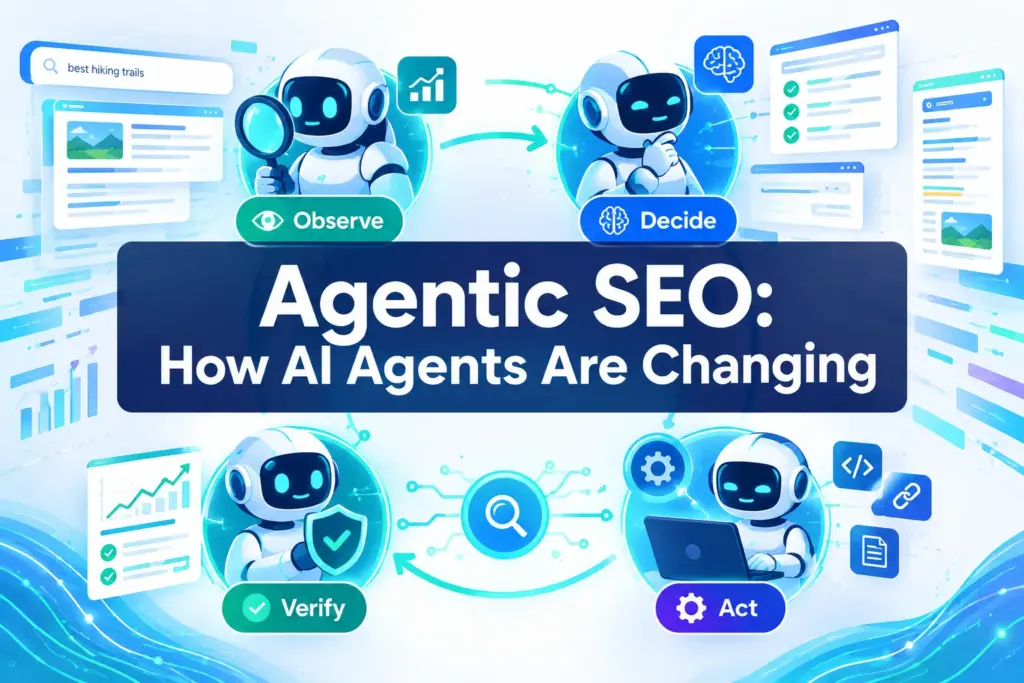
Quick Answer: Agentic SEO is the practice of using autonomous AI agents to plan, execute, and optimize SEO workflows, from keyword research and content audits to technical fixes and rank tracking, with minimal human intervention. In 2026, it represents the biggest structural shift in search optimization since mobile-first indexing, driven by AI reasoning models that can observe data, make decisions, take action, and verify results in a continuous loop.
Key Takeaways
- Agentic SEO uses AI agents that operate in an autonomous loop: observe → decide → act → verify, running tasks that previously required a full SEO team.
- These agents differ from traditional SEO tools because they don’t just report data, they act on it, continuously and at scale.
- Agentic SEO platforms are now available for businesses of all sizes, not just enterprise. Costs range from affordable SaaS tiers to custom agency deployments. [2][8]
- AI agents handle keyword research, content optimization, technical audits, and even content republishing, but they still need human oversight for strategy and brand decisions.
- The biggest risk isn’t Google penalties from agentic SEO itself, it’s poor configuration, low-quality outputs, and removing human judgment entirely.
- Results timelines are similar to traditional SEO: expect 60-120 days for meaningful organic traffic movement, depending on site authority and competition.
- The role of the SEO specialist is shifting from execution to strategy, quality control, and revenue alignment. [10]
- GEO (generative engine optimization) and AI search visibility are now part of the agentic SEO mandate, not just Google rankings.
What Is Agentic SEO and How Does It Work?
Agentic SEO is SEO powered by AI agents that can autonomously complete multi-step tasks without a human clicking through each one. Instead of using a tool to pull a keyword report and then manually deciding what to do with it, an agentic system observes the data, decides on the best action, executes it, and checks whether it worked, all in sequence.
The core architecture has three layers [10]:
- A reasoning model (like GPT-4o, Claude 3.5, or Gemini 1.5) that interprets data and makes decisions.
- A tool layer (often using the Model Context Protocol, or MCP) that connects the agent to real-world systems, Google Search Console, CMS platforms, analytics tools, rank trackers.
- A verification layer that checks outcomes and feeds results back into the next cycle.
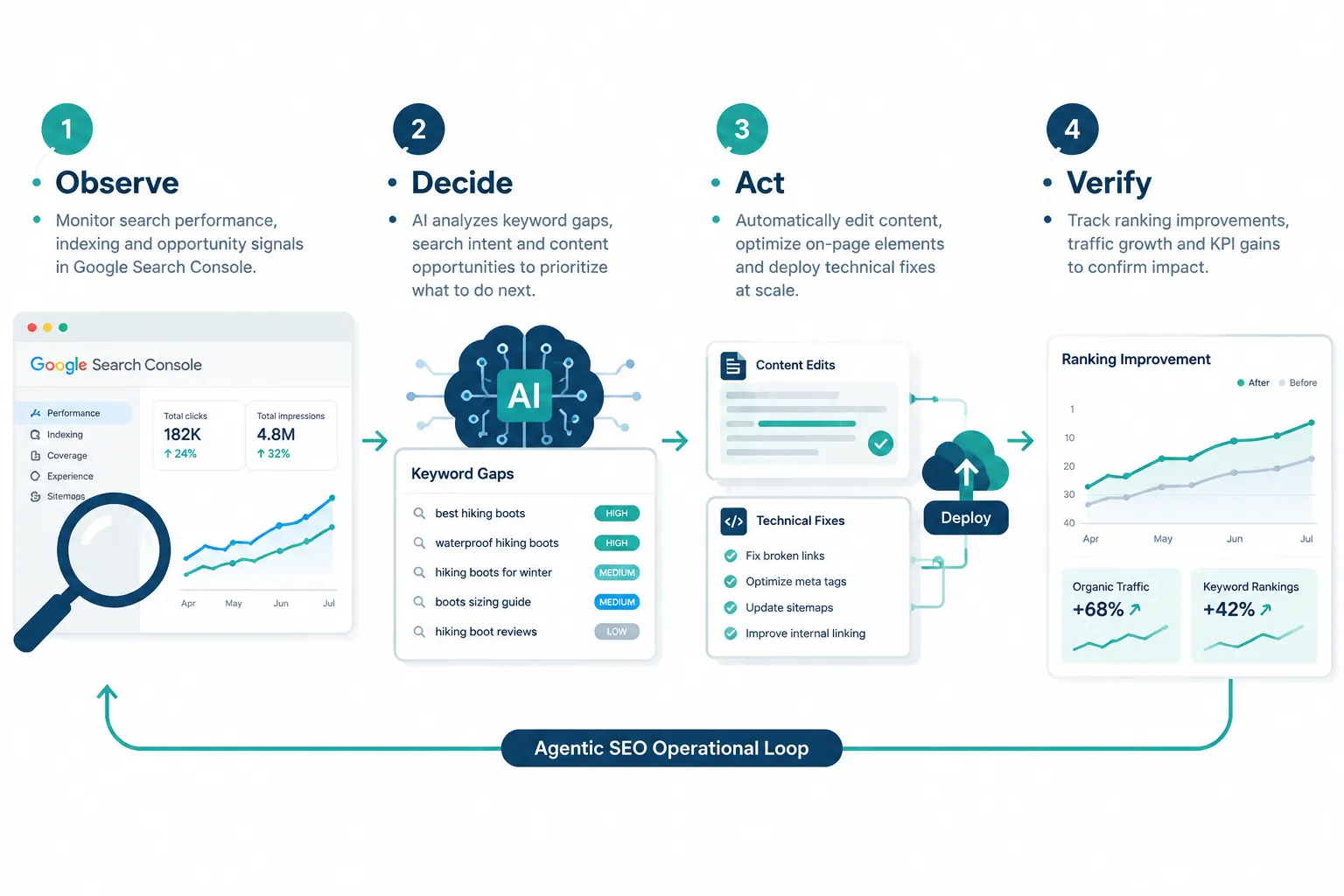
The operational loop looks like this:
- Observe: The agent pulls data from Google Search Console, crawl reports, and competitor analysis.
- Decide: It identifies which pages to fix, what content to create, and which technical issues to prioritize.
- Act: It writes content drafts, pushes meta tag updates, fixes internal linking gaps, or flags issues for a developer.
- Verify: It tracks rank changes and traffic shifts, then adjusts the next cycle accordingly.
This continuous audit, fix, republish pattern is what separates agentic SEO from any automation tool that came before it. [9]
How Are AI Agents Different From Traditional SEO Tools?
Traditional SEO tools, think Ahrefs, Semrush, Screaming Frog, are excellent at collecting and presenting data. But they stop there. You still have to interpret the data, prioritize actions, and do the work yourself.
AI SEO agents close that gap. They don’t just show you that 47 pages have thin content. They draft improvements, schedule republishing, and track whether those pages recover. [4]
Key differences at a glance:
| Capability | Traditional SEO Tools | AI SEO Agents |
|---|---|---|
| Data collection | ✅ Yes | ✅ Yes |
| Automated action | ❌ No | ✅ Yes |
| Continuous monitoring | Partial | ✅ Yes |
| Multi-step task chains | ❌ No | ✅ Yes |
| Human required per task | ✅ Always | Optional |
The practical result: a single person using an agentic SEO platform can manage the workload that previously required a team of three to five specialists. [7]
Can AI Agents Do SEO Better Than Humans, and Can Agentic SEO Replace an SEO Specialist?
AI agents can execute SEO tasks faster and at greater scale than any human. For repeatable, data-driven work, technical audits, meta description updates, internal link optimization, content gap analysis, they’re genuinely more efficient.
But “better” depends entirely on what you’re measuring. Agents are weak at:
- Brand voice and editorial judgment, they optimize for signals, not nuance.
- Understanding business context, they don’t know your sales cycle, your best customers, or your competitive positioning.
- Navigating novel situations, a major Google algorithm update in an uncharted direction still requires human interpretation.
- Building relationships, digital PR, link acquisition, and community-driven content still need people.
So no, agentic SEO doesn’t replace an SEO specialist. It replaces the execution work that takes up 60-70% of a specialist’s week. [10] The specialist’s role shifts to strategy, oversight, quality control, and connecting SEO outcomes to revenue, which is where the real value was always hiding.
Think of it like this: a good accountant using accounting software isn’t replaced by that software. They just stop doing manual ledger entries and spend more time on financial strategy.
Agentic SEO Tools and Platforms Available Now
The market for agentic SEO platforms moved fast in mid-2026. Several strong options exist across different automation levels and price points. [2][8]
Leading platforms as of 2026:
- Frase, Strong content optimization agent with automated brief-to-draft workflows. [2]
- Surfer SEO with agentic features, Content scoring and automated optimization cycles.
- IndexableAI, Purpose-built agentic SEO platform with full audit-to-fix pipelines. [8]
- QuickSEO AI, Automated technical SEO and content agents for SMBs. [5]
- Rework AI SEO agents, Focused on enterprise-scale content operations. [3]
Agencies are also building custom agentic stacks using OpenAI’s API or Claude, connected to GSC, CMS, and analytics via MCP integrations. [10] This is more flexible but requires technical setup.
When evaluating any platform, look at three things: how deeply it integrates with Google Search Console, whether it can push changes directly to your CMS or only suggest them, and how transparent the decision log is so you can audit what the agent actually did.
How Much Does Agentic SEO Cost Compared to Regular SEO?
Agentic SEO platforms typically run from around $99/month for SMB-tier tools to several thousand dollars per month for enterprise platforms with full automation and dedicated support. [6][7] Custom agency deployments with proprietary agentic stacks sit at the higher end.
Compare that to traditional SEO: a mid-market SEO agency engagement in the USA runs $2,500,$10,000/month. An in-house SEO specialist costs $60,000,$100,000/year in salary alone.
The cost case for agentic SEO is strong, not because the tools are cheap, but because they multiply output per dollar spent. A $500/month agentic platform doing the work of a $5,000/month agency retainer is a real scenario for many businesses.
That said, the tool cost is only part of the equation. You still need someone who understands SEO strategy to configure the agents correctly, review outputs, and make judgment calls. Factor in that time.
Is Agentic SEO Right for Small Businesses or Just Enterprise?
Agentic SEO works for businesses of all sizes, but the right entry point differs. Small businesses and startups benefit most from tools that automate the high-volume, repetitive tasks, technical audits, meta optimization, content refreshes, without requiring a dedicated SEO team. [5][9]
Choose agentic SEO if you:
- Have an existing website with 50+ pages that need regular optimization.
- Are publishing content consistently but lack bandwidth to optimize each piece.
- Want to compete in AI search results (Google AI Overviews, Perplexity, ChatGPT) alongside traditional rankings.
- Have a basic understanding of SEO but can’t afford a full-time specialist.
Wait or get expert help first if you:
- Don’t have a clear content strategy, agents will optimize in the wrong direction.
- Have a brand-new site with no domain authority, agentic optimization won’t substitute for foundational link building and content quality.
- Can’t review agent outputs regularly, unsupervised agents can create problems at scale.
How Do AI Agents Handle Keyword Research and Content Optimization?
AI SEO agents approach keyword research by pulling data from GSC, keyword APIs, and competitor analysis tools, then clustering and prioritizing opportunities based on search volume, difficulty, and topical relevance to your existing content. [9] They can identify content gaps, map keywords to pages, and flag cannibalization issues automatically.
For content optimization, the better platforms run a continuous cycle:
- Audit existing pages against current top-ranking content.
- Identify specific gaps in coverage, word count, semantic terms, or structured data.
- Draft or suggest edits to close those gaps.
- Republish and track rank movement over the following weeks.
This continuous audit, optimize, republish loop is what makes agentic SEO genuinely different from a one-time content audit. [10] The agent keeps working after you’ve moved on.
One important note: keyword research agents are only as good as the intent modeling behind them. Always review cluster outputs before letting an agent create content at scale, misaligned intent is the most common early mistake.
What Are Common Mistakes People Make With AI SEO Agents?
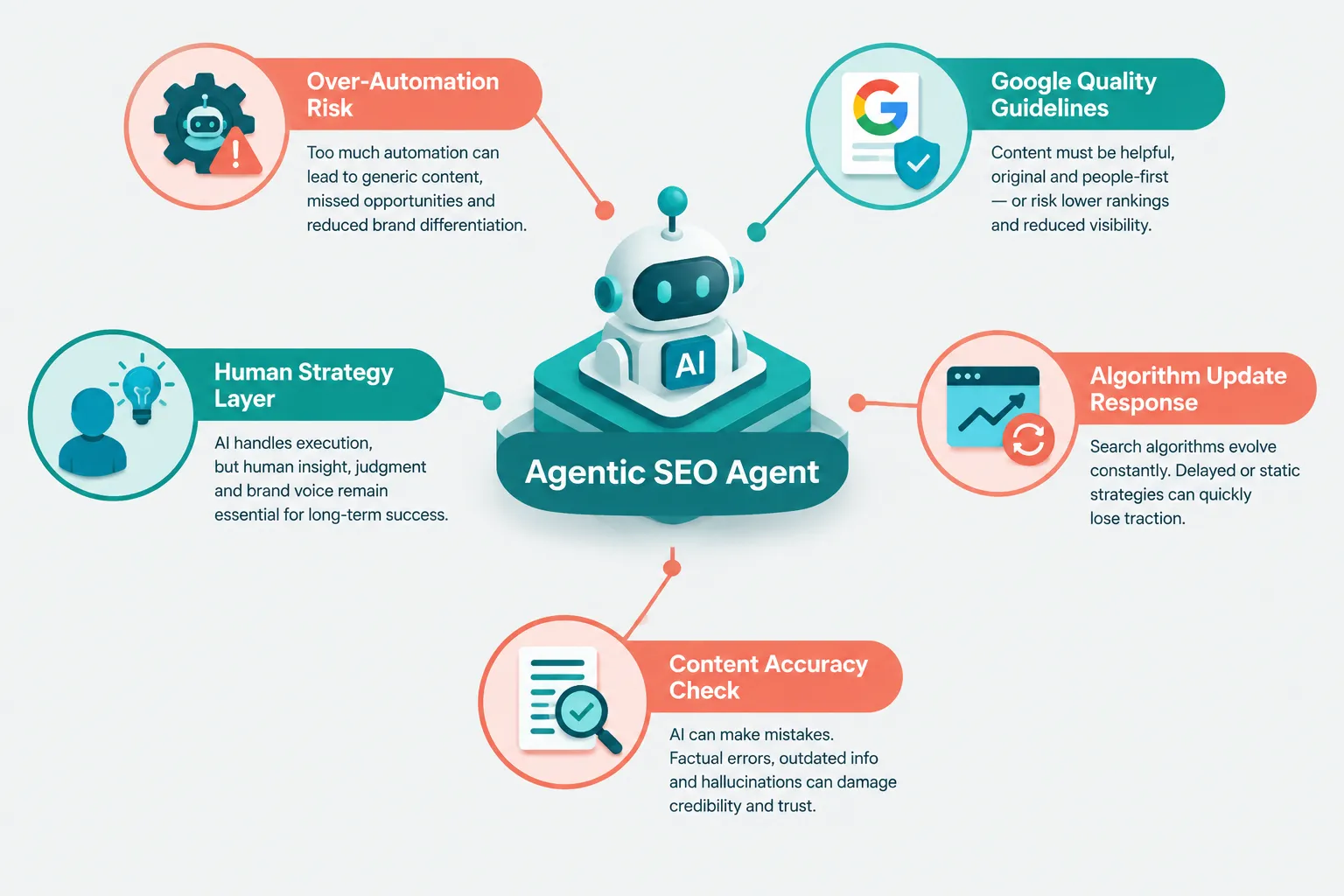
The most common mistake is treating agentic SEO as a set-and-forget system. Agents need configuration, monitoring, and periodic recalibration, especially after major Google algorithm updates.
Other frequent mistakes:
- No content quality review: Agents optimize for signals. Without human editorial review, you can end up with technically optimized but genuinely unhelpful content, exactly what Google’s helpful content systems target.
- Over-automation too early: Running full automated publishing before you’ve validated the agent’s output quality on a small batch.
- Ignoring GEO and AI search: Focusing only on traditional rankings while missing the growing share of traffic coming from Google AI Overviews, ChatGPT, and Perplexity. Agentic SEO strategy in 2026 needs to cover both. [1]
- Poor GSC integration: Agents without deep Google Search Console access are operating partially blind.
- No human strategy layer: The agent executes. Someone still needs to decide what the business actually needs from SEO, more leads, more brand awareness, specific product pages, and configure the agent around that goal.
How Does Agentic SEO Handle Google Algorithm Updates?

AI agents monitor ranking fluctuations and traffic changes in near real-time, which means they can detect the signature of an algorithm update faster than a weekly manual review. [9] When a core update hits, a well-configured agent will flag affected pages, cross-reference against known quality signals, and queue up a response workflow.
What agents can’t do is interpret the intent behind a new update before Google’s documentation catches up. For example, when Google shifts how it weights first-hand experience signals or adjusts how AI Overviews source content, that requires a human to read the signals, understand the direction, and update the agent’s optimization criteria.
The practical approach: use agents for fast detection and response at scale, and keep a human in the loop for strategic recalibration after each major update.
What Are the Limitations of Agentic SEO, and Is It Safe?
Agentic SEO is safe when configured correctly and supervised. Google’s guidelines target low-quality, manipulative content, not automation itself. Agents that produce genuinely helpful, accurate, well-structured content are not at risk of penalties. Agents that mass-produce thin, repetitive, or misleading content are. [1]
Real limitations to know:
- Agents can’t build genuine authority, that still requires real expertise, original research, and credible backlinks.
- They struggle with EEAT signals (Experience, Expertise, Authoritativeness, Trustworthiness) that require real human credentials and first-hand experience.
- Complex technical SEO issues, JavaScript rendering problems, server-side rendering, Core Web Vitals on custom stacks, often still need a developer.
- Multi-language and multi-regional SEO adds complexity that most current agents handle inconsistently.
The risk isn’t that agentic SEO will get you penalized. The risk is that without proper oversight, it produces mediocre content at scale, which quietly erodes your site’s quality signals over time.
How Long Does It Take to See Results From Agentic SEO?
Expect the same timeline as traditional SEO: 60-120 days for meaningful organic traffic movement on most sites. [9] Agentic SEO doesn’t change how Google crawls, indexes, or evaluates content. It changes how fast you can execute optimization work.
Where agentic SEO genuinely accelerates results is in the volume of work completed in that window. A traditional SEO engagement might optimize 10-15 pages in the first 90 days. An agentic system can work through hundreds of pages in the same period, which means more ranking opportunities in play simultaneously.
For AI search visibility (Google AI Overviews, Perplexity citations), the timeline can be faster, well-structured, authoritative content can start appearing in generative answers within weeks of optimization.
What Skills Do You Need to Use Agentic SEO Effectively?
You don’t need to be a developer to use most agentic SEO platforms. But you do need a working understanding of SEO fundamentals, keyword intent, content quality standards, technical SEO basics, and how to read Google Search Console data. [7]
Skills that make agentic SEO work better:
- SEO strategy: knowing what to optimize and why, not just how.
- Content judgment: ability to review agent outputs and catch quality issues before publishing.
- Data literacy: reading GSC, analytics, and rank tracking data to evaluate agent performance.
- Prompt and configuration skills: setting up agent workflows with clear, specific instructions.
The more SEO knowledge you bring to the configuration stage, the better your agents will perform. Garbage in, garbage out applies here as much as anywhere in AI.
FAQ
What is the simplest definition of agentic SEO? Agentic SEO uses AI agents that autonomously plan, execute, and optimize SEO tasks, like a virtual SEO team that works continuously without manual prompting for each step.
Is agentic SEO the same as AI SEO? Not exactly. AI SEO is a broad term for using AI in SEO work. Agentic SEO specifically refers to AI systems that take autonomous, multi-step actions, not just AI-assisted writing or analysis tools.
Do I still need a human SEO specialist if I use agentic SEO tools? Yes, for strategy, quality control, and business alignment. Agents handle execution; humans handle judgment and direction.
Will agentic SEO get my site penalized by Google? Not if the output is genuinely helpful and high-quality. Google penalizes manipulative or low-quality content, not automation itself. Proper oversight is the key safeguard.
Can agentic SEO help with Google AI Overviews and AI search citations? Yes. Agentic SEO can optimize content structure, entity coverage, and topical authority, all of which improve visibility in Google AI Overviews, Perplexity, and ChatGPT search results.
What’s the best agentic SEO platform for a small business? QuickSEO AI and Frase are strong starting points for smaller teams. IndexableAI is worth evaluating if you want a platform built specifically for agentic workflows. [5][2][8]
How is agentic SEO different from marketing automation? Marketing automation handles campaign workflows (emails, ads, social). Agentic SEO specifically handles search optimization tasks, audits, content, technical fixes, and rank tracking.
Does agentic SEO work for local SEO? Yes, particularly for multi-location businesses that need to manage and optimize large numbers of location pages. Agents can audit, update, and track local pages at scale.
What’s the biggest mistake to avoid with agentic SEO? Removing human review from the content publishing step. Agents that publish without editorial oversight can erode content quality at scale, which is harder to recover from than a slow start.
Is agentic SEO a passing trend or a permanent shift? It’s structural. The underlying shift, AI systems that can act, not just analyze, is already embedded in how the major platforms are building their tools. This is where SEO operations are heading. [1][10]
Conclusion
Agentic SEO isn’t a shortcut or a silver bullet. It’s a fundamental change in how SEO work gets done, moving from a series of manual tasks to a continuous, automated optimization loop that runs at a scale no human team can match alone.
The businesses that get the most from it in 2026 are the ones that treat it as a force multiplier, not a replacement for thinking. Configure your agents around a clear strategy. Review their outputs. Keep a human in the loop for the decisions that require judgment. And make sure your agentic SEO stack covers both traditional search rankings and AI search visibility, because those two channels are converging fast.
Practical next steps:
- Audit your current SEO workflow and identify the highest-volume, most repetitive tasks, those are your best candidates for agentic automation.
- Start with one platform (Frase, QuickSEO AI, or IndexableAI are solid starting points) and run a 30-day pilot on a defined set of pages.
- Set up deep Google Search Console integration before anything else, agents without GSC access are working with incomplete data.
- Build a review process: every agent output should have a human checkpoint before it goes live, at least until you’ve validated output quality.
- Expand your optimization target beyond Google rankings to include AI search citations, Google AI Overviews, and Perplexity, that’s where a growing share of zero-click and referral traffic is coming from.
The SEO teams and businesses that figure out how to work with agentic systems, rather than being replaced by them or ignoring them, will have a real and compounding advantage in organic search over the next few years.
🤖 Agentic SEO Readiness Checker
Answer 5 quick questions to see if your business is ready to use AI SEO agents.
1. Does your site have 50+ published pages?
2. Do you publish new content at least monthly?
3. Do you have Google Search Console set up?
4. Can you review AI-generated content before publishing?
5. Do you understand basic SEO concepts (keywords, intent, technical SEO)?
References
[1] 5 Seo Predictions For 2026 – https://www.marketingaid.io/5-seo-predictions-for-2026/ [2] Best Ai Seo Agents 2026 – https://www.frase.io/blog/best-ai-seo-agents-2026 [3] Best Ai Agents For Seo 2026 – https://resources.rework.com/tools/ai-agents/best-ai-agents-for-seo-2026 [4] Best Ai Seo Agents 2026 – https://www.teamday.ai/blog/best-ai-seo-agents-2026 [5] Best Ai Seo Agents 2026 – https://quickseo.ai/blog/best-ai-seo-agents-2026 [6] The Top Agentic Seo Companies – https://firstpagesage.com/seo-blog/the-top-agentic-seo-companies/ [7] Best Ai Seo Agents In 2026 Ranked By Automation Power – https://www.parikshitkhanna.com/post/best-ai-seo-agents-in-2026-ranked-by-automation-power [8] Best Agentic Seo Platforms – https://indexableai.com/agentic-seo/best-agentic-seo-platforms/ [9] Agentic Seo Ai Agents Automate Seo Tasks 2026 – https://rajeshrnair.com/blog/seo/seo-strategy/agentic-seo-ai-agents-automate-seo-tasks-2026.html [10] Agentic Seo 2026 Playbook – https://quillly.com/blogs/agentic-seo-2026-playbook