

Last updated: October 5, 2026
Quick Answer
The right Salesforce marketing partner India has three things most vendors claim but few actually have: certified Agentforce and Data 360 delivery experience, a transparent offshore delivery model with US-overlap hours, and case studies that show measurable revenue or retention outcomes, not just “successful go-lives.” Shortlist partners by checking their AppExchange listing, asking for three reference calls, and testing their Data Cloud and Agentforce knowledge with specific technical questions before you sign anything.
Key Takeaways
- Salesforce’s 2026 roadmap centers on Agentforce and Data 360, so your partner needs hands-on experience with both, not just legacy Marketing Cloud campaigns.[8][3]
- A genuine Salesforce partner builds and customizes; a reseller just sells licenses. The difference matters more now because Agentforce implementations require custom configuration.[6]
- India has a deep bench of Salesforce Marketing Cloud partners, from boutique Data Cloud specialists to large firms like PwC India, so narrowing the field means matching specialization to your specific need.
- Verify certification directly on Salesforce’s own partner directory and AppExchange, not just on the vendor’s website.
- Ask about Einstein Trust Layer, data masking, and permission set design. If a partner can’t explain these, they haven’t deployed Agentforce in production.[6]
- Implementation timelines for a mid-size Marketing Cloud plus Data 360 project typically run several months, not weeks, because of data unification and governance work.
- Support doesn’t end at launch. The strongest India-based partners offer managed services with defined response times across US time zones.
- Reading reviews matters, but reading them for specifics (which cloud, which integration, what outcome) matters more than counting star ratings.
What does a Salesforce marketing cloud partner do
A Salesforce Marketing Cloud partner plans, builds, connects, and maintains your Salesforce marketing stack so your team can run campaigns, journeys, and AI-powered experiences without constant engineering support. That includes everything from initial strategy and data architecture to configuring Agentforce agents and training your internal team.
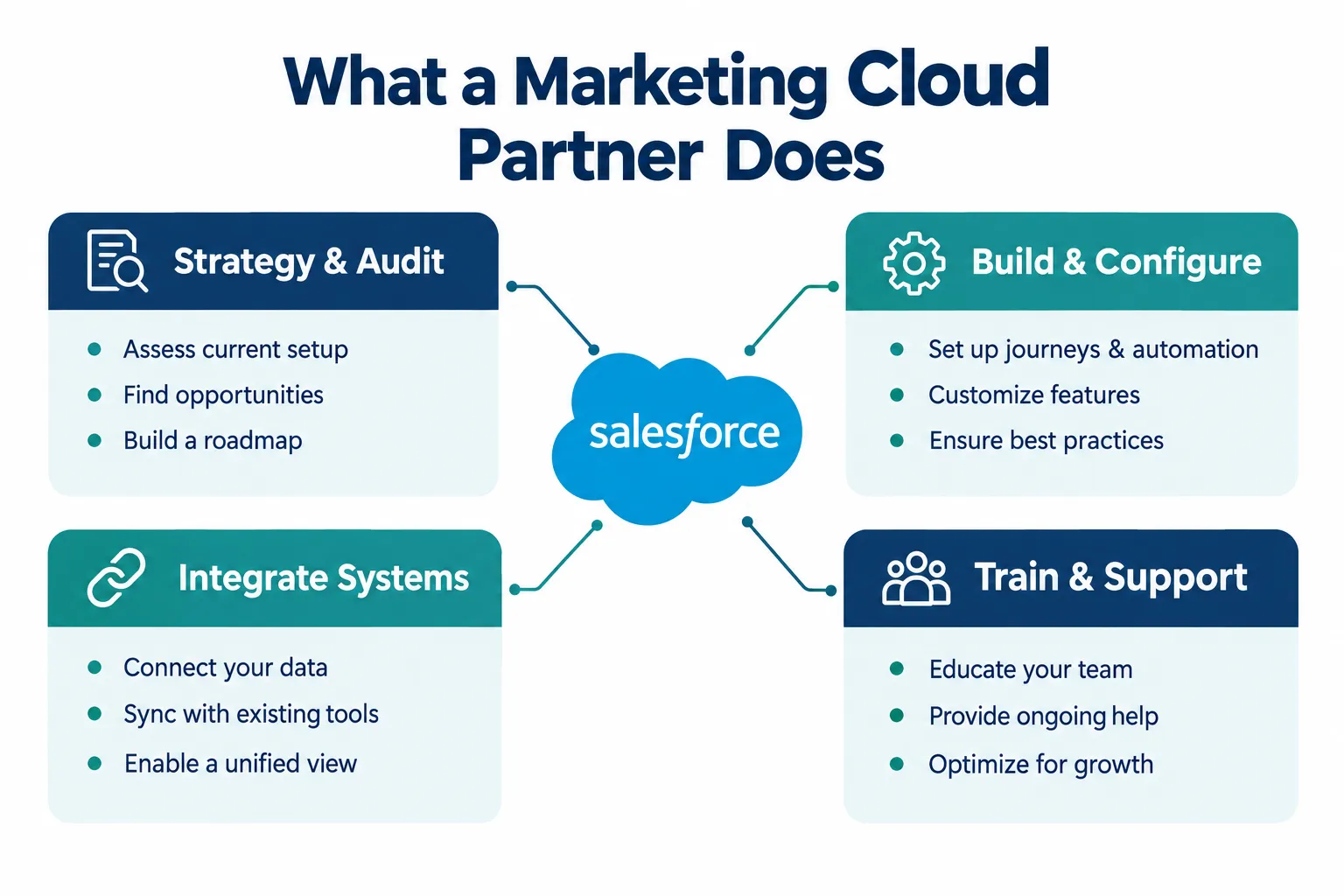
In practice, a capable Salesforce marketing partner India handles:
- Discovery and audit: Reviewing your current CRM, data sources, and marketing goals before recommending an architecture.
- Implementation: Building journeys, email templates, SMS flows, and now AI agents inside Agentforce.
- Data unification: Connecting Data 360 (the current evolution of Data Cloud) to pull customer records from CRM, commerce, support, and even unstructured sources like Google Drive or SharePoint into one usable profile.[8]
- Integration: Linking Salesforce to your website, ad platforms, data warehouse, and internal systems using Zero Copy connectors or MuleSoft.
- Governance and security: Setting permission sets, licenses, and trust controls so AI agents only access what they should.[6]
- Training and support: Making sure your marketing team can actually run the platform after launch.
A partner who only does the first two items on that list (discovery and implementation) and disappears after go-live isn’t a full partner. They’re a project contractor. If your goal is AI-powered growth that compounds over time, you need someone who stays involved in data governance and optimization long after launch.
What changed with Salesforce in 2026: Agentforce, Data 360 and AI-powered marketing
Salesforce’s Winter ’26 release pushed AI and unified data further into the center of the platform, meaning Marketing Cloud work in 2026 is no longer just about email journeys. It’s about grounding AI agents in real, governed customer data through Data 360.
Three shifts matter most for buyers evaluating a partner right now:
- Agentforce is the new delivery layer. Salesforce positions Agentforce as the integrated solution for building, deploying, and scaling AI agents on the Salesforce Platform, with Data Cloud acting as the engine that grounds those agents in real-time customer records.[12] A later update, sometimes referred to as “Agentforce 360,” added Intelligent Context, and Salesforce shipped a Data 360 MCP Server in developer preview in May 2026, following general availability of hosted MCP servers in April 2026.[3]
- Data 360 handles more data types, faster. The Winter ’26 release added new Zero Copy connectors to data warehouses, unstructured data connectors for Google Drive and SharePoint, and a Data 360 Code Extension that lets teams run existing code to build complex calculated insights.[8]
- Governance isn’t optional anymore. Salesforce’s own guidance for provisioning Agentforce with Data Cloud spells out that admins must assign correct permission sets and licenses, enable Einstein Trust Layer features such as Large Language Model Data Masking, and configure agent data libraries using text, HTML, or PDF sources.[6]
What this means for you: if a partner’s pitch deck still talks only about “email automation” and “journey builder,” they’re behind. Ask them directly how they’ve used Data 360 and Agentforce together, because that combination is now the core of Salesforce’s AI marketing story.
Salesforce partner vs reseller: what’s the real difference
A Salesforce partner designs, configures, and customizes your implementation; a reseller mainly sells you licenses and may hand off the technical work to someone else. This distinction matters more in 2026 because Agentforce and Data 360 require real configuration work, not just a license activation.
| Factor | Salesforce Partner | Salesforce Reseller |
|---|---|---|
| Core role | Strategy, build, integrate, support | License sales, sometimes basic setup |
| Technical depth | In-house certified consultants and developers | Often outsources implementation |
| AI/Agentforce readiness | Can configure agents, trust layer, permission sets | Rarely has hands-on Agentforce experience |
| Ongoing relationship | Managed services, optimization, support | Transactional, ends after sale |
| Accountability for outcomes | Tied to business results | Tied to license renewal |
Decision rule: choose a true implementation partner if you need Agentforce, Data 360, or custom journey logic. Choose a reseller only if you already have an internal Salesforce team and just need procurement support.
Common mistake: assuming a company with “Salesforce Partner” in their name automatically does hands-on build work. Some partner-tier companies are really license brokers with a thin consulting layer on top. Ask directly who writes the Apex code, builds the data model, and configures the agent, before you sign.
Who are the best Salesforce marketing cloud partners in India
There’s no single “best” Salesforce Marketing Cloud partner in India. The right one depends on whether you need Data Cloud specialization, multi-cloud breadth, vertical industry experience, or enterprise-scale consulting. Here’s how the India market actually breaks down by specialization.
| Partner type | Example | Known for |
|---|---|---|
| Data Cloud-focused implementation | Concretio (Gurugram) | Zero-Copy integration, unifying data into a single customer view for real-time journeys[1] |
| Marketing/Data Cloud consulting | Frontial Technologies | Marketing Cloud, Data Cloud, Sales and Service Cloud managed services across India, the Middle East, Europe, North America[2] |
| Pure-play Marketing and Data Cloud | AgileSpace Digital | AppExchange-listed, focused purely on Marketing and Data Cloud consulting[4] |
| Vertical-focused consultancy | DWAO | Used by ecommerce, BFSI, travel, media, and telecom brands for personalized journey activation[5] |
| Long-standing MarTech consulting partner | Sokrati | Salesforce Consulting Partner since 2004 with broad MarTech ecosystem knowledge[7] |
| Summit Partner with Agentic AI focus | TechMatrix | Deploys AI-powered agents using Agentforce to automate workflows[9] |
| Multi-cloud partner with Agentforce in portfolio | Avatu | Certified across Marketing Cloud, Data Cloud, and Agentforce, serving India, UK, USA, Europe, APAC |
| Enterprise consulting arm | PwC India (Enterprise Apps/SFDC) | Marketing Cloud implementation for large, complex enterprise rollouts |
My honest take: if you’re a mid-market US company that needs a Data Cloud-first implementation with Zero Copy integration, a boutique specialist like Concretio or AgileSpace will likely move faster and cost less than a large consulting firm. If you’re running a global, multi-brand enterprise with compliance complexity, PwC India’s structure may be worth the premium. Match the partner’s size and specialization to your actual complexity, not to brand recognition.
Salesforce Agentforce implementation partners in India: how to evaluate experience
A strong Agentforce implementation partner in India can show you a live or demo agent they built, explain how they grounded it in Data 360, and describe how they configured the Einstein Trust Layer. If they can’t walk you through those three things specifically, they haven’t done real Agentforce work yet.
Ask to see:
- A working example of an agent connected to a data library built from text, HTML, or PDF sources[6]
- How they handled permission sets and license assignment for the agent
- Their approach to Large Language Model Data Masking for sensitive customer data[6]
- Whether they’ve worked with the newer Data 360 MCP Server capability, which moved from developer preview to broader availability through 2026[3]
Salesforce Data 360 partner certification in India
Certification alone doesn’t prove delivery skill, but it’s a reasonable filter. Look for individual consultant certifications like Data Cloud Consultant and Agentforce Specialist, not just a company-level “partner” badge. Certifications are earned by people, and the people on your project are the ones who matter. Ask for the names and certification IDs of the actual consultants who will work on your account, not just the sales team you’re talking to now.
Edge case: some smaller India-based shops have one or two highly certified senior consultants who oversee a larger junior delivery team. That’s not automatically a red flag, but you should confirm the senior person stays actively involved through your build, not just the sales call.
Salesforce marketing cloud partner requirements and qualifications
At minimum, a Salesforce marketing partner India should hold verifiable Salesforce certifications, show production Marketing Cloud and Data Cloud project history, and demonstrate security and governance competence. Anything less puts your customer data and your launch timeline at risk.
A practical qualification checklist:
- Certifications: Marketing Cloud Developer/Consultant, Data Cloud Consultant, Agentforce Specialist (ask for names, not just logos)
- Partner tier: Registered, Select, or Summit partner status on Salesforce’s own directory
- Portfolio depth: At least 2-3 relevant case studies in your industry or similar complexity
- Security practices: Experience configuring Einstein Trust Layer, data masking, and least-privilege permission sets[6]
- Integration skill: Demonstrated Zero Copy, MuleSoft, or API integration work, not just native Salesforce clicks-not-code setup
- Delivery model clarity: A clear answer on who does the work (onshore, offshore, hybrid) and who you’ll talk to day-to-day
How to verify if a Salesforce partner is certified
Verify directly on Salesforce’s own channels, not the vendor’s marketing site. Check the company’s listing on AppExchange, where partner profiles list their specializations and client regions.[2][4] You can also ask the vendor to share Trailhead profile links for the named consultants on your project, since individual certifications are tied to public Trailblazer profiles. If a partner hesitates to share these, treat it as a warning sign.
How much does Salesforce consulting cost in India
Salesforce consulting costs in India are generally lower than US or UK-based agencies for comparable work, because offshore delivery teams operate at lower overhead, but the exact number depends heavily on scope, not location. A simple Marketing Cloud journey build costs far less than a full Data 360 unification plus Agentforce rollout.
What actually drives the price:
- Number of data sources being unified into Data 360
- Whether you need custom Agentforce agents versus pre-built templates
- Integration complexity (how many external systems connect to Salesforce)
- Ongoing managed services versus one-time implementation
- Seniority mix of the delivery team (senior architects cost more than junior configurators)
Decision rule: get itemized scope-based quotes from at least three partners instead of asking for a flat number upfront. A vendor who quotes a price before understanding your data sources and integration needs is guessing, not estimating.
Salesforce partner implementation timeline: how long does it take
A standard Marketing Cloud implementation typically runs a few weeks to a couple of months. Adding Data 360 unification and Agentforce agent configuration extends that to several months, because data mapping, governance setup, and agent testing take real time.
Common phases look roughly like this:
- Discovery and architecture: Early weeks, mapping data sources and defining the customer data model
- Build: Journeys, templates, agent configuration, and trust layer setup
- Testing: Including agent response testing and data masking validation
- Launch and optimization: Go-live followed by a stabilization period
Common mistake: rushing the discovery phase to hit an arbitrary launch date. Rushed data mapping is the single biggest cause of Agentforce agents giving wrong or incomplete answers after launch, because the agent is only as good as the data it’s grounded in.[12]
Salesforce AI-powered growth solutions India partners should offer
The strongest India-based Salesforce partners in 2026 go beyond basic email and SMS journeys and offer AI agents for service and sales handoff, predictive segmentation built on Data 360, and conversational engagement across chat and messaging channels. If a partner’s “AI offering” is limited to subject-line generation, that’s not an AI growth solution, it’s a feature.
Look for partners who can show:
- Agentforce agents handling real customer inquiries with defined escalation paths
- Predictive audience segments built from unified Data 360 profiles rather than siloed campaign data
- Conversational engagement flows that connect marketing, sales, and service context in one view
- Measurable outcomes tied to these tools: conversion lift, response time reduction, or retention improvement, backed by actual before/after data from their own client work
This is also where good marketing fundamentals still apply. An AI agent sending perfectly personalized offers through a broken email marketing foundation won’t convert any better than a basic campaign. Ask your partner how they handle the basics (deliverability, list hygiene, consent) before you evaluate how advanced their AI layer is.
Common mistakes when choosing a Salesforce partner
The most expensive mistake is picking a partner based on price alone without checking whether they’ve actually delivered Data 360 and Agentforce work, not just legacy Marketing Cloud campaigns. The second most common mistake is signing with a company that outsources your project to a third-party subcontractor you never meet.
Other mistakes worth watching for:
- No reference checks: Accepting case study slides without calling actual past clients
- Vague delivery model: Not knowing who, specifically, will build your project day to day
- Ignoring data governance: Treating Einstein Trust Layer and permission sets as an afterthought instead of a core requirement[6]
- Overbuying scope: Signing up for a full Data 360 and Agentforce rollout when a simpler Marketing Cloud build would solve the immediate problem
- No measurable goals: Starting a project without agreeing on what “success” looks like in numbers
I’ve seen this play out with companies that treat a Salesforce project like outsourcing SEO marketing: they hand off the work and assume “hands-off” means “handled.” It doesn’t. The same oversight discipline that applies when you choose the right SEO company applies here, too: stay involved, ask questions, and review progress regularly.
What questions to ask before hiring a Salesforce consultant
Before hiring, ask direct questions that force specific answers, not marketing language. The goal is to find out exactly who does the work, how they’ve handled AI governance, and what happens if something breaks after launch.
A short checklist to bring to your first call:
- Who, by name, will work on our Data 360 and Agentforce configuration, and what are their certifications
- Can we speak with two or three reference clients who had a similar project scope
- How do you configure Einstein Trust Layer and permission sets for agent data access
- What is your offshore delivery structure, and what hours overlap with our team
- What does your support model look like in the first 90 days after launch
- How do you measure success, and can you show real before/after numbers from past projects
- What happens if the project timeline slips, who’s accountable
This approach mirrors how smart buyers evaluate any growth partner. If you’ve ever worked through a strong demand marketing strategy for customer acquisition, you already know the pattern: specificity beats polish every time.
Salesforce partner support after implementation
Real support after implementation means defined response times, proactive monitoring, and regular strategy reviews, not just a support email address that goes quiet after go-live. Ask what tier of support is included in your contract and what costs extra.
Three support models to watch for:
- Standard support: Ticket-based help desk for bugs and small fixes
- Managed services: Proactive monitoring, regular optimization, and ongoing agent tuning
- Dedicated pod: A named team that stays assigned to your account for strategic reviews and new feature rollout
Decision rule: choose managed services or a dedicated pod if you’re running Agentforce agents in production, because agents need ongoing tuning as customer behavior and data change. A basic ticket system isn’t enough once AI is making decisions in front of real customers.
How to read Salesforce marketing cloud partner reviews in India
Read reviews for specifics, not star counts. A review that says “great team, fast turnaround” tells you nothing useful. A review that names the cloud (Marketing Cloud, Data Cloud), the integration type, and the measured outcome tells you whether this partner can do your actual project.
Where to look:
- AppExchange partner listings, which often include client region and specialization detail[2][4]
- Direct reference calls (always more reliable than written reviews)
- Case studies that name specific metrics, not vague claims like “significant improvement”
- LinkedIn posts or comments from people who actually worked with the team, not just the agency’s own marketing
Common mistake: relying only on a partner’s own website testimonials. Cross-check at least one independent source, like AppExchange listings or a direct reference call, before trusting self-published case studies.
Conclusion
Choosing a Salesforce marketing partner India in 2026 comes down to three checks: verified Agentforce and Data 360 experience, a transparent delivery and support model, and reference clients who can confirm real results. Skip any of those three, and you’re taking a risk you don’t need to take.
Here’s what I’d do next if I were in your seat. Shortlist three to five partners using the categories above, request named consultant certifications for each, and schedule reference calls before any contract discussion. Then ask the specific questions from the checklist in this guide, not generic ones. The partners who answer clearly, with names and numbers instead of slogans, are the ones worth your time. The rest aren’t ready for the work you’re trying to do.
FAQ
What is the difference between Salesforce Marketing Cloud and Data 360? Marketing Cloud is the platform for building and sending campaigns and journeys. Data 360 (the evolution of Data Cloud) is the data layer that unifies customer information from multiple sources so those campaigns and AI agents can be personalized and grounded in real, current data.[8]
Do I need Agentforce experience in my Salesforce partner, or is Marketing Cloud experience enough? If you plan to use AI agents for customer service, sales support, or conversational marketing, you need a partner with hands-on Agentforce configuration experience, including Einstein Trust Layer and permission set setup, not just general Marketing Cloud campaign skills.[6]
Is it cheaper to hire a Salesforce partner in India than in the US? Generally yes, for comparable scope, because offshore delivery costs less in overhead. But cost depends more on project complexity, data sources, and integration needs than on the partner’s location alone.
How long does a Data 360 and Agentforce implementation usually take? A full Data 360 unification combined with Agentforce agent configuration typically takes several months, covering data mapping, governance setup, build, testing, and a stabilization period after launch.
What’s the risk of choosing a Salesforce reseller instead of a true implementation partner? A reseller may not have the in-house technical depth to configure Agentforce agents, set up data governance, or troubleshoot integration issues, which can leave you dependent on a third party you never directly contracted with.
How do I verify a Salesforce partner’s certifications are real? Ask for the named consultants’ Trailblazer profile links and check the company’s AppExchange listing directly, rather than relying on logos or claims on the vendor’s own marketing site.[2][4]
What should be included in post-implementation support? At minimum, defined response times for issues, basic monitoring, and a scheduled check-in. For Agentforce deployments, ongoing agent tuning and managed services are strongly recommended since agent performance depends on continuously updated data.
Can a smaller boutique partner in India handle enterprise-scale Salesforce projects? Some can, especially Data Cloud specialists with senior certified consultants, but enterprise-scale, multi-region rollouts often need the broader bench and compliance infrastructure that larger firms like PwC India provide. Match partner size to project complexity rather than assuming bigger is always better.
References
[1] Salesforce Marketing Cloud Services – https://www.concret.io/salesforce-marketing-cloud-services [2] Appexchange Listing Detail – https://appexchange.salesforce.com/appxListingDetail?listingId=95413444-4dc2-4eee-b87e-097d1fd950ae [3] What Is Salesforce Agentforce – https://atlan.com/know/ai-agent/ai-agent-applications/what-is-salesforce-agentforce/ [4] Appexchange Listing Detail – https://appexchange.salesforce.com/appxListingDetail?listingId=a2d06711-9d28-4d75-947a-46c3ec28c333 [5] Sfmc Consulting – https://dwao.com/in-en/services/marketing-automation/sfmc-consulting [6] Article View – https://help.salesforce.com/s/articleView?id=005389134&language=en_US&type=1 [7] Salesforce Partnership – https://sokrati.com/partnerships/saleforce-partnership [8] See What’s New With AI, Data Cloud and Sales – https://trailhead.salesforce.com/content/learn/modules/winter-26-release-highlights/see-whats-new-with-ai-data-cloud-and-sales [9] TechMatrix Consulting – https://www.techmatrixconsulting.com/ [10] Agentforce Data Cloud Agents – https://www.salesforce.com/in/events/webinars/agentforce-data-cloud-agents/?bc=OTH [12] Agentforce Data Cloud Agents – https://www.salesforce.com/in/events/webinars/agentforce-data-cloud-agents/?bc=OTH