

Last updated: October 20, 2026
Quick Answer
Black-hat SEO and CTR manipulation involve tricking search engines with fake clicks, hidden content, or bot traffic instead of earning rankings through genuine quality and relevance. Google’s behavioral classifiers have gotten sharper since early 2026, so manipulated click signals now get flagged faster and gains disappear within weeks. Marketers who want lasting results should treat CTR manipulation as a short-term gamble with long-term penalty risk, not a real growth strategy.
Key Takeaways
- Black-hat SEO breaks search engine guidelines on purpose to force rankings up faster than organic effort allows.
- CTR manipulation means generating fake or paid clicks on search results to fool ranking algorithms into thinking a page is popular.
- Google’s NavBoost system and leaked internal documents confirm click data has influenced rankings for years, which is exactly why manipulation tools exist.
- A Q1 2026 behavioral classifier update shrank the window where fake CTR boosts work, often to days rather than months.
- Penalties range from ranking drops to full manual action removal from search results, and recovery can take months.
- Many marketers still try these tactics because legitimate SEO growth feels slow compared to promised “instant” ranking jumps.
- Legitimate CTR optimization (better titles, meta descriptions, rich snippets) works without any guideline risk.
- Services selling CTR manipulation or click-bot traffic exist openly online, but quality, safety and results vary wildly.
- If you inherit a site with black-hat history, audit backlinks, cloaking scripts and traffic patterns before doing anything else.
What Is Black-Hat SEO and How Does It Differ From White-Hat Techniques
Black-hat SEO refers to any tactic that violates a search engine’s published guidelines to gain rankings faster than normal optimization allows. White-hat SEO follows those guidelines and focuses on genuine value for searchers.
The difference comes down to intent and risk:
- Black-hat tactics: cloaking, hidden text, keyword stuffing, private blog networks (PBNs), paid link schemes, and CTR manipulation through bots or click farms.
- White-hat tactics: original content creation, legitimate backlink earning, technical SEO fixes, and improving user experience.
Black-hat methods sometimes produce quick spikes, but they carry a built-in expiration date because search engines actively hunt for these patterns [1]. White-hat SEO is slower but compounds over time without the threat of a manual action wiping out your visibility overnight.
If you’re building a long-term brand, business site, or client portfolio, white-hat SEO is the only defensible choice. If you’re running a disposable affiliate site you don’t mind losing, the calculation changes, but that’s a business risk decision, not an SEO strategy. For a deeper breakdown of specific tactics, see this guide on SEO and black hat tactics.
What Exactly Is CTR Manipulation and How Does It Work
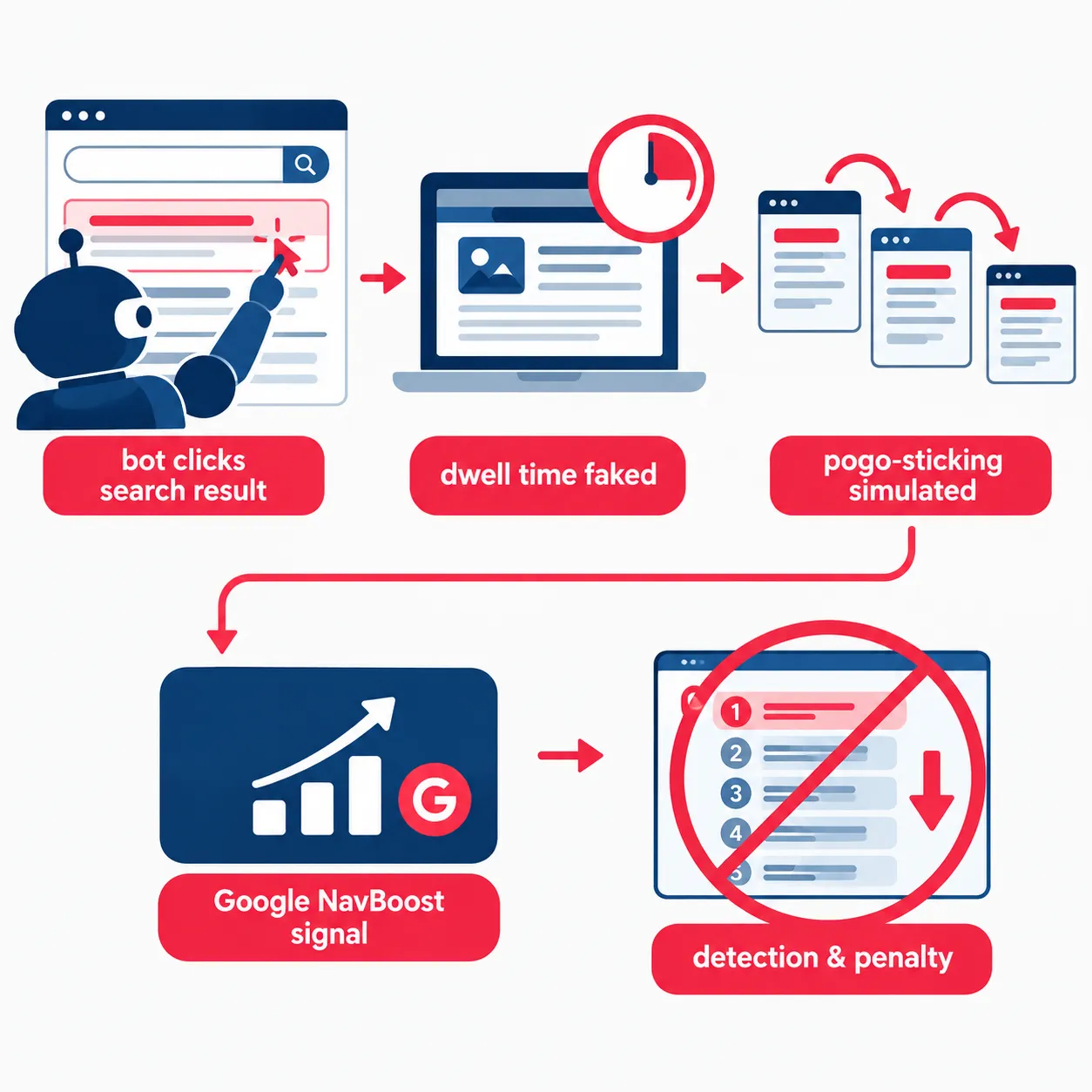
CTR manipulation means artificially inflating the click-through rate on a search result using bots, click farms, or incentivized clickers, with the goal of signaling to the search engine that the page deserves a higher ranking.
Here’s the basic mechanics:
- A tool or service sends automated or human-driven traffic to search Google for a target keyword.
- The traffic clicks on the targeted page in the results, sometimes simulating dwell time and scroll behavior.
- The pattern is designed to mimic organic searcher behavior closely enough to pass early detection filters.
- Repeated over days or weeks, the tactic tries to convince ranking systems that users genuinely prefer this result.
Google’s NavBoost system and the 2024 leaked API documents confirmed that click and engagement data has been part of ranking signals for a long time [2][3]. That confirmation is exactly why CTR manipulation tools multiplied, people assumed if clicks matter, faking them should work too. The problem is that “mattering” and “being easy to fake without consequence” are two very different things.
What Are the Main Penalties for Using Black-Hat SEO Tactics
The main penalties include manual actions (removal from search results), algorithmic ranking suppression, loss of trust signals, and in severe cases, full deindexing of the site.
Typical penalty outcomes look like this:
| Violation Type | Likely Consequence | Recovery Difficulty |
|---|---|---|
| Hidden text/cloaking | Manual action, ranking drop | Moderate, fix and request review |
| Paid link schemes | Link devaluation, ranking loss | Moderate to hard |
| CTR manipulation/click fraud | Algorithmic discounting of signal, possible manual review | Hard, signal distrust lingers |
| PBN usage | Entire network devalued | Hard, often requires rebuilding links |
Algorithmic discounting is the quieter but more common outcome for CTR manipulation specifically. Instead of a visible penalty notice, Google’s systems simply stop trusting the click signal from that page or domain, so the boost evaporates without warning [4][5].
Why Do Some Marketers Still Use Black-Hat SEO Despite the Risks
Marketers use black-hat SEO when they’re under pressure for fast results, running short-lifespan sites, or simply underestimate how quickly detection systems improve.
Common reasons this keeps happening:
- Client or boss pressure for “page one in 30 days” promises that white-hat SEO can’t realistically deliver.
- Affiliate or arbitrage sites built to be disposable, where getting caught just means starting a new domain.
- Genuine belief that a short manipulation window still beats zero movement, especially for brand-new sites with no authority.
- Misunderstanding of how detection works, assuming bot traffic looks “human enough” to pass unnoticed.
This is a business trade-off, not a growth hack. Anyone promising guaranteed rankings through manipulation is selling a short runway, not a sustainable channel. If you’re weighing paid growth channels against this kind of risk, a safer comparison point is exploring multi-channel marketing that doesn’t depend on gaming any single algorithm.
How Can I Tell if My Site Has Been Hit by a Black-Hat Attack or Penalty
You can usually tell through a sudden, unexplained traffic or ranking drop combined with unusual signals in Search Console, like spam link spikes or manual action notices.
Checklist to diagnose the problem:
- Check Google Search Console for manual action messages under “Security & Manual Actions.”
- Compare organic traffic graphs for sudden cliffs rather than gradual declines.
- Review your backlink profile for a spike in low-quality or foreign-language spam domains (a sign of negative SEO).
- Audit server logs for bot-like traffic patterns: repeated IP ranges, identical user agents, unnatural click timing.
- Look for cloaked pages or hidden redirects you didn’t create, which may mean the site was hacked.
If your site was never knowingly involved in black-hat tactics, this could be a negative SEO attack from a competitor sending spam links or fake clicks to your pages [6]. Document everything before you start cleanup, since you’ll need it for a reconsideration request if a manual action is involved.
What Are the Most Common Black-Hat SEO Mistakes That Get Caught
The most common mistakes are sloppy automation patterns, inconsistent traffic sources, and reusing the same tactic across too many keywords at once.
Frequent errors that trigger detection:
- Unnatural click timing: bots clicking at perfectly even intervals instead of random human patterns.
- IP clustering: too many clicks from the same data center or proxy range.
- No real engagement after the click: zero scroll, zero secondary page views, instant exit.
- Scaling too fast: jumping a page from page three to page one in days, which looks statistically abnormal.
- Mixing manipulation with other black-hat tactics: combining fake clicks with spam links makes the pattern more obvious, not less.
Choose legitimate optimization if you’re running a site with any long-term value. Choose to accept the risk only if you fully understand the site could be deindexed tomorrow.

Can CTR Manipulation Actually Improve Rankings and Is It Worth It
CTR manipulation can produce short-term ranking bumps in some cases, but the gains are generally temporary and the risk-to-reward ratio has worsened significantly through 2026.
Here’s the honest picture:
- Historical evidence (including the 2024 API leak) shows click and engagement data genuinely influences some ranking signals [2].
- But Google’s detection systems have improved specifically because they know manipulation tools exist and target the same patterns repeatedly [5][7].
- Even when a boost works, it tends to decay within days to a few weeks as the algorithm recalibrates trust in that signal [8][9].
- The “worth it” calculation depends entirely on what you’d lose if caught, a disposable affiliate site has little downside; a client’s main business domain has a lot.
Decision rule: if losing the site’s rankings entirely would hurt your income, reputation, or a client relationship, CTR manipulation isn’t worth the gamble. If you’re experimenting on a throwaway test property purely to understand how detection works, that’s a different, more acceptable use case.
How Long Does a Google Penalty Last if You Get Caught Doing Black-Hat SEO
Penalty duration varies by violation type, but most manual actions last from several weeks to many months, and algorithmic trust penalties can linger even after the visible penalty is lifted.
Rough recovery timelines:
- Manual action for thin/spam content: weeks to a couple of months after cleanup and reconsideration request.
- Link scheme penalties: often 3-6 months, since disavowing and rebuilding trust takes time.
- CTR manipulation discounting: no official timeline exists, but anecdotal recovery often takes longer because there’s no formal reconsideration process, you just have to earn trust back through consistent, clean signals [4][5].
- Repeat offenses: penalties compound, and repeat violators often see longer suppression periods or permanent distrust of the domain.
Common mistake: assuming a lifted manual action means full recovery. Rankings often return slowly over weeks, not instantly, because algorithmic trust rebuilds gradually.
What White-Hat SEO Strategies Should I Use Instead of Black-Hat Tactics
Use strategies built around genuine relevance, technical health, and real user satisfaction: better content, cleaner site structure, and legitimate backlink earning.
Practical starting points:
- Write content that directly answers what searchers are asking, backed by clear structure and useful examples.
- Fix technical issues like slow load times, broken links, and poor mobile usability, see this guide on why websites don’t get indexed if visibility is the real problem.
- Earn backlinks through outreach, guest content, and genuinely useful resources rather than buying links.
- Improve click-through rate the legitimate way: compelling titles, accurate meta descriptions, and schema markup for rich snippets.
- Track backlink health regularly using tools like those covered in this roundup of top SEO backlink monitoring tools.
For a broader toolkit of legitimate growth tactics, this overview of SEO techniques and strategies is a useful next stop.
Do Any Black-Hat SEO Tricks Still Work in 2026 or Have They All Been Patched
Some black-hat tricks still produce short bursts of results in 2026, but the window for exploitation has shrunk considerably since Google’s Q1 2026 behavioral classifier update.
What’s changed:
- Classifier updates specifically target patterns common to click-bot traffic, including timing consistency and engagement depth after the click [5][7].
- Expert commentary through mid-to-late 2026 generally agrees that CTR manipulation’s effective lifespan per campaign has dropped from months to days in many niches [8][9].
- Older tricks like keyword stuffing and basic cloaking are largely obsolete, they get caught almost immediately by current systems [1].
- Newer, more subtle manipulation attempts (mixing real and fake traffic, rotating proxy pools) survive slightly longer but require far more technical effort and cost than they used to.
Edge case: very low-competition, low-volume keywords sometimes see manipulation go undetected longer simply because there’s less scrutiny on them. That’s not a loophole worth building a strategy around, it’s a gap that closes the moment the keyword gets any real attention.
How Does Google Detect CTR Manipulation and Click Fraud
Google detects CTR manipulation primarily through behavioral pattern analysis, comparing click timing, device diversity, engagement depth, and traffic source consistency against expected human baselines.
Key detection methods:
- Pattern recognition: identifying clicks that arrive in unnaturally regular intervals or from clustered IP ranges.
- Engagement verification: checking whether users who click actually scroll, interact, or spend realistic time on the page.
- Cross-referencing signals: comparing click spikes against other ranking factors like backlink growth or content freshness to spot mismatches.
- Device and network fingerprinting: flagging traffic that repeats identical device signatures or comes from known proxy/VPN pools.
This is the same logic agencies and SEO auditors use when checking a site for suspicious activity, understanding detection methods helps both defense and offense, which is why transparency about these systems matters for marketers trying to stay compliant [4][5].
What Should I Do if I Inherited a Website With Black-Hat SEO Problems
If you inherited a site with black-hat SEO history, start with a full technical and link audit before making any content changes, since cleanup order matters for recovery speed.
Step-by-step cleanup plan:
- Check Search Console for existing manual actions or security issues first.
- Audit the backlink profile and disavow clearly spammy or irrelevant domains.
- Scan for cloaked pages, hidden text, or unauthorized redirects left behind by previous scripts.
- Remove or rewrite thin, keyword-stuffed content that no longer matches search intent.
- Monitor traffic and ranking changes weekly for at least two to three months after cleanup, since recovery is gradual.
- If a manual action exists, file a reconsideration request only after you’re confident every violation has been fixed.
If this feels like more than you can handle alone, outsourcing the audit to an experienced SEO professional is often faster than learning the detection patterns from scratch. This guide on how to outsource your SEO marketing walks through what to look for in a provider.
How Much Do Black-Hat SEO Services Cost and Who’s Offering Them
Pricing for black-hat SEO and CTR manipulation services varies widely, from low-cost bot traffic packages to more expensive “managed” click campaigns sold through gray-market SEO forums and marketplaces.
What the landscape generally looks like:
- Basic bot-driven click packages are sold at the lower end of the market, often through anonymous sellers on freelance or forum marketplaces.
- More elaborate services claiming “human click farms” or mixed real-and-bot traffic charge more, positioning themselves as harder to detect [3][10].
- Pricing and feature claims change constantly and are rarely verifiable, so treat any specific number you see online with heavy skepticism, there’s no reliable, audited pricing data for this gray market.
- The sellers themselves range from individual freelancers to small agencies, most operating with no accountability if the tactic backfires.
Decision rule: if a service won’t explain exactly how its traffic is generated or guarantees permanent rankings, that’s a signal to walk away, regardless of price.
Is Aggressive SEO the Same Thing as Black-Hat SEO or Are They Different
Aggressive SEO and black-hat SEO are not the same thing. Aggressive SEO means pushing hard on legitimate tactics, fast content production, heavy outreach, rapid technical fixes, while staying inside guidelines. Black-hat SEO specifically means breaking those guidelines.
The confusion usually comes from pace, not method:
- An aggressive white-hat campaign might publish dozens of quality articles per month and run large-scale legitimate outreach, fast but compliant.
- A black-hat campaign might publish ten pages but rely on cloaking or fake engagement to rank them, slow output, but rule-breaking.
- Speed alone doesn’t make a strategy risky; the methods used to achieve that speed do.
If you’re scaling SEO aggressively for a business, the smarter path is aggressive white-hat execution: more content, more outreach, more technical polish, done faster, not faker. For a structured approach to scaling content output safely, this breakdown of content strategy fundamentals is a solid reference point.
Conclusion
Black-hat SEO and CTR manipulation promise a shortcut, but the shortcut keeps getting shorter. Google’s 2026 classifier updates have made fake click signals decay faster than ever, and the penalties for getting caught, ranking suppression, manual actions, or full distrust of your domain, usually cost more time than the manipulation ever saved.
If you’re running a real business, blog, or client account, the safer and more durable path is building genuine relevance: solid content, clean technical SEO, and backlinks you’d be proud to explain to anyone who asks. Start with a basic audit of your current site health, fix any lingering technical issues, and build a content and outreach plan that doesn’t depend on fooling an algorithm that keeps getting better at spotting exactly that. If you want a second opinion on your site’s current SEO health, reach out through the contact page to talk through next steps.
FAQ
Is black-hat SEO illegal? No, it’s not illegal in most jurisdictions, but it violates search engine guidelines and can get a site penalized or removed from search results.
Can CTR manipulation get my whole domain banned? It can lead to algorithmic discounting of click signals or, in severe cases, a manual action affecting the whole domain, though outright “bans” are rare compared to ranking suppression.
Does buying traffic count as CTR manipulation? Yes, if that traffic is designed to simulate organic search clicks to influence rankings rather than for genuine visits, it counts as manipulation.
How do I know if a competitor is using negative SEO against me? Look for sudden spam link spikes or unusual click traffic patterns in your analytics that don’t match your actual marketing activity.
Is cloaking always black-hat? Yes, showing different content to search engines than to users is considered deceptive and violates most search engine guidelines.
Can white-hat SEO ever produce fast results? It can for low-competition niches or when technical fixes unlock pages that were already strong but poorly indexed, but it rarely matches the speed black-hat tactics promise.
Do SEO agencies ever secretly use black-hat tactics? Some do, especially low-cost providers promising guaranteed rankings. Vetting an agency’s methods before hiring is essential.
What’s the safest way to improve CTR without manipulation? Improve titles and meta descriptions, add structured data for rich snippets, and make sure the page content matches search intent closely.
References
- What Is Black Hat SEO. sucuri.net.
- E39ac39f F16a 43c8 955a 5fab4af618b0. notebook.google.com.
- Ctr Manipulation. authorityspecialist.com.
- Ctr Manipulation Erkennen. seo-kreativ.de.
- Detecting and Preventing Ctr Manipulation. seo-kreativ.de.
- Serp Manipulation. doralseo.com.
- Ctr Manipulation in SEO. brimcove.com.
- Ctr Manipulation. fhseohub.com.
- What Is Ctr Manipulation SEO. seolinkscan.com.
- Best Ctr Manipulation Tools. straight.com.
black-hat SEO, CTR manipulation, click fraud, SEO penalties, Google algorithm updates, negative SEO, white-hat SEO, NavBoost, search ranking signals, SEO detection, technical SEO, digital marketing risks