
A text message gets opened within three minutes. An email might sit unread for three days. That single gap explains why so many restaurant owners are rethinking their marketing budgets this year. The debate over email vs SMS for restaurants is not about picking a winner and walking away, it is about understanding what each channel does best and when to use it.
Restaurants juggle tight margins, slow shifts, and crowded inboxes every single day. Choosing the wrong channel for the wrong message wastes money and annoys guests. This article breaks down the real performance data, generational habits, and practical strategy behind email vs SMS for restaurants so you can build a smarter communication plan.
Key Takeaways
- SMS delivers faster visibility and currently produces the highest return on investment among restaurant marketing channels [1][2].
- Email remains the preferred channel for many diners and still serves as the strategic backbone of restaurant communication [3][4].
- Social media leads overall channel usage, but email and SMS are now standard parts of the restaurant marketing stack [5][6].
- Younger diners lean toward SMS for immediacy; email still wins for deeper storytelling and loyalty content [7][8].
- Combining email and SMS consistently outperforms using either channel alone [9][10].
Email vs SMS for Restaurants: Engagement and Speed
When it comes to raw attention, SMS is hard to beat. Text messages boast open rates far above email, and most are read within minutes of arriving [1][2]. For a restaurant pushing a same-day special or filling empty tables during a slow Tuesday lunch, that speed is priceless. Email, by contrast, moves at a slower pace. Messages often sit in an inbox for hours or days before being opened, if they get opened at all [7].
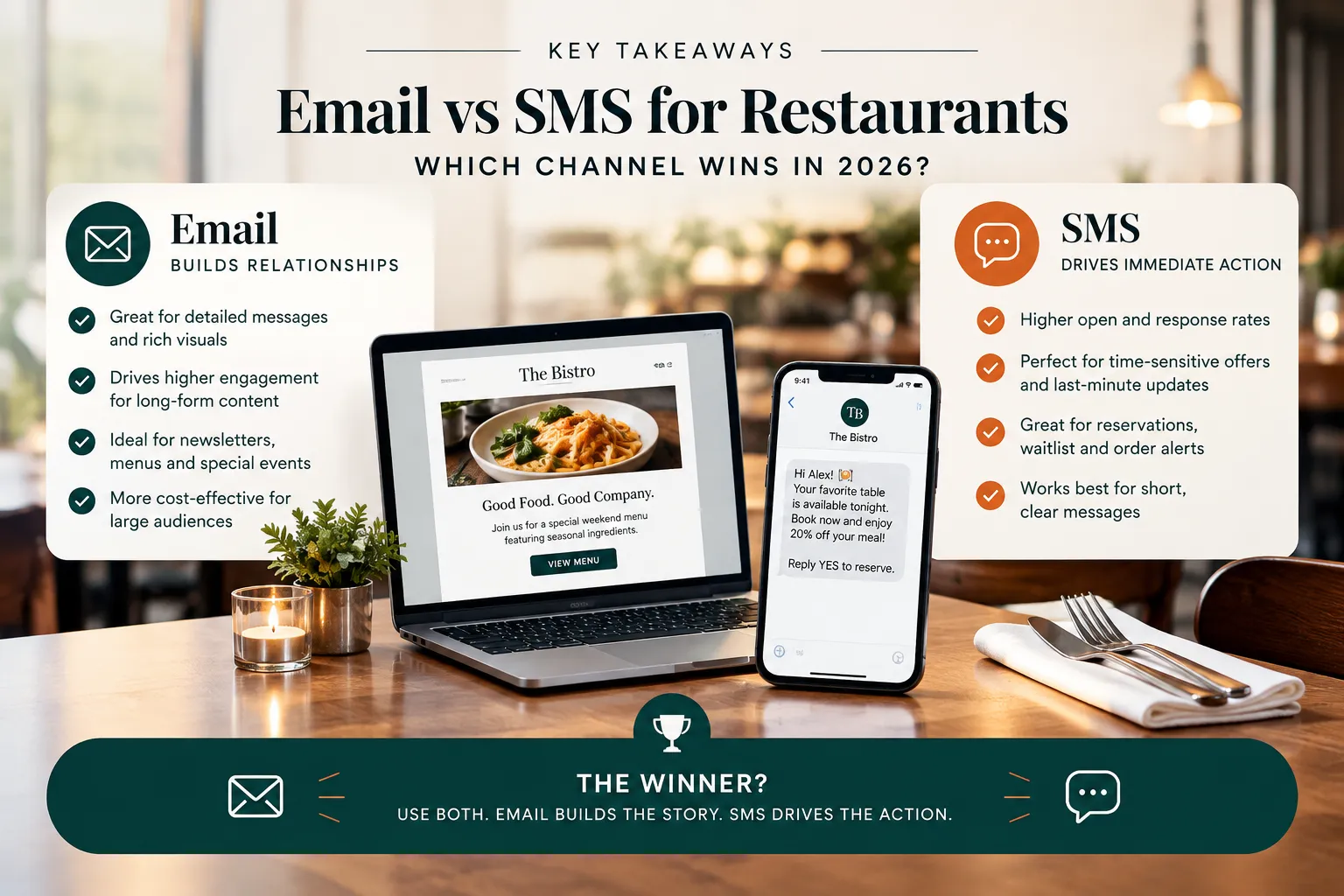
That does not make email useless. It simply changes its job. Email is built for depth, menus, photos, event invitations, and loyalty program updates all work better in a format that allows more space and visual design [3][4]. SMS is built for urgency. A one-line message about a flash discount or a last-minute reservation opening performs exactly the way it should: fast and direct.
The practical takeaway: match the message to the channel. Urgent, short, time-sensitive offers belong in SMS. Rich storytelling, menu launches, and brand-building content belong in email.
Return on Investment: Why SMS Leads the Numbers
Looking purely at return on investment, SMS currently holds the top spot among restaurant performance channels [1][2]. The math is simple. Text messages cost little to send, reach guests almost instantly, and drive quick action, whether that is a reservation, a pickup order, or a visit during a slow period. Because the lag between sending and acting is so short, restaurants can measure results almost in real time.
Email still earns its place in the budget. It remains the preferred communication channel for a large share of diners, according to industry research [3][4]. Many guests actively want restaurant updates in their inbox rather than their phone’s message thread, especially for non-urgent news like new menu items or holiday hours. That preference keeps email relevant even as SMS claims the performance crown.
Market trends also point toward continued growth in restaurant SMS marketing adoption, with more operators expected to expand text-based campaigns over the next few years [2][6]. Restaurants that ignore this shift risk missing a channel their competitors are already using to fill seats faster.
Channel Usage Across the Restaurant Marketing Stack
Social media remains the most heavily used marketing channel for restaurants overall, but email and SMS have both become standard tools in the modern marketing stack [5][6]. Very few successful restaurant brands rely on just one channel anymore. Instead, they layer channels together, using each one for a specific purpose.
Here is a simple way to think about how the three core channels typically function:
| Channel | Primary Strength | Best Use Case |
|---|---|---|
| Social Media | Discovery and awareness | Attracting new guests, visual content |
| Depth and storytelling | Newsletters, loyalty programs, events | |
| SMS | Speed and urgency | Flash deals, reservation reminders, same-day promos |
This table is not about ranking channels against one another. It is about recognizing that email vs SMS for restaurants is really a question of role, not rivalry.
Generational and Use-Case Differences
Age plays a real role in channel preference. Younger diners, particularly those under 35, tend to respond faster to SMS and expect quick, casual communication [7][8]. Older diners and long-time loyalty program members often favor email, appreciating the slower pace and richer content it allows [3].
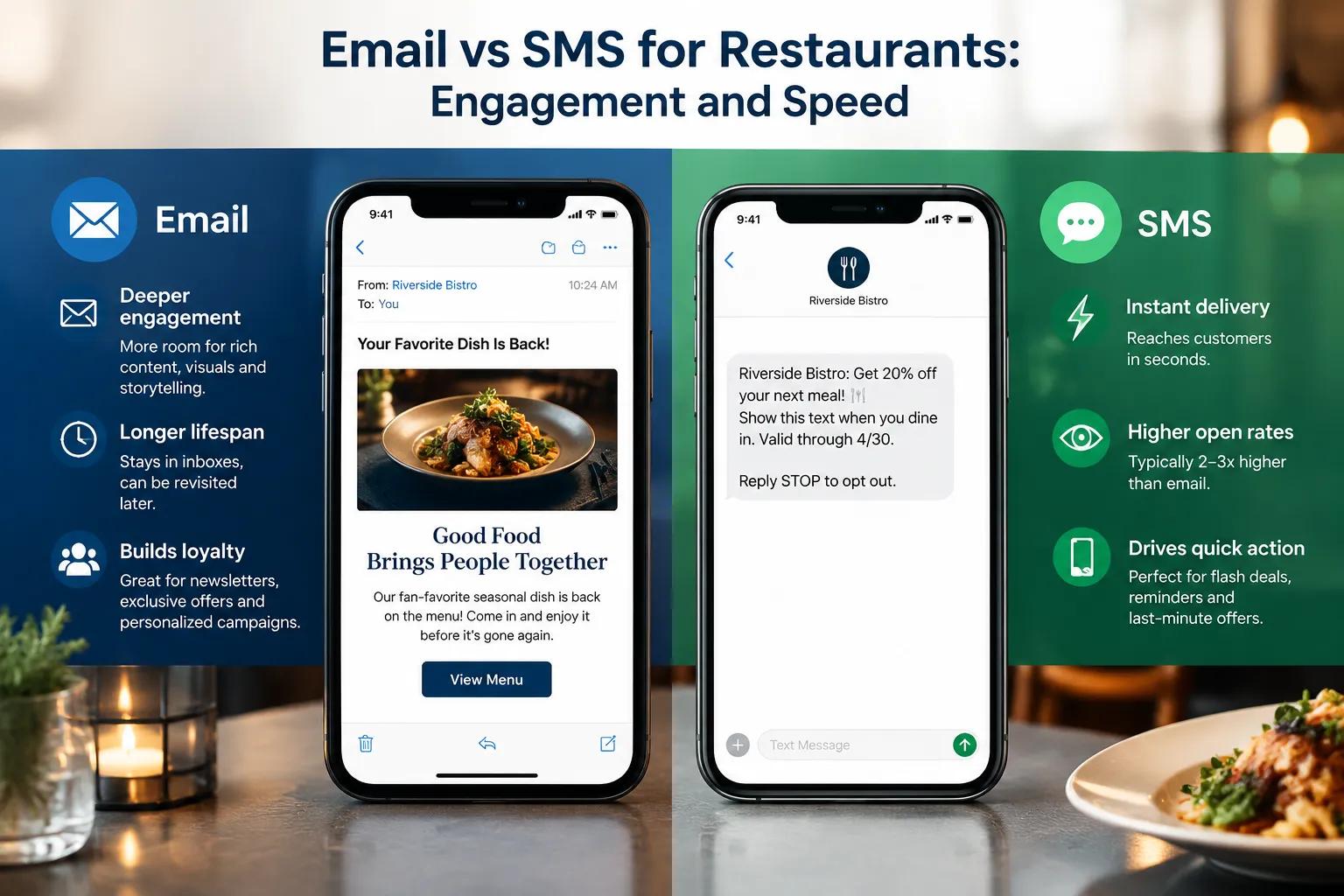
Use case matters just as much as age. A restaurant announcing a brand-new seasonal menu with professional photography should lean on email, where images and formatting shine. A restaurant trying to fill tables during an unexpected slow night should lean on SMS, where the message reaches guests almost immediately.
Consider these common scenarios:
- Reservation reminders: SMS wins due to speed and reliability.
- Weekly specials with photos: Email wins due to visual space.
- Loyalty point updates: Either works, though email allows more detail.
- Last-minute cancellations or openings: SMS wins decisively.
- Holiday hours and event invitations: Email provides more context.
Performance Benchmarks for Restaurant Email vs SMS
Benchmark data from 2024 through 2026 consistently shows SMS leading on open rates and response speed, while email leads on content depth and audience preference [7][9]. Restaurants running both channels report that email tends to build long-term brand affinity, while SMS tends to drive short-term, measurable action.
This pattern lines up with broader customer engagement research showing that different channels serve different stages of the guest relationship, awareness and loyalty through email, immediate action through SMS [9].
The Case for Synergy Over Either/Or Thinking
The strongest argument in the entire email vs SMS for restaurants debate is not about choosing one. Research consistently shows that email and SMS used together outperform either channel used alone [9][10]. A guest who receives a thoughtful email about a new seasonal menu, followed later by a well-timed SMS reminder about a limited-time discount, is more likely to act than a guest who only receives one type of message.
This layered approach also respects guest attention. Not every message deserves a text. Not every announcement deserves a full email. Splitting content by urgency and depth keeps both channels effective instead of overused.
Practical Strategy for Restaurants Heading Into 2026
Expert consensus for late 2026 points to a clear, practical approach for restaurant owners weighing email vs SMS for restaurants [1][2][10]:
- Build both lists from day one. Collect email addresses and phone numbers at checkout, online ordering, and reservation booking.
- Reserve SMS for urgency. Use it for flash sales, reservation confirmations, and same-day openings.
- Reserve email for depth. Use it for newsletters, menu launches, loyalty updates, and storytelling.
- Track both channels separately. Measure open rates, response speed, and conversion for each.
- Layer campaigns together. Pair an email announcement with a follow-up SMS nudge for maximum impact.
- Respect frequency limits. Guests tolerate frequent SMS less than frequent email, so send texts sparingly and with clear value.
Following this structure helps restaurants avoid the common mistake of treating email and SMS as competitors rather than teammates.
Conclusion
The email vs SMS for restaurants question does not have a single winner. SMS delivers unmatched speed and currently the best return on investment for urgent, action-driving messages. Email remains the preferred channel for many guests and the best format for storytelling, menu launches, and loyalty communication. Social media still leads overall usage, but email and SMS have become essential, standard parts of any serious restaurant marketing stack.
The real opportunity lies in combining the two. Restaurants that pair thoughtful email content with well-timed SMS alerts consistently see stronger results than those relying on just one channel. Start by building both contact lists, assign clear roles to each channel, and track performance separately before combining campaigns for maximum effect. The restaurants that master this balance will be the ones filling tables fastest in 2026 and beyond.
References
- Sms Marketing for Restaurants. peblla.com.
- Sms for Restaurant Marketing Strategy. bloomintelligence.com.
- Emails on the Menu Restaurant Patrons Prefer the. mediapost.com.
- Emails on the Menu Restaurant Patrons Prefer the. mediapost.com.
- US Restaurant Trends Report 2024 Final. go.sevenrooms.com.
- Restaurant Marketing Statistics. restroworks.com.
- Restaurant Email Marketing Statistics. tablein.com.
- Blog. fishbowl.com.
- Customer Engagement Report. mailchimp.com.
- Owned Attention. fb101.com.