Last updated: September 15, 2026
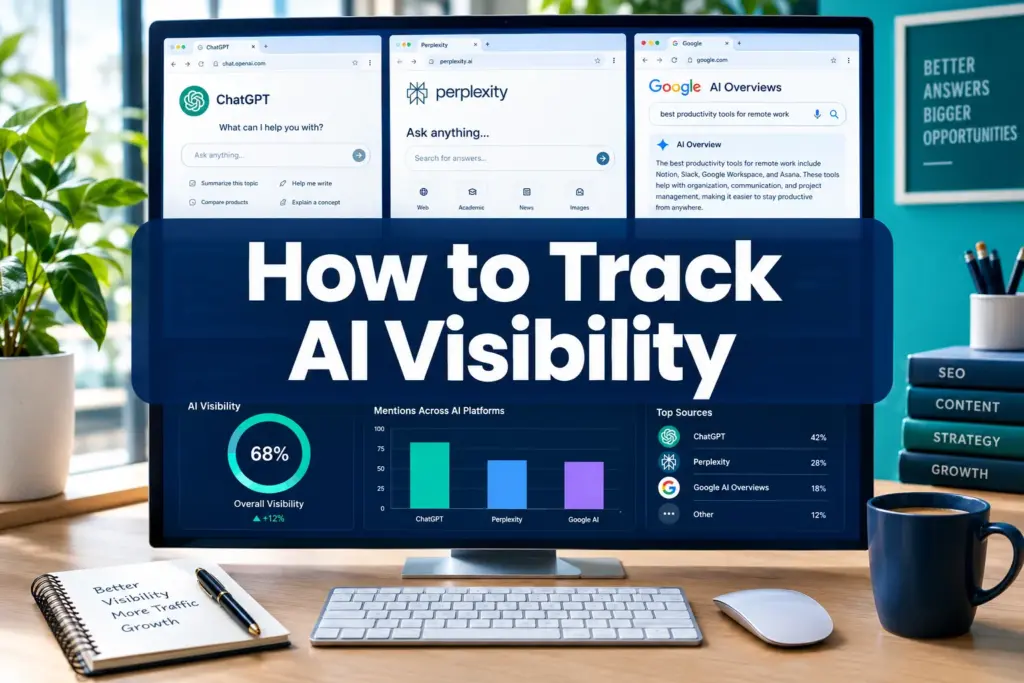
Quick Answer: AI search tracking means monitoring how often and how prominently your brand, content, or website appears inside AI-generated answers, across tools like Google AI Overviews, ChatGPT, Perplexity, and Gemini. It’s different from traditional rank tracking because there are no fixed position numbers. Instead, you measure citation frequency, share of voice, and prompt coverage across multiple AI engines. In 2026, this is no longer optional, Google AI Overviews now appear on a significant share of all queries [6], and if you’re not tracking your AI visibility, you’re flying blind on a growing chunk of your organic traffic.
Key Takeaways
- AI search tracking measures citations and mentions in AI-generated answers, not just blue-link rankings
- Google AI Overviews have surged to appear on roughly 58% of queries, making AI-specific tracking essential [6]
- The core metrics to track are: citation rate, share of voice, prompt coverage, and AI snippet frequency
- Tools like Ahrefs AI Visibility Checker, RankScale, Lumar, and others now offer dedicated AI tracking features [3][4][9]
- Backlinks still matter for AI visibility, they signal authority that AI systems use to evaluate sources
- Traditional SEO and AI visibility tracking work together; you don’t have to choose one over the other
- Prompt-based workflows (testing specific questions your audience asks) are replacing keyword-only tracking
- Content that is factual, well-structured, and cited by credible sources gets picked up by AI engines more often
What Is AI Search Tracking and How Is It Different from Regular SEO
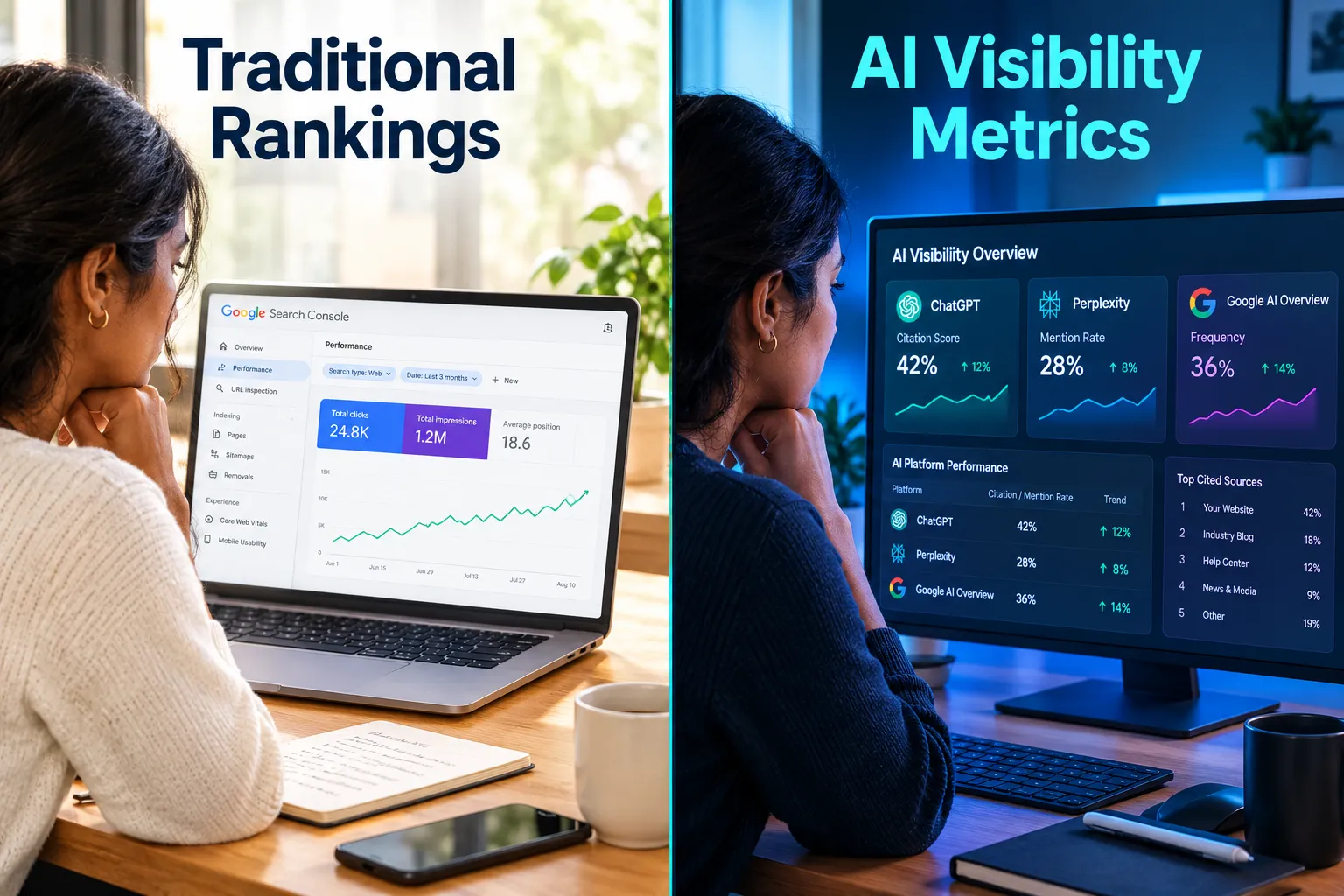
AI search tracking is the practice of monitoring whether and how your content appears inside AI-generated responses, the summaries, answers, and citations that tools like Google AI Mode, ChatGPT, Perplexity, and Gemini produce. Traditional SEO rank tracking tells you where your page sits in a list of blue links. AI search tracking tells you whether an AI system is actually pulling from your content to answer a user’s question.
The difference matters because AI answers often don’t show a ranked list at all. A user asks a question, gets a synthesized paragraph, and sees one to three source links, if any. Being “position 5” in traditional results doesn’t guarantee you’re cited in that AI answer. And being cited in the AI answer doesn’t always mean you rank in the top five traditional results.
The practical gap: Many businesses I’ve seen are still only checking Google Search Console rankings. They notice traffic dipping but can’t explain why. The explanation, in many cases, is that a competitor is being cited in AI Overviews for the same queries, and the user never scrolls to the blue links.
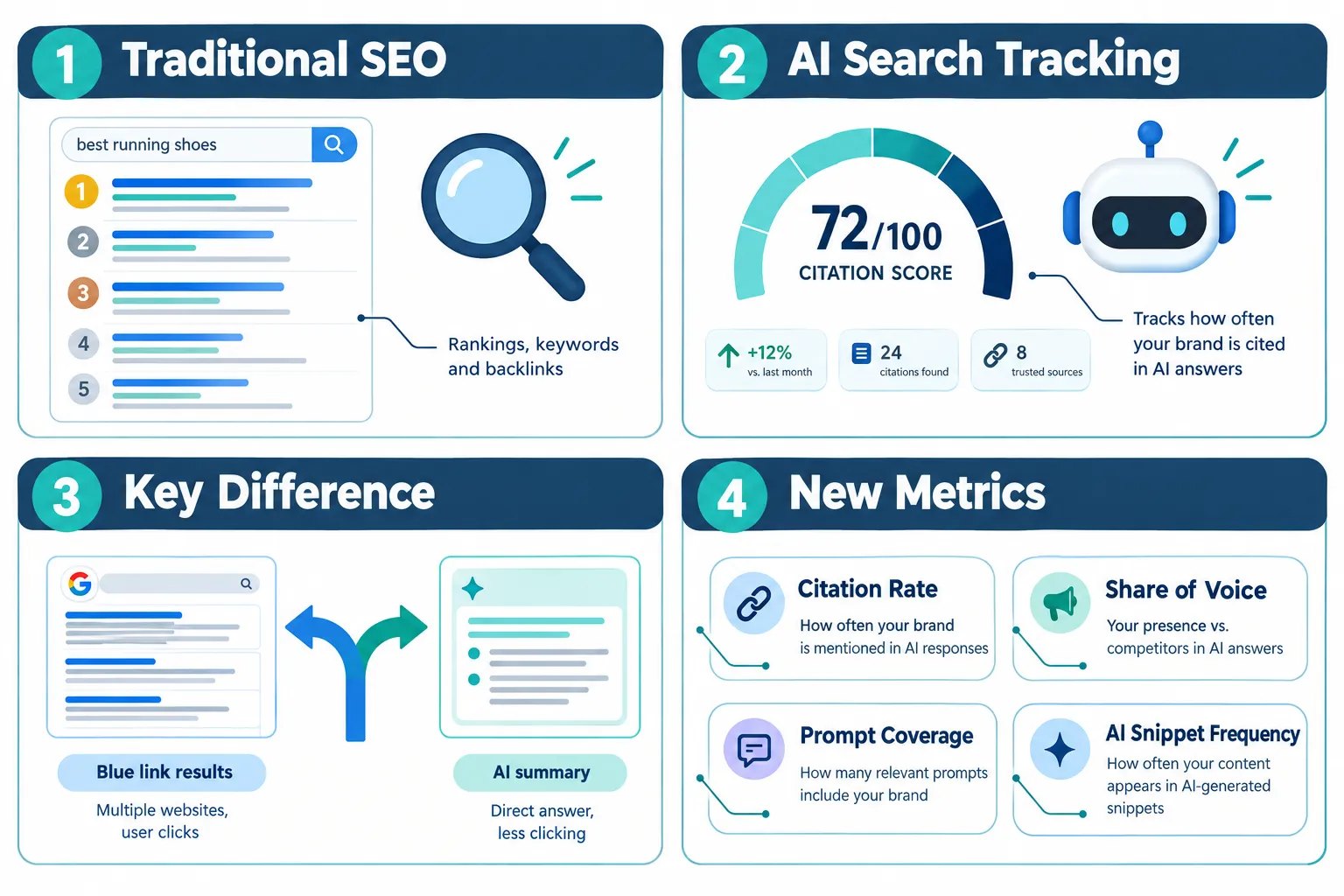
Key differences at a glance:
| Dimension | Traditional SEO Tracking | AI Search Tracking |
|---|---|---|
| What you measure | Keyword ranking position | Citation rate, mention frequency |
| Result format | Ranked list of URLs | Synthesized AI answer + sources |
| Engines tracked | Google, Bing | Google AI Mode, ChatGPT, Perplexity, Gemini |
| Primary metric | Position 1-100 | Share of voice, prompt coverage |
| Update frequency | Daily/weekly | Per query run |
How to Measure Your Website Visibility in AI Search Results
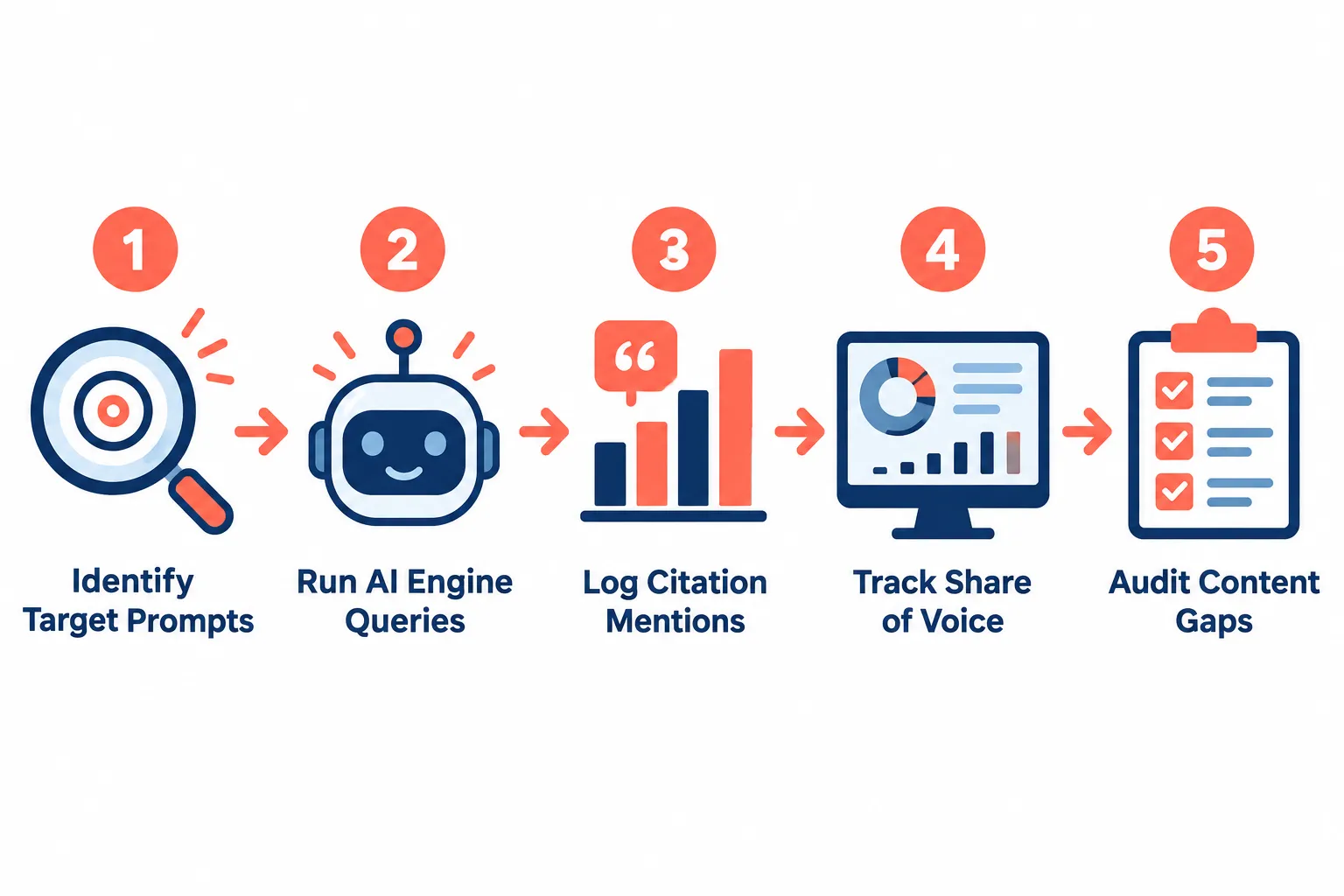
Measuring AI visibility starts with a prompt-based workflow rather than a keyword list. You identify the specific questions your target audience asks, then run those prompts across AI engines and record whether your site is cited, mentioned, or used as a source.
Here’s a practical starting framework:
- Build a prompt set, List 20-50 questions your customers actually ask. Use Google’s “People Also Ask” boxes, your own search query data from Google Search Console, and customer support logs.
- Run prompts across engines, Test each question in Google AI Overviews, ChatGPT, Perplexity, and Gemini. Record which sources each engine cites.
- Log your citation rate, Out of 50 prompts, how many times does your domain appear in the AI response? That’s your baseline citation rate.
- Track share of voice, Of all citations across your prompt set, what percentage point to your domain vs. competitors?
- Repeat weekly or bi-weekly, AI search results shift more often than traditional rankings, so consistent tracking matters [5][10].
Tools like Omnia, LLMPulse, and RankScale automate much of this workflow [8][9][5]. Ahrefs now offers a dedicated AI Visibility Checker that scores your domain’s presence across AI engines [3].
What Tools Can Track AI Search Engine Rankings
Several dedicated AI search tracking tools have matured significantly in 2026. You don’t need to run every prompt manually anymore [2].
Dedicated AI visibility tools:
- Ahrefs AI Visibility Checker, Scores your domain’s citation rate across major AI engines. Good starting point for SEO teams already using Ahrefs [3].
- RankScale, Built specifically for AI search tracking, with share-of-voice reporting across ChatGPT, Perplexity, and Google [9].
- Lumar, Offers AI visibility tracking integrated with its technical SEO crawling platform, useful for enterprise teams [4].
- Omnia, Tracks AI mentions and citation patterns with a prompt-testing interface [8].
- LLMPulse, Focused on tracking brand mentions inside LLM-generated answers [5].
- Frase, Has added AI visibility features to its existing content optimization suite [2].
- Zapier’s roundup lists several workflow-based tools for teams that want to automate tracking across engines [1].
Pricing reality: Most dedicated AI tracking tools start around $50,$200/month for small teams, with enterprise plans running higher. Many offer free trials. If budget is tight, a manual prompt-testing workflow with a shared spreadsheet is a legitimate starting point before committing to paid tools.
Which AI Search Engines Should You Be Tracking
Track the engines your audience actually uses. For most businesses in the USA and India in 2026, that means four platforms:
- Google AI Overviews / AI Mode, Still the highest-volume AI search surface by far. Google AI Overviews now appear on a large share of queries [6][7], making this the single most important engine to track.
- ChatGPT, Significant user base, especially for research and product discovery queries.
- Perplexity, Growing fast among tech-savvy and professional audiences. Cites sources explicitly, making tracking straightforward.
- Gemini, Google’s standalone AI assistant, increasingly integrated into Google Workspace and Android.
Choose X if: You’re a B2B SaaS company, prioritize ChatGPT and Perplexity, where your buyers research solutions. You’re a local business, Google AI Overviews is your primary focus. You’re in e-commerce, watch all four, but Google AI Mode will drive the most commercial traffic.
What Metrics Matter Most for AI Search Visibility
The core metrics for AI search tracking have become more standardized in 2026 [10]. Here’s what to actually measure:
- Citation Rate, The percentage of your tracked prompts where your domain is cited as a source. This is your headline metric.
- AI Share of Voice, Your citations as a percentage of all citations across your prompt set. Shows competitive position.
- Prompt Coverage, How many of your target prompts trigger any AI answer at all (not all queries get AI Overviews).
- Snippet Frequency, How often your content is directly quoted or paraphrased inside the AI answer text.
- Traffic from AI Referrals, Measurable in Google Analytics 4 as referral traffic from ChatGPT, Perplexity, and similar domains. This is becoming a distinct, trackable channel [8].
The metric that surprises most teams: Share of voice, not citation rate, is the number that reveals competitive exposure. You might have a 40% citation rate and still be losing ground if a competitor is cited in 70% of the same prompts.
Why Is My Site Not Appearing in AI Search Summaries
There are several common reasons a site gets skipped by AI engines, even when it ranks well in traditional search [7]:
- Thin or vague content, AI systems favor content that directly answers specific questions with clear, factual language.
- Weak authority signals, Low domain authority and few quality backlinks reduce the likelihood an AI engine treats your content as a credible source.
- Poor content structure, Content without clear headings, defined answers, and logical flow is harder for AI systems to parse and cite.
- No existing traditional ranking, Most AI citations in Google AI Overviews come from pages that already rank in the top 10 for that query [7]. If you’re not ranking, you’re rarely cited.
- Missing entity clarity, If your content doesn’t clearly state who you are, what you do, and what topic you’re covering, AI engines have trouble attributing it correctly.
Quick fix: Audit your top 10 pages. For each one, ask: does this page directly answer a specific question in the first two paragraphs? If not, restructure it so it does.
How to Optimize Content for AI Search Results
Optimizing for AI search results, sometimes called generative engine optimization (GEO) or answer engine optimization (AEO), follows a different logic than traditional on-page SEO. The goal is to make your content easy for AI systems to read, trust, and cite.
Practical steps that work:
- Lead with the answer. Put the direct answer to the page’s main question in the first paragraph, not buried in paragraph five.
- Use structured, scannable formatting. Clear H2s, short paragraphs, and bullet lists help AI engines extract and cite specific passages.
- Include verifiable facts with sources. AI systems favor content that cites credible data. Unsupported claims get skipped.
- Build topical authority. Cover a topic cluster thoroughly across multiple pages. AI engines reward depth and consistency on a subject.
- Earn quality backlinks. Backlinks remain a strong authority signal that AI systems use to evaluate source credibility [7].
- Keep content current. Outdated pages lose citations. Update your most important content at least annually.
Do Backlinks Still Matter for AI Search Visibility
Yes, backlinks still matter, and significantly. AI engines like Google’s systems use the same underlying authority signals that traditional search uses to evaluate which sources are credible enough to cite [7]. A page with strong backlinks from trusted domains is more likely to be pulled into an AI-generated answer than an equally well-written page with no external links pointing to it.
That said, the relationship is slightly different from traditional SEO. For AI visibility, what matters more is the quality and relevance of links rather than raw quantity. A few citations from well-known industry publications carry more weight than dozens of low-quality directory links.
Common mistake: Assuming that because AI search is “new,” backlinks are irrelevant. They’re not. They’re still one of the clearest signals of trustworthiness that any search system, AI or traditional, can evaluate.
How Often Do AI Search Rankings Change
AI search results are less stable than traditional rankings. Because AI systems generate answers dynamically based on their training data, real-time retrieval, and query context, the same prompt can return different cited sources from one week to the next [5][10].
In practice, expect meaningful shifts in your citation patterns every two to four weeks. Major model updates (like a new version of ChatGPT or a Google AI Mode rollout) can cause larger, more sudden shifts.
What this means for tracking: Run your full prompt set at least twice a month. Don’t react to a single week’s data, look for trends over 60-90 days before making major content decisions.
Can You Still Rank Well in Traditional Search While Tracking AI Visibility
Absolutely, and you should do both. Traditional SEO and AI search tracking are not competing priorities. In fact, strong traditional rankings are one of the best predictors of AI citation [7]. Pages that rank in the top 10 for a query are significantly more likely to be cited in AI Overviews for that same query.
The practical approach is a hybrid tracking framework: continue monitoring traditional keyword rankings in tools like Google Search Console, Ahrefs, or Semrush, while adding AI-specific citation tracking on top. Think of AI visibility as a layer above your existing SEO program, not a replacement for it.
What’s the Difference Between Tracking ChatGPT vs. Google AI Overviews vs. Perplexity
Each engine has a different citation behavior, and tracking them separately gives you more useful data:
- Google AI Overviews, Pulls from pages already indexed and ranking in Google. Citations tend to be more stable and tied to traditional SEO authority. Highest commercial impact for most businesses.
- ChatGPT (with browsing), Uses real-time web retrieval for some queries. Citation patterns are less predictable and vary by query type. Strong for informational and research queries.
- Perplexity, Explicitly shows sources for every answer. Makes tracking straightforward. Favors recent, well-sourced content. Growing fast in professional and research audiences.
Tracking tip: Don’t aggregate all three into a single score at first. Track them separately for 60 days to understand where your content performs well and where the gaps are. Then prioritize the engine that drives the most referral traffic to your site.
Common Mistakes People Make with AI Search Optimization
The biggest mistakes I see teams make when they start focusing on AI visibility:
- Tracking only Google, ignoring ChatGPT and Perplexity, You’re missing a growing share of research-phase traffic.
- Optimizing for AI without fixing traditional SEO first, If your pages don’t rank in traditional search, they rarely appear in AI citations either.
- Chasing citations without measuring traffic, A citation that sends zero referral traffic is worth less than one that sends 200 qualified visitors per month.
- Rewriting all content at once, Prioritize your highest-traffic, highest-intent pages first. Don’t overhaul everything simultaneously.
- Ignoring structured data, Schema markup helps AI systems understand your content’s context, authorship, and entity relationships.
- Not tracking competitors, Your AI share of voice only makes sense relative to who else is being cited for the same prompts.