


Last updated: October 5, 2026
Quick Answer
India IT outsourcing services in 2026 look nothing like the cost-arbitrage model US companies used ten years ago. Indian providers now price contracts around outcomes, staff them with AI and data specialists instead of generic coders, and compete on speed and quality instead of headcount [1]. For a US mid-market company, the smart move is to treat an Indian partner as a technology team, not a vendor, and build the relationship around clear governance, security standards, and measurable delivery outcomes rather than just an hourly rate.
Key Takeaways
- India IT outsourcing services have shifted from staff-based billing to outcome-based contracts, driven by AI productivity gains inside Indian delivery teams [1].
- Mid-market companies (typically $10 million to $1 billion in revenue) get the best return because they need enterprise-grade capability without enterprise-size internal IT departments.
- The four core delivery models are staff augmentation, project outsourcing, managed services, and dedicated offshore teams, each fits a different stage of growth.
- Indian IT providers are investing heavily in AI and data specialists while trimming generic, entry-level engineering roles [4].
- Security and compliance diligence (SOC 2, ISO 27001, data residency terms) matters more in 2026 than it did five years ago, because AI workloads touch more sensitive data.
- A dedicated offshore team usually takes four to ten weeks to stand up, depending on skill rarity and background checks.
- Nearshore options like Mexico and Latin America win on time-zone overlap; India still wins on talent depth, AI/ML specialization, and 24/7 coverage.
- Governance, not price, is the single biggest predictor of whether a US-India outsourcing relationship succeeds or fails.
What is India IT outsourcing and how does it work
India IT outsourcing is the practice of hiring a technology provider based in India to handle software development, cloud management, cybersecurity, data engineering, or IT support on behalf of a US company. It works through a mix of remote delivery centers, shared project tools, and overlapping work hours that let Indian teams extend or replace parts of a US company’s internal IT function.
Here’s the basic mechanics of how it plays out in practice:
- Scoping: The US company defines what needs to get built, fixed, or run (a Salesforce migration, a cloud security audit, ongoing application support).
- Delivery model selection: The work gets assigned to individual contractors, a project team, a managed service desk, or a dedicated team built just for that client.
- Daily operations: Indian teams typically work a 4 to 6 hour overlap window with US Eastern or Pacific time, using tools like Jira, Slack, and shared cloud environments.
- Reporting: Progress gets tracked against SLAs (service-level agreements), sprint goals, or uptime targets rather than just hours logged.
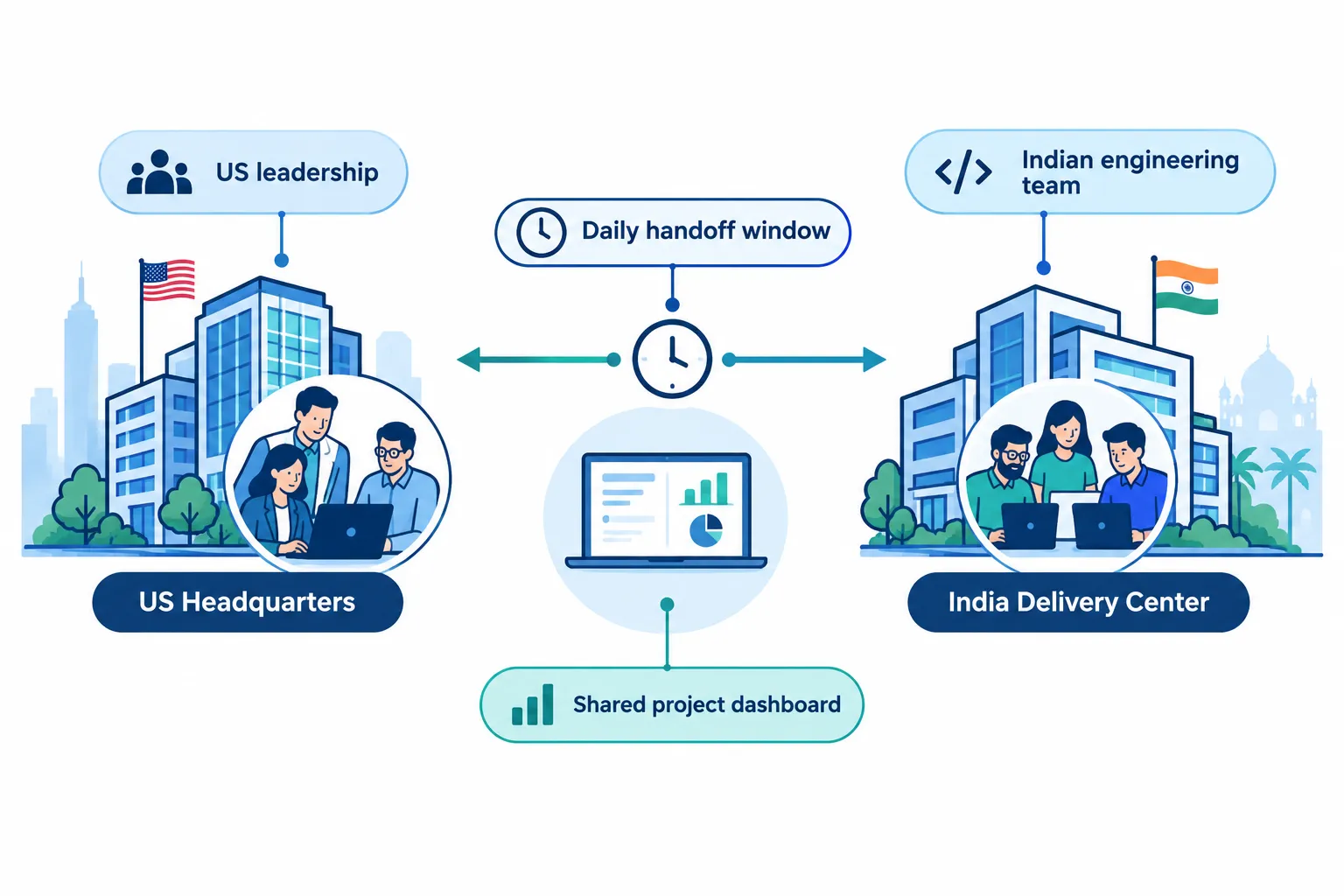
The model works best when the US side treats the arrangement as a distributed team with shared tools and shared accountability, not a contractor relationship managed purely through invoices.
How is India IT outsourcing changing in 2026
India IT outsourcing in 2026 is moving away from billing by headcount and toward billing by result. Clients are asking Indian IT providers to do more work with fewer people, and AI tools inside those providers are making that demand possible without blowing up delivery timelines [1].
This shift shows up in a few concrete ways:
- Shorter, outcome-tied contracts. Reuters reporting from August 2026 found that AI is reshaping India’s IT services contracts, with clients pushing for more deliverables at lower headcount and providers restructuring pricing around completed outcomes instead of hours billed [1].
- AI revenue growing inside major Indian IT firms. Providers are reporting rising AI-related revenue as clients shift budget from routine maintenance work toward AI-enabled modernization projects [5].
- India is moving up the value chain, not losing the work. Despite early fears that AI would gut India’s outsourcing industry, multiple reports from mid-2026 found the opposite: India’s roughly $280 billion-plus IT services sector is adapting by shifting talent toward higher-value AI, data, and architecture roles instead of shrinking [9][4].
My take: the US companies winning with India IT outsourcing services right now aren’t the ones chasing the lowest hourly rate. They’re the ones asking providers to show exactly how AI tooling speeds up delivery, then negotiating contracts that pass some of that productivity gain back to the client as lower cost per outcome, not just lower cost per hour.
Staff augmentation vs project outsourcing vs managed services vs dedicated teams
The right delivery model depends on how long you need the work, how much control you want, and whether the task is a one-time project or an ongoing function. There is no single “best” model, only the model that fits your specific need.
| Model | Best for | Control level | Typical length |
|---|---|---|---|
| Staff augmentation | Filling a specific skill gap on an existing team (e.g., one Salesforce developer) | High, managed by US team directly | 3-12 months, extendable |
| Project outsourcing | Defined deliverables with a start and end date (an app build, a migration) | Medium, provider manages delivery | 2-9 months |
| Managed services | Ongoing functions like help desk, cloud ops, or cybersecurity monitoring | Low, provider owns SLAs and uptime | 12+ months, auto-renewing |
| Dedicated offshore team | A permanent extension of your engineering org, working as your team | High, integrated into your processes | Ongoing, multi-year |
Decision rule: choose staff augmentation if you need one or two specific skills fast. Choose project outsourcing if the scope and end date are fixed. Choose managed services if you need 24/7 coverage without hiring internally. Choose a dedicated team if India will be a permanent part of your engineering org for years, not months.
Best India IT outsourcing companies for US businesses: how to shortlist
There is no single “best” India IT outsourcing company for every US business, the right fit depends on your tech stack, company size, and whether you need AI/data specialization or general application support. What matters more than any ranked list is a repeatable shortlisting process.
A practical shortlisting approach:
- Start with category, not brand. Search for providers specializing in your actual need, Salesforce implementation, cloud security, data engineering, rather than generic “IT outsourcing” firms.
- Check client overlap with your size. A provider built for Fortune 500 retainer work may ignore a mid-market account; a provider built for small startups may lack enterprise security processes.
- Request two reference calls with current clients in your industry or similar revenue range, not just case studies.
- Run a small paid pilot (2-4 weeks) before signing a multi-year managed services deal.
Common mistake: picking a provider based on a polished sales deck alone. Ask to speak with the actual delivery manager and engineers who would work on your account before signing anything.
India IT outsourcing costs vs hiring in-house in 2026
India IT outsourcing services generally cost less per hour than US in-house hires, but the real savings in 2026 come from speed, specialization, and avoided overhead, not just lower wages. Comparing only hourly rates misses most of the real financial picture.
What actually drives the cost difference:
- Lower base compensation for comparable technical skill, though this gap has narrowed for senior AI and data roles as Indian salaries for specialized talent rise.
- No US benefits, payroll tax, or office overhead for the outsourced portion of the team.
- Faster ramp-up, a dedicated team can often start producing usable work in weeks instead of the 2-4 months typical for a US hiring cycle.
- Fewer idle resources, managed services and project models let you scale the team up or down instead of carrying fixed headcount.
India’s IT and business process management sector remains a massive, mature export industry generating revenue in the hundreds of billions of dollars annually, which is part of why the talent pool and infrastructure for specialized work stay deep even as AI changes how that work gets delivered [2].
Edge case: if your work requires constant in-person collaboration, tight regulatory data residency inside the US, or extremely niche domain knowledge only available locally, in-house hiring may still beat outsourcing even at a higher cost.
If you’re also trying to figure out where to put savings from smarter IT spend, it’s worth applying the same “spend smarter, not more” thinking to your broader marketing and growth budget, see this breakdown on spending smarter across multiple marketing channels.
How to find reliable India IT outsourcing providers: a selection framework
Finding a reliable India IT outsourcing provider in 2026 means evaluating nine specific dimensions, not just price. Skipping any one of these creates risk that shows up months later, usually at the worst possible time.
| Criteria | What to check |
|---|---|
| Security | SOC 2, ISO 27001 certification, data handling policy |
| Technical capability | Live code review or technical interview with proposed team |
| Communication | English fluency, documentation quality, async update habits |
| Time-zone coverage | Overlap hours with your core US team |
| Compliance | HIPAA, GDPR, or industry-specific regulatory experience |
| SLAs | Defined uptime, response time, and escalation paths in writing |
| Pricing structure | Outcome-based options, not just hourly billing |
| Scalability | Ability to add specialists within weeks, not months |
| AI capability | Actual AI-assisted delivery tooling, not just marketing claims |
Quick example: a 200-employee logistics company evaluating providers for a cloud migration should weight security and compliance heaviest, since logistics data often touches customer PII. A SaaS startup building an AI feature should weight technical capability and AI tooling heaviest instead.
India IT outsourcing for AI, machine learning, cloud, and other tech stacks
India has become a serious option for AI and machine learning outsourcing in 2026, not just application support, because Indian providers have spent several years building dedicated AI practices, data engineering teams, and cloud specializations [7][8]. The country isn’t just coding to spec anymore, many providers now co-design AI systems with clients.
Where India IT outsourcing services are strongest for specialized tech stacks:
- Data engineering and AI/ML model development, building the data pipelines and feature stores that feed AI models, not just the models themselves.
- Cloud infrastructure and migration (AWS, Azure, GCP) including cost optimization and security hardening.
- Cybersecurity operations, including 24/7 security operations center (SOC) monitoring.
- Salesforce and enterprise application development, including CRM customization and integration work.
- Application modernization, moving legacy systems to cloud-native, API-first architectures.
A BBC report from mid-2026 highlighted how AI is reshaping work inside India’s outsourcing sector broadly, with routine coding tasks increasingly automated while demand grows for engineers who can architect, govern, and validate AI systems [3]. That’s the skill shift US buyers should expect to see on their own project teams.
Decision rule: choose an India-based AI/ML partner if your project needs deep bench strength across data science, MLOps, and cloud infrastructure simultaneously. Choose a smaller boutique AI shop (US or elsewhere) if your need is narrow and highly specialized.
Is India IT outsourcing still worth it in 2026
Yes, India IT outsourcing is still worth it in 2026 for most US mid-market companies, but the value proposition has changed from “cheaper labor” to “faster access to AI-ready technical talent and mature delivery processes.” Companies expecting 2015-style cost arbitrage alone will be disappointed; companies expecting a genuine technology partner will likely find real value.
Evidence supporting this shift:
- Analysts and industry observers pushed back directly on the narrative that AI would “steamroll” India’s outsourcing industry, pointing instead to providers retraining and redeploying talent into higher-value AI and automation work [9].
- Global enterprises continue to select India specifically for AI and automation capability, not just cost, according to industry coverage from 2026 [7].
- India’s outsourcing sector remains one of the largest in the world by revenue, giving it the scale needed to staff large AI and cloud programs that smaller markets can’t match [2].
Who it’s not ideal for: very early-stage startups with under 5 employees and no technical co-founder may struggle to manage an offshore relationship without someone senior overseeing delivery. In that case, a small local contractor or a US-based fractional CTO may be a better first step.
India IT outsourcing risks and how to avoid common mistakes
The biggest risks in India IT outsourcing are communication breakdowns, scope creep, and weak security oversight, and nearly all of them trace back to poor governance on the US side, not the Indian provider itself. Avoiding these risks is mostly about setting structure up front.
Common mistakes and how to prevent them:
- Mistake: no single accountable owner on the US side. Fix it by naming one internal leader who owns the relationship, even if a vendor manager handles daily details.
- Mistake: vague SLAs. Fix it by defining measurable response times, uptime percentages, and escalation paths in the contract, not just general “best effort” language.
- Mistake: skipping security audits because the provider “seems trustworthy.” Fix it by requiring SOC 2 or ISO 27001 documentation before any data access is granted.
- Mistake: treating the relationship as transactional. Clients demanding “more for less” without adjusting scope or timelines strain even AI-enabled teams, 2026 reporting shows providers pushing back on unrealistic compression of both cost and delivery time simultaneously [6].
- Mistake: no onboarding investment. Offshore teams that never get proper access to your product context, customers, or business goals deliver technically correct but strategically wrong work.
Edge case: if your internal stakeholders change frequently (new CTO every 12-18 months), build extra documentation requirements into the contract so institutional knowledge doesn’t live only in people’s heads.
What size companies benefit most from India IT outsourcing: startups vs enterprise
Mid-market companies, roughly $10 million to $1 billion in annual revenue, tend to get the best return from India IT outsourcing because they have enough complexity to need specialized talent but not enough internal headcount to hire it all locally. Startups and enterprises can both benefit, but the approach differs sharply.
- Startups should favor staff augmentation or small dedicated pods (2-5 people) focused on one core product area. Speed and low commitment matter more than process maturity at this stage.
- Mid-market companies should favor dedicated offshore teams or managed services, since they need predictable delivery and 24/7 coverage without enterprise-level internal IT staff.
- Enterprises typically run hybrid models: a managed services contract for routine operations plus multiple dedicated teams for strategic initiatives, often spread across several Indian providers to avoid concentration risk.
Quick example: a 150-person e-commerce company needing ongoing cloud cost optimization and a holiday-season traffic surge plan fits a managed services model. A 25-person SaaS startup building its first AI feature fits a small dedicated team instead.
India IT outsourcing vs nearshore alternatives like Mexico or Latin America
India wins on talent depth, round-the-clock coverage, and AI/ML specialization; Mexico and Latin America win on time-zone overlap and cultural proximity to the US. The right choice depends on what matters more for your specific workflow.
| Factor | India | Mexico / Latin America |
|---|---|---|
| Time-zone overlap | 4-6 hours, mostly late US workday | Full workday overlap |
| Talent pool size | Very large, especially AI/data | Growing but smaller |
| 24/7 coverage | Strong, built for follow-the-sun support | Harder without multiple shifts |
| Cost per hour | Generally lower | Moderate, rising |
Decision rule: choose India if you need deep AI/data specialization, 24/7 support, or the largest possible talent pool. Choose Mexico or Latin America if daily real-time collaboration during US business hours matters more than cost or specialization depth.
Data security and compliance with India IT outsourcing
Data security and compliance are non-negotiable parts of any India IT outsourcing relationship in 2026, especially as more projects involve AI systems that touch customer data, financial records, or health information. The baseline expectation should be documented certifications, not verbal assurances.
What to require before any data access:
- SOC 2 Type II report covering security, availability, and confidentiality controls.
- ISO 27001 certification for information security management.
- Data residency and processing terms spelled out in the contract, including where data is stored and who can access it.
- Regulatory alignment specific to your industry, HIPAA for healthcare, GDPR if you serve EU customers, PCI DSS for payment data.
- Background checks and access controls for individual engineers working on sensitive systems.
Common mistake: assuming a provider’s general company-wide certification automatically covers your specific project team. Always confirm which certifications apply to the actual engineers and infrastructure handling your data, not just the parent company’s marketing page.
How long does it take to build an offshore team in India, and how do you govern it
Building a dedicated offshore team in India typically takes four to ten weeks from signed contract to a fully staffed, productive team, depending on how specialized the roles are. Generic developer roles move faster; senior AI, data, or security specialists take longer because that talent is in higher demand.
A realistic build timeline:
- Weeks 1-2: Scope definition, provider selection, and contract finalization.
- Weeks 2-4: Candidate sourcing and technical interviews (US side should interview finalists directly).
- Weeks 4-6: Onboarding, access provisioning, and tooling setup.
- Weeks 6-10: Ramp-up period where productivity gradually reaches full capacity.
Governance structure that works: set up a single US-side point of contact (ideally a CTO, VP of Engineering, or IT director) paired with a single India-side delivery lead. Hold a weekly sync for tactical issues and a monthly business review for strategic priorities, budget, and roadmap alignment. Put decision rights in writing, who approves scope changes, who approves hires, who can escalate blockers, before the team starts work, not after the first conflict.
In my experience advising growth-stage companies on vendor relationships generally, the governance cadence matters more than almost any other factor. Teams that skip the weekly sync in the first 90 days almost always end up renegotiating scope by month four.
If outsourcing your core technology function sounds similar to outsourcing other specialized functions, the same due-diligence logic applies, see how we think about this for outsourcing SEO and marketing work, where the same governance and vetting principles apply.
FAQ
What does “India IT outsourcing services” actually mean? It refers to hiring an India-based technology provider to handle software development, cloud management, cybersecurity, or IT support for a company based elsewhere, typically through staff augmentation, project contracts, managed services, or dedicated teams.
Is India IT outsourcing cheaper than hiring in the US? Generally yes on a per-hour basis, though the bigger 2026 advantage is faster access to specialized AI and cloud talent and the ability to scale a team up or down without fixed US headcount costs.
How do I verify an Indian IT provider is trustworthy? Request SOC 2 or ISO 27001 documentation, speak directly with two current clients in a similar industry, and run a small paid pilot project before signing a long-term contract.
Can a small startup use India IT outsourcing services? Yes, but startups should start with staff augmentation or a small 2-5 person dedicated pod rather than a large managed services contract, since smaller commitments are easier to manage without a large internal technical team.
What’s the difference between staff augmentation and a dedicated offshore team? Staff augmentation adds individual contractors managed by your existing team for a defined period; a dedicated offshore team is a permanent, integrated extension of your engineering organization built for long-term ongoing work.
Is AI replacing India’s outsourcing industry? No. Reporting through 2026 shows India’s outsourcing sector adapting by shifting talent toward AI, data, and architecture specialization rather than shrinking, even as routine coding tasks become more automated [4][9].
How long does it take to see results from an India-based dedicated team? Most teams reach full productivity within 6 to 10 weeks of onboarding, assuming proper documentation, access, and a clear governance structure are in place from day one.
Should I pick India or Mexico for outsourcing? Pick India for AI/ML specialization, 24/7 coverage, and the largest talent pool. Pick Mexico or Latin America if full-day real-time overlap with US business hours matters more than specialization or cost.
Conclusion
India IT outsourcing services in 2026 reward companies that show up with a clear plan, not just a budget. The providers worth working with are pricing around outcomes, staffing AI and data specialists ahead of generic coders, and expecting US clients to bring real governance to the table [1][4]. That’s a better deal for serious buyers than the old cost-arbitrage model ever was, but it only pays off if you do your part.
If you’re evaluating this path, start with three concrete steps this quarter: define one pilot project with a measurable outcome (not just a headcount request), shortlist three providers using the nine-point framework above, and name one internal owner before any contract gets signed. Skip the multi-year commitment until a 30-60 day pilot proves the provider can actually deliver against your specific tech stack and compliance needs. That single discipline, pilot first, commit second, is the difference between an India outsourcing relationship that becomes a real technology partnership and one that turns into a line item you regret in 18 months.
References
[1] Ai Reshapes Indias It Services Sector Contracts Clients Demand More Less 2026 08 20 – https://www.reuters.com/world/india/ai-reshapes-indias-it-services-sector-contracts-clients-demand-more-less-2026-08-20/ [2] Nasscom SR Press release – https://www.nasscom.in/sites/default/files/media_pdf/Nasscom%20SR%20Press%20release.pdf [3] BBC News article – https://www.bbc.com/news/articles/c5yrq1090p8o [4] India outsourcing industry AI impact hiring contracts – https://qz.com/india-outsourcing-industry-ai-impact-hiring-contracts-081226 [5] AI forces India’s $315 billion IT industry to reshape – https://www.ibtimes.sg/ai-forces-indias-315-billion-it-industry-reshape-clients-shift-hours-outcomes-92597 [6] AI reshapes India’s IT services sector contracts – The Star – https://www.thestar.com.my/tech/tech-news/2026/08/21/ai-reshapes-india039s-it-services-sector-contracts-as-clients-demand-more-for-less [7] Global enterprises choose India IT services AI automation – https://www.wisemonk.io/blogs/global-enterprises-choose-india-it-services-ai-automation [8] India IT sector reshape – Outsource Accelerator – https://news.outsourceaccelerator.com/india-it-sector-reshape/ [9] India’s outsourcing isn’t getting steamrolled by AI – https://www.briefs.co/news/india-s-outsourcing-isn-t-getting-steamrolled-by-ai-ing-says/ [10] AI reshapes India’s IT services sector contracts – Ground News – https://ground.news/article/ai-reshapes-indias-it-services-sector-contracts-as-clients-demand-more-for-less