


Last updated: September 14, 2026
Quick Answer: Google AI Mode uses the same core ranking systems as regular Google Search, there is no separate AI index. To get cited in AI Mode results, you need to rank in the top 10-20 organic results first, then structure your content so it contains short, extractable answers that AI systems can pull directly. The biggest shift in 2026 is not how to rank, but how to stay visible when AI answers are eating your click-through rates.
Key Takeaways
- Google AI Mode and AI Overviews run on Google’s existing ranking systems, no special AI-only technical setup is required [9]
- Getting cited in AI Mode starts with ranking organically in the top 10-20 results; AI citations rarely come from page 2 or beyond
- Content structured with direct, self-contained answers gets cited more often than long, narrative-heavy pages
- Click-through rates from AI Overviews to source websites are significantly lower than traditional organic clicks, increasing zero-click behavior [1]
- Google Search Console now includes AI Overviews impression data, but click data remains limited [2]
- Building entity authority, consistent brand signals, author credibility, and topical depth, is the most durable AI visibility strategy in 2026
- Small websites can get cited in AI Mode, but they need strong topical focus and clear expertise signals
- Common mistakes include chasing AI-specific schema tricks, ignoring content structure, and not tracking AI impression data in Search Console
What Is Google AI Mode and How Does It Work
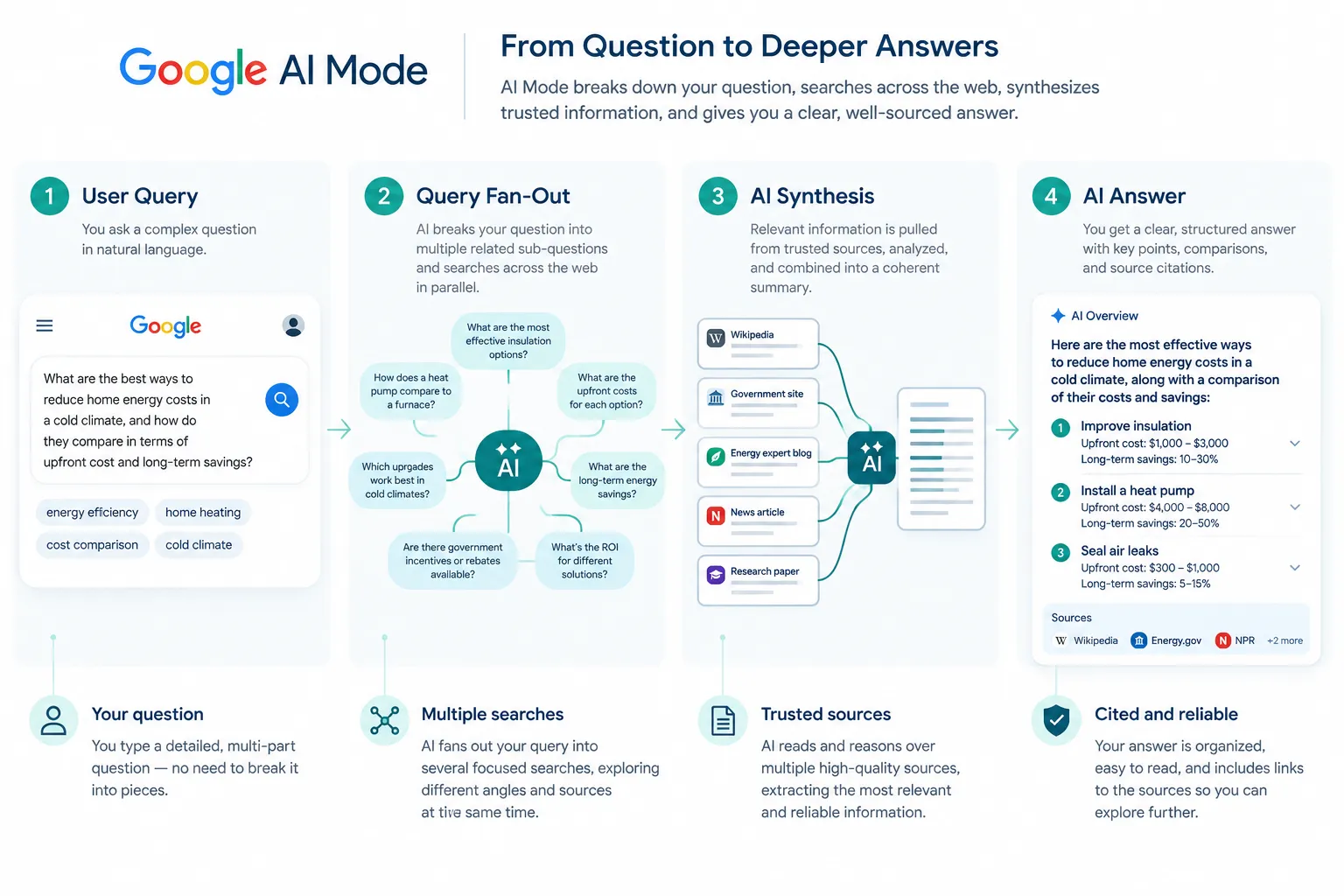
Google AI Mode is an AI-powered search experience that generates synthesized answers directly in the search results page, pulling from multiple sources rather than just listing links. It uses a process called query fan-out, where a single user query gets broken into multiple sub-questions that are researched simultaneously, then merged into one coherent answer.
Here is what makes it different from a standard featured snippet:
- Query fan-out: AI Mode doesn’t just answer your question, it anticipates follow-up questions and answers those too, all in one response
- Multi-source synthesis: Instead of pulling from one page, AI Mode blends information from several sources into a single answer
- Inline citations: Sources are cited inside the AI answer, but users often don’t click through to them
- Conversational follow-ups: Users can ask follow-up questions without starting a new search, keeping them inside the AI experience longer
Google confirmed in 2026 that AI Overviews and AI Mode use the same core ranking infrastructure as regular Search, not a separate AI model trained on different signals [9]. This matters because it means your existing SEO work still counts.
How Does Google AI Mode Affect SEO Rankings
AI Mode does not directly change your organic rankings, but it does change what happens after you rank. Your position in the traditional results stays the same, but AI Mode places a large generated answer above those results, pushing organic links further down the page [1].
The practical effect:
- Visibility without traffic: Your content can be cited inside an AI answer while your organic listing gets fewer clicks
- Zero-click growth: More users get their answer from the AI response and leave without visiting any source site
- Top-of-page real estate shrinks: Organic results that used to sit near the top now appear below AI-generated content, ads, and knowledge panels
For businesses and marketers, this means ranking #1 is still valuable, but the metric you need to watch is no longer just position. It’s whether your content is being cited inside AI answers, and whether those citations are generating any downstream traffic or brand awareness.
The Difference Between AI Mode Results and Regular Google Search
Regular Google Search returns a list of ranked links with titles, descriptions, and sometimes rich snippets. AI Mode returns a generated paragraph (or several) that directly answers the query, with small citation links embedded in the text.
| Feature | Regular Search | Google AI Mode |
|---|---|---|
| Format | Ranked link list | Generated answer + citations |
| Sources shown | Up to 10 per page | 3-8 inline citations |
| User behavior | Click to read | Read in-SERP, maybe click |
| Click-through rate | Higher | Significantly lower |
| Content requirement | Rank in top 10 | Rank + be extractable |
The key difference for SEO: in regular search, ranking gets you clicks. In AI Mode, ranking is just the entry requirement, being structured correctly is what gets you cited.
Best SEO Practices for Google AI Mode in 2026
The most effective Google AI Mode SEO strategy combines traditional ranking fundamentals with content structure changes that make your pages easier for AI systems to extract and cite.
1. Rank first, optimize second AI citations almost exclusively come from pages already ranking in the top 10-20 organic results. If your page isn’t ranking, no amount of AI-specific optimization will get you cited [9].
2. Write self-contained answer paragraphs Each section of your content should be able to stand alone as a complete answer. Avoid answers that depend on reading earlier paragraphs to make sense. AI systems pull passages, not full articles.
3. Match the exact question, not just the topic Use the precise phrasing users search for in your headings. “How does Google AI Mode work” in an H2 is more likely to be cited for that query than a heading like “Understanding the Mechanics of AI Search.”
4. Build entity authority Consistent brand mentions, author bylines with real credentials, About pages, and topical depth across your site all signal to Google that you are a credible source on a given subject. This is increasingly important for AI citation selection [6].
5. Keep answers short and direct The passages AI Mode cites tend to be 40-80 words. Long, winding explanations get skipped. Lead with the answer, then add detail.
6. Use structured data where it genuinely applies FAQ schema, HowTo schema, and Article schema help Google understand your content structure. But there is no special AI Mode schema, Google has confirmed no unique markup is required [9].
How to Get Your Content Cited in Google AI Mode Results
Getting cited in AI Mode comes down to three things: ranking, structure, and credibility. All three need to be present.
Step-by-step approach:
- Identify queries where AI Overviews already appear, use an incognito browser and search your target keywords. If AI Overviews show up, that’s your target.
- Check which pages are being cited, look at the inline citations in the AI answer. These are your direct competitors for citation.
- Analyze their content structure, are they using direct answer paragraphs? Short definitions? Step-by-step lists? Match that pattern.
- Improve your own page structure, rewrite your opening paragraphs to lead with the direct answer. Add question-based H2s that mirror real search queries.
- Build topical authority, publish related content that covers the broader topic cluster, not just one page on one keyword.
- Monitor in Search Console, Google’s AI Overviews report shows impressions for queries where your site appeared in an AI Overview [2]. Track this weekly.
One thing I’ve noticed: pages that answer the complete question, including common follow-up questions, tend to get cited more often than pages that answer only the primary query. AI Mode’s fan-out process rewards comprehensive, well-structured content.
Does Google AI Mode Hurt Traffic to Websites
Yes, for many sites it does, but the impact varies significantly by query type and industry. Google’s push toward AI Mode and expanded AI Overviews as the default search experience is pushing organic links further down the page, which reduces click-through rates for many publishers [1].
Queries most affected by traffic loss:
- Informational queries (“how does X work,” “what is Y”), these are almost fully answered inside AI Mode
- Definition and comparison queries, AI Mode handles these well without requiring a click
- Simple how-to queries, step-by-step answers appear directly in the AI response
Queries less affected:
- Commercial and transactional queries (“buy X,” “best X for Y”), users still click to compare and purchase
- Local queries, “near me” searches still drive map and listing clicks
- Brand-specific queries, users searching for your brand by name will still click through
- Complex research queries, users wanting depth still click to read the full source
The honest answer: if your traffic model depends heavily on informational content, AI Mode is compressing your click volume. The strategic response is to shift more content toward commercial intent, build direct audience relationships (email, community), and focus on being the cited source even if clicks are lower, because citations still build brand awareness.
What Content Types Rank Best in AI Mode
Short, direct, factual content with clear structure performs best in AI Mode citations. Based on patterns observed across AI Overviews and AI Mode results in 2026, these content formats get cited most frequently [7]:
- Definition paragraphs, 2-4 sentence explanations of what something is
- Numbered step lists, clear process breakdowns with one action per step
- Comparison summaries, concise “X vs Y” paragraphs with a clear conclusion
- Direct answer + reason, “The answer is X because Y” format
- FAQ-style Q&A sections, question as heading, direct answer as first sentence
Content that rarely gets cited: long narrative introductions, content with answers buried after extensive background, pages with thin topical coverage, and content that hedges every statement without reaching a clear conclusion.
Can Small Websites Rank in Google AI Mode
Small websites can absolutely get cited in AI Mode, but they need to earn it through topical focus and credibility signals, not domain authority alone. Google’s AI systems look for the most relevant and trustworthy answer for a specific query, which means a small, highly specialized site can outperform a large general site on niche topics [10].
What gives small sites a real shot:
- Deep topical focus, covering one subject area thoroughly rather than many subjects shallowly
- Clear author expertise, named authors with verifiable credentials and consistent publishing history
- Specific, niche queries, AI Mode cites the best answer, not the biggest brand, for long-tail and niche questions
- Strong on-page structure, small sites with clean, well-structured content often outperform larger sites with messy formatting
The mistake small sites make is trying to compete on broad, high-volume queries before establishing authority on narrower ones. Start specific, build credibility, then expand.
Common SEO Mistakes With Google AI Mode
Most of the mistakes I see businesses making with Google AI Mode SEO come from misunderstanding how AI citations actually work.
Mistake 1: Building “AI-specific” content that ignores ranking fundamentals If your page doesn’t rank in the top 20, AI Mode won’t cite it. Chasing AI citations without a solid organic ranking foundation is wasted effort.
Mistake 2: Ignoring content structure Publishing long, well-researched articles with no extractable answer passages. AI systems need short, self-contained paragraphs they can pull directly.
Mistake 3: Opting out of AI Overviews without understanding the tradeoff Google now allows sites to opt out of AI Overviews via Search Console controls [2]. But opting out means losing citation visibility entirely, which may hurt brand awareness even if it slightly improves click-through rates. This decision needs data, not gut feeling.
Mistake 4: Not tracking AI impression data Google Search Console shows AI Overviews impression data. Most marketers aren’t looking at it. This is free signal about where you’re appearing (or not) in AI results [2].
Mistake 5: Treating AI Mode as a separate channel It’s not. AI Mode is built on the same index and ranking systems as regular Search [9]. Optimizing for AI Mode means optimizing for Google Search, with extra attention to content structure and entity signals.
How to Track Performance in Google AI Mode
Google Search Console is currently the primary tool for tracking AI Mode and AI Overviews performance. The AI Overviews report shows impressions, meaning how often your site appeared as a citation in an AI-generated answer [2].
What you can track today:
- AI Overviews impressions (available in Search Console)
- Queries triggering AI Overviews where your site appears
- Changes in click-through rate on queries where AI Overviews are present
What you can’t track yet:
- Clicks directly from AI Mode citations (not yet reported separately)
- AI Mode-specific impression data (currently merged with AI Overviews data)
- Brand awareness impact from citations without clicks
Practical tracking setup:
- Open Google Search Console → Performance → Search type: Web
- Filter by queries where you suspect AI Overviews appear
- Compare CTR before and after AI Overviews appeared on those queries
- Track impressions vs. clicks gap, a widening gap often signals AI Overviews are absorbing attention [4]
Third-party tools like SEMrush, Ahrefs, and specialized AI search trackers are adding AI Overview tracking features, but Search Console remains the most reliable source for now.
AI Mode vs Traditional SEO: Which Matters More in 2026
Neither replaces the other, AI Mode SEO is traditional SEO with a content structure layer added on top. The ranking signals that put you in the top 10 organic results are the same signals that make you eligible for AI Mode citations [9].
Think of it this way: traditional SEO gets you to the table. Content structure and entity authority determine whether AI Mode picks your content to cite.
Where to focus your effort:
- If your organic rankings are weak → prioritize traditional SEO fundamentals (technical health, backlinks, content quality)
- If you’re ranking but not getting cited → focus on content structure, direct answer paragraphs, and entity signals
- If you’re getting cited but not getting clicks → focus on commercial content, email capture, and brand-building beyond search
The businesses that will do best in 2026 and beyond are the ones treating AI Mode visibility as an extension of their SEO strategy, not a replacement for it.
Conclusion
Google AI Mode SEO is not a new discipline, it’s an evolution of what good SEO has always required, with a sharper focus on content structure and entity credibility. The fundamentals haven’t changed: rank well, write clearly, build trust. What has changed is the outcome. Ranking now earns you a citation more often than a click, and that shift has real implications for how you measure success and build your content strategy.
Your action plan:
- Audit your top-performing pages and rewrite opening paragraphs to lead with direct answers
- Add question-based H2s that mirror the exact queries your audience searches
- Set up AI Overviews tracking in Google Search Console and review it weekly
- Identify which of your target queries trigger AI Overviews and analyze who is being cited
- Build topical depth across your site, one great page rarely outperforms a well-structured topic cluster
- Shift some content investment toward commercial and transactional intent to protect click-driven revenue
AI Mode is not going away. The search experience is moving toward answers-first, and the sites that adapt their content structure now will be the ones that maintain visibility as that shift accelerates.
Frequently Asked Questions
Does Google AI Mode use a separate ranking algorithm? No. Google has confirmed that AI Overviews and AI Mode use the same core ranking systems as regular Google Search. There is no separate AI index or AI-specific ranking algorithm [9].
Do I need special schema markup to appear in AI Mode? No special schema is required for AI Mode citations. Standard structured data (FAQ schema, Article schema, HowTo schema) can help Google understand your content, but Google has not specified any AI-only markup requirements [9].
Can I opt my website out of Google AI Mode? Yes. Google introduced new Search Console controls in 2026 that allow site owners to opt out of AI Overviews. However, opting out removes your content from AI citations entirely, which may reduce brand visibility even if it slightly improves click-through rates on organic listings [2].
How do I know if my site is being cited in AI Mode? Check Google Search Console’s AI Overviews report, which shows impressions for queries where your site appeared as a citation in an AI-generated answer [2].
Does getting cited in AI Mode improve my organic rankings? Not directly. AI citations are a result of ranking well, not a cause of it. Being cited does not appear to be a ranking signal that boosts your organic position.
What is query fan-out in Google AI Mode? Query fan-out is the process where Google’s AI breaks a single user query into multiple sub-questions, researches them simultaneously, and combines the answers into one synthesized response. Content that answers the main question plus common follow-up questions is more likely to be cited.
Is Google AI Mode available in India? Google has been expanding AI Overviews and AI Mode globally throughout 2026. Availability varies by region and query type. Check Google’s official announcements for the latest rollout status in specific markets.
How long does it take to start appearing in AI Mode citations? There is no fixed timeline. If your page already ranks in the top 10-20 results and has well-structured, extractable content, it can be cited as soon as AI Overviews start appearing for that query. Improving content structure on existing ranking pages is the fastest path to citations.
References
[1] Google Pushes Organic Results Further Down, https://www.geo.tv/latest/679784-google-pushes-organic-results-further-down-heres-everything-publishers-should-know
[2] New Controls for Website Owners, https://blog.google/products-and-platforms/products/search/new-controls-website-owners/
[4] Key SEO and AI News for August 2026, https://www.seopress.org/newsroom/seo-news/august-2026/
[6] Key SEO and AI News for August 2026, https://www.marketingminer.com/en/blog/key-seo-and-ai-news-for-august-2026
[7] August 2026 Google Algorithm and Search Industry Updates, https://www.impressiondigital.com/blog/august-2026-google-algorithm-and-search-industry-updates/
[9] Google’s 2026 SEO Guidance: AI Overviews Use Core Ranking Systems, https://pressfrolic.com/ai-search-optimization/googles-2026-seo-guidance-ai-overviews-use-core-ranking-systems/
[10] AI SEO 2026: What Changed in August and How to Adapt, https://www.linkedin.com/pulse/ai-seo-2026-what-changed-august-how-adapt-your-search-saurabh-anand-twhac
🔍 AI Mode Citation Readiness Checker
Check how ready your page is to be cited in Google AI Mode results.