

Last updated: October 20, 2026
Quick Answer
Digital marketing for builders works best as a layered system: local SEO and Google Business Profile for people actively searching, paid search and Local Services Ads for fast visibility, and Meta or Instagram for demand creation among people who haven’t started searching yet. Builders who combine these channels and follow up fast on inquiries generate roughly three times more leads per dollar than those relying only on mailers and trade shows.[1] The real differentiator in 2026 isn’t which channel you pick, it’s whether you qualify leads properly and respond within minutes instead of days.
Key Takeaways
- A qualified construction lead has budget, timeline, decision-making authority, and a project that matches your crew’s capability, not just a name and phone number.
- Digital channels now outperform traditional marketing by roughly 3x in lead efficiency, with search and local SEO taking the biggest share of budget.[1][2]
- Cost per lead varies widely: $15,$85 on Angi, flat $499/month on Houzz, about 2.5% commission on BuildZoom, and $150,$600+ on Google Ads for competitive trades.[3][4]
- Google Search and Local Services Ads dominate small jobs; Meta and Instagram drive awareness for custom builds and large remodels; commercial work still runs through bid boards and GC relationships.[5][6]
- Most builders who “aren’t getting leads” have a broken Google Business Profile, no review strategy, or a website that doesn’t load fast on mobile.
- Speed-to-lead matters: automated alerts that notify estimators within seconds of an inquiry reduce drop-off significantly.[7]
- Small and mid-size contractors doing under 10 projects a month can often manage digital marketing in-house; firms scaling past that usually need a dedicated agency or specialist.
- GA4 connected to a CRM like HubSpot, Procore, or Salesforce shows which channels actually produce booked projects, not just clicks.[8]
What Makes a Construction Lead Qualified
A qualified construction lead has four things: a real project, a realistic budget, a decision-maker on the line, and a timeline that fits your crew’s availability. Without all four, you’re spending time on tire-kickers.
Here’s a practical filter builders can use before any sales call:
- Project fit: Does the scope match what you actually build (custom homes, remodels, commercial fit-outs)?
- Budget alignment: Has the prospect given a number, even a range, that’s realistic for the work described?
- Authority: Are you talking to the homeowner or decision-maker, or a renter/relative gathering quotes for someone else?
- Timeline: Is the project starting in the next 3-6 months, or just “someday”?
A lead who fills out a form at midnight asking for a “ballpark price” on a kitchen remodel with no address or budget is not qualified yet. A lead who calls after viewing three of your past projects on Instagram and asks for a site visit next week is much closer to ready.
Common mistake: treating every form submission as sales-ready. Builders who skip qualification waste estimator hours chasing people who were never going to hire anyone this year.
Best Digital Marketing Channels for Getting Construction Leads
The best channel depends on job size and whether the buyer is actively searching or just scrolling. There’s no single “best” channel, there’s a right channel for each stage of demand.
| Channel | Best for | Role |
|---|---|---|
| Google Search / SEO | Small jobs, large remodels | Primary source |
| Google Local Services Ads | Small jobs | Primary, supporting for remodels |
| Meta / Instagram | Custom builds, large remodels | Primary demand creation |
| Bid boards (Dodge, BidClerk) | Commercial work | Primary |
| Referrals / Google Business Profile reviews | All segments | Ongoing trust signal |
Residential builders typically see Google Search and Local Services Ads carry the “ready to buy” traffic, while Meta and Instagram build awareness among people who haven’t started searching.[5] Commercial contractors still depend heavily on plan rooms and general-contractor relationships rather than paid social.[3][6]
Decision rule: choose local SEO and Google Business Profile first if you’re a general contractor doing residential work in one metro area. Choose bid boards and LinkedIn outreach first if you’re bidding commercial contracts over $500,000.
If you want a deeper framework for turning content into consistent inquiries, this content strategy guide for lead generation walks through the planning side of this.
How Much Does It Cost to Generate Construction Leads
Cost depends heavily on platform and trade, ranging from under $20 per lead on marketplaces like Angi to $600+ per lead on competitive Google Ads keywords. There’s no flat industry number, the real question is cost per booked project, not cost per lead.
2026 benchmarks show this spread clearly:[3][4]
- Angi: roughly $15,$85 per lead
- Houzz: flat $499/month subscription, no per-lead fee
- BuildZoom: about 2.5% commission on won projects
- Google Ads (residential): $150,$600+ per lead in competitive metros
- Bid boards (Dodge, BidClerk, regional plan rooms): $120,$400 per lead, with 1-2 week cycle times
Example: a kitchen remodeler in a mid-size city might pay $200 per Google Ads lead but close 1 in 4, landing a $15,000 project for roughly $800 in ad spend, a strong return. A commercial contractor paying $300 per bid-board lead but closing 1 in 15 on a $2 million project still comes out ahead because the deal size dwarfs the acquisition cost.
Why Am I Not Getting Leads as a Builder
Most builders without leads have a broken or neglected Google Business Profile, a slow website, or zero recent reviews, not a “marketing isn’t working” problem. Fix the foundation before blaming the channel.
Check these in order:
- Google Business Profile: Is it claimed, verified, and updated with photos from the last 90 days?
- Reviews: Do you have at least 15-20 recent, detailed reviews? Prospects skip profiles with under 10.
- Website speed and mobile usability: Does it load in under 3 seconds on a phone?
- Contact friction: Can someone call or message you in one tap, or do they have to fill out a five-field form?
- Service area pages: Do you have a page for each city or neighborhood you actually serve, or just one generic “about us” page?
Local SEO and GBP management are now considered non-negotiable for general contractors trying to show up in local search and the map pack.[3] Builders skipping this step are invisible no matter how much they spend on ads.
Google Ads vs Facebook Ads for Construction Lead Generation
Google Ads captures people already searching for a builder; Facebook (Meta) and Instagram create demand among people who haven’t started looking yet. Use Google Ads for immediate bookings and Meta for pipeline-building over months.
Google Ads pros:
- High intent, people are searching “kitchen remodel contractor near me”
- Faster conversion to booked calls
- Works well for small jobs and repairs
Google Ads cons:
- Expensive in competitive metros ($150,$600+ per lead)[4]
- Requires ongoing bid management
Meta/Instagram pros:
- Great for showcasing finished custom builds and large remodels visually
- Lower cost per click, good for brand awareness
- Works well for homeowners not yet actively searching[5]
Meta/Instagram cons:
- Longer sales cycle before someone converts
- Needs strong visual content (photos, before/after, video walkthroughs)
Decision rule: choose Google Ads if you need bookings this month. Choose Meta/Instagram if you’re building a 6-12 month pipeline of custom build or large remodel clients.
How to Qualify Construction Leads Before Following Up
Qualify a lead by confirming project scope, budget range, timeline, and decision-making authority before scheduling a site visit or sending a detailed quote. Skipping this step wastes estimator hours on people who were never close to hiring.
A simple qualification script for inbound calls or forms:
- Ask what the project involves in their own words (not just “remodel”)
- Ask for a rough budget range, even “$20k to $40k” is useful
- Confirm who’s making the final decision
- Ask when they want the project to start
- Ask if they’ve gotten other quotes yet (tells you where you stand in the buying process)
Edge case: commercial leads often can’t share budget early due to procurement rules. In that case, qualify on project scope, RFP timeline, and whether you’re on the approved bidder list instead.
What’s the Average Cost Per Lead for Home Builders
Home builders typically see cost per lead land between $150 and $400 on paid search, and lower (often under $100) on local marketplaces like Angi, depending on market competitiveness and project size. Custom home builders in high-demand metros often pay more because fewer qualified leads exist per search.
Rural or smaller-market builders generally pay less per lead but also see lower search volume, meaning total lead count stays lower even with efficient spend.
Common Mistakes Builders Make With Digital Marketing
The biggest mistake is treating digital marketing as a one-time project instead of an ongoing system that needs monthly attention. Builders who “set it and forget it” lose visibility within a few months.

Other frequent mistakes:
- No follow-up system: leads go cold because no one calls back within the hour
- Ignoring Google Business Profile: letting it sit unclaimed or outdated
- Mixing budgets across unrelated channels: spending evenly on Google, Meta, and print without tracking what actually books jobs
- No landing pages: sending ad traffic to a generic homepage instead of a page built for that specific service or city
- Treating all leads the same: a commercial RFP and a $5,000 repair job need completely different sales processes
If budget management across channels feels overwhelming, this guide on spending smarter across multiple marketing channels is worth a read before increasing ad spend further.
How Long Does It Take to Start Getting Construction Leads
Paid ads can generate leads within days, but local SEO and organic visibility usually take 3 to 6 months to produce consistent, lower-cost leads. Builders wanting fast volume should start with paid search or Local Services Ads while SEO builds in the background.
A realistic timeline:
- Week 1-2: Google Ads and Local Services Ads can start producing calls almost immediately once set up correctly
- Month 1-3: Google Business Profile optimization and review growth start improving local map pack visibility
- Month 3-6: Organic SEO rankings begin climbing for service and city pages
- Month 6+: Organic traffic typically becomes the lowest-cost, highest-volume lead source
Common mistake: expecting SEO to replace paid ads within the first month. SEO is a compounding asset, not a quick fix.
Which Lead Generation Services Work Best for Contractors
Marketplace services like Angi, Houzz, and BuildZoom work well for contractors wanting volume without managing their own ads, while owned channels (website, GBP, email) work better for long-term cost efficiency. Most successful builders use both, not one or the other.
- Choose Angi or Thumbtack if you want fast volume and don’t mind per-lead fees
- Choose Houzz if you do design-focused remodels and want flat-fee predictability
- Choose BuildZoom if you’re comfortable with commission-based pricing on won work
- Build your own SEO and GBP presence regardless of marketplace use, because it reduces long-term dependency on paid platforms
Email nurture also plays a role for leads that aren’t ready yet. A solid email marketing foundation keeps warm leads engaged until they’re ready to book.
What Size Contractor Needs Professional Lead Generation
Contractors handling fewer than 5-10 active projects a month can often manage basic digital marketing in-house, while firms scaling past that volume usually benefit from a dedicated agency or in-house marketing hire. The tipping point is less about revenue and more about time, once the owner or office manager can’t keep up with ads, reviews, and content, it’s time to outsource.
If outsourcing SEO specifically feels like the right move, this breakdown on how to outsource your SEO marketing covers what to look for in a provider and what to avoid.
How to Set Up a Construction Lead Generation Funnel
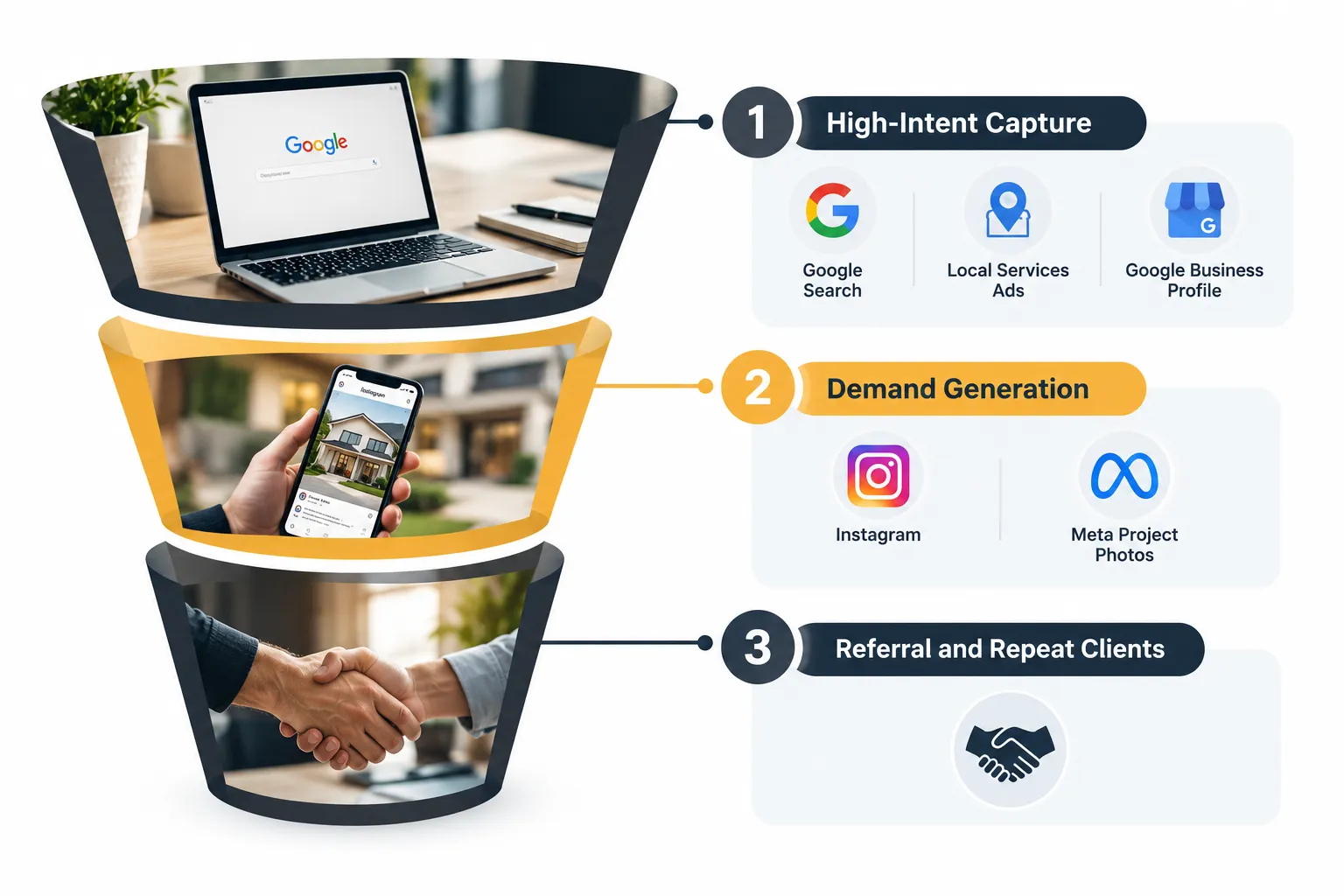
A construction lead funnel has three layers: high-intent capture (Google Search, Local Services Ads, GBP), demand generation (Meta, Instagram with project visuals), and referral/repeat client programs for larger work.[5][6][9]
Step-by-step setup:
- Claim and optimize Google Business Profile with service areas, photos, and regular posts
- Build service-specific landing pages for each major offering and city you serve
- Launch Google Ads or Local Services Ads targeting high-intent search terms
- Run Meta/Instagram campaigns showcasing finished projects to build awareness
- Connect GA4 to your CRM (HubSpot, Procore, Salesforce) to track which source produces booked jobs, not just form fills[8]
- Set up automated speed-to-lead alerts so estimators get notified within seconds of a new inquiry[7]
- Build a referral and review request system for every completed project
This matches how AI-driven search and chat tools are starting to summarize contractor information too, structured data and clear service pages help builders show up correctly when people ask AI tools for recommendations.[7][9]
Are Construction Leads Worth the Cost
Yes, for most builders, paid leads are worth the cost when the average project value is at least 10-15 times the cost per lead and close rates stay above 15-20%. Below that ratio, paid lead generation often isn’t sustainable without heavy reliance on repeat business and referrals.
Run this quick math before committing budget:
- Average project value ÷ cost per lead = should be 10x or higher
- Close rate below 10% usually means a qualification problem, not a lead-quality problem
- If referrals already fill your calendar, paid leads may only be worth it during slow seasons
How to Follow Up With Construction Leads to Close More Deals
Follow up within minutes on inbound inquiries, and commit to 8-12 touchpoints across phone, email, and LinkedIn for larger projects before giving up. Builders who respond fast consistently close more work than those who wait a day or two.
A practical follow-up cadence:
- Minute 1-5: automated text or call confirming receipt of inquiry
- Hour 1: personal call from an estimator
- Day 1: email recap with next steps and rough pricing range
- Day 3, 7, 14: follow-up touches if no response
- Week 3-6: for commercial deals, shift to LinkedIn outreach and proposal check-ins
Commercial construction sales cycles are long, and guidance in 2026 stresses qualifying prospects before scheduling site visits, then following up 8-12 times after sending a proposal.[10][11] Giving up after two attempts is the single most common reason qualified leads go cold.
For a broader customer acquisition lens on this, demand marketing as an acquisition strategy explains how nurture sequences fit into longer buying cycles like commercial construction.
FAQ
What makes a construction lead “qualified” versus just a contact? A qualified lead has a real project, realistic budget, decision-making authority, and a timeline within the next few months, not just contact information.
Is SEO or paid ads better for builders? Paid ads work faster for immediate bookings; SEO becomes the lower-cost, higher-volume channel after 3-6 months. Most builders need both.
How much should a small contractor budget for digital marketing monthly? There’s no universal number, but many small residential contractors allocate a meaningful share of revenue to local SEO, GBP management, and modest paid ad spend rather than one large campaign.
Do commercial contractors need social media marketing? Not usually as a primary channel. Commercial work relies more on bid boards, plan rooms, and GC relationships, with LinkedIn useful for relationship-building.[3][6]
What’s the fastest way to get leads as a new builder with no reviews? Start with Local Services Ads and ask every early client for a detailed review immediately after project completion, reviews compound trust fast.
Should I use Angi, Houzz, or build my own website first? Build your own website and GBP presence first since it’s a long-term asset, then add marketplaces like Angi or Houzz for volume on top.
How do I know if my marketing spend is actually working? Connect GA4 to your CRM so you can trace which channel, keyword, or landing page produced leads that actually turned into booked projects.[8]
Conclusion
Generating qualified construction leads in 2026 isn’t about picking one magic channel, it’s about building a system where high-intent search, demand-building social content, and disciplined follow-up all work together. Builders who treat Google Business Profile, local SEO, and speed-to-lead as daily habits consistently outperform those chasing the next shiny ad platform.
Start small: fix your Google Business Profile this week, set up one qualification script for inbound calls, and track every lead source in a simple spreadsheet or CRM for 90 days. Once you see which channel actually produces booked projects, double down there before adding anything new.
References
- Construction. levyonline.com.
- Residential Construction Marketing. buildern.com.
- Construction Leads 2026. pipelineon.com.
- Lead Generation for Construction Companies. tomba.io.
- Builder Marketing System. peloramarketing.com.
- Construction. cufinder.io.
- Construction Lead Generation. theedigital.com.
- Marketing for Construction Companies. sixthcitymarketing.com.
- Digital Marketing for Contractors. percepture.com.
- Generate More Leads for Construction. abstraktmg.com.
- 2026 Contractor Marketing Tips. footbridgemedia.com.