
Last updated: October 22, 2026
Quick Answer
Google AI Overviews Link Visibility in 2026 depends on how well your content answers a question directly, how clearly it’s structured, and whether Google trusts it enough to insert as an inline citation inside the generated answer. Since the May, June 2026 interface changes, inline links now sit inside the answer text itself, not just in a side panel, which means getting cited can send real traffic, though clicks remain lower than classic blue-link rankings [1][2].
Key Takeaways
- AI Overviews now appear on a large share of informational queries in the US, and inline citations sit directly inside the generated text after 2026 redesign changes [1][3].
- Click-through rates from AI Overviews are still lower than traditional search results, though 2026 data shows a modest recovery compared to 2025 [2][3].
- Google has stated there’s no special technical trick for AI Overviews SEO, unique, people-first, well-structured content remains the foundation [4].
- Citations differ from simple brand mentions; being named without a clickable link provides far less value [5].
- Being indexed in Google Search is a basic requirement, but indexing alone doesn’t guarantee a citation slot.
- Fresh, well-organized content with a clear direct-answer paragraph near the top performs better in citation selection [1][4].
- Some industries, health, finance, and local business, see heavier AI Overview presence and stricter sourcing standards [6][7].
- You can’t fully opt out of appearing in AI Overviews unless you block Googlebot entirely, which also removes you from regular search [8].
What Exactly Are Google AI Overviews and How Do They Differ From Regular Search Results
Google AI Overviews are AI-generated summary boxes that appear above or within regular search results, pulling information from multiple web pages and compressing it into a short answer with inline source links [4]. Regular search results, by contrast, just list ranked pages without synthesizing an answer.
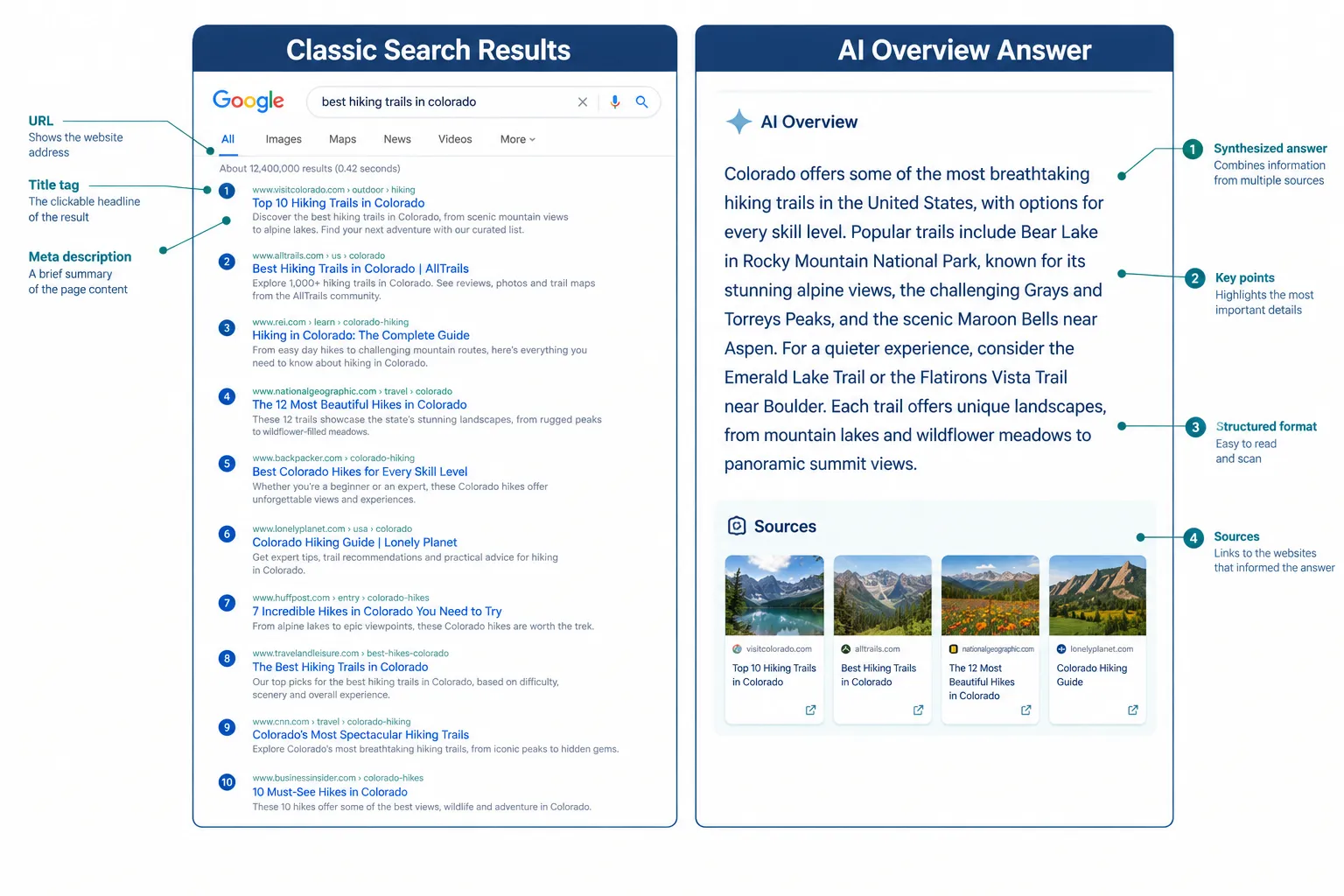
The core difference is intent. A classic result expects the user to click through and read. An AI Overview tries to answer the question right there on the results page, using snippets pulled from several sources at once. Google’s own documentation confirms there’s no separate ranking system for AI features, pages still need to meet standard quality and helpfulness guidelines to be eligible for inclusion [4].
Example: search “best time to water plants in summer,” and instead of ten links, you’ll likely see a short synthesized answer citing two or three gardening sites with inline chevrons next to specific claims.
How Do Inline Citations Work in Google AI Overviews
Inline citations are small numbered markers or chevron icons embedded directly within the AI-generated answer text, linking to the specific source page that supports that sentence or claim [5][9]. This is different from older AI Overview formats where sources sat only in a separate footer or side panel.
After the May 2026 update, Google restructured these citation elements to make them more visible and clickable within the flow of the answer itself [1]. Key mechanics to understand:
- Each citation links to one specific URL, not just a domain.
- A single answer can cite multiple sources across different sentences.
- Source panels below the main answer still exist, but inline markers now carry more weight visually.
- Subscription-gated or paywalled content sometimes gets a visible label, which can reduce click willingness [9].
If a paragraph makes three distinct factual claims, Google may cite three different pages, spreading citation value across competitors rather than handing it to one dominant source.
Why Isn’t My Website Getting Cited in Google AI Overviews
Most websites miss out on citations because their content doesn’t answer the question clearly within the first few sentences, or because the page lacks the structural signals Google’s systems use to extract quotable passages. This is a formatting and clarity problem more often than a technical SEO problem.
Common reasons for exclusion:
- The page buries the answer under a long introduction instead of stating it upfront.
- Headings don’t match how people actually phrase questions.
- The content is thin, generic, or duplicates what dozens of other sites already say.
- The page isn’t properly indexed, or it has crawl errors blocking access.
- There’s no clear authorship or topical depth signaling expertise.
Decision rule: if your top organic competitors for a query have numbered steps, tables, or direct-answer boxes and your page is a wall of text, that’s usually the first thing to fix.
What Type of Content Gets the Most Citations in AI Overviews
Content that leads with a direct, specific answer and then backs it up with clear structure, lists, steps, short definitions, and comparison data, earns the most inline citations. Google’s official guidance repeatedly points toward “people-first,” well-organized, and recently updated pages as the preferred source type [4].
Patterns that tend to win citation slots:
- Original data, surveys, or tool comparisons that can’t be found verbatim elsewhere.
- How-to guides with numbered steps.
- Glossary-style definitions answered in one or two sentences.
- Pages updated recently, with a visible “last updated” date.
- Clear author bios showing subject expertise, especially for health, finance, and legal topics.
If you’re also curious how AI Mode differs from AI Overviews in terms of citation behavior, this comparison of Google AI Mode vs AI Overviews breaks down the format differences in detail.
Do AI Overview Citations Actually Drive More Clicks to Your Site
Yes, but less reliably than a top-three classic ranking position. Industry tracking through 2026 shows click-through rates from AI Overviews recovering slightly compared to 2025, but still sitting below what the same position would generate in traditional blue-link results [2][3].
Why clicks stay shallow even with a citation:
- Many users get their answer directly from the overview and never scroll to sources.
- Multiple competing sources dilute attention across several links instead of one.
- Mobile users especially tend to treat the AI answer as the final stop.
That said, a citation still carries brand visibility value even without a click, appearing as a trusted source repeatedly can build recognition over time, similar to how zero-click SEO strategies already work for featured snippets and knowledge panels.
How Do I Optimize My Content to Earn More Inline Citations
Optimizing for inline citations means restructuring content so the most useful sentence appears first, followed by supporting detail Google’s systems can lift cleanly without losing context. This is less about keyword density and more about answer clarity.
Practical steps, in order:
- Open every major section with a two-to-three sentence direct answer.
- Use question-style subheadings that mirror how people actually search.
- Break long explanations into short bullets or numbered steps.
- Add a comparison table where relevant, tables are easy for AI systems to extract cleanly.
- Keep paragraphs short enough to stand alone if quoted out of context.
- Update the page regularly and show a visible last-updated date.
- Add schema markup where applicable to reinforce page structure.
For a broader framework on this approach, see this guide on Google AI Mode SEO: How to Rank and Get Cited in 2026, which covers related tactics for AI-driven search surfaces.
Does My Site Need to Be Indexed in Google Search to Appear in AI Overviews
Yes. A page must be crawlable and indexed in regular Google Search before it can ever be considered for an AI Overview citation [4][8]. Indexing is the baseline requirement, not a guarantee.
Once indexed, a page still competes on quality signals, helpfulness, structure, freshness, and topical authority, to actually get selected as a citation source. If your page isn’t showing up in regular search results at all, fixing AI Overview visibility should wait until basic indexing and crawlability issues are resolved first. Checking your Google Search Console’s AI performance report is a practical first move to confirm whether Google is even seeing your pages as eligible.
What’s the Difference Between AI Overview Link Visibility and Featured Snippets
Featured snippets pull one single passage from one page and display it in a boxed answer above regular results, while AI Overviews synthesize information from multiple pages into one generated paragraph with several inline citations [6][7]. A featured snippet gives one site the spotlight; an AI Overview usually spreads citation credit across two to five sources.
Another key difference: featured snippets have existed since 2014 and follow fairly predictable extraction rules. AI Overviews are newer, more dynamic, and change their selected sources more frequently based on freshness and query interpretation. For a deeper breakdown of how these formats fit into the broader AI search landscape, see SEO vs GEO vs AEO in 2026.
Are There Any Industries Where AI Overviews Citations Matter More
Yes. Health, finance, legal, and local business queries see heavier AI Overview coverage and stricter sourcing standards because Google applies tighter quality checks to topics that affect money, safety, or wellbeing [6][7]. Brand-name searches have also seen a sharp rise in AI Overview triggering through 2026 [10].
Industries where citation visibility carries extra weight:
- Health and medical information (YMYL content faces stricter author-expertise checks).
- Personal finance and investing guidance.
- Local services, where Google Business Profile data often feeds directly into AI answers, covered in this Google Business Profile optimization guide for AI search.
- Ecommerce product research queries, especially comparison searches.
What Are the Common Mistakes People Make When Trying to Get AI Overview Citations
The biggest mistake is chasing AI Overview citations as a separate project instead of fixing the underlying content clarity and structure that both traditional SEO and AI systems reward. Treating this as a trick rather than a quality fix usually backfires.
Other frequent mistakes:
- Stuffing keywords instead of answering the question plainly.
- Ignoring freshness, letting outdated content sit without updates.
- Publishing thin pages with no original insight or data.
- Forgetting to monitor backlink and citation sources, which tools covered in top SEO tools for monitoring backlinks can help track.
- Not tracking actual AI visibility performance at all, see how to track AI visibility for a practical starting point.
Can You Opt Out of Appearing in Google AI Overviews
Partially, but it comes at a cost. Google doesn’t offer a standalone toggle to appear in regular search while being excluded only from AI Overviews; blocking the “nocache” or similar directives, or disallowing Googlebot entirely, removes your content from AI features but also limits how it appears across broader search surfaces [8].
For most publishers, opting out isn’t worth the trade-off since it also affects general visibility and featured snippet eligibility.
How Often Do the Websites and Citations in AI Overviews Change
Citations rotate fairly often, especially for competitive or frequently updated topics, since Google continuously re-evaluates freshness and relevance signals. The May, June 2026 interface changes also reshuffled how citations display, making turnover more noticeable to site owners tracking their inline link presence [1].
Expect citation sources to shift when:
- A competing page publishes updated statistics or a more recent date stamp.
- Google refines how it interprets a query’s intent.
- A page loses indexing or crawl access temporarily.
Is Getting Cited in AI Overviews Worth the Effort Compared to Regular Ranking
For most sites, yes, as a complement to traditional ranking, not a replacement. Classic top-three rankings still generally produce more reliable clicks than an AI Overview citation alone, based on 2026 click-through comparisons [2][3].
Choose to prioritize AI Overview optimization if:
- Your topic area already triggers AI Overviews heavily (health, finance, how-to, local).
- You already rank reasonably well organically and want added visibility layers.
- Brand recognition value matters as much as direct clicks for your business goals.
Rely mainly on classic SEO fundamentals if your query space rarely triggers AI Overviews or if direct conversion-driven clicks matter more than visibility alone. Pairing both approaches, alongside broader tactics from multi-channel marketing: don’t spend more, spend smarter, tends to produce the most balanced results.
Do Ecommerce Sites Get Treated Differently for AI Overview Citations
Yes, to some extent. Product research and comparison queries often pull in structured data like pricing, availability, and reviews, meaning ecommerce pages with clean schema markup and updated product details have an edge in citation selection [7].
Practical considerations for ecommerce:
- Keep product schema, pricing, and stock status current.
- Add clear comparison tables for similar products.
- Maintain genuine customer reviews, since review signals often feed into AI-generated comparisons.
- Answer the core question in the first two sentences of each section
- Use question-based subheadings matching real search phrasing
- Add at least one table or numbered list per major topic
- Keep content updated with a visible last-updated date
- Confirm indexing and crawlability through Search Console
- Add author credentials for YMYL topics
FAQ
What is an inline citation in Google AI Overviews?
It’s a small numbered or chevron marker embedded within the AI-generated answer text that links directly to the specific source page supporting that sentence [9].
Does Google have a separate ranking algorithm for AI Overviews? No. Google states there’s no distinct technical SEO process for AI features; standard quality and helpfulness guidelines apply [4].
Why do AI Overview clicks convert less than organic clicks? Many users treat the AI-generated answer as sufficient and never scroll to the cited sources, especially on mobile [2][3].
Can a page appear in AI Overviews without ranking well organically? It’s uncommon. Strong organic visibility usually correlates with citation eligibility, since both depend on similar quality signals.
How many sources typically get cited in one AI Overview answer? It varies by query, but answers commonly cite between two and five different source pages [5].
Do schema markup and structured data help with citations? Yes, particularly for product, how-to, and FAQ content, since structured data makes extraction more reliable for AI systems.
Is AI Overview visibility the same across all countries? No. Coverage and trigger rates vary by market and language, with the US showing some of the heaviest AI Overview presence through 2026 [3].
Should small businesses worry about AI Overview citations? Local business owners should, especially since Google Business Profile data increasingly feeds local AI-generated answers.
Conclusion
Earning Google AI Overviews link visibility in 2026 comes down to a simple discipline: answer the question clearly, structure the page so Google can lift a clean quote from it, and keep the content current. The May, June 2026 interface changes made inline citations more visible than ever, which raises the stakes for pages that already do the basics well.
Start by auditing your top-performing pages against the checklist above, confirm they’re indexed and crawlable, and restructure at least one key page this month to lead with a direct answer. Then track results through Search Console’s AI performance data and adjust from there. This is a grow-at-your-own-pace process, not a one-time fix, and treating it that way will serve you better long term than chasing shortcuts.
References
- Google AI Overviews Link Updates May 2026. seohandbook.co.uk.
- AI Overviews AI Mode Click Through 2026. theblogtimer.com.
- Google AI Overviews Statistics. cognizo.ai.
- AI Features. developers.google.com.
- Citations vs. Mentions Chatgpt Perplexity AI Overviews. deepsmith.ai.
- AI Overviews. seohandbook.co.uk.
- AI Overviews. seo.com.
- Updates AI Mode Overviews Explore Web. google.
- Google AI Overviews Inline Citations 5 Changes Brand Visibility. berecommended.com.
- Googles AI Overviews Roughly Tripled on Brand Name Searches in September. marketscale.com.