

Last updated: October 20, 2026
Most marketing teams argue about this without realizing they are solving two different problems. One team wants more leads next quarter. The other wants a business that keeps growing on its own, month after month. That mismatch is exactly why growth marketing vs demand generation keeps coming up in hiring meetings, budget reviews and LinkedIn debates.
Quick Answer
Demand generation is about creating awareness and buyer intent so sales has pipeline to work with, it mostly owns the top and middle of the funnel [1][2]. Growth marketing is a wider, experiment-driven discipline that owns the entire customer journey, from the first click to renewal and referral [3][4]. If you need pipeline fast, prioritize demand gen. If you need a business that compounds over time, you need growth marketing, and most mature companies eventually need both.
Key Takeaways
- Demand generation asks “how do we create pipeline?” Growth marketing asks “how do we build a business that compounds?” [1]
- Demand gen is often treated as a subset of growth marketing, feeding the top of a bigger funnel [3][5].
- Core demand gen KPIs: MQLs, SQLs, pipeline value, CPL, and MQL-to-SQL conversion rate [4][6][7].
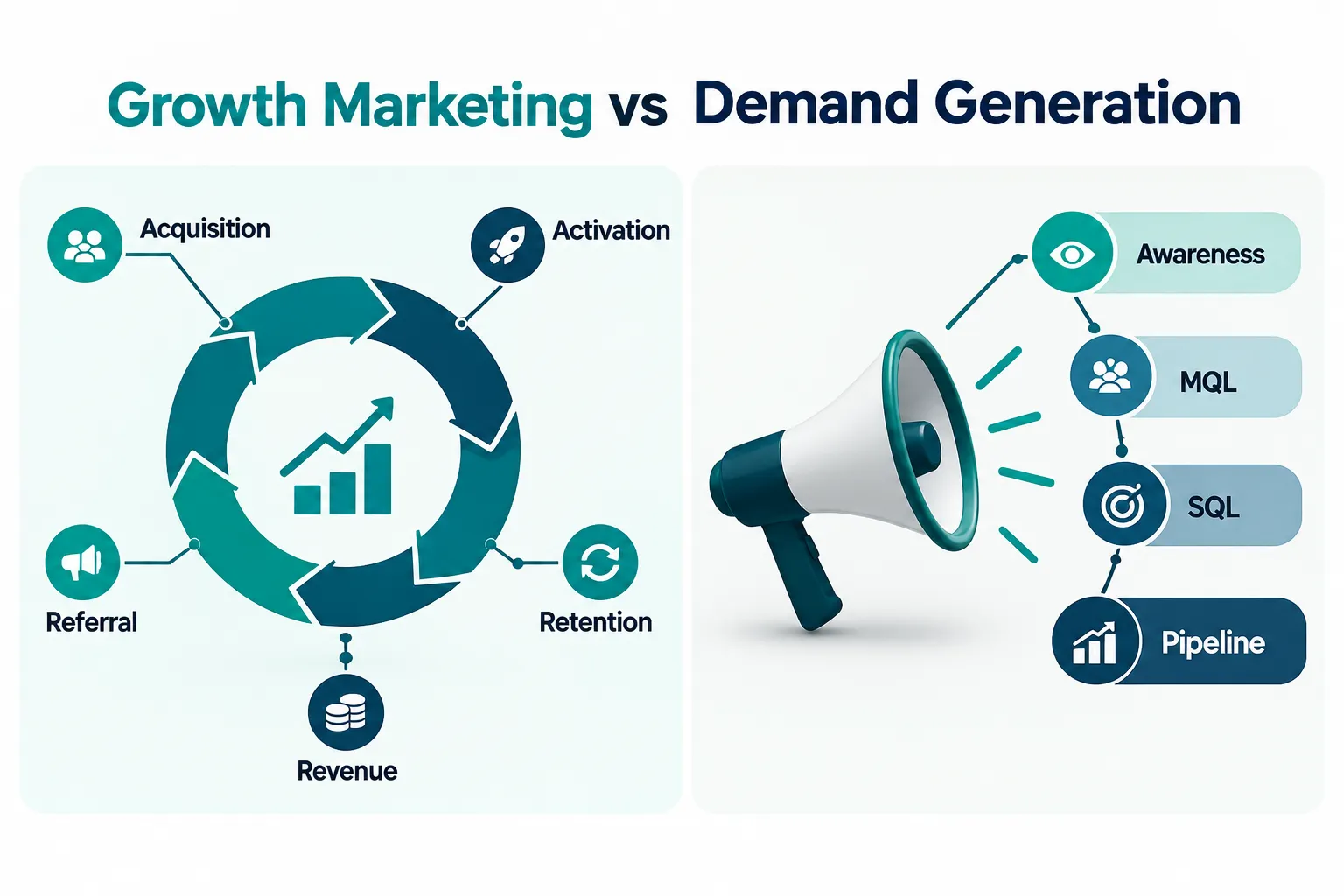
- Core growth marketing KPIs follow the AAARRR framework: Acquisition, Activation, Retention, Revenue, Referral [2][4][8].
- Startups with no product-market fit should lean demand gen first; product-led businesses need growth marketing early [2][3].
- You can run both at once, but they need shared definitions of a “qualified lead” or conflict is guaranteed [4][6].
- Demand generation is not exclusive to B2B, B2C subscription and e-commerce brands use it too, just with different channels [2][5].
- Tooling overlaps (CRM, analytics) but growth teams add experimentation platforms; demand gen teams lean on ABM and content tools [7][9].
What’s the Actual Difference Between Growth Marketing and Demand Generation
Demand generation focuses on creating awareness and purchase intent among people who are not yet customers, mainly at the top and middle of the funnel. Growth marketing is broader, it owns acquisition, activation, retention, expansion and referral across the whole customer lifecycle [1][2][4].
Think of it this way: demand gen fills the pipeline. Growth marketing decides what happens to everyone after they enter that pipeline, including what keeps them paying, upgrading or recommending you to someone else.
A simple way I explain this to students in workshops: demand gen is a campaign discipline, growth marketing is a systems discipline. Demand gen teams plan a webinar series or an ABM push. Growth teams run constant experiments on onboarding flows, pricing pages and retention emails, and they treat every change as a test, not a one-time campaign [2][8].
Decision rule: if your main problem is “we don’t have enough leads,” you have a demand generation problem. If your problem is “we get signups but they churn,” that’s a growth marketing problem.
When Should I Choose Growth Marketing vs Demand Generation for My Business
Choose demand generation when your priority is building a sales pipeline and you sell through a sales team with a defined buying committee. Choose growth marketing when your business runs on self-serve signups, trials or subscriptions and survival depends on activation and retention, not just leads [2][3].
Use this quick guide:
| Situation | Better fit |
|---|---|
| Long B2B sales cycle, enterprise deals | Demand generation |
| Self-serve SaaS or app with free trial | Growth marketing |
| New product, no proven retention yet | Growth marketing (fix activation first) |
| Established pipeline needs but weak awareness | Demand generation |
| Subscription box or consumer app | Growth marketing |
Common mistake: companies hire a “demand gen manager” expecting them to also fix churn and onboarding. Those are different skill sets. Demand gen specialists are usually strong in content, paid media and ABM, not product analytics or lifecycle experimentation [6][8].
What KPIs Matter Most for Growth Marketing
Growth marketing KPIs are built around the AAARRR framework, Acquisition, Activation, Retention, Revenue, Referral, often called pirate metrics [2][4][8]. These numbers track the whole growth loop, not just how many people show up.
The metrics growth teams watch most:
- Customer lifetime value (CLV)
- Churn rate and retention rate by cohort
- Activation rate (percentage of new users reaching a key “aha” action)
- Net revenue retention (NRR)
- LTV:CAC ratio
- Total revenue growth over time [4][6][8]
Growth teams run constant A/B tests and cohort analysis to move these numbers, rather than relying on one big campaign [4][8]. A common edge case: a product with high acquisition but low activation will look fine on paid media dashboards while quietly losing money, because nobody is watching activation rate closely enough.
What Are the Key Metrics to Track in Demand Generation
Demand generation success is measured by how much qualified pipeline a campaign produces, not just traffic or impressions. The standard metric set includes MQLs, SQLs, pipeline value, and cost efficiency per lead [4][6][7].
Metrics demand gen teams report on:
- Marketing Qualified Leads (MQLs) and Sales Qualified Leads (SQLs) [4][6][7]
- Pipeline created and pipeline influenced, both volume and dollar value [4]
- MQL to SQL conversion rate and lead-to-close velocity [4][6]
- Cost per lead (CPL) and cost per acquisition (CPA) [6][7]
- Website traffic and engagement tied back to specific campaigns [2][6]
Content Marketing Institute’s 2026 analysis flags a real risk here: teams that only report MQL counts, without tracking pipeline velocity or revenue, end up disconnected from sales and finance, and the whole program looks “broken” even when top-of-funnel numbers look healthy [6]. If you’re building out a demand marketing acquisition strategy, it’s worth reading our guide on using demand marketing as a customer acquisition strategy for a step-by-step breakdown.
How Much Budget Do You Typically Need for Demand Generation Campaigns
There’s no fixed industry-wide number you can safely quote, because budgets scale with deal size, sales cycle length and channel mix. What’s reliable advice: budget for demand gen should be planned against pipeline targets, not against vanity traffic goals.
A practical way to plan:
- Work backward from your revenue target to the pipeline value you need.
- Divide by your average close rate to find how many SQLs you need.
- Use historical CPL and MQL-to-SQL rates to estimate spend per channel.
- Add 15-20% buffer for testing new channels.
If you don’t have historical data yet (common for new startups), start small on two channels, measure CPL honestly for 60-90 days, then scale the channel that produces the cheapest qualified pipeline, not just the cheapest click.
Can You Do Growth Marketing and Demand Generation at the Same Time
Yes, and most companies past their early stage should. The catch is they need shared definitions, what counts as a “qualified lead,” what counts as “activated,” and who owns handoff between teams [4][6].
Without shared definitions, demand gen will claim credit for a signup that growth marketing later converts through a clever onboarding email, and both teams will report different numbers to leadership. I’ve seen this exact disagreement derail reporting meetings for months at companies that never sat the two teams down to agree on a single funnel map.
Fix: build one shared dashboard that tracks the full journey, awareness through referral, and assign clear ownership for each stage, even if the day-to-day tactics stay separate.
Is Demand Generation Only for B2B Companies
No. Demand generation works for B2C brands too, though the channels and messaging differ from B2B. Subscription boxes, consumer apps and e-commerce brands all run demand gen campaigns to build category awareness before someone ever hits “buy” [2][5].
The difference is tactical, not structural:
- B2B demand gen leans on ABM, webinars, LinkedIn and long nurture sequences.
- B2C demand gen leans on social content, influencer partnerships, video and shorter nurture cycles.
Both versions share the same goal: create intent among people who don’t yet know they need you.
What Tools Do Growth Marketing Teams Use vs Demand Gen Teams
Both teams often share a CRM and analytics stack, but growth teams add experimentation tools while demand gen teams add intent and ABM tools. Overlap exists, but the emphasis is different [7][9].
| Function | Demand gen tools | Growth marketing tools |
|---|---|---|
| Lead capture | Landing page builders, forms | Onboarding flow builders |
| Nurturing | Email automation, ABM platforms | Lifecycle email, in-app messaging |
| Measurement | Attribution software, CRM reporting | Cohort analytics, A/B testing platforms |
| Content | Content marketing tools, webinar software | Product analytics, experimentation dashboards |
If you’re building your email nurture sequences for either motion, our piece on building a solid email marketing foundation walks through the basics without the jargon. And if you’re running campaigns across several channels, check our breakdown of multi-channel marketing without overspending.
How Long Does It Take to See Results from a Demand Generation Campaign
Most demand generation campaigns take 60-90 days before you see reliable signal on cost per lead and conversion rate, and longer B2B sales cycles can push pipeline visibility out to six months or more. Short-term paid campaigns show traffic results fast, but qualified pipeline takes longer to mature.
A realistic rough timeline:
- Weeks 1-4: campaign setup, initial traffic, early CPL signal
- Weeks 5-12: MQL volume stabilizes enough to judge channel performance
- Months 3-6: SQL conversion and closed revenue data become trustworthy for B2B
Edge case: if your sales cycle is nine months, judging a campaign at the 90-day mark on revenue alone is a mistake, you should judge it on pipeline value and velocity instead, since closed revenue simply hasn’t had time to show up yet.
What Are the Most Common Mistakes in Growth Marketing
The most common mistake is treating growth marketing as a set of acquisition hacks instead of a full-funnel discipline tied to retention and revenue. Teams chase viral tactics without fixing the activation or retention problems that make growth sustainable.
Other recurring mistakes I see in teams learning this discipline:
- Running A/B tests without enough traffic to reach statistical confidence
- Optimizing acquisition cost while ignoring LTV:CAC ratio
- Skipping cohort analysis, so churn patterns go unnoticed for months
- Copying another company’s “growth hack” without checking if it fits the product
Mistake fix: before testing any new acquisition channel, confirm your activation and retention numbers are stable. Pouring traffic into a leaky funnel just wastes budget faster.
How Is Demand Generation Different from Lead Generation
Demand generation creates new intent and awareness among people who don’t yet know your category exists. Lead generation captures intent that already exists, usually through forms, gated content or outbound outreach [6].
Content Marketing Institute’s 2026 framing is useful here: “demand identification” captures existing intent, while “demand generation” creates new intent [6]. Lead gen often sits downstream of demand gen, demand gen builds the audience, lead gen converts the warmest part of that audience into a name and email address.
If your marketing only runs lead capture forms with no top-of-funnel content or awareness work behind them, you’re doing lead gen, not demand gen, even if your team calls it demand gen. For practical lead capture tactics, see our guide on generating leads with the right content strategy.
Which Approach Is Better for Early Stage Startups
Early stage startups without proven product-market fit usually need growth marketing first, because the real risk is weak activation and retention, not lack of awareness. Once retention is proven, demand generation becomes useful to scale pipeline on top of a working product [2][3].
A rough sequencing that works for most startups:
- Validate that users who try the product actually stick around (growth marketing territory).
- Fix onboarding and activation until retention numbers are stable.
- Once retention holds, layer in demand generation to scale top-of-funnel volume.
Common mistake for founders: spending the first marketing budget on paid demand gen campaigns before fixing a leaky activation funnel. The leads show up, but they churn before the business ever earns the acquisition cost back.
When Does Demand Generation Not Work for a Business
Demand generation underperforms when a business has no clear buying trigger, a weak or unproven product, or no sales process ready to handle the leads it generates. Pipeline without a system to convert it is wasted spend [4][6].
It also breaks down when:
- The product has high churn, so new leads replace lost customers instead of adding net growth
- Sales and marketing disagree on what counts as “qualified,” so good leads get ignored
- The campaign measures MQL volume only, with no visibility into pipeline velocity or revenue [6]
Decision rule: if your churn rate is higher than your new lead growth rate, fix retention before spending more on demand generation. Otherwise you’re filling a bucket with a hole in it.
Do I Need to Hire Separate Teams for Growth Marketing and Demand Gen
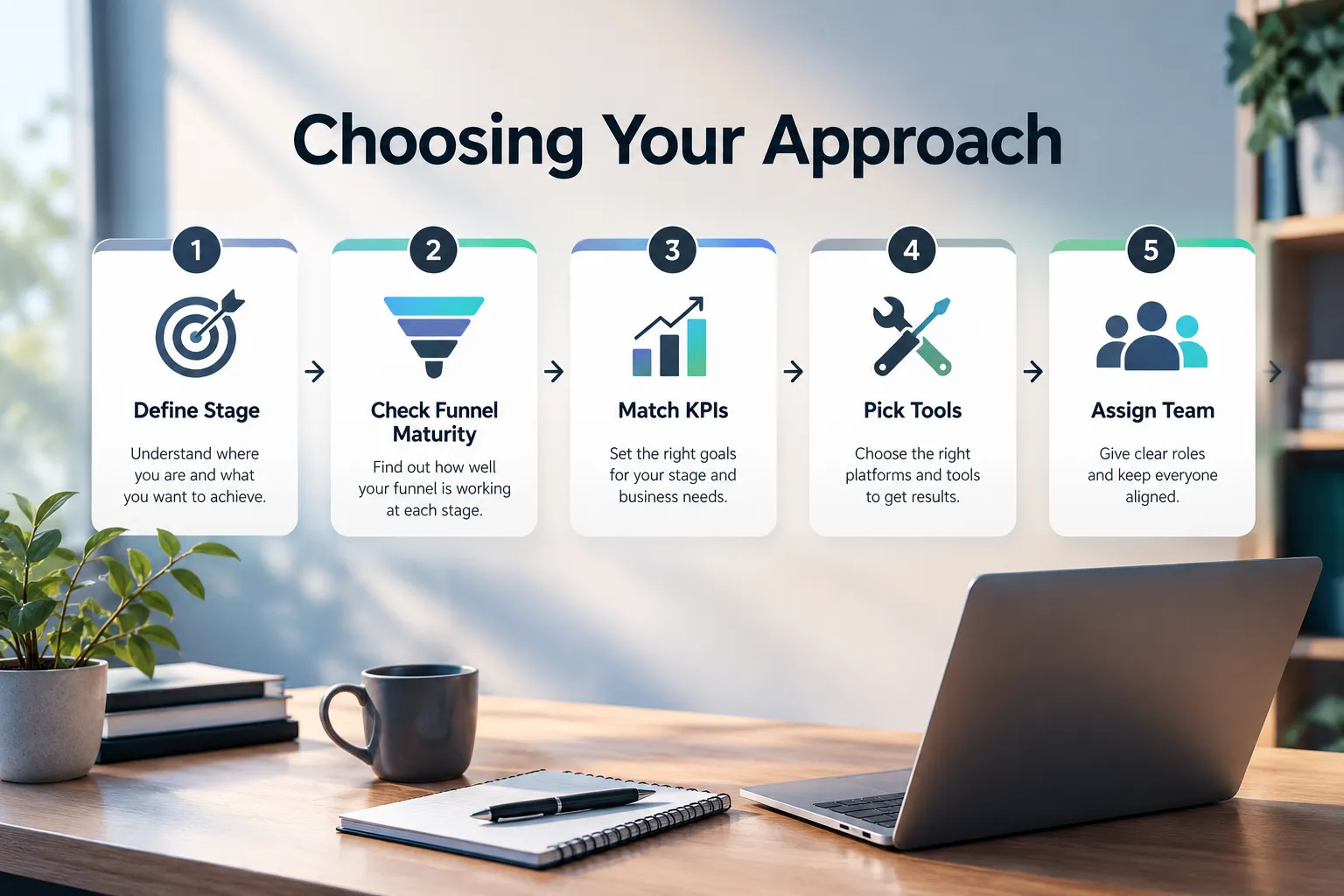
Not always, small teams can combine both responsibilities in one or two people, but companies past roughly 20-30 employees in marketing usually benefit from separate ownership with shared reporting. The skill sets genuinely differ: demand gen leans on content, paid media and ABM; growth marketing leans on experimentation, product analytics and lifecycle messaging [4][6][8].
For freelancers, bloggers and small business owners reading this, you likely don’t need a separate hire yet. Focus on learning both skill sets yourself, since early-stage businesses rarely have budget for two specialists. If you’re exploring digital marketing as a career path, this split is also useful to understand for interviews, since hiring managers increasingly ask candidates to name which side they’re stronger in.
If you’re deciding whether to outsource either function, our article on outsourcing your SEO and marketing work covers the trade-offs of hiring versus contracting specialists.
FAQ
Is growth marketing just a rebrand of digital marketing? No. Growth marketing is narrower and more experiment-focused than general digital marketing, it specifically targets acquisition, activation, retention, revenue and referral using structured testing [2][8].
Does demand generation include SEO and content marketing? Yes. Content marketing, SEO-driven organic traffic and paid media are standard demand gen channels used to build awareness and intent [2][6].
Can a solo founder run both motions without a team? Yes, especially early on. Focus on retention and activation first (growth marketing basics), then add demand gen campaigns once the product holds onto users.
What’s the single biggest KPI difference between the two? Demand gen tracks pipeline creation (MQLs, SQLs, pipeline value). Growth marketing tracks the full lifecycle, especially LTV:CAC and net revenue retention [4].
Is pipeline influenced the same as pipeline created? No. Pipeline created means the campaign directly generated the opportunity. Pipeline influenced means the campaign touched a deal that originated elsewhere [4].
Do B2C companies need demand generation KPIs at all? Yes, though the channels differ. A subscription app still tracks CPL-equivalent metrics and conversion rates, just through social and app-store channels instead of ABM [2][5].
How do I know if my demand gen program is actually “broken”? If you only report MQL counts with no visibility into pipeline velocity, SQL conversion or closed revenue, your program likely has a reporting and alignment problem, not just a lead-volume problem [6].
Conclusion
Growth marketing and demand generation solve different problems, and that’s exactly why the growth marketing vs demand generation debate keeps resurfacing in every marketing team I’ve seen. Demand gen fills your pipeline. Growth marketing decides whether that pipeline turns into a business that keeps growing without constant new spend.
If you’re a student or career switcher reading this to figure out which skill set to build first, my honest recommendation: learn growth marketing fundamentals (experimentation, analytics, retention thinking) alongside basic demand gen tactics (content, paid media, lead nurturing). Employers increasingly want people who understand both sides of this funnel, not specialists who only know half the story.
Start by auditing your own project, client, or employer’s funnel this week. Map out where you lose people, awareness, activation, or retention, and that single exercise will tell you which discipline needs your attention first.
References
- Growth Marketing vs. Demand Generation. nicodigital.com.
- Growth Marketing vs. Demand Generation. mountain.com.
- Growth Marketing Guide. amplitude.com.
- Growth Marketing vs. Demand Generation. customerimpact.be.
- Demand Generation. zapier.com.
- Growth Marketing vs. Demand Generation. thomasnet.com.
- Growth Marketing vs. Demand Gen. growclass.co.
- Growth Marketing vs. Demand Generation. neilpatel.com.
- Growth Marketing vs. Demand Generation. tomba.io.
growth marketing, demand generation, marketing KPIs, pipeline generation, customer acquisition, lead generation vs demand generation, AAARRR framework, B2B marketing strategy, startup marketing, marketing funnel, digital marketing for beginners, career in marketing