
Last updated: September 14, 2026
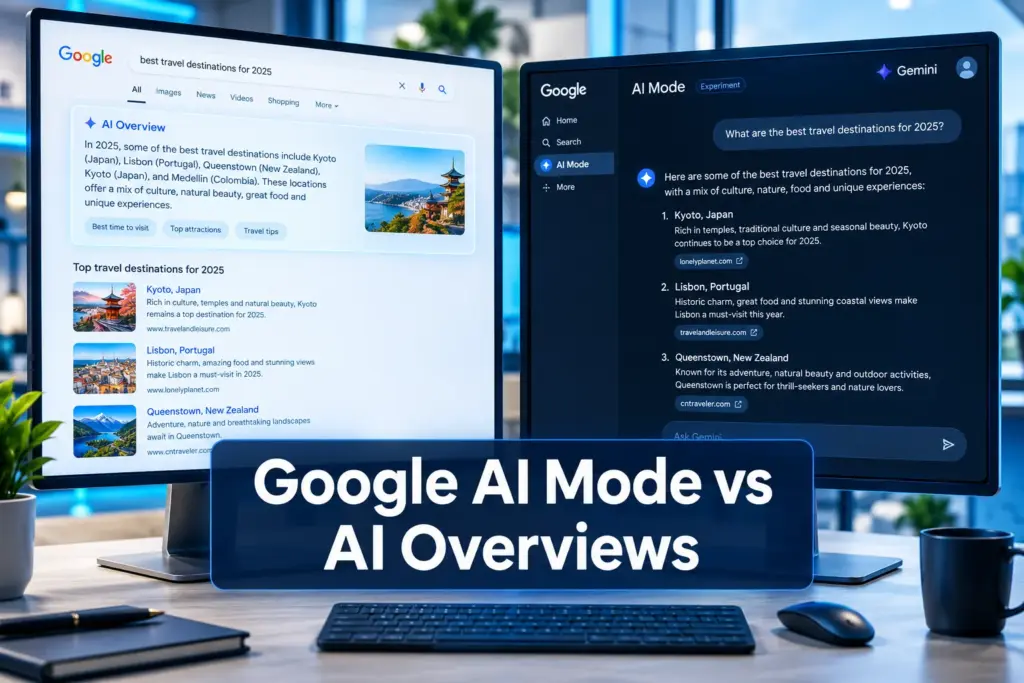
Quick Answer: Google AI Overviews are AI-generated summaries that appear at the top of standard search results pages, sitting above organic blue links. Google AI Mode is a separate, dedicated search experience that replaces the entire results page with a Gemini-powered conversational answer. Both surfaces pull citations from the same pool of web pages, so your AI search SEO strategy needs to account for both, but they work differently and require slightly different optimization approaches.
Key Takeaways
- AI Overviews appear on the standard SERP for roughly 47-64% of queries and now reach over 2.5 billion monthly users across 200+ countries.
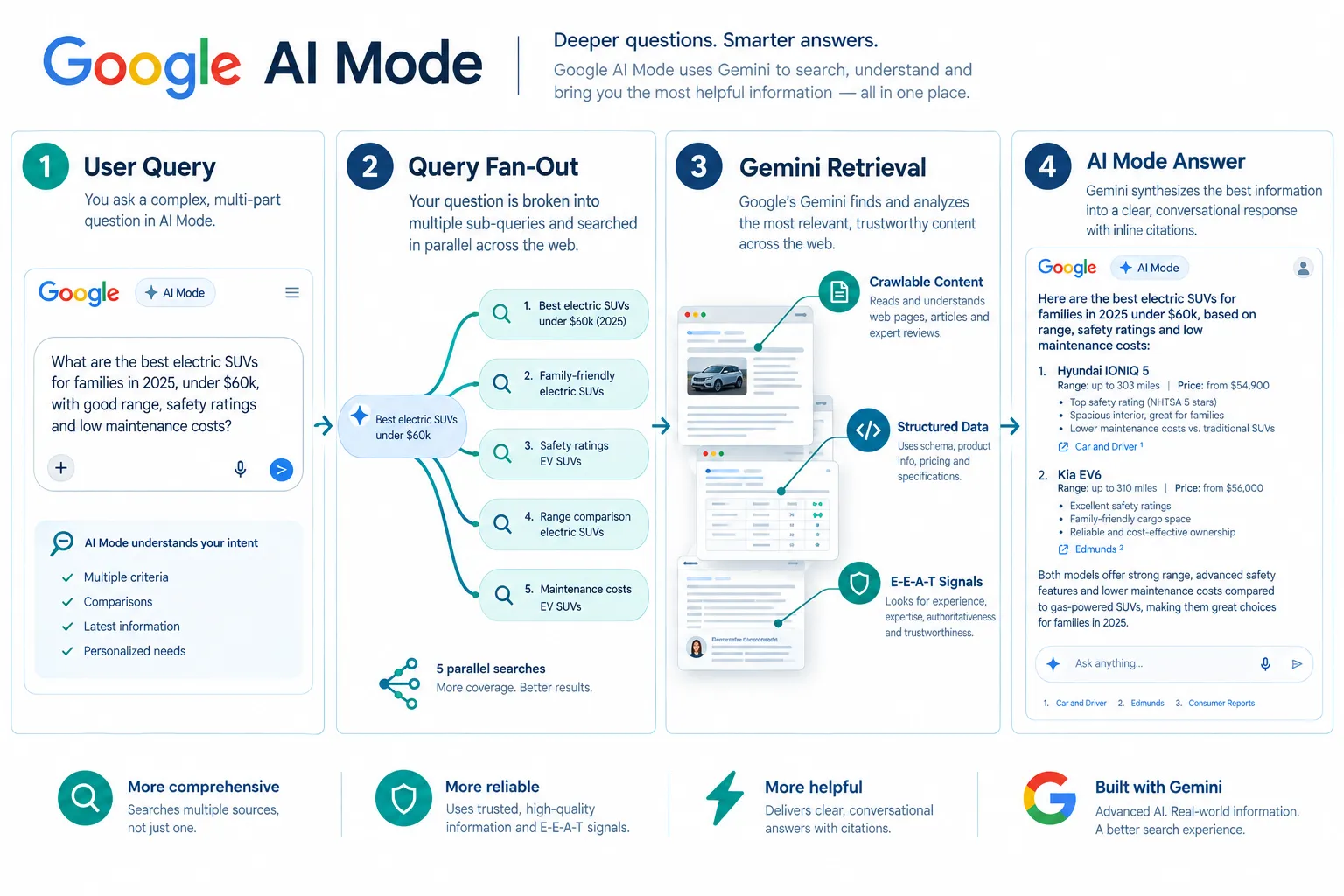
- AI Mode is a full-page conversational experience powered by Gemini, with over 1 billion monthly users. It uses a “query fan-out” technique, breaking your question into parallel sub-queries before synthesizing an answer.
- The two are connected: users can move from an AI Overview directly into AI Mode for deeper follow-up, and both draw citations from the same indexed web pages.
- About 92% of AI Overview citations come from pages already ranking in the organic top 10, so traditional SEO still matters enormously [4].
- Brand mentions correlate about 3x more strongly with AI visibility than backlinks do, making entity authority a critical ranking signal [4].
- Top organic positions can see a 30-50% CTR drop on queries where AI Overviews appear, making AI citation presence a key metric to track.
- Google’s core ranking systems underpin both AI and traditional results, there are no separate technical requirements for AI inclusion beyond standard indexability and snippet eligibility [6].
- The best content structure for both surfaces: question-based headings, direct 40-80 word answers immediately below each heading, and FAQ/HowTo schema markup [1][8].
What Is Google AI Mode and How Does It Work?
Google AI Mode is a dedicated search tab that replaces the traditional list of blue links with a full, conversational AI-generated answer. Instead of scanning a page of results, you get a synthesized response from Gemini with inline citations and a follow-up chat interface.
Under the hood, AI Mode uses a technique called query fan-out: it takes your question, breaks it into multiple related sub-queries, runs those in parallel across Google’s index and Knowledge Graph, then synthesizes everything into a single coherent answer. As of mid-2026, AI Mode runs on Gemini 3.5 Flash and is available in nearly 200 countries across 98 languages.
What makes this significant for AI search SEO is that AI Mode behaves more like a research assistant than a search engine. It provides detailed, multi-source answers with fewer direct links than a standard SERP. Getting cited inside that answer, rather than just ranking as a blue link, becomes the real win.
You can now access AI Mode directly from the Chrome address bar, through the Google Search interface, and via an “Ask anything” box that sometimes appears inside expanded AI Overviews. That last point matters: AI Overviews and AI Mode are increasingly connected, not separate silos.
What Are Google AI Overviews and When Did They Launch?
Google AI Overviews are AI-generated summary boxes that appear at the top of a standard Google Search results page, above the organic blue links. They launched broadly in May 2024 at Google I/O and have expanded significantly since.
By mid-2026, AI Overviews appear on roughly 47-64% of queries and reach over 2.5 billion monthly users across more than 200 countries. They’re no longer experimental, they’re a core part of how Google delivers search results. In fact, nearly 100% of People Also Ask results are now answered by AI Overviews, which significantly reduces traditional snippet click opportunities.
AI Overviews use retrieval-augmented generation: they fetch content from multiple web sources, synthesize it into a prose answer, and display inline citations. The pages cited are almost always already ranking in the top 10 organically [4].
Is Google AI Mode the Same Thing as AI Overviews?
No, they’re different products, but they’re closely related. AI Overviews sit inside the traditional SERP. AI Mode replaces the SERP entirely with a conversational interface.
Think of it this way:
| Feature | AI Overviews | AI Mode |
|---|---|---|
| Where it appears | Top of standard SERP | Dedicated tab/full-page experience |
| Traditional links visible? | Yes, below the overview | Fewer, embedded as citations |
| Conversational follow-up? | Limited (“Ask anything” box) | Full chat interface |
| Monthly users (2026) | 2.5 billion+ | 1 billion+ |
| Powered by | Gemini (RAG) | Gemini 3.5 Flash (RAG + fan-out) |
Since Google I/O 2026, the two are integrated: a user can start with an AI Overview on the standard SERP and seamlessly move into AI Mode for a deeper conversation. Both surfaces pull from the same pool of indexed, citation-worthy pages, so optimizing for one largely optimizes for the other [6].
How Does Google AI Mode Affect SEO Rankings?
AI Mode doesn’t change your traditional rankings directly, but it does change what those rankings are worth. A page that ranks #3 organically may get far fewer clicks if AI Mode answers the query without the user ever visiting your site.
The more important shift: being cited inside an AI Mode answer is now more valuable than holding a blue-link position for many queries. AI Mode provides detailed answers with fewer outbound links, so each citation carries more weight. Pages need to be crawlable, indexable, and structured so AI systems can extract clear, self-contained passages [6][10].
The good news is that Google has confirmed there are no additional technical requirements beyond standard SEO for AI Mode inclusion. If your page is indexed and eligible to appear with a snippet, it can be considered as a citation source [6].
Do AI Overviews Hurt Organic Click-Through Rates?
Yes, meaningfully. For queries where AI Overviews appear, top organic positions see an average CTR drop of 30-50%. The gap between AI Overview-present and AI Overview-absent queries is now roughly 37%.
Expanded AI Overviews now sometimes load by default without a “Show more” button, pushing traditional organic results further down the page. Combined with the “Ask anything” box that funnels users into AI Mode, the net effect is fewer clicks reaching organic results for informational queries.
That said, the impact isn’t uniform:
- Informational queries (how-to, definitions, comparisons) see the biggest CTR drops.
- Transactional and navigational queries (buy, sign up, brand searches) are less affected.
- Local queries still drive clicks to local packs and business profiles.
The strategic response isn’t to panic about traffic loss, it’s to shift part of your measurement focus toward AI citation presence and brand visibility inside AI answers.
Which Websites Get Featured in AI Overviews?
Pages that already rank in the top 10 organically. About 92% of AI Overview citations come from top-10 organic results, which means classic SEO still heavily determines AI visibility [4].
Beyond ranking, a few factors increase your chances of being cited:
- Brand mentions across the web correlate about 3x more strongly with AI visibility (correlation
0.664) than backlinks (0.218) [4]. - About 61.79% of AI Overview sources overlap with featured snippet winners, so optimizing for featured snippets directly improves your AI citation odds [4].
- Pages with clear, direct answers under question-based headings are more likely to be extracted as citation passages [1][8].
- Structured data (FAQ, HowTo, Article schema) helps AI systems understand your content’s structure and relationships [1][10].
The practical takeaway: if you’re not ranking in the top 10 for a query, you’re unlikely to be cited in AI Overviews for that query. Fix the ranking first, then optimize the content structure for citation.
How to Optimize Content for Google AI Mode Results
Optimizing for AI Mode follows the same principles as AI Overviews SEO, with a few additions because AI Mode handles more complex, multi-part queries.
Content structure that works for both:
- Use question-based H2/H3 headings that mirror how people actually search. AI systems scan headings to match content to sub-queries.
- Write a direct 40-80 word answer immediately below each question heading, before adding supporting detail. This creates extractable passages [1][2].
- Lead with the answer, then explain it. Don’t bury the key point three paragraphs in.
- Use short paragraphs, bullets, and tables for complex information. AI systems prefer structured content they can parse cleanly [8].
- Implement FAQ, HowTo, and Article schema to clarify your content’s structure for automated systems [1][10].
- Build entity authority through brand mentions, author bylines, and clear topical coverage, not just backlinks [4].
For AI Mode specifically:
- Cover related sub-topics within the same page. AI Mode’s fan-out technique breaks queries into sub-queries, so a page that answers the main question and the natural follow-ups is more likely to be cited across multiple parts of an answer.
- Add a self-contained opening summary (the first 150 words under your H1) that works as a standalone TL;DR. AI Mode often pulls from early-page content for its initial answer [2][7].
What’s the Difference Between AI Mode and Traditional Search Results?
Traditional search returns a ranked list of links. You choose which one to click. AI Mode synthesizes an answer from multiple sources and presents it as a single response with inline citations.
The user experience is fundamentally different:
- Traditional search: You see 10 blue links, scan titles and descriptions, click the most relevant one.
- AI Mode: You get a complete answer immediately. You might click a citation to verify a claim or go deeper, but many users don’t need to.
For SEO professionals, this shifts the goal from “rank #1 so users click my link” to “be the source AI Mode cites when it answers this question.” Both matter, but the weight is shifting.
Does Google AI Mode Replace Featured Snippets?
Not entirely, but it’s reducing their visibility and click value. For queries where AI Mode or expanded AI Overviews appear, featured snippets are often absorbed into the AI answer rather than displayed as a separate box.
The practical effect is that featured snippet optimization is now a means to an end: winning a featured snippet significantly increases your odds of being cited in AI Overviews (about 61.79% overlap) [4]. So keep optimizing for snippets, just understand that the direct click benefit is smaller than it used to be.
Can You Disable Google AI Overviews?
You can reduce how often you see them, but you can’t fully disable them. Google allows users to filter results using the “Web” tab in Search, which shows traditional blue-link results without AI Overviews. Some users have found browser extensions that suppress the AI Overview box.
From a publisher or SEO perspective, you cannot opt your content out of being cited in AI Overviews. Google treats AI citations similarly to how it treats snippets, if your content is indexed and publicly accessible, it’s eligible for inclusion.
Are AI Overviews Available in All Countries?
Broadly, yes. As of mid-2026, AI Overviews are available in over 200 countries and territories, and AI Mode supports 98 languages. Coverage has expanded significantly since the initial US-only launch in 2024.
That said, availability can vary by query type, language, and region. Some markets see AI Overviews on a smaller percentage of queries than the US does. If you’re running SEO campaigns in specific international markets, it’s worth checking local SERP behavior directly rather than assuming US patterns apply everywhere.
Best Practices for SEO with Google AI Mode in 2026
The core principle: don’t treat AI search as separate from traditional SEO. Google’s own guidance confirms that the same core ranking systems underpin both AI and traditional results [6]. Strong traditional SEO is the foundation. AI-specific optimization is the layer on top.
The dual strategy that works:
For traditional ranking (still essential):
- Ensure important pages are crawlable, indexable, and eligible for snippets.
- Build semantic topic clusters with strong internal linking.
- Earn quality backlinks and brand mentions.
- Optimize for SERP features: featured snippets, People Also Ask, video, local packs, these feed AI Overviews [10].
For AI citation optimization:
- Structure every page as question-answer pairs with direct answers first [1][2].
- Add explicit author bylines, dateModified markup, and E-E-A-T signals through original data and expert sourcing.
- Implement FAQ, HowTo, and Article schema [1][10].
- Build entity authority: get your brand mentioned across credible, relevant sources [4].
- Write content that’s self-contained at the paragraph level, passages that make sense without surrounding context are more likely to be extracted as citations [7][8].
For measurement:
- Track AI Answer Inclusion Rate: how often your brand appears in AI answers for target queries.
- Monitor query-level CTR in Google Search Console, segmented by queries where AI Overviews appear vs. don’t.
- Use Google’s generative AI reports in Search Console, which now reflect AI Overview performance inside standard performance data.
How Do AI Overviews Impact Traffic to My Website?
The honest answer: it depends on your query mix. Informational queries see the biggest traffic impact, with CTR drops of 30-50% for top positions when AI Overviews appear. Transactional and navigational queries are less affected.
One documented example: a University of Washington study estimated AI Overviews reduced referrals to Wikipedia by around 5%, though Google disputes the exact figure, the directional impact is real.
For most websites, the practical impact looks like this:
- Informational blog content targeting “how,” “what,” and “why” queries: expect reduced direct traffic, but increased brand exposure if you’re being cited.
- Commercial and transactional pages: less affected by AI Overviews, more affected if AI Mode starts handling purchase-intent queries more aggressively.
- Local service pages: largely protected by local pack results, which AI Overviews don’t fully replace.
The response isn’t to abandon content marketing, it’s to ensure your content is structured to earn citations, not just clicks.
Frequently Asked Questions
Q: Do I need to do anything special technically to appear in AI Overviews? No. Google has confirmed there are no additional technical requirements beyond standard SEO. If your page is indexed and eligible to appear with a snippet in regular search, it can be considered for AI Overview citations [6].
Q: Is AI Mode available on mobile? Yes. AI Mode is available on both desktop and mobile, and Google has integrated it into the Chrome address bar on desktop as well.
Q: Will optimizing for AI Overviews hurt my traditional rankings? No. The same content improvements that help AI citation, clear structure, direct answers, strong E-E-A-T, also improve traditional rankings. There’s no trade-off [6][10].
Q: How do I know if my content is being cited in AI Overviews? Google Search Console now includes generative AI reporting that shows when your pages appear as citations in AI Overviews. You can also manually search your target queries and check whether your site appears as a cited source.
Q: Does page speed matter for AI Overview citations? Yes, indirectly. Page experience signals are part of Google’s core ranking systems, which determine which pages are eligible for AI citations. A slow, poorly performing page is less likely to rank in the top 10, and therefore less likely to be cited [6].
Q: Should I use AI-generated content to optimize for AI search? Google’s guidance focuses on content quality and usefulness, not how it was created. The issue with AI-generated content is often quality and originality, not the fact that AI wrote it. Thin, generic AI content won’t rank, and won’t get cited.
Q: How often do AI Overviews appear for commercial queries? Less often than for informational queries. AI Overviews are most common on “how,” “what,” and “why” queries. Commercial and transactional queries still tend to show traditional results more prominently.
Q: Can I track AI Mode citations separately from AI Overview citations? Currently, Google Search Console groups generative AI appearances together. Third-party tools are beginning to differentiate between the two surfaces, but this is still evolving in 2026.
Conclusion
Google AI Mode and AI Overviews are different products with different user experiences, but they share the same underlying content pool and the same optimization logic. AI Overviews sit on top of the standard SERP and reach 2.5 billion users. AI Mode replaces the SERP entirely and has crossed 1 billion monthly users. Both are now mainstream, not experimental.
The SEO implication is straightforward: you can’t ignore either surface, and you don’t need a completely separate strategy for each. Strong traditional SEO, ranking in the top 10, earning brand mentions, building topical authority, is still the foundation. AI-specific optimization is about structuring that content so AI systems can extract clear, citation-worthy passages from it.
Your next three actions:
- Audit your top-traffic pages for question-based headings and direct answers. If a reader has to scroll three paragraphs to find the answer, rewrite the structure.
- Check Google Search Console for your generative AI report. Identify which queries show AI Overviews and whether your pages are being cited or just ranking below them.
- Implement FAQ and Article schema on your highest-priority pages. This is one of the clearest signals you can send to AI systems about your content’s structure [1][10].
AI search SEO isn’t about chasing a new algorithm. It’s about making your content genuinely useful, clearly structured, and easy for both humans and AI systems to understand. That’s always been good SEO, it just matters more now.
References
[1] How To Optimize For Ai Overviews – https://searchengineland.com/guide/how-to-optimize-for-ai-overviews [2] Optimization Strategies Google Ai Overviews – https://www.conductor.com/academy/optimization-strategies-google-ai-overviews/ [4] How To Rank In Google Ai Overviews – https://www.onely.com/blog/how-to-rank-in-google-ai-overviews/ [6] Succeeding In Ai Search – https://developers.google.com/search/blog/2025/05/succeeding-in-ai-search [7] Optimize For Google Ai Overviews – https://llmpulse.ai/blog/optimize-for-google-ai-overviews/ [8] Rank In Ai Overviews – https://seoalive.com/blog/rank-in-ai-overviews [10] How To Rank In Ai Overviews – https://seoprofy.com/blog/how-to-rank-in-ai-overviews/