

Last updated: October 20, 2026
More than 90% of new-home buyers start their research online before they ever call a builder or walk into a model home [1]. That single fact should shape every marketing decision you make heading into 2027. If your website, Google Business Profile, and ad campaigns aren’t built for how buyers actually search today, including through AI tools, you’re losing leads to builders who got there first.
This guide breaks down digital marketing for builders: 12 lead tactics for 2027, written for builders, marketing managers, and freelancers who handle builder clients. No fluff, no recycled checklists. Just practical steps you can act on this quarter.
Quick Answer
The strongest digital marketing strategy for builders in 2027 combines local SEO and AI search optimization, a conversion-ready website with virtual tours, geo-targeted Google and Meta ads, and structured email/SMS nurture sequences, backed by a referral and review system. Budget roughly 2.5-7% of annual revenue depending on your build volume, and track cost per lead by channel, not just total spend [1][2].
Key Takeaways
- Digital channels now account for 55-65% of total builder marketing budgets, with digital ads around 35-40% and organic/SEO around 20-25% [2][3].
- Builders should budget 2.5-3.5% of annual revenue for standard operations, and 3-7% for custom or small-volume builders [1][2].
- AI Overviews and AI assistants are answering buyer questions before they reach your site, so AI search optimization is now part of core SEO work [1].
- Cost per lead varies widely: $15,$85 on Angi, around $120,$400 for bid boards, and $150,$600+ on Google Ads depending on the trade [4][5].
- Email nurture sequences can deliver over 400% ROI for builders with long 12-18 month sales cycles [2].
- Reviews, referrals, and realtor/lender partnerships remain the most profitable lead source for many builders [3][4][5].
- Speed-to-bid automation, alerting estimators within seconds of a new inquiry, is becoming a real competitive edge [6].
What’s the Best Digital Marketing Strategy for Home Builders in 2027
The best strategy treats marketing as a five-stage system: attract, capture, nurture, sell, and delight, rather than a list of disconnected tactics [1]. Builders who win leads consistently build connected ecosystems where SEO, paid ads, email, and reviews all feed each other.
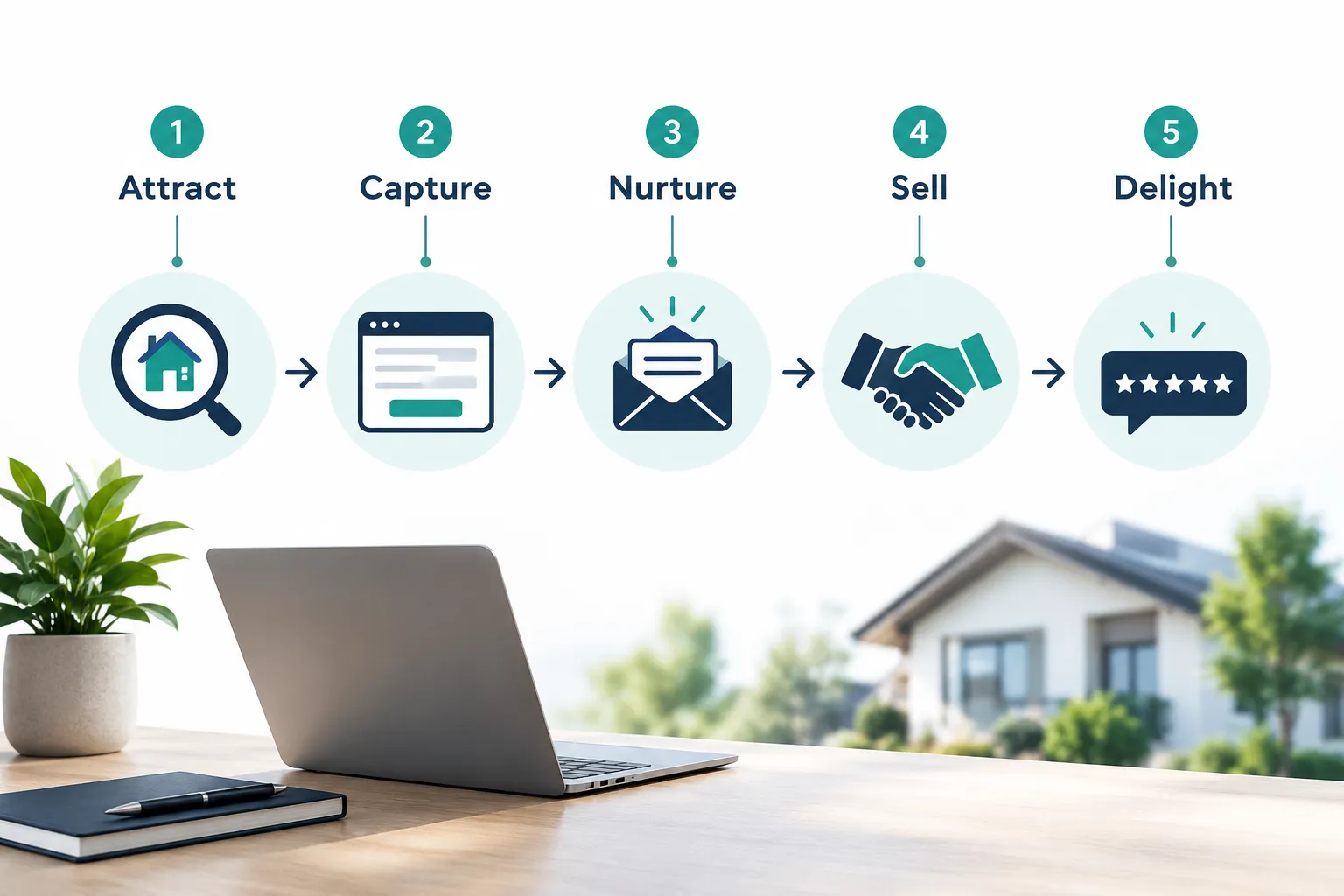
Here’s what that looks like in practice:
- Attract: Local SEO, Google Business Profile, AI search visibility, and social content pull in buyers researching a neighborhood or build type.
- Capture: A conversion-ready website with clear forms, live inventory, and virtual tours turns visitors into leads.
- Nurture: Email and SMS sequences keep leads warm during the 12-18 month decision window [7][8].
- Sell: Fast follow-up and speed-to-bid systems close the gap between interest and signed contract [6].
- Delight: Post-sale reviews and referral requests feed the next attract stage.
Choose this system-based approach if you build more than a handful of homes a year. If you’re a solo contractor doing 2-3 projects annually, start simpler: a strong Google Business Profile, a few before/after posts, and a referral ask after every job.
How Much Should I Budget for Digital Marketing as a Builder
Plan for 2.5-3.5% of annual revenue if you’re a volume production builder, and 3-7% if you’re a custom or small-volume builder [1][2]. Within that budget, aim for roughly 35-40% on paid digital ads and 20-25% on organic channels like SEO and content [2][3].
A practical starting point for many small-to-mid builders is setting aside a defined monthly amount specifically for digital marketing, often landing somewhere in the mid-four to low-five figures depending on market size and competition [9]. The mistake builders make here is treating marketing spend as a leftover line item instead of a fixed cost tied to revenue goals.
Decision rule: if you can’t name your current cost per lead by channel, don’t increase ad spend yet. Fix your tracking first, then scale.
Which Social Media Platforms Work Best for Construction Companies
Instagram and Facebook work best for visual proof of work, while LinkedIn works best for commercial and B2B construction relationships [8]. Choose platforms based on who actually makes the buying decision, not where you personally enjoy posting.
- Instagram/Facebook: Before/after photos, drone reels, 3D walkthroughs, and community updates for residential builders [8].
- LinkedIn: Project showcases and decision-maker outreach for commercial, mixed-use, and B2B construction firms [5].
- YouTube: Longer walkthrough videos and homebuyer education content that also supports SEO.
A common mistake is spreading effort across five platforms with weak content instead of posting consistently on two platforms with strong visuals.
Why Am I Not Getting Qualified Leads From My Google Ads
Unqualified leads from Google Ads usually come from broad keyword targeting, weak landing pages, or missing geo-filters, not from the platform itself. Builders often blame the channel when the real problem is campaign setup.
Common causes and fixes:
| Problem | Likely Cause | Fix |
|---|---|---|
| Leads outside your service area | Broad geographic targeting | Tighten radius targeting around build zones |
| High volume, low quality | Generic keywords like “home builder” | Shift to specific intent keywords, e.g., “custom home builder [city]” |
| Clicks but no conversions | Weak or generic landing page | Build a dedicated page with pricing ranges, gallery, and a short form |
| Expensive clicks, few leads | Competing on broad national terms | Add Local Service Ads alongside Search Ads [6][8] |
If you’re paying $150,$600+ per qualified lead on Google Ads and seeing poor quality, audit your negative keywords and landing page relevance before cutting the budget entirely [5].
What’s the Difference Between PPC and Organic Marketing for Builders
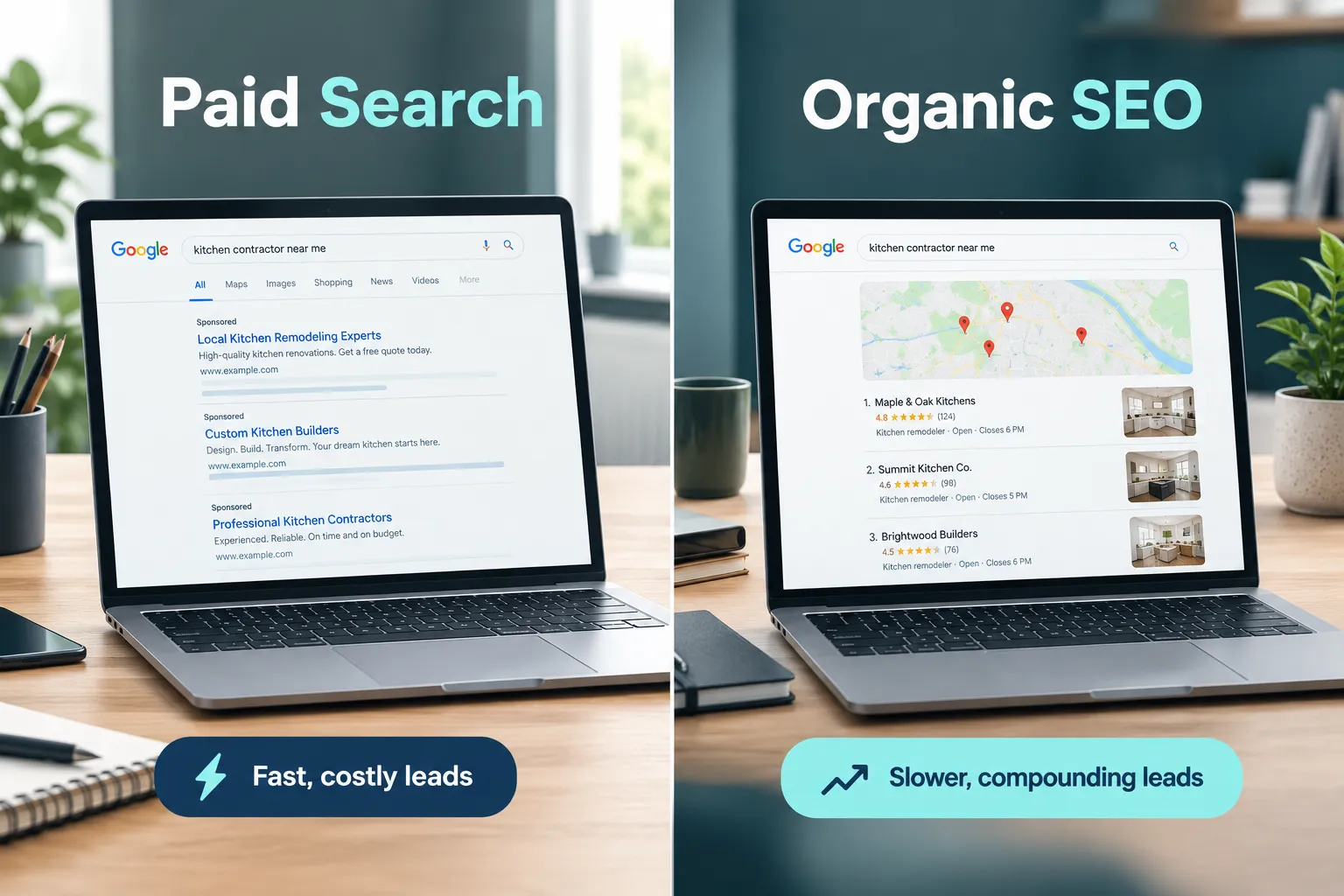
PPC (pay-per-click) gets you visible immediately but stops producing leads the moment you stop paying, while organic marketing like SEO and content builds visibility that compounds over months and keeps working after you’ve invested the initial effort. Most builders need both, used for different jobs.
- Choose PPC if: you need leads fast, you’re launching a new community, or you have a strong landing page ready to convert traffic.
- Choose organic/SEO if: you want long-term cost efficiency, you’re building authority in a specific service area, or your budget is limited and needs to stretch further over time.
For a deeper look at balancing these channels without overspending, see this breakdown of multi-channel marketing and spending smarter, not more.
How Do Successful Builders Generate Leads Online
Successful builders combine local SEO, listing site presence, paid search, and strong referral systems rather than relying on a single channel. No single tactic carries the full load.
Core channels that consistently produce leads:
- Google Business Profile optimized for service areas and reviews [1].
- Listing on NewHomeSource, Zillow, Realtor.com, Redfin, and Houzz [1][4].
- Local Service Ads and Search Ads for high-intent project keywords [6][8].
- Email and SMS nurture for the long decision cycle [7][8].
- Reviews and realtor/lender referral partnerships [3][5].
If you want a step-by-step breakdown of turning content into actual leads, this guide on generating leads with the right content strategy walks through the process.
Is Digital Marketing Worth It for Small Local Builders
Yes, digital marketing is worth it for small local builders, but the mix should lean heavier on organic and referral tactics than paid ads, since small builders often can’t absorb high cost-per-lead numbers. A $15,000 annual digital budget spent entirely on Google Ads at $400 per lead buys far fewer leads than the same budget split across SEO, Google Business Profile, and a referral program.
Small builders should prioritize:
- A well-optimized Google Business Profile (free, high impact).
- Consistent before/after photo posting on social media.
- A simple review-request system after every completed project.
- One paid channel tested carefully before scaling spend.
What Are the Biggest Digital Marketing Mistakes Builders Make
The biggest mistakes are treating the website as a brochure instead of a lead-capture tool, ignoring mobile speed, and stopping lead follow-up after the first call. These mistakes quietly cost builders thousands in missed conversions.
Other frequent mistakes:
- No tracking setup, so nobody knows which channel actually produces paying clients.
- Posting project photos without any call-to-action or contact form nearby.
- Treating email as a newsletter instead of a structured nurture sequence.
- Ignoring AI search visibility while competitors optimize their content for AI Overviews [1].
If your website needs a content refresh to fix these gaps, this content marketing hack is a useful starting point.
How Do I Track ROI on My Builder Marketing Campaigns
Track ROI by assigning every lead a source tag at the point of capture, then following that lead through to signed contract, not just through to form submission. Vanity metrics like impressions and clicks don’t tell you which channel pays for itself.
A workable tracking setup includes:
- UTM parameters on every paid and social link.
- Call tracking numbers for phone leads from different channels.
- A CRM or spreadsheet that logs source, cost, and final outcome per lead.
- Monthly review of cost per lead by channel, compared against your actual sale value.
Edge case: if you sell custom homes with six-figure margins, even a $600 cost-per-lead channel can be worth it if conversion rates are strong. Don’t judge cost per lead in isolation, always weigh it against your average project value.
Should I Hire a Digital Marketing Agency or Handle It Myself
Hire a specialized home-builder marketing agency if you lack in-house SEO or paid ads expertise and have budget for ongoing management, typically in the range builders report spending on digital marketing specifically, often $5,000,$15,000 per campaign cycle [9]. Handle it yourself if you’re a small-volume builder with time to learn and a limited budget.
- Choose an agency if: you need Local Service Ads, Google Ads, and SEO managed simultaneously, or you’ve tried DIY and your lead quality stayed flat.
- Choose DIY if: your main need is Google Business Profile upkeep, basic social posting, and review requests.
If you decide to outsource, this guide on how to outsource your SEO marketing explains what to look for in a vendor and how to avoid wasted spend.
How Does Video Marketing Help Construction Companies Get More Leads
Video marketing helps because drone reels, 3D walkthroughs, and virtual tours let buyers pre-qualify themselves emotionally before they ever schedule a visit, which raises the quality of leads who do show up [1][8]. Builders who skip video rely entirely on static photos, which convert less reliably for big-ticket purchases.
Practical video formats worth prioritizing:
- Drone footage of community layouts and lot positions.
- 3D walkthroughs embedded directly on floor plan pages.
- Short before/after reels for remodels and additions, organized by project type [8].
What’s the Typical Cost Per Lead for Home Builder Marketing
Cost per lead ranges from about $15,$85 on Angi, roughly $120,$400 for public bid boards, and $150,$600+ on Google Ads depending on the trade and market [4][5]. Platforms like Houzz and BuildZoom use flat monthly fees or commission models instead of per-lead pricing.
| Channel | Typical Cost Model |
|---|---|
| Angi | Per lead, $15,$85 |
| Houzz | Flat monthly subscription |
| BuildZoom | Commission-based, around 2.5% |
| Public bid boards | Per qualified lead, $120,$400 |
| Google Ads | Per qualified lead, $150,$600+ |
Source data: [4][5]
How Long Does It Take to See Results From Digital Marketing
Paid ads can produce leads within days, SEO typically takes three to six months for noticeable movement, and referral/review systems take a full project cycle or two to start compounding. Builders chasing quick SEO wins often give up right before results start showing.
A realistic timeline:
- Weeks 1-4: Paid ads and Local Service Ads start generating leads.
- Months 2-4: Google Business Profile and local SEO begin climbing in visibility.
- Months 4-8: Organic SEO traffic and AI search citations grow if content is consistent.
- Ongoing: Referral and review systems compound with every completed project.
What Marketing Channels Work Best for Luxury Home Builders
Luxury home builders get the best results from high-production video, realtor/lender referral partnerships, and curated social content over broad paid advertising, since luxury buyers research extensively and rely heavily on trust signals before contacting a builder. Volume-based paid ads often attract the wrong audience for high-end projects.
Priority channels for luxury builders:
- Realtor and private lender referral networks [3][5].
- High-end photography and video showcasing craftsmanship, not just square footage.
- LinkedIn and Instagram presence that signals credibility to high-net-worth buyers.
- A website built for storytelling, not just lead forms, paired with WhatsApp or direct messaging options for quick personal contact, similar to the approach outlined in this guide on WhatsApp marketing for small business.
Pros and Cons of Relying on Third-Party Listing Sites
Listing sites like NewHomeSource, Zillow, and Houzz give builders instant visibility in front of active buyers, but they also put your leads in a shared marketplace competing against other builders on the same page [1][4].
Pros:
- Immediate access to high-intent buyers already comparing builders.
- No need to build audience from scratch.
- Useful for new market entry before your own SEO matures.
Cons:
- Commoditized positioning, buyers compare you side by side with competitors.
- Ongoing subscription or per-lead costs that don’t stop.
- Less control over how your brand and projects are presented.
Decision rule: use listing sites as a supplement during your first 12-18 months in a new market, then shift budget toward owned channels (SEO, email list, Google Business Profile) as they mature.
FAQ
What is Generative Engine Optimization and does it matter for builders? Generative Engine Optimization (GEO) means structuring your website content so AI tools like Google AI Overviews can read, understand, and cite it when answering buyer questions. It matters because AI assistants are increasingly answering buyer questions before they visit your site [1].
Do I need a separate website for each community I build? Not necessarily. A single site with dedicated, well-structured pages per community usually performs better for SEO than multiple scattered microsites.
How important are Google reviews for builder lead generation? Very important. Reviews directly influence Google Business Profile ranking and buyer trust, and a steady “reviews velocity” system is considered a base-layer tactic by multiple 2026 industry guides [1][3][5].
Should I run Facebook ads or Google ads first? Start with Google Ads or Local Service Ads for high-intent, ready-to-buy searches, then add Facebook/Meta for remarketing people who already visited your site [6][8].
What’s a realistic first step if I have almost no marketing budget? Claim and fully optimize your Google Business Profile, request reviews after every project, and post consistent before/after photos. All three are free or near-free.
How does email marketing fit into a 12-18 month sales cycle? Email keeps your brand in front of leads during their entire research window through scheduled nurture sequences, rather than relying on a single contact point. This guide on building a solid email marketing foundation covers setup steps in detail.
Is SEO still worth it with AI search growing? Yes. AI search tools pull their answers from well-structured, authoritative web content, so strong SEO fundamentals, including interactive, SEO-driven customer experiences, remain the foundation for AI visibility too.
Conclusion
Digital marketing for builders: 12 lead tactics for 2027 comes down to one core idea: connect your channels instead of running them in isolation. A buyer who sees your Google Business Profile, clicks through to a fast-loading site with a virtual tour, gets added to an email nurture sequence, and later leaves a review after their build, that’s a system working together, not twelve separate tactics competing for attention.
Start small if you need to. Fix your Google Business Profile this week, tighten your Google Ads targeting next, and set up basic lead-source tracking before you spend another rupee or dollar on ads. Build the system one piece at a time, and 2027 becomes the year your marketing finally pays for itself instead of just generating activity.
References
- Marketing for Home Builders. hbr-digital.com.
- Digital Marketing for Homebuilders. buildwithfoundation.com.
- Residential Construction Marketing. buildern.com.
- Construction Leads 2026. pipelineon.com.
- Lead Generation for Construction Companies. tomba.io.
- Construction Lead Generation. theedigital.com.
- Marketing Strategy Ideas for Home Builders. chatterbuzzmedia.com.
- Home Builder Marketing Trends 2026. foxxr.com.
- Home Builder Marketing Guide. digitalthirdcoast.com.