

Ninety percent of home searches now start online, yet most agents still rank nowhere near the top three results that actually get clicked. That gap between where buyers look and where agents show up is the entire business case for local SEO for real estate agents in 2026. Google’s two core updates this year, in March and May, reshuffled real estate visibility again, rewarding agents who treat search like infrastructure rather than an afterthought [1].
Local SEO for real estate agents is no longer about stuffing a city name into a title tag. It now involves structured data, neighborhood-level content, Google Business Profile management, and backlinks tied to actual communities. Agents who ignore this are losing leads to competitors who show up in the Map Pack and in AI-generated search answers before a buyer ever opens a listing portal.
Key Takeaways
- Neighborhood-specific content, not city-wide pages, is the foundation of local SEO for real estate agents in 2026 [1].
- Google’s AI Search agents rely on structured, verified local data, making technical SEO and IDX setup more important than ever [2].
- Google Business Profile activity, including posts and review velocity, acts as an ongoing ranking signal, not a one-time setup task [3].
- Local backlinks from community organizations and citations outperform generic directory links [4].
- A minimum viable local SEO program combines GBP optimization, neighborhood content, video, and consistent review generation [5].
Why Local SEO for Real Estate Agents Changed This Year
Two core algorithm updates, one in March and one in May 2026, shifted how Google evaluates local relevance for service-based professionals like real estate agents [1]. These updates coincided with the rollout of Google’s AI-driven “Search agents,” a feature that pulls structured, verified data to answer buyer and seller queries directly inside search results [2].
This matters because AI answers still depend on traditional SEO inputs. Clean website architecture, accurate business listings, and well-organized content feed the AI systems that now sit between an agent and a potential client [2][4]. Agents who skip the basics are effectively invisible to both human searchers and the AI tools summarizing results for them.
Demand for real estate remains overwhelmingly search-driven. Buyers research neighborhoods, school zones, and commute times long before contacting an agent, and most of that research happens through Google [6]. This is why the agents who win now are the ones building topical authority around specific places, not just promoting themselves.
Replace the above with the slot image below.
Neighborhood-First Content: The Core of Local SEO for Real Estate Agents
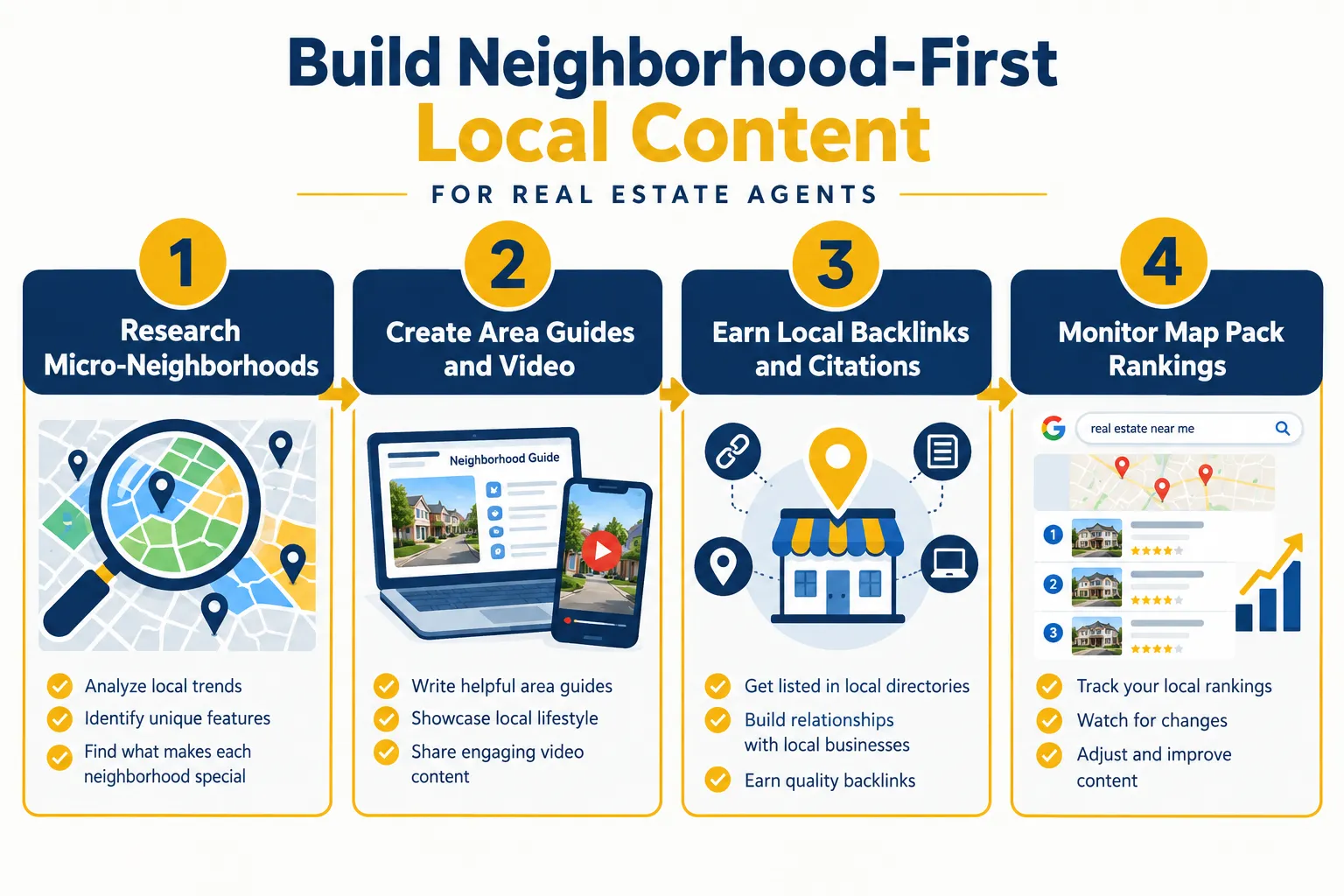
The single biggest shift in local SEO for real estate agents is the move away from broad city pages toward hyper-specific neighborhood content [1]. A page titled “Homes in Springfield” performs far worse than a page covering “Oak Hill Historic District: Market Trends, Schools, and Walkability.”
Effective neighborhood pages typically include:
- Local market data: median price, days on market, inventory trends
- Lifestyle details: parks, restaurants, transit access, school ratings
- Original photos or video: not stock imagery
- A clear call to action: scheduling a consultation or home valuation
Video is now woven directly into these neighborhood pages rather than treated as a separate channel. Short walkthroughs of specific blocks, drone footage of local parks, and interviews with small business owners all signal relevance that text alone cannot [1]. This rich media also increases time on page, a factor that correlates with stronger rankings.
Brokerages have taken notice. Some are now partnering directly with SEO firms to dominate the Google Map Pack within defined submarkets, treating local search ownership as a competitive moat rather than a marketing nice-to-have [7].
Technical Foundations That Support Neighborhood Content
Great content fails if the technical layer is broken. IDX integration, the system that pulls live listing data into an agent’s website, must be implemented correctly or search engines and AI systems cannot index the listings properly [5]. Common technical issues include:
| Issue | Impact on Local SEO |
|---|---|
| Slow-loading IDX widgets | Lower rankings, higher bounce rate |
| Duplicate listing pages | Diluted page authority |
| Missing schema markup | AI and search engines misread business data |
| No mobile optimization | Lost rankings on mobile-first index |
Schema markup deserves particular attention. Structured data that clearly labels an agent’s name, service area, reviews, and listings helps Google’s AI Search agents represent that agent accurately in generative results [2][8].
Google Business Profile: The Daily Engine of Local SEO for Real Estate Agents
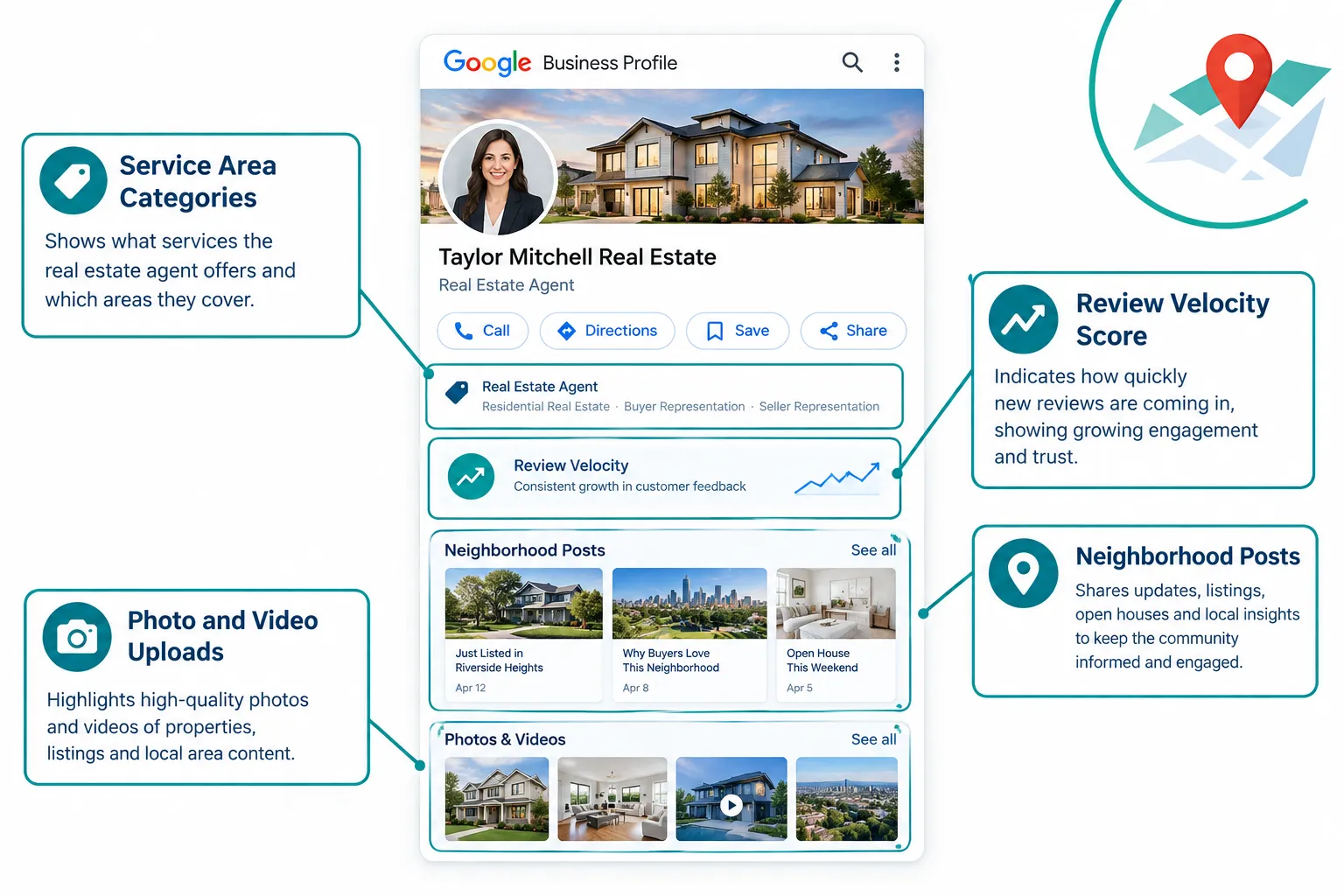
Google Business Profile, or GBP, has evolved from a static listing into an active performance signal. Google now treats ongoing GBP activity, including fresh posts, updated photos, and review velocity, as evidence that a business is real and engaged [3].
“A profile that goes quiet for months signals stagnation to both users and the algorithm.”
Category selection has also become more granular. Agents who select only “Real Estate Agent” are missing opportunities to use secondary categories and service-area settings that map directly to how buyers search, such as specific suburbs or property types [3][9].
A minimum viable GBP strategy for 2026 includes:
- Weekly posts featuring new listings, local market updates, or community events
- A steady cadence of new reviews, ideally several per month, not a one-time push
- Fresh photos and short videos added regularly
- Accurate, specific service-area boundaries rather than an entire metro region
- Monthly checks on business information accuracy, including phone number and hours
Review velocity in particular has become a trust signal that AI systems reference when summarizing “best agent near me” style queries [3][8].
Local Backlinks and Citations That Actually Move Rankings
Generic directory submissions no longer carry much weight. What moves the needle now are backlinks and citations tied to genuine community involvement: sponsoring a local youth sports team, contributing to a neighborhood association newsletter, or being quoted in a local news feature [4][6].
These links work because they are contextually relevant. A backlink from a city chamber of commerce or a local school fundraiser page tells search engines that an agent is embedded in the community, not just buying links in bulk. This kind of targeted citation building is harder than mass directory submissions, but it produces far stronger and more durable results [4].
AI SEO for Real Estate: A New Specialization
A new category of service, sometimes called AI SEO for real estate, has emerged specifically to map an agent’s expertise so AI search systems can represent it accurately [8]. These services focus on structuring an agent’s bio, transaction history, and local knowledge into formats that generative search tools can parse and summarize.
This is a direct response to Google’s Search agents, which increasingly answer queries like “best agent for first-time buyers in [neighborhood]” without the user clicking through to a website at all [2]. If an agent’s expertise is not clearly structured and verifiable, the AI simply will not surface it.
Building a Minimum Viable Local SEO Program for Real Estate Agents
Agents overwhelmed by the scope of modern local SEO for real estate agents should focus on a lean, consistent program rather than chasing every tactic at once. Based on current consensus among industry sources, the essentials are:
- A fully optimized Google Business Profile with weekly activity
- At least five neighborhood-specific content pages, each with original media
- A review generation system producing new reviews every month
- Clean technical SEO, including correct IDX setup and schema markup
- A handful of genuine local backlinks each quarter
This short list, executed consistently, outperforms sporadic bursts of effort aimed at dozens of tactics [5].
Conclusion
Local SEO for real estate agents in 2026 rewards consistency, specificity, and technical accuracy over volume and generic effort. The agents gaining visibility are publishing neighborhood-level content, keeping their Google Business Profile active every week, earning community-based backlinks, and making sure their website’s technical foundation can be read correctly by both search engines and AI systems.
The next step is practical: audit the current Google Business Profile for category accuracy and posting frequency, identify three neighborhoods that deserve dedicated content pages, and start a simple monthly review request routine. Small, consistent actions in these areas compound into real visibility in the Map Pack and in AI-generated search results.
References
- Local SEO for Real Estate What Works for Agents in 2026. unosearch.io.
- Search Io 2026. google.
- SEO Real Estate Agents Local Rankings Leads. veduis.com.
- Real Estate SEO. viacon.io.
- SEO for Real Estate Agents. seobility.net.
- Real Estate SEO. reallyo.com.
- Article 091be1c9 339e 52ed 8458 1f9c4fbbf302. wboc.com.
- Article 9d4e120c 2ec3 5ad5 9f5d A7dc801ec75d. wboc.com.
- Local SEO for Real Estate Agents. amplifiles.ai.