

Last updated: October 28, 2026
Quick Answer
Descript wins for solo creators and narrative shows who want transcript-based editing and AI rewriting. Adobe Podcast wins for anyone who just needs fast, free audio clean-up without touching a timeline. Riverside wins for interview and panel podcasts that need reliable remote recording plus automatic clip creation. There is no single “best” pick here, the right answer depends on how many hosts you have, how messy your raw audio is, and whether you need social clips as output.
Key Takeaways
- Descript edits podcasts like a text document, cutting filler words and retakes directly from the transcript.
- Adobe Podcast’s Enhance Speech v2 is free and browser-based, built for one-click noise removal, not full editing.
- Riverside focuses on remote multi-guest recording plus AI-generated Magic Clips for social media.
- All three tools transcribe audio automatically, but only Descript markets a full AI “co-editor” called Underlord.
- Adobe Podcast caps free usage at 4 hours of enhancement per day and 1 GB per file.
- Riverside needs an internet connection to start a session, though local recording backup reduces mid-call data loss.
- Beginners generally find Descript’s doc-style interface easier to learn than traditional timeline editors.
- Free alternatives exist, but most trade off transcription accuracy or filler-word detection for a lower price.
What Does Descript Actually Do for Podcast Editing
Descript turns your podcast into an editable document. Instead of dragging audio clips on a timeline, you delete a sentence from the transcript and the matching audio disappears too [1].
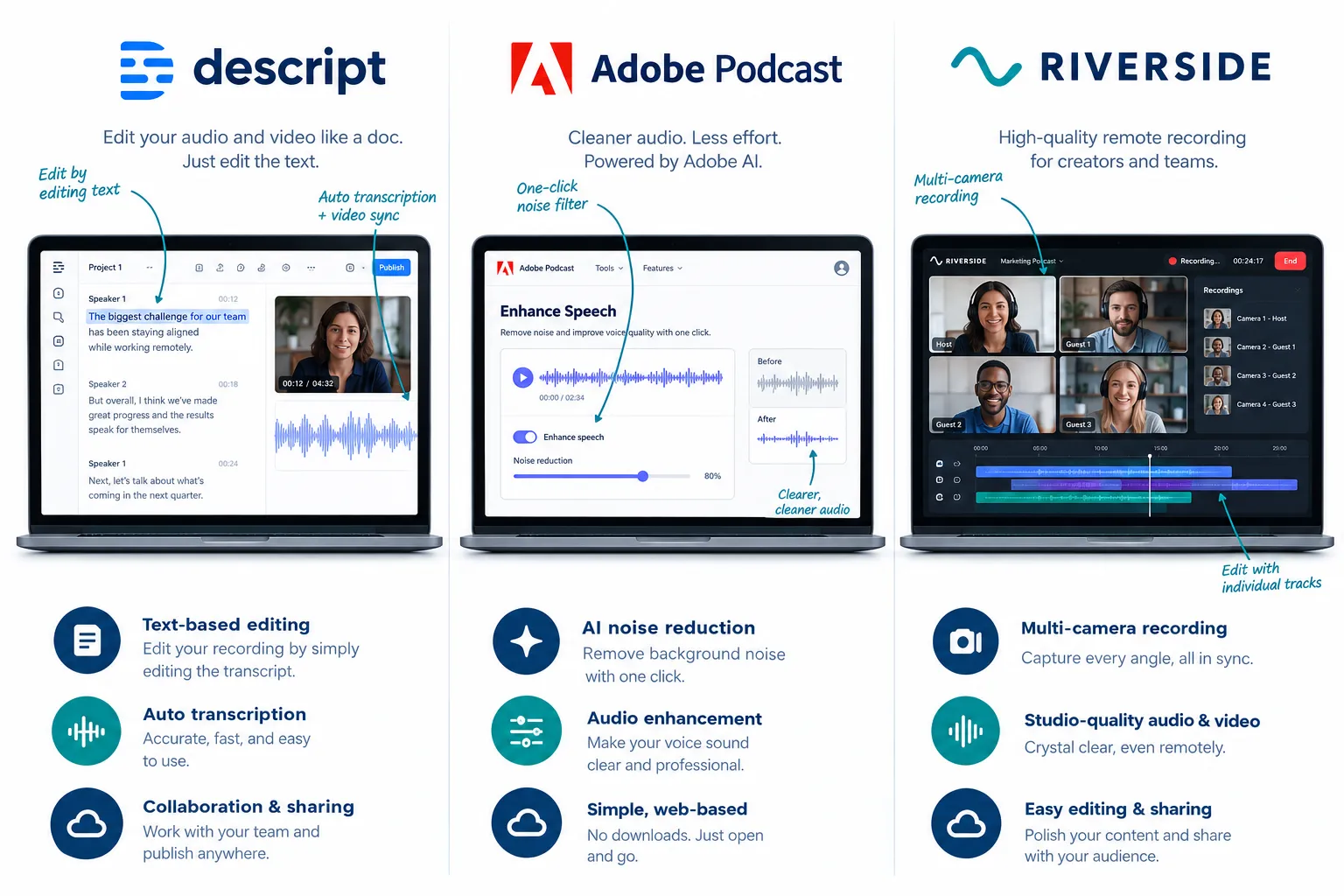
This matters because most podcast editing time goes into cutting ramble, restarts, and dead air. Descript’s transcript view lets you do that the same way you’d edit a Word document, select text, hit delete, done.
Beyond basic cuts, Descript supports WAV, MP3, AAC, AIFF, M4A, and FLAC files, and can publish straight to popular podcast hosts, which removes a step most editors still do manually [1]. Its AI assistant, Underlord, can also write episode titles and show notes, translate into more than 20 languages, and generate a rough cut from a raw recording [1].
Choose Descript if: you edit solo, want to rearrange content by rewriting text, or publish in multiple languages.
How Much Does Descript Cost vs Adobe Podcast Per Month
Adobe Podcast’s core speech enhancement is free, while Descript runs on a freemium model with paid tiers unlocking more transcription hours, export quality, and Underlord features. Adobe’s free tier allows up to 4 hours of enhancement per day with a 1 GB file size limit, which covers most individual episodes comfortably [2][3].
Descript’s pricing structure is different because you’re paying for an editing and production platform, not just a clean-up filter. If your show needs heavy multilingual generation, voice correction, or AI co-editing, that cost difference is justified. If you only need clean speech with no editing, Adobe Podcast’s free plan already does the job.
A practical rule: if your monthly workflow is “record, clean audio, publish,” Adobe Podcast’s free tier may be all you need. If your workflow includes rewriting scripts, cutting takes, or generating notes, Descript’s paid tiers pay for themselves in saved editing time.
Can Riverside Remove Background Noise Automatically
Yes, Riverside’s AI podcast editor includes automatic noise handling as part of its recording and post-production pipeline, though its main strength is assembling full episodes rather than deep audio restoration . Riverside is built around studio-quality remote recording, so each participant’s track is captured locally and cleaned before final mixing.
Riverside also offers Magic Clips, which scans a recorded session and pulls out highlight moments automatically, turning long interviews into short, shareable social clips . That’s a different value proposition than Adobe Podcast’s single-purpose noise filter, Riverside is closer to a full production assistant for interview shows.
Common mistake: assuming Riverside replaces dedicated audio restoration tools for very noisy field recordings. For heavily degraded audio, pairing Riverside’s recording with Adobe Podcast’s Enhance Speech afterward often gives a cleaner result.
Which Tool Is Easiest for Beginners Editing Podcasts
For someone who has never edited audio, Adobe Podcast is the fastest to learn because it’s a single upload-and-process action with no timeline at all [4][5]. You drop in a file, the AI cleans it, and you download the result.
Descript takes a bit longer to learn but rewards that time investment quickly because text-based editing feels familiar to anyone who has used a word processor [1]. Riverside sits in the middle, recording setup is simple, but learning Magic Clips and multi-track export takes a short learning curve.
If you’re completely new and just want clean audio without touching software skills, start with Adobe Podcast. Once you’re comfortable, move to Descript or Riverside depending on whether you record solo or with guests.
Does Adobe Podcast Have Transcription and Editing
Adobe Podcast has moved beyond a pure clean-up tool into a fuller web platform that includes automatic transcription, remote recording, and AI-assisted editing features [2][5][6]. This positions it closer to a lightweight production suite rather than just a noise filter.
The March 2026 update added advanced source separation inside Enhance Speech, letting creators independently adjust speech, background noise, and music, plus download isolated stems for each [7]. That’s a meaningful upgrade for anyone remixing audio or working with background music beds.
Adobe’s FAQ is clear that Enhance Speech works on whatever spoken language is present but doesn’t translate or generate new speech, it cleans existing audio [8]. So transcription and editing exist, but the heavy creative rewriting that Descript offers isn’t part of Adobe’s approach.
Why Choose Descript Over Riverside for Podcasting
Pick Descript over Riverside when your show is scripted, heavily edited, or needs multilingual output, because Descript’s transcript-first workflow and Underlord AI are built for rewriting and language generation, not just recording [1]. Riverside is stronger when the priority is capturing multiple remote guests reliably and turning that session into social clips fast .
A quick decision rule: if you spend more time rewriting and restructuring than recording, go Descript. If you spend more time scheduling guests and repurposing clips for social media, go Riverside.
Neither tool is strictly better, they solve different production bottlenecks. A narrative true-crime podcast benefits from Descript’s editing control. A weekly interview show benefits from Riverside’s recording stability and clip automation.
Free Alternatives to Descript for Podcast Editing
Adobe Podcast’s Enhance Speech is the most practical free alternative if your main need is removing noise and cleaning voice quality, not full editing [2][3][4]. Audacity remains a free open-source option for manual timeline editing, though it lacks AI-driven transcript editing or filler-word detection.
If budget is the main constraint, a realistic free stack looks like this:
- Record with your phone or a basic USB mic.
- Clean audio with Adobe Podcast’s free Enhance Speech tier (up to 4 hours/day, 1 GB per file) [2][3].
- Manually trim in Audacity or your phone’s built-in editor.
- Export and upload directly to your podcast host.
This stack won’t match Descript’s automatic filler-word removal, but it gets a usable episode published at zero cost.
Can You Remove Filler Words Like Um and Uh Automatically
Yes, Descript specifically advertises one-click removal of filler words and background noise as part of its core editing toolkit [1]. Because editing happens at the transcript level, the AI can detect “um,” “uh,” and similar fillers in the text and cut the matching audio automatically.
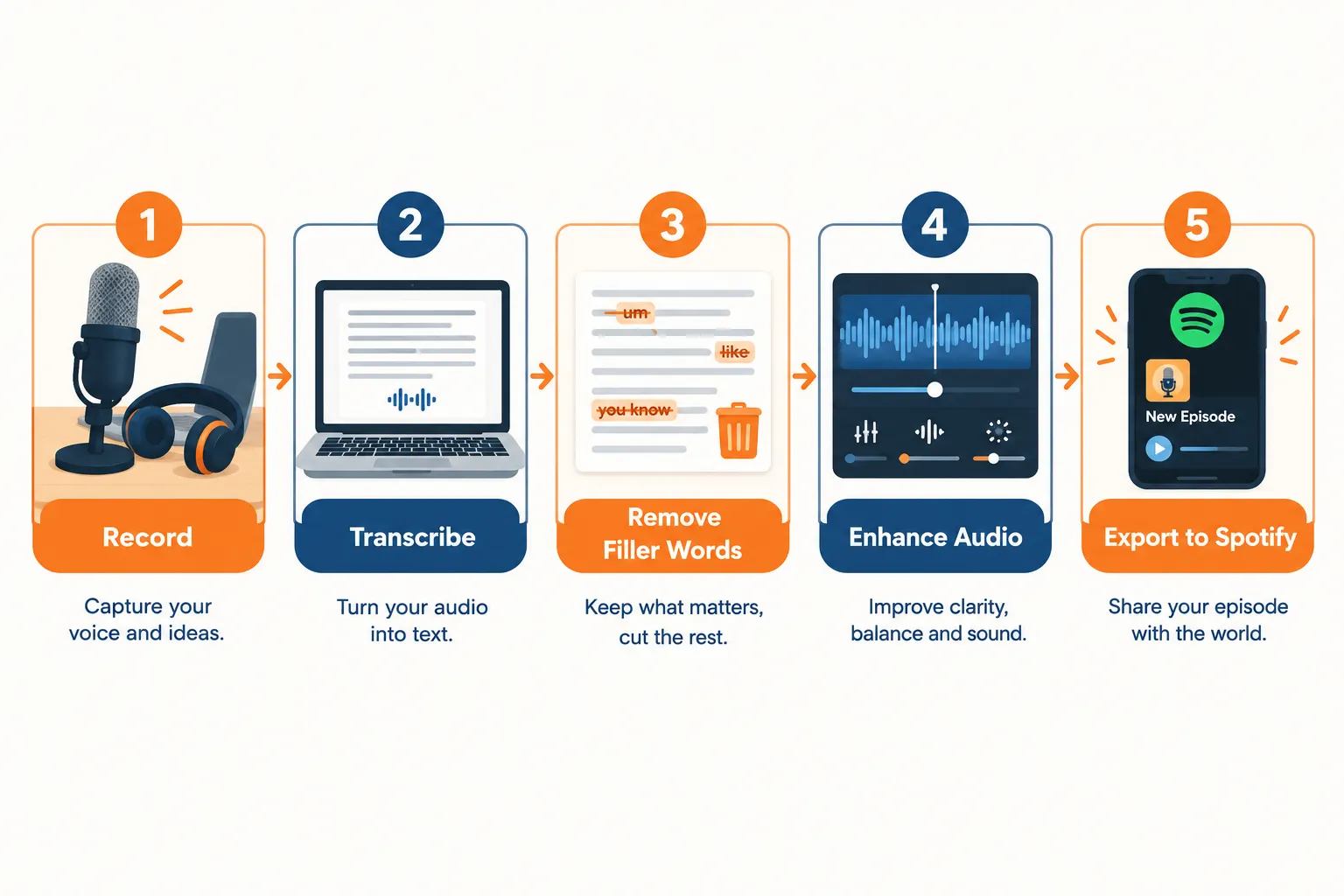
Adobe Podcast and Riverside don’t market dedicated filler-word removal the same way, Adobe focuses on noise and voice clarity [4][8], while Riverside focuses on recording quality and highlight extraction . If filler-word cleanup is your top priority, Descript is the more direct fit among the three.
Edge case: automatic filler removal sometimes cuts words that were intentional pauses for emphasis. Always do a quick listen-through after automated cleanup before publishing.
Does Riverside Work Without Internet Connection
No, Riverside requires an internet connection to start and manage a recording session, since it’s a browser-based platform for remote, multi-guest capture . However, Riverside records each participant’s audio and video locally on their own device during the session, which protects against data loss if someone’s connection drops mid-recording.
This local-recording-plus-cloud-sync approach is a deliberate design choice for interview podcasts: even a shaky internet connection on a guest’s end shouldn’t ruin their final audio quality, because the high-resolution file uploads separately once the session ends.
Best AI Podcast Editor for Solo Podcasters
For someone recording and editing alone, Descript is generally the strongest fit among the three because its transcript-based workflow, filler-word removal, and AI co-editor reduce manual timeline work significantly [1]. Solo creators rarely need Riverside’s multi-guest recording infrastructure, and Adobe Podcast alone doesn’t offer the rearranging and script tools a solo editor often wants.
That said, if a solo podcaster only records short, simple voice notes and wants zero learning curve, Adobe Podcast’s free Enhance Speech tier might be the faster path from raw file to publish-ready audio [4][6].
Can I Export Directly to Spotify From These Tools
Descript supports direct publishing to popular podcast hosting services from within its platform, which can simplify getting an episode from edit to live [1]. Riverside similarly positions itself around end-to-end publishing and distribution after recording and editing . Adobe Podcast, by contrast, is focused on audio enhancement rather than distribution, so you’ll typically export the cleaned file and upload it to your host or Spotify for Podcasters separately [2][4].
If one-click publishing matters to your workflow, weigh that alongside editing style when choosing between Descript and Riverside.
What Are Common Mistakes People Make With Descript
The biggest mistake is treating Descript purely as a transcription tool and skipping the AI editing features that actually save time, like automatic filler-word cuts and Underlord-generated show notes [1]. Another common error is not reviewing AI-suggested cuts before export, automated edits occasionally remove context that changes meaning.
A third mistake: ignoring file format compatibility. Descript supports WAV, MP3, AAC, AIFF, M4A, and FLAC, so importing an unsupported format can cause avoidable friction early in a project [1].
Is Adobe Podcast Worth the Price Compared to Free Options
For creators who only need speech clean-up, Adobe Podcast’s free tier already covers most needs, making the paid Premium tier worth it mainly for heavier daily usage beyond the 4-hour cap or larger files above 1 GB [2][3]. If your show records long-form episodes (3+ hours) or multiple shows per day, the premium plan removes those limits.
For light solo podcasters publishing a 30-45 minute weekly episode, the free tier is usually sufficient, and paying extra wouldn’t add real value yet.
How Do I Fix Audio Sync Issues in Riverside
Audio sync issues in Riverside usually stem from inconsistent internet speed during a session, which can momentarily affect the live preview even though local recordings stay accurate . The fix is almost always in post: re-sync tracks during export, since Riverside uploads each participant’s local high-quality file separately from the live stream.
Practical steps:
- Finish the recording and let all local files upload fully before editing.
- Check each guest’s track individually rather than trusting the live preview timing.
- Use Riverside’s built-in alignment tools to nudge tracks if small offsets appear.
- Re-export and listen to a short section before publishing the full episode.
Comparison at a Glance
| Feature | Descript | Adobe Podcast | Riverside |
|---|---|---|---|
| Editing style | Transcript-based | One-click enhancement | Timeline + Magic Clips |
| Best for | Solo, scripted, multilingual shows | Quick audio clean-up | Interview/panel shows |
| Filler word removal | Yes, automatic [1] | Not a core feature | Not a core feature |
| Works offline | No | Browser-based, needs upload | Needs internet to start |
| Social clip generation | Limited | No | Yes, Magic Clips |
| Free tier | Limited | Yes, 4 hrs/day, 1GB/file [2][3] | Limited |
FAQ
Is Descript better than Adobe Podcast for podcast editing? Descript offers full editing and AI rewriting, while Adobe Podcast focuses on clean-up only. Choose Descript for editing control, Adobe Podcast for quick noise removal [1][4].
Does Adobe Podcast cost money? Adobe Podcast’s Enhance Speech is free up to 4 hours per day and 1 GB per file; a premium tier exists for heavier usage [2][3].
Can Riverside record multiple guests remotely? Yes, Riverside is built around remote multi-guest recording with local backup for each participant .
Does Descript support filler-word removal? Yes, Descript can automatically detect and remove filler words like “um” and “uh” as part of transcript-based editing [1].
Is Adobe Podcast language-specific? No, Enhance Speech works on whatever spoken language is present but doesn’t translate between languages [8].
Which tool is best for interview podcasts? Riverside is generally the strongest fit for interview and panel shows due to its remote recording and Magic Clips features .
Can I download isolated audio tracks from Adobe Podcast? Yes, the March 2026 update added stem downloads for speech, noise, and music separately [7].
Conclusion
Picking between Descript, Adobe Podcast, and Riverside comes down to your actual production pattern, not which tool has the flashiest AI label. If you edit alone and want to rewrite your show like a document, Descript gives you that control. If you just need clean, professional-sounding voice audio without learning an editor, Adobe Podcast’s free tier gets you there fast. If your show depends on remote guests and you want ready-made social clips after every episode, Riverside fits that workflow best.
Try the free tiers of all three with one real episode before committing to a paid plan. That hands-on test tells you more about fit than any feature list. For more practical guidance on AI tools, content workflows, and growing your online presence, explore our AI content repurposing workflow guide and our content marketing resources for next steps on turning podcast content into wider reach. You can also check our AI content repurposing for professionals guide if you plan to turn episodes into blog posts and social clips, and our keyword research guide if you want your show notes to rank in search as well.
References
- Podcasting. descript.com.
- Enhance. podcast.adobe.com.
- Enhance Speech V2. podcast.adobe.com.
- Enhancespeech. podcast.adobe.com.
- Enhance Speech. podcast.adobe.com.
- Record Your Podcast for Free. podcast.adobe.com.
- Whats New in Adobe Podcast March 2026. podcast.adobe.com.
- Adobe Podcast FAQ. helpx.adobe.com.