
Last updated: September 14, 2026
Quick Answer: Generative Engine Optimization (GEO) is the practice of structuring, formatting, and distributing content so that AI-powered search engines, like Google AI Overviews, Perplexity, and ChatGPT Search, cite, quote, or surface your brand in their generated responses. Unlike traditional SEO, which targets ranked blue links, GEO targets the synthesized answer itself. This Generative Engine Optimization Guide covers everything you need to know to get started in 2026 and stay ahead through 2027.
Key Takeaways
- GEO is not a replacement for SEO, it’s a parallel discipline that targets AI-generated answers rather than ranked links.
- AI search engines like Perplexity, Google AI Mode, and ChatGPT Search now synthesize answers from multiple sources, making citation visibility a new marketing metric.
- Direct-answer formatting, entity clarity, and authoritative sourcing are the three biggest drivers of GEO success.
- Small businesses can compete in GEO, AI engines don’t exclusively favor large brands; they favor well-structured, credible content.
- You can run GEO and SEO simultaneously; the two strategies share most of their technical foundations.
- Backlinks still matter in GEO, but third-party mentions, structured data, and Wikidata entity signals carry more weight than in classic SEO.
- Tracking GEO performance requires new tools, standard rank trackers don’t measure AI citation frequency.
- Content freshness is critical: AI engines deprioritize stale, undated content when synthesizing answers.
- The Query Fan-Out Framework (emerging in late 2026) is becoming a core GEO planning tool for mapping how AI systems expand a single query into multiple sub-questions [3].
- Healthcare, finance, and professional services are among the industries most disrupted by AI search, and most in need of GEO strategies [4].
What Is Generative Engine Optimization and How Does It Differ from SEO
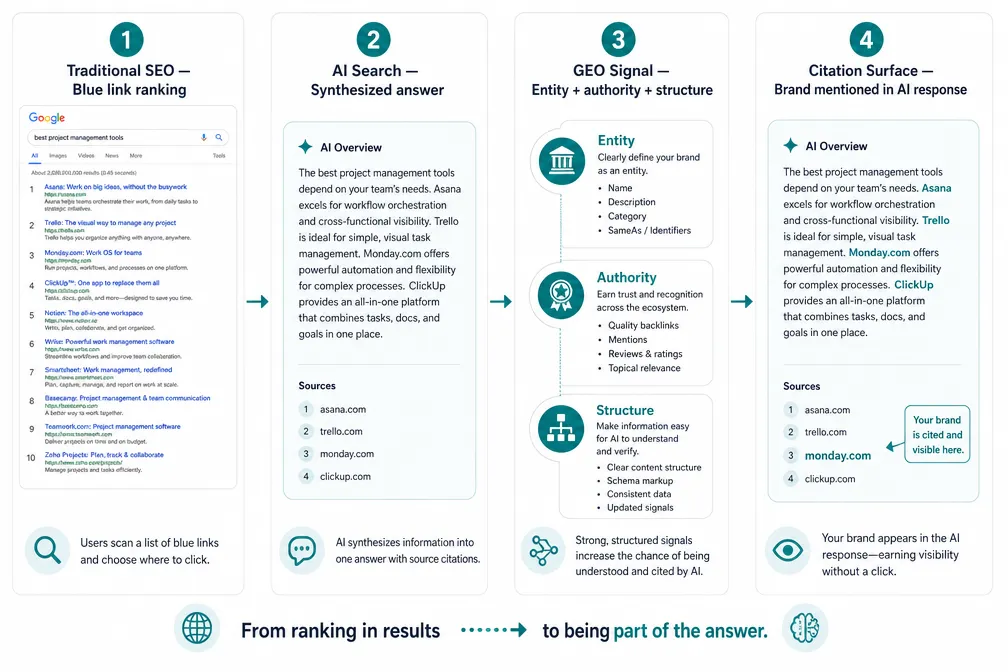
GEO is the discipline of optimizing content to be cited or quoted inside AI-generated answers, not just ranked in a list of links. Traditional SEO earns a position on a results page; GEO earns inclusion in the answer itself.
The core difference comes down to the output format. A classic Google search returns ten blue links. An AI search engine, Google AI Mode, Perplexity, ChatGPT Search, reads dozens of sources and writes a synthesized response, sometimes citing two or three of them. Your goal in GEO is to be one of those cited sources.
Key distinctions at a glance:
| Dimension | Traditional SEO | Generative Engine Optimization |
|---|---|---|
| Target output | Ranked link | Cited passage in AI answer |
| Success metric | Click-through rate, rankings | Citation frequency, brand mentions |
| Primary signal | Backlinks + on-page relevance | Entity authority + answer structure |
| Content format | Long-form keyword content | Direct-answer, self-contained passages |
| Measurement tool | Rank trackers (Ahrefs, SEMrush) | AI visibility trackers (emerging) |
The term “GEO” is sometimes used interchangeably with LLMO (Large Language Model Optimization) or AEO (Answer Engine Optimization), but GEO has become the most widely adopted label in the industry [5][7].
How Do I Optimize Content for AI Search Results Like ChatGPT and Perplexity
Optimizing for AI search means writing content that AI systems can easily read, trust, and quote. The three pillars are: answer-first structure, verifiable claims, and strong entity signals.
Step-by-step approach:
- Lead with the direct answer. Put your clearest, most complete answer in the first 2-3 sentences of every section. AI engines extract passages, not full pages.
- Write self-contained paragraphs. Each paragraph should make sense if lifted out of context. Avoid pronouns without clear antecedents (“it,” “they,” “this”), name the subject explicitly.
- Cite verifiable sources. AI engines weight content higher when claims are backed by named, credible sources. Unsupported assertions get passed over.
- Use structured formatting. Headers, numbered lists, and short tables help AI parsing engines identify discrete facts and definitions.
- State constraints clearly. Specify who the information applies to, when it’s relevant, and what conditions change the outcome. This makes passages more “quoteable.”
- Keep content updated. Add a visible “last updated” date. AI systems use recency as a quality signal [8].
Google’s own AI optimization guidance confirms that clear, helpful, well-structured content written for people, not for algorithms, is the foundation of AI search visibility [8].
Best Practices for Getting Your Website Cited in Generative AI Responses
Getting cited in AI responses depends on three factors: content quality, entity authority, and citation surface area. All three are buildable, even for smaller sites.
Content quality practices:
- Write FAQ-style sections that mirror the exact phrasing of real user questions.
- Use definition blocks (“GEO is…”) at the start of key sections, these are frequently lifted verbatim.
- Include original data, observations, or frameworks that AI engines can’t find elsewhere.
Entity authority practices:
- Ensure your brand, author names, and key topics are represented on third-party platforms (LinkedIn, industry directories, Wikidata where applicable).
- Build consistent NAP (Name, Address, Phone) signals if you’re a local business.
- Earn mentions in industry publications, not just backlinks, AI engines read the web, not just link graphs [7].
Citation surface area practices:
- Publish content that covers a topic’s full “fan-out”, the cluster of related sub-questions AI systems expand into when processing a query [3].
- Distribute content across formats: articles, videos with transcripts, podcast show notes, press releases.
- Get listed in AI-friendly directories and knowledge bases that generative engines regularly crawl [6].
Quick rule: If your content can answer a question completely in one paragraph, it’s more likely to be cited than a 3,000-word article that buries the answer on page two.
Does GEO Matter More Than Traditional SEO in 2027
GEO does not replace traditional SEO in 2027, but it’s no longer optional for brands that depend on organic search traffic. The two disciplines work best together.
Traditional SEO still drives significant traffic through blue-link clicks, especially for navigational and transactional queries. But for informational queries, “what is,” “how to,” “best way to”, AI-generated answers are increasingly the first (and sometimes only) result a user sees. In those cases, zero-click behavior means your SEO ranking may not deliver a visit at all unless you’re also the cited source in the AI answer.
When GEO matters most:
- Your audience asks informational questions (definitions, comparisons, how-tos).
- You operate in a high-trust vertical like healthcare, finance, or legal [4].
- Your brand is newer and hasn’t yet built deep backlink authority.
When traditional SEO still leads:
- High-intent commercial queries (“buy running shoes near me”).
- Brand-name searches where users want your specific site.
- Local search with map pack results.
The practical answer for 2026: invest in both. Most GEO best practices, structured content, E-E-A-T signals, technical site health, directly strengthen your traditional SEO at the same time.
How to Structure Content So AI Engines Understand and Recommend It
AI engines recommend content that is easy to parse, clearly attributed, and directly useful. Structure is a signal, not just a readability aid.
Structural elements that improve GEO performance:
- H2/H3 headings phrased as questions, mirrors how users query AI systems and helps engines match your content to the right query.
- Definition blocks, open key sections with a one-sentence definition of the core term.
- Numbered steps for processes, AI engines reproduce step-by-step formats accurately and frequently.
- Short comparison tables, structured data is easier for language models to parse than prose comparisons.
- Schema markup, FAQ schema, HowTo schema, and Article schema all improve machine readability [8].
- Author bylines with credentials, E-E-A-T signals (Experience, Expertise, Authoritativeness, Trustworthiness) influence which sources AI engines treat as authoritative [8].
Common structural mistake: Writing long, flowing essays with no subheadings. A 1,500-word article with no internal structure is nearly invisible to AI parsing, even if the content is excellent.
What Are Common Mistakes People Make With Generative Engine Optimization
The most common GEO mistake is treating it as a separate strategy from SEO and building two disconnected content workflows. GEO and SEO share the same foundation; the differences are in emphasis and measurement.
Other frequent mistakes:
- Burying the answer. Starting every section with background context before getting to the point. AI engines extract the first clear answer they find, if yours is in paragraph four, it gets skipped.
- Vague entity references. Writing “the company” instead of “Sameer Digital” or “the tool” instead of “Google Search Console.” AI systems need explicit entity names to attribute content correctly.
- Ignoring off-site mentions. Focusing only on on-page optimization while neglecting third-party brand mentions, press coverage, and directory listings that build entity authority [7].
- No freshness signals. Publishing undated content or never updating old articles. AI engines treat stale content as lower-confidence.
- Over-optimizing for one AI engine. Each platform (Google AI Mode, Perplexity, ChatGPT Search) has slightly different citation patterns. Optimizing only for one limits your reach.
- Skipping structured data. Schema markup is low-effort and directly improves how AI engines parse and categorize your content [8].
Which Generative AI Search Engines Should I Optimize For First
For most digital marketers in 2026, the priority order is: Google AI Overviews/AI Mode first, Perplexity second, ChatGPT Search third. This reflects current traffic volume and commercial intent distribution.
Why this order:
- Google AI Mode reaches the largest existing search audience and shares infrastructure with traditional Google Search, so GEO improvements here often lift traditional rankings too [8].
- Perplexity is the fastest-growing dedicated AI search engine and has a highly engaged, research-oriented user base, valuable for B2B and professional services.
- ChatGPT Search has a large user base but is used more for conversational tasks than research-intent queries, making citation conversion rates lower for most content categories.
Edge case: If your audience skews heavily toward tech-savvy or developer communities, prioritize Perplexity and ChatGPT Search earlier, those audiences adopted AI search first and use it most frequently.
How Long Does It Take to See Results From GEO Efforts, and Can You Do GEO and SEO at the Same Time
GEO results typically appear within 4-12 weeks of publishing well-structured, authoritative content, faster than traditional SEO link-building cycles, but dependent on how frequently AI engines re-crawl and re-index your domain.
Yes, you can absolutely run GEO and SEO simultaneously, and you should. The two strategies are not in conflict. In fact, the content practices that improve GEO (direct answers, structured formatting, E-E-A-T signals, fresh content) are the same practices Google’s human-search algorithm rewards.
How to integrate both:
- Apply GEO formatting (answer-first, self-contained paragraphs, FAQ sections) to every new piece of content.
- Continue building backlinks for traditional SEO authority, those same authority signals feed into how AI engines evaluate source credibility.
- Track both traditional rankings and AI citation frequency as separate KPIs.
- Audit existing high-traffic pages for GEO readiness: add definition blocks, update dates, add schema markup.
The only real tension: GEO favors shorter, more direct answers, while some traditional SEO strategies push for maximum word count. Resolve this by being comprehensive but structured, cover every sub-question in its own clearly headed section rather than in long undivided prose.
What Tools Help You Track Generative Engine Optimization Performance
Standard rank trackers don’t measure AI citation frequency, so GEO requires a different measurement stack. The category is still maturing, but several approaches are available now.
Current tracking options:
- Manual prompt testing, query your target keywords directly in Google AI Mode, Perplexity, and ChatGPT Search and record whether your brand is cited. Time-consuming but free and accurate.
- AI visibility platforms, tools specifically built to monitor brand mentions in AI responses are entering the market in 2026, including features in platforms like LLM Pulse [9] and others in the emerging “LLMO tracking” category [2].
- Google Search Console, still valuable for tracking impressions and clicks from AI Overview-adjacent queries; look for queries where impressions are high but CTR is dropping (a signal that AI answers are intercepting clicks).
- Brand mention monitoring, tools like Mention or Brand24 can track when your brand appears in AI-generated content that gets published or shared.
- Query Fan-Out audits, map the sub-questions your target topic expands into, then audit which of those sub-questions your content currently answers [3].
Honest note: GEO measurement is the least mature part of the discipline. Expect the tooling landscape to change significantly through 2027 as platforms build dedicated AI visibility dashboards.
Is GEO Only for Big Brands, or Can Small Businesses Benefit
GEO is not exclusive to large brands. In fact, small businesses and niche publishers often have an advantage in GEO because they can produce highly specific, deeply authoritative content on narrow topics that large brands don’t cover in detail.
AI engines don’t rank by brand size, they rank by content quality, structural clarity, and entity authority. A well-structured article from a small specialist can outperform a generic overview from a major publication if it answers the question more directly and completely.
How small businesses can compete:
- Focus on a tight topic cluster where you have genuine expertise, AI engines reward depth over breadth.
- Build entity authority through local citations, industry directory listings, and consistent author profiles [6].
- Publish original observations, small-scale experiments, or niche case studies that larger publishers won’t bother with.
- Answer hyper-specific questions that broad content farms skip over.
The commercial adoption of GEO services is accelerating, agencies are now packaging GEO alongside traditional SEO [6], which means small businesses have growing access to professional GEO support without needing to build in-house expertise from scratch.
How Do Backlinks and Citations Work Differently in Generative Engine Optimization
Backlinks still matter in GEO, but they’re no longer the dominant signal they are in traditional SEO. AI engines evaluate a broader set of authority signals, including unlinked brand mentions, entity consistency, and third-party citation patterns.
How citations work in GEO:
- Unlinked mentions count. If a credible publication mentions your brand or quotes your content without linking to you, AI engines can still register that as an authority signal.
- Entity consistency matters. Your brand name, author names, and key claims should appear consistently across your site, social profiles, and third-party sources, inconsistency reduces entity confidence.
- Source diversity beats link volume. Being mentioned across many different credible domains (even without links) signals broader authority than having many links from a narrow set of sources [7].
- Wikidata and knowledge graph presence, for brands and authors with sufficient public profile, a Wikidata entry or Google Knowledge Panel strengthens entity recognition in AI systems.
What hasn’t changed: Content from sites with strong traditional backlink profiles still earns more AI citations on average, because backlink authority correlates with the trustworthiness signals AI engines also value.
What Content Format Works Best for Generative AI Engines, and How Often Should I Update It
The content formats that perform best in GEO are: FAQ sections, definition blocks, numbered step guides, and short comparison tables. These formats are easy for AI engines to parse and reproduce accurately.
Long-form narrative content still has value, but only when it’s broken into clearly headed, self-contained sections. An unbroken 2,000-word essay is harder for AI systems to extract from than a 1,200-word article with eight well-labeled sections.
Update frequency guidance:
- High-velocity topics (AI tools, search algorithm changes): update every 1-3 months.
- Evergreen how-to content: review and refresh every 6 months; update the “last updated” date when you make changes.
- Definitional content (“what is GEO”): update annually or when the definition meaningfully evolves.
- Data-driven content: update whenever the underlying data changes, stale statistics are a GEO liability.
AI engines use content freshness as a quality proxy. A page last updated in 2023 will lose citation priority to a comparable page updated in 2026, all else being equal.
FAQ
What does GEO stand for? GEO stands for Generative Engine Optimization, the practice of optimizing content to be cited or quoted in AI-generated search responses from engines like Google AI Mode, Perplexity, and ChatGPT Search.
Is GEO the same as AEO (Answer Engine Optimization)? They overlap significantly. AEO focuses on earning featured snippets and voice search answers; GEO specifically targets AI-generated responses from large language model-based engines. Most practitioners treat GEO as the broader, more current term.
Do I need technical SEO skills to do GEO? Basic technical SEO knowledge helps, especially schema markup and site structure, but GEO is primarily a content strategy discipline. Writers and content strategists can implement most GEO practices without deep technical expertise.
Will GEO hurt my traditional SEO rankings? No. GEO best practices (structured content, E-E-A-T, direct answers, fresh content) align with what Google’s traditional algorithm also rewards. There’s no known trade-off.
How do I know if an AI engine has cited my content? Manual testing (querying AI engines directly) is the most reliable method currently. Dedicated AI visibility tracking tools are emerging but not yet standardized as of late 2026.
Is schema markup required for GEO? Not strictly required, but strongly recommended. FAQ schema, HowTo schema, and Article schema all improve how AI engines parse and categorize your content, increasing citation probability.
What’s the single most important GEO change I can make today? Rewrite the opening paragraph of your most important pages to lead with a direct, complete answer to the page’s primary question, before any background context. This single change improves AI extractability more than almost any other tactic.
Can GEO work for e-commerce sites? Yes, especially for product category pages and buying guides. Optimizing those pages with direct-answer introductions, comparison tables, and FAQ sections can earn citations in AI shopping and research queries.
Conclusion
GEO is not a trend to watch, it’s a discipline to start building now. AI search engines are already the first touchpoint for millions of informational queries, and that share is growing through 2027. The brands and publishers that earn citations in those AI-generated answers will capture attention that never reaches a traditional search results page.
The good news: most of what makes content GEO-ready also makes it better for traditional SEO, for readers, and for your brand’s overall credibility. You’re not rebuilding your content strategy, you’re sharpening it.
Your next steps:
- Audit your top 10 pages for GEO readiness: do they lead with a direct answer? Are sections clearly headed? Is there a visible “last updated” date?
- Add FAQ sections to your highest-traffic informational pages using question phrasing that mirrors real user queries.
- Implement FAQ and Article schema on your core content pages.
- Start manual prompt testing, query your target topics in Google AI Mode and Perplexity weekly to track whether your brand is being cited.
- Map the query fan-out for your most important topics and identify content gaps where AI engines are pulling from competitors instead of you.
- Build entity authority off-site, update your LinkedIn, industry directories, and author profiles to ensure consistent entity signals across the web.
This Generative Engine Optimization Guide will be updated as the discipline evolves. Bookmark it and check back.
References
[1] Generative Engine Optimisation Azoma Geo 120600787 – https://finance.yahoo.com/technology/ai/articles/generative-engine-optimisation-azoma-geo-120600787.html [2] anythingengineoptimization – https://anythingengineoptimization.com/ [3] Query Fan Out Framework Targets Llm Visibility In Ai Search – https://www.desmoinesregister.com/press-release/story/120630/query-fan-out-framework-targets-llm-visibility-in-ai-search/ [4] AI Search Rewrites the Rules: Healthcare, Finance, and Professional Services Among Five Industries Hit Hardest – https://www.malaymail.com/news/money/mediaoutreach/2026/09/10/ai-search-rewrites-the-rules-healthcare-finance-and-professional-services-among-five-industries-hit-hardest-geniushub-ranking-first-no-longer-means-being-seen/486257 [5] Generative Engine Optimization – https://smartmoneymedia.org/guides/generative-engine-optimization [6] Seopack Adds Ai And Generative Engine Optimization To Its Seo Service Portfolio – https://markets.businessinsider.com/news/stocks/seopack-adds-ai-and-generative-engine-optimization-to-its-seo-service-portfolio-1036511141 [7] Awesome Generative Engine Optimization – https://github.com/amplifying-ai/awesome-generative-engine-optimization [8] AI Optimization Guide – https://developers.google.com/search/docs/fundamentals/ai-optimization-guide [9] GEO Guide – https://llmpulse.ai/blog/geo-guide/ [10] Boomcycle Digital Marketing Publishes Free Digital Marketing Glossary For AI Search Era – https://www.usatoday.com/press-release/story/42572/boomcycle-digital-marketing-publishes-free-digital-marketing-glossary-for-ai-search-era/