Last updated: September 15, 2026
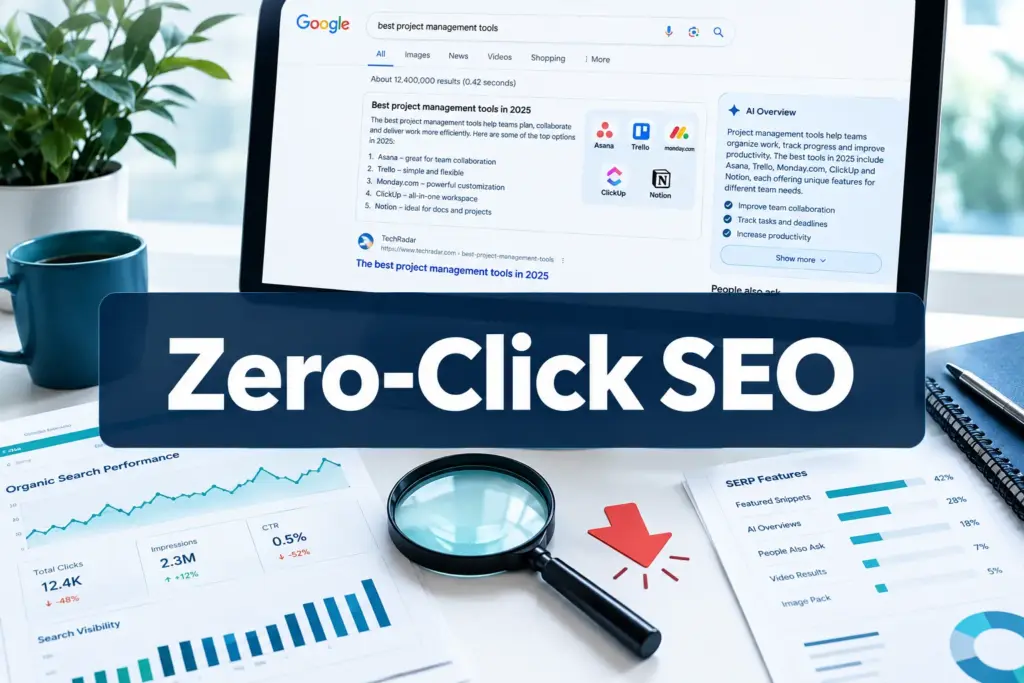
Quick Answer: Zero-click SEO is the practice of optimizing your content to appear in Google’s featured snippets, AI Overviews, knowledge panels, and other SERP features that answer a user’s question directly on the search results page, without requiring a click to your website. Winning at zero-click SEO means treating search visibility, brand attribution, and AI citations as primary KPIs alongside raw traffic numbers.
Key Takeaways
- Over 58% of Google searches in the US now end without a click to any website [5]
- Zero-click SEO shifts your goal from “get the click” to “own the answer”, brand visibility inside SERP features is the new metric that matters
- Featured snippets, AI Overviews, knowledge panels, and People Also Ask boxes are the main zero-click real estate worth targeting
- Structured data, answer-first content formatting, and FAQ sections are the highest-leverage technical moves
- Local businesses and bottom-funnel queries remain more resilient to zero-click loss than informational content
- Google Search Console impressions data is your most direct tool for measuring zero-click visibility
- Industries like health, finance, recipes, and basic how-to content face the steepest click-loss exposure
- You can still generate leads and revenue from zero-click exposure, brand recall, direct searches, and AI citations all feed your funnel
What Is Zero-Click Search and Why Is It Happening
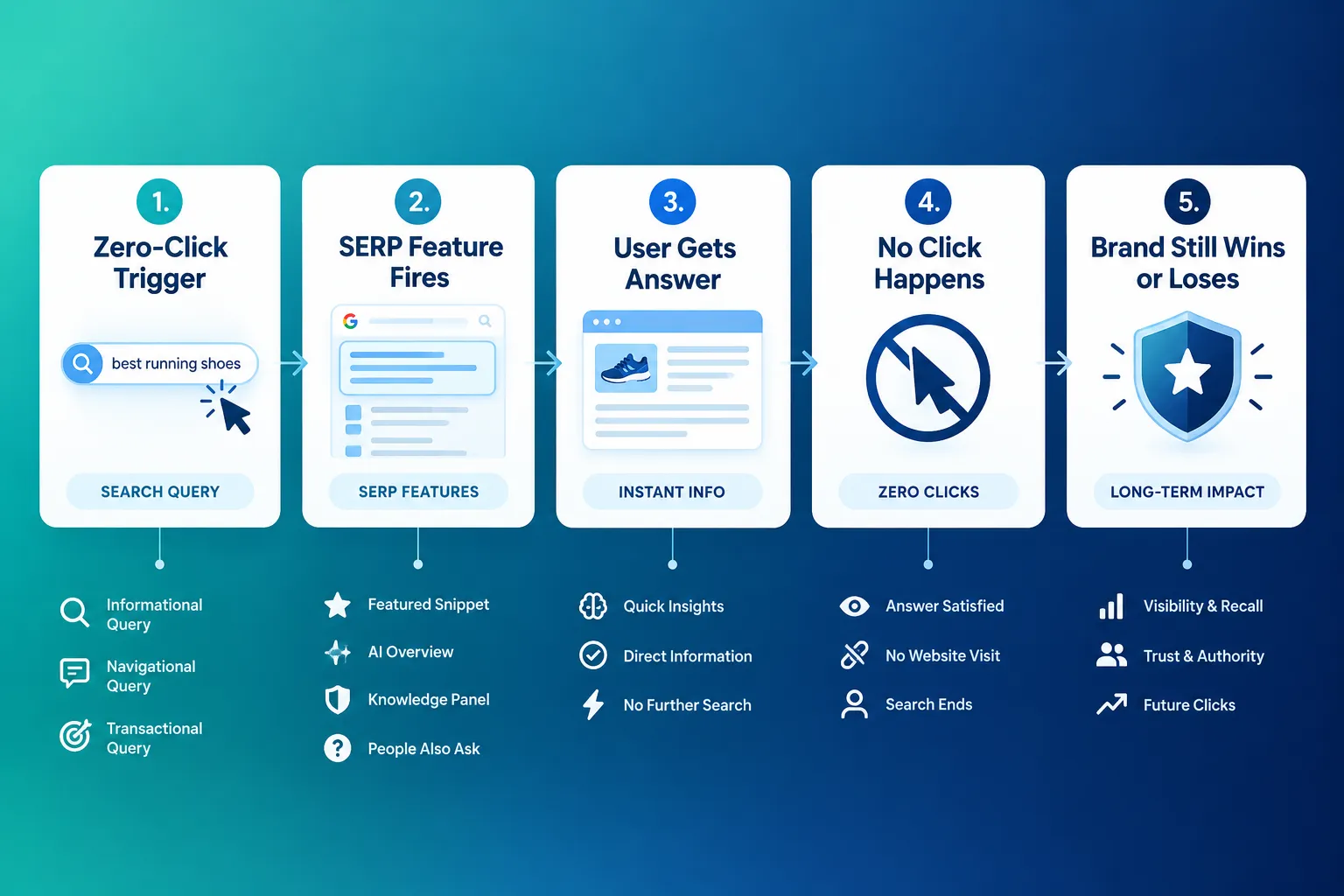
Zero-click search happens when Google answers a query directly on the search results page, so the user gets what they need without clicking any result. It’s not a bug, it’s Google’s stated goal of making search faster and more useful.
The reasons it’s accelerating in 2026 are structural. Google has been adding SERP features, featured snippets, knowledge panels, AI Overviews, People Also Ask boxes, calculators, weather widgets, for years. The launch of AI Overviews (formerly Search Generative Experience) pushed this further by synthesizing multi-source answers at the top of the page [1]. Users get a complete response before they ever see the blue links. For informational queries especially, there’s often no reason left to click.
This isn’t going to reverse. Google’s incentive is to keep users on Google. That’s the honest context you need to build your strategy around.
How Much Search Traffic Goes to Zero-Click Results
The numbers are significant and have been climbing steadily. According to Semrush research, more than 58% of US Google searches end without a click to an external website [5]. On mobile, that figure is even higher.
A few important nuances:
- Not all zero-click searches represent lost opportunity. Many are navigational (people typing a brand name directly) or transactional queries where Google shows a direct answer like a phone number or store hours.
- The loss is concentrated in informational content. How-to queries, definition searches, quick facts, and comparison questions are where click-through rates have dropped most sharply [2].
- AI Overviews are accelerating the trend. Early data from 2025-2026 shows that queries triggering AI Overviews see meaningfully lower CTR to organic results below the fold [1][9].
The practical implication: if a large portion of your organic traffic comes from informational content, your click volume is likely declining even if your impressions are stable or growing.
Zero-Click SEO vs. Traditional Organic Traffic: What Actually Changes
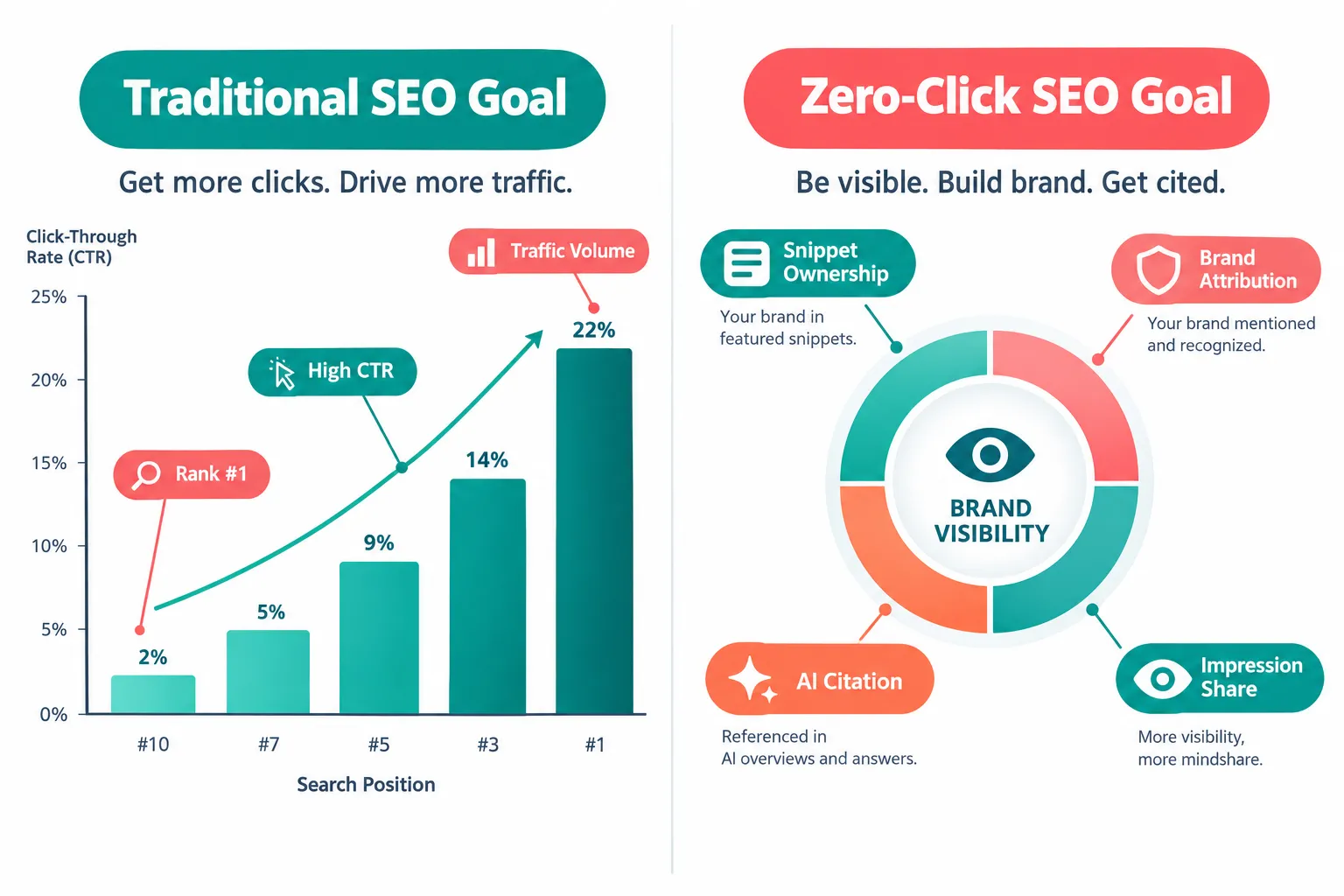
Traditional SEO success was measured in clicks, sessions, and rankings. Zero-click SEO requires a different scorecard.
| Metric | Traditional SEO | Zero-Click SEO |
|---|---|---|
| Primary goal | Rank #1, earn click | Own the SERP feature |
| Success KPI | CTR, sessions, conversions | Impressions, brand mentions, AI citations |
| Content format | Long-form, keyword-rich | Answer-first, structured, citable |
| Technical focus | Page speed, crawlability | Structured data, schema markup |
| Measurement tool | GA4 sessions | GSC impressions + position tracking |
The shift isn’t about abandoning traditional SEO. It’s about adding a second layer of intent: write content that Google can extract and display, not just content that ranks and gets clicked [10].
How to Optimize for Featured Snippets and Knowledge Panels
Featured snippets appear for roughly 12-13% of all searches, and they capture a disproportionate share of attention even when they reduce clicks [6]. Optimizing for them is the most direct zero-click SEO tactic available.
For featured snippets:
- Identify snippet-eligible queries. Look for question-based keywords where Google already shows a snippet. Tools like Semrush’s Position Tracking or Ahrefs will flag these.
- Format your answer for extraction. Place a concise 40-60 word direct answer immediately after the H2 heading that matches the query. Don’t bury it.
- Use the right format. Paragraph snippets work for definitions and explanations. Numbered lists work for steps. Bullet lists work for comparisons. Tables work for structured data.
- Add FAQ schema. Marking up your FAQ section with structured data increases the chance Google surfaces your content in rich results [5][10].
For knowledge panels:
Knowledge panels pull from Google’s Knowledge Graph, which is heavily influenced by Wikipedia, Wikidata, your Google Business Profile, and consistent entity data across the web. For brands, this means:
- Keep your Google Business Profile fully updated
- Ensure your brand name, founding date, and description are consistent across all major directories
- Build authoritative backlinks that reinforce your brand as a named entity
Best Zero-Click SEO Strategies to Get Traffic When Google Answers the Question
The goal isn’t just to appear in SERP features, it’s to use that visibility to drive brand recall, direct traffic, and bottom-funnel conversions. Here’s what actually works [3][10]:
1. Own the snippet, then convert downstream When your brand answers the question inside a featured snippet or AI Overview, users associate the answer with you. That brand attribution drives direct searches and return visits, even without an immediate click [1].
2. Target bottom-funnel queries aggressively Transactional queries (“best CRM for small business,” “hire SEO agency in Chicago”) still generate clicks at much higher rates than informational ones. Shift content investment toward comparison pages, product landing pages, and service pages [8].
3. Build for AI citation AI Overviews and tools like Perplexity and ChatGPT pull from structured, authoritative content. Write self-contained passages with clear entity references, specific data points, and cited sources. This is generative engine optimization (GEO) applied to zero-click SEO [4][9].
4. Use schema markup strategically FAQ, HowTo, Product, LocalBusiness, and Article schema all increase your content’s extractability. This is one of the highest-ROI technical SEO moves in 2026 [5][10].
5. Strengthen your brand search volume Zero-click exposure increases branded searches. Track your branded query volume in Google Search Console as a downstream indicator that your SERP presence is building real awareness.
Zero-Click SEO for Local Businesses vs. National Brands
Local businesses and national brands face very different zero-click realities, and the strategies diverge accordingly.
Local businesses actually have a structural advantage. Google’s local pack, Maps results, and Business Profile features are zero-click in format but often drive direct phone calls, direction requests, and in-store visits, none of which show up as website clicks. A restaurant with 500 monthly “get directions” taps from Google Maps is winning zero-click SEO even if their website traffic is flat [7].
For local SEO, the priorities are:
- Complete, accurate Google Business Profile with updated hours, photos, and services
- Reviews (volume and recency both matter)
- Local schema markup on your website
- Consistent NAP (name, address, phone) data across directories
National brands and publishers face a harder path. Informational content, the bread and butter of content marketing, is most exposed to zero-click loss. The strategic response is to shift toward proprietary data, original research, and content formats that can’t be easily summarized in a snippet (interactive tools, in-depth comparisons, case studies).
Does Zero-Click Traffic Hurt Your Website or Is It Actually Good
It depends on what you’re measuring and what your business model is.
Where it genuinely hurts: Publishers and media sites that monetize through display advertising are directly harmed by lower click volumes. If your revenue model requires pageviews, zero-click search is a real problem [2][9].
Where it’s neutral or positive: For most businesses selling products or services, the click was never the end goal, a lead or sale was. If your brand appears in a featured snippet answering a question your target customer is asking, that builds awareness and trust even without a click. Studies on brand lift from SERP feature exposure support this [1][3].
The honest answer: Zero-click search redistributes value from content publishers to search engines. For businesses with strong brand equity and bottom-funnel content, the impact is manageable. For sites that depend on high-volume informational traffic to monetize ads, it’s a structural challenge that requires a content strategy pivot.
Which Industries Are Most Affected by Zero-Click Search Results
Not all industries are equally exposed. The degree of impact depends on the query types that drive your traffic [5][8].
High exposure (most affected):
- Health and medical information (symptoms, drug definitions, basic diagnoses)
- Finance (interest rate definitions, basic tax questions, currency conversions)
- Recipes and food content
- Weather, sports scores, and real-time data
- Basic how-to and DIY content
Moderate exposure:
- Travel (destination overviews, visa requirements)
- Education (course definitions, degree explanations)
- Technology (product specs, basic tutorials)
Lower exposure (more resilient):
- Legal and professional services (high-stakes, nuanced queries)
- B2B SaaS and enterprise software (complex buying decisions)
- E-commerce with strong brand differentiation
- Local service businesses (plumbers, dentists, agencies)
If your site is in a high-exposure category, the strategic priority is moving traffic toward content that requires depth, nuance, or a decision, things Google can’t fully resolve in a snippet.
How to Track and Measure Zero-Click Visibility
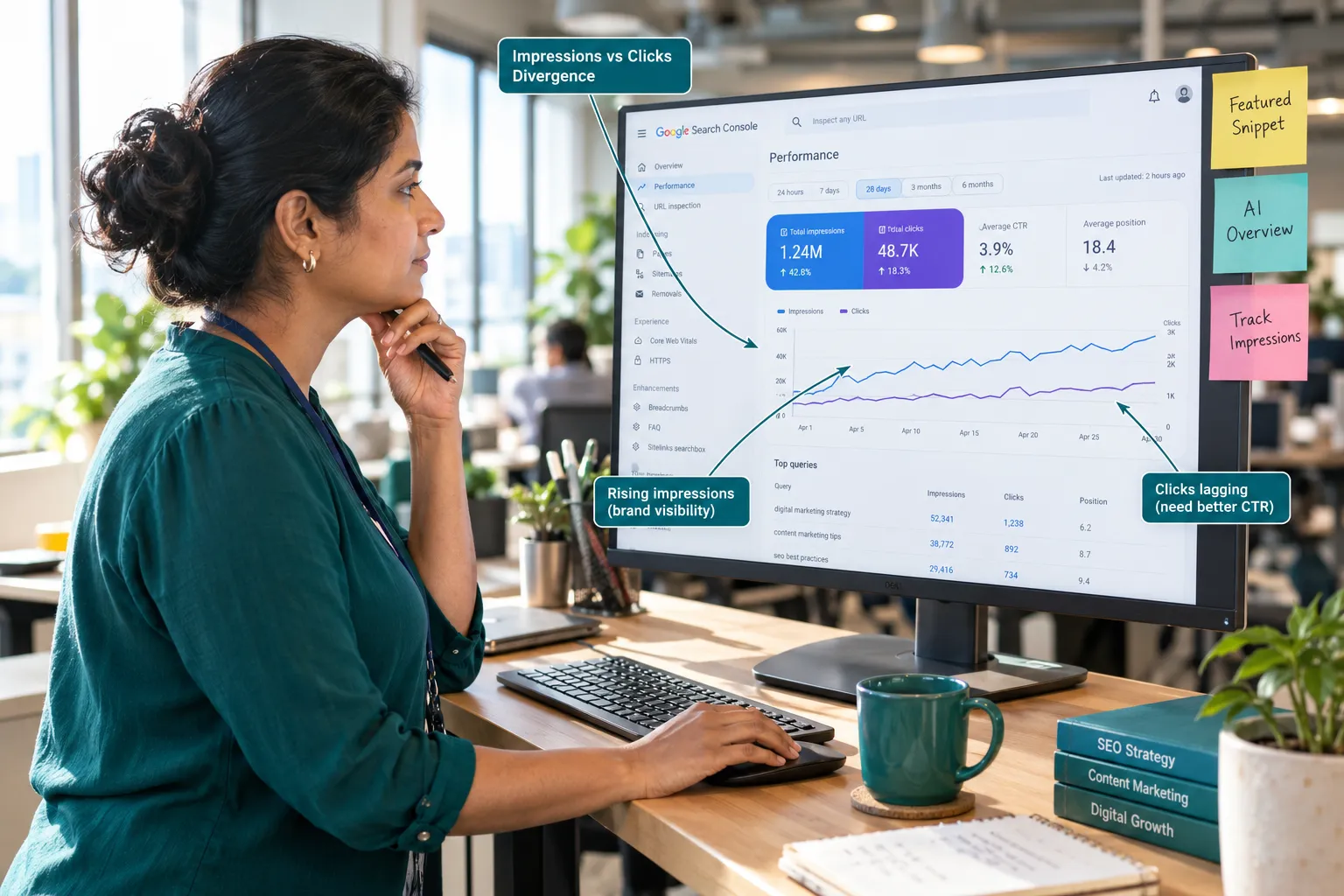
Standard analytics tools miss most of this. GA4 shows you clicks and sessions, it doesn’t show you how many times your content appeared in a featured snippet without being clicked.
Google Search Console is your primary tool. Here’s the practical method:
- Open GSC → Performance → Search Results
- Enable both Impressions and Clicks columns
- Filter by query type or page
- Look for queries with high impressions but disproportionately low CTR, these are your zero-click exposure candidates
- Cross-reference with SERP feature data from Semrush or Ahrefs to confirm whether a snippet or AI Overview is suppressing clicks [2][5]
Additional signals to track:
- Branded search volume trends (rising brand searches = zero-click awareness working)
- Direct traffic trends in GA4
- Position tracking for featured snippet ownership in Semrush or Ahrefs
- AI citation monitoring tools (emerging category in 2026) for tracking mentions in ChatGPT, Perplexity, and Gemini responses [9]
Common Mistakes People Make Trying to Rank for Featured Snippets
Most zero-click SEO mistakes come from misunderstanding what Google is actually extracting.
- Burying the answer. Placing your direct response three paragraphs into a section almost guarantees Google won’t extract it. The answer needs to be the first thing after the relevant heading.
- Writing for humans only, not for extraction. Conversational prose is great for readers but hard for algorithms to parse. Use clear headings, short paragraphs, and structured formats (lists, tables) alongside your prose.
- Ignoring schema markup. Content without structured data is harder for Google to categorize and display. FAQ schema alone can significantly increase rich result eligibility [10].
- Targeting the wrong queries. Chasing high-volume informational queries where Google already has a strong snippet is less effective than finding mid-volume queries where the current snippet is weak or absent.
- Not tracking snippet ownership. Many teams optimize for snippets but never confirm whether they actually won them. Set up position tracking specifically for snippet-eligible queries.
Can You Still Make Money With Zero-Click SEO Traffic
Yes, but the revenue path is less direct, and you need to design for it intentionally.
The brands that are monetizing zero-click visibility in 2026 are doing it through three main mechanisms:
Brand attribution driving direct conversions. When your brand consistently answers questions in your category, users come back directly when they’re ready to buy. This shows up as direct traffic and branded search conversions, not as organic click revenue.
Bottom-funnel content that still earns clicks. Comparison pages, “best X for Y” content, and service landing pages still generate clicks because the user intent is commercial, not just informational. These pages convert at higher rates anyway.
AI citation as a trust signal. Being cited in AI Overviews, Perplexity answers, or ChatGPT responses builds credibility with users who then seek you out. This is an emerging but real revenue channel for SaaS companies and agencies in particular [1][4].
The content strategy pivot is: spend less on high-volume informational content that feeds Google’s snippets with no return, and spend more on content that sits at the intersection of your audience’s questions and their buying decision.
How to Pivot Your Content Strategy for Zero-Click Search
A zero-click SEO content strategy isn’t about writing less, it’s about writing smarter.
Audit your existing content first. Pull your top informational pages in GSC. If they have high impressions and low CTR, check whether a featured snippet or AI Overview is present. Those pages are candidates for either restructuring (to win the snippet and build brand attribution) or pivoting (to add a commercial angle that earns clicks).
Shift your content mix toward:
- Original research and proprietary data (hard to summarize in a snippet)
- Detailed comparison content with specific use-case recommendations
- Case studies and client results (builds trust, can’t be replicated by AI)
- Interactive tools and calculators (require a click by definition)
- Video content embedded in articles (Google can’t fully extract video in a snippet)
Restructure existing content for extraction:
- Add a direct answer paragraph at the top of each major section
- Include an FAQ section on every page targeting question-based queries
- Add structured data markup (FAQ, HowTo, Article schema)
- Use clear, descriptive H2 and H3 headings that mirror search queries
Track the right metrics going forward: impressions, snippet ownership rate, branded search volume, and AI citation frequency, alongside your traditional traffic and conversion numbers.
FAQ
What is zero-click SEO in simple terms? Zero-click SEO is optimizing your content to appear in Google’s answer features (featured snippets, AI Overviews, knowledge panels) so your brand gets visibility even when users don’t click through to your website.
Is zero-click search bad for SEO? It depends on your business model. For ad-supported publishers, lower click volumes reduce revenue. For businesses selling products or services, zero-click visibility builds brand awareness that drives conversions through other channels.
Which SERP features count as zero-click? Featured snippets, AI Overviews, knowledge panels, People Also Ask boxes, local packs, calculators, weather widgets, sports scores, and direct answer boxes all deliver information without requiring a click.
How do I know if my site is losing traffic to zero-click results? In Google Search Console, look for queries with high impressions but unusually low CTR (under 1-2%). Cross-reference with a SERP checker to confirm whether a featured snippet or AI Overview is present for those queries.
Does structured data help with zero-click SEO? Yes. Schema markup (FAQ, HowTo, LocalBusiness, Product) makes your content easier for Google to parse and display in rich results. It’s one of the highest-impact technical moves for zero-click optimization.
Can local businesses benefit from zero-click search? Yes. Local businesses often benefit because zero-click features like Google Maps, Business Profiles, and local packs drive phone calls and in-store visits, which don’t require a website click but still represent real business value.
What’s the difference between zero-click SEO and GEO (generative engine optimization)? Zero-click SEO focuses on traditional SERP features like featured snippets and knowledge panels. GEO (generative engine optimization) focuses specifically on getting cited in AI-generated answers from tools like Google AI Overviews, ChatGPT, and Perplexity. In practice, the tactics overlap significantly.
How important is brand visibility in zero-click results? Increasingly central. In 2026, brand attribution inside SERP features is treated as a primary KPI by leading SEO teams, because it drives direct searches, return visits, and AI citations that feed the broader marketing funnel.
What content formats are hardest for Google to summarize in a snippet? Original research with proprietary data, interactive tools, detailed case studies, video content, and complex multi-variable comparisons are all harder to reduce to a single snippet answer.
How do I track AI citations for my brand? This is an emerging category. Tools like Semrush, BrightEdge, and dedicated AI visibility platforms are building citation tracking features. You can also manually test key queries in ChatGPT, Perplexity, and Gemini to see whether your brand or content appears.
Conclusion
Zero-click SEO isn’t a crisis, it’s a recalibration. Google has changed what “winning” looks like in search, and the teams that adapt fastest will come out ahead.
The core shift is this: stop measuring only clicks and start measuring presence. If your brand appears in featured snippets, AI Overviews, and knowledge panels for the questions your target customers are asking, you’re building awareness and trust at the top of the funnel, even when no click happens.
Your practical next steps:
- Open Google Search Console this week and pull your top 20 pages by impressions. Flag any with CTR under 2%, those are your zero-click exposure candidates.
- Pick three pages and restructure them with answer-first paragraphs, FAQ sections, and schema markup.
- Audit your content mix. If more than 60% is informational, start shifting investment toward comparison content, original research, and bottom-funnel pages.
- Set up position tracking in Semrush or Ahrefs specifically for featured snippet ownership on your target queries.
- Test your brand’s presence in ChatGPT, Perplexity, and Google AI Mode for your key category queries. That’s your AI citation baseline.
Zero-click search is not going away. But brands that treat visibility as a KPI, not just traffic, will find it’s a very winnable game.
References
[1] Goodbye Clicks Hello Ai Zero Click Search Redefines Marketing – https://www.bain.com/insights/goodbye-clicks-hello-ai-zero-click-search-redefines-marketing/ [2] Zero Click Searches – https://searchengineland.com/guide/zero-click-searches [3] Win Visibility Zero Click Search – https://www.imaginuity.com/blog/win-visibility-zero-click-search/ [4] Zero Click Search – https://www.optimizegeo.ai/blog/zero-click-search [5] Zero Click Searches – https://www.semrush.com/blog/zero-click-searches/ [6] Serp Features Clicks Visibility – https://www.contentgrip.com/serp-features-clicks-visibility/ [7] Zero Click Search – https://www.seo-kreativ.de/en/blog/zero-click-search/ [8] Zero Click Searches – https://www.seo.com/blog/zero-click-searches/ [9] Zero Click Shift Ai Search – https://www.siteimprove.com/blog/zero-click-shift-ai-search/ [10] Zero Click Seo How To Stay Visible When No One Clicks – https://42dm.net/zero-click-seo-how-to-stay-visible-when-no-one-clicks/