

Last updated: October 20, 2026
Most real estate agents chase lead volume and wonder why their calendar stays empty. The agents who actually close deals in 2027 will focus on lead quality first, using AI-driven tools, local SEO, and smarter nurture systems instead of just spending more on ads.
Quick Answer
Real estate digital marketing in 2027 works best when agents combine local SEO, video content, AI-powered lead scoring, and personalized nurture sequences instead of relying only on paid ads. Qualified leads come from channels that show buying or selling intent, not just form fills. The 12 strategies below cover platforms, budgets, timelines, and the mistakes that quietly waste agent marketing spend.
Key Takeaways
- A qualified real estate lead shows intent signals: timeline, budget readiness, and a specific property or neighborhood interest.
- Database reactivation and referral-based leads convert better than cold paid traffic in most markets.
- Local SEO and a complete Google Business Profile remain the foundation of consistent inbound leads.
- Video content and virtual tours are becoming a primary lead-generation engine, not just a nice-to-have.
- New agents should budget more for ads; experienced agents should invest in automation and database mining.
- Most agents fail not because of bad ads but weak follow-up and no lead qualification system.
- Facebook Ads tend to suit broad-reach branding; Google Ads suit high-intent, bottom-of-funnel searches.
- Expect 60 to 90 days of consistent effort before digital channels produce steady qualified leads.
What Counts as a Qualified Lead in Real Estate
A qualified real estate lead is someone who has a defined timeline (usually within 3 to 6 months), a realistic budget, and a specific reason to buy or sell, not just curiosity. Someone browsing listings for fun on a Sunday night is not the same as someone who filled out a home valuation form after getting a job transfer notice.
Agents should score leads using a simple framework before investing follow-up time:
- Timeline: Are they moving in weeks, months, or “someday”?
- Motivation: Job change, growing family, downsizing, investment, or divorce?
- Financial readiness: Pre-approved, exploring, or just browsing?
- Engagement depth: Did they request a valuation, book a call, or just click an ad?
A lead that scores high on three of these four points is worth immediate follow-up. One that scores low on all four should go into a long-term nurture list, not a daily call sheet.
How Do I Know if a Real Estate Lead Is Actually Interested
A lead shows genuine interest when their behavior matches their stated intent, such as repeatedly viewing the same property type, replying to messages within hours, or asking specific questions about financing or neighborhoods. Generic replies like “just looking” or no response after two follow-ups usually signal low intent.
Practical signs of real interest include:
- Opening multiple emails in a drip sequence instead of unsubscribing
- Asking about school districts, HOA fees, or closing timelines
- Engaging with retargeting ads by clicking through to specific listings
- Responding quickly to SMS or WhatsApp check-ins
This is where a solid email marketing foundation matters. Tracking opens, clicks, and reply patterns gives agents real behavioral data instead of guessing based on a single form submission.
Best Digital Marketing Platforms for Real Estate Agents in 2027
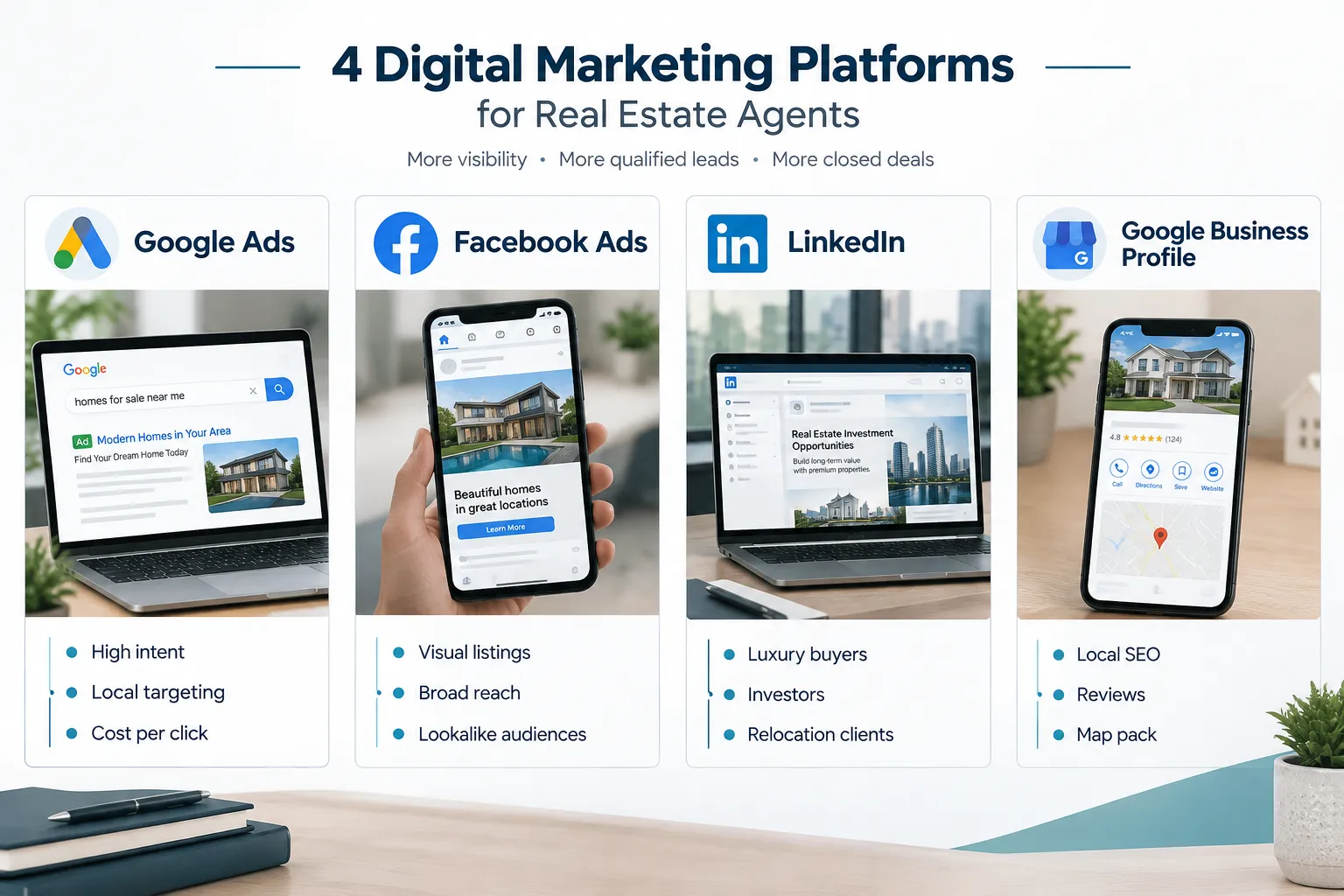
The strongest platforms for real estate lead generation in 2027 are Google Search, Google Business Profile, Facebook/Instagram, and LinkedIn for higher-value clients, each serving a different stage of buyer or seller intent. No single platform covers the entire funnel on its own.
| Platform | Best For | Lead Intent Level |
|---|---|---|
| Google Ads / SEO | People actively searching homes or agents | High |
| Google Business Profile | Local visibility, reviews, map pack traffic | High |
| Facebook/Instagram | Branding, listing visuals, broad targeting | Medium |
| Luxury buyers, investors, relocation clients | Medium to High | |
| YouTube/Video | Virtual tours, neighborhood guides, trust-building | Medium |
Agents working with investors or relocation clients should strengthen Google Business Profile optimization since local search often decides which agent gets the first call [1][2].
How Much Should I Budget for Real Estate Digital Marketing
Most independent agents should budget between 5 and 10 percent of gross commission income on digital marketing, split across paid ads, content creation, and CRM or automation tools. New agents with no database often need to lean closer to 10 percent early on, while experienced agents with a referral base can spend less and still get consistent leads.
A simple starting split for a modest monthly budget:
- 40 percent on paid ads (Google and Facebook combined)
- 25 percent on content creation (photos, video, virtual tours)
- 20 percent on CRM, automation, and lead scoring tools
- 15 percent on local SEO and Google Business Profile management
Choose a higher ad spend if you are new to an area with no referral network. Choose automation-heavy spending if you already have 500+ contacts sitting idle in a spreadsheet.
Why Am I Not Getting Leads From My Real Estate Ads
Most underperforming real estate ads fail because of weak targeting, generic ad copy, or landing pages that ask for too much information too soon. A listing ad sending traffic to a slow, cluttered homepage will waste spend even with a good offer.
Common fixes:
- Replace generic “Contact me for listings” copy with a specific value offer, like a free home valuation
- Send ad traffic to a single-purpose landing page, not the full website homepage
- Shorten the lead form to name, phone, and one qualifying question
- Retarget website visitors who didn’t convert the first time
This connects directly to content strategy for lead generation, because the ad is only half the equation. The landing page and follow-up sequence decide whether that click turns into a qualified lead or a wasted dollar.
Facebook Ads vs Google Ads for Real Estate Lead Generation
Google Ads generally produces higher-intent leads because people are actively searching for homes or agents, while Facebook Ads work better for building visibility and nurturing cold audiences over time. Agents often get the best results using both together rather than picking one.
| Factor | Google Ads | Facebook Ads |
|---|---|---|
| Intent level | High (active search) | Medium (interruption-based) |
| Cost per lead | Usually higher | Usually lower |
| Best use | Bottom-of-funnel, ready buyers | Top-of-funnel, brand awareness |
| Creative need | Minimal (text ads) | High (video, images) |
Choose Google Ads if your budget is limited and you need fewer, higher-quality leads. Choose Facebook Ads if you have strong visual content and want to build a larger retargeting pool over time [3][4].
Real Estate Digital Marketing for New Agents vs Experienced Agents
New agents should prioritize paid ads, local SEO, and building an email list from scratch, while experienced agents should focus on database reactivation, referral systems, and AI-powered lead scoring on existing contacts. The strategy difference comes down to what each agent already has: experienced agents have a database, new agents have time and energy but no contacts.
A simple decision rule: if you have fewer than 100 contacts, spend more on paid acquisition. If you have 500 or more contacts sitting idle, spend more time and tools on reactivation campaigns instead of chasing new cold traffic. Research on CRM-driven lead generation supports database reactivation as one of the lowest-cost, highest-quality lead sources available to established agents [2][5].
Common Mistakes Real Estate Agents Make With Lead Generation
The biggest mistake agents make is treating every lead the same way instead of qualifying and prioritizing follow-up based on intent. A close second is abandoning a channel after two or three weeks because results feel slow.
Other recurring mistakes:
- No CRM, so leads get lost in text messages and email inboxes
- Posting listings on social media without any call to action
- Running ads without a dedicated landing page
- Ignoring WhatsApp marketing even though it works well for quick, personal follow-up with buyers and sellers in many markets
- Spending the entire budget on ads with nothing left for automation or nurture tools
How Long Does It Take to Get Real Estate Leads From Digital Marketing
Most agents should expect 60 to 90 days of consistent activity before digital marketing produces a steady, predictable stream of qualified leads. Paid ads can generate inquiries within days, but converting those inquiries into appointments and closings takes longer because real estate decisions rarely happen overnight.
Rough timeline expectations:
- Weeks 1-2: Ads and landing pages go live, initial clicks and form fills appear
- Weeks 3-6: Lead quality becomes clearer, nurture sequences start showing response patterns
- Weeks 8-12: SEO and content start contributing organic inquiries alongside paid traffic
Agents expecting instant results from a new campaign usually quit right before the channel starts working.
Best Time of Year to Run Real Estate Marketing Campaigns
Spring (February through May) and early fall (September to October) are typically the strongest windows for real estate marketing campaigns in most US markets, since buyer and seller activity naturally increases during these periods [2][6]. That said, local market conditions and school calendars shift this timing, so agents should check historical listing volume in their own city before assuming the national pattern applies.
Practical approach:
- Increase ad spend 4-6 weeks before your local market’s peak season
- Use slower months (December, January) for content creation, database cleanup, and SEO work instead of heavy ad spend
- Run seller-focused valuation campaigns right before peak listing season starts
Lead Generation Tools for Real Estate Agents That Actually Work
The tools that consistently help agents generate qualified leads combine a CRM, an automated nurture system, and a local SEO or content tool, rather than relying on one all-in-one platform to do everything. No single tool replaces a clear process.
Categories worth evaluating honestly:
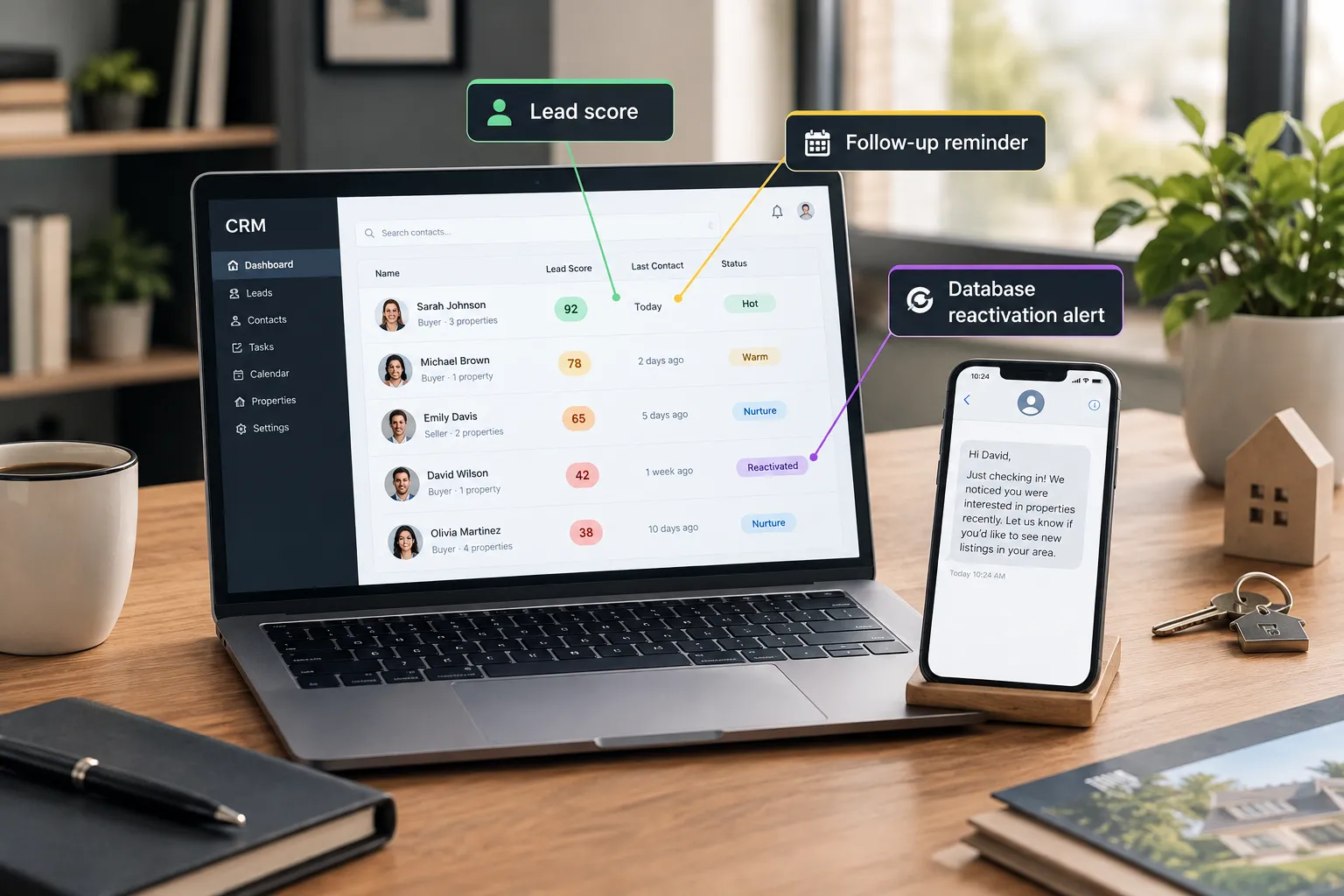
- CRM with lead scoring: Tracks engagement and ranks leads by intent automatically
- Home valuation widgets: One of the highest-converting lead magnets for seller leads [1][3]
- Video and virtual tour tools: Increasingly central to listing engagement and buyer trust [4][7]
- Email and SMS automation: Moves beyond basic drip sequences into AI-timed follow-up
Before buying any tool, check whether it integrates with your existing CRM. A powerful tool that doesn’t talk to your database just creates another inbox to manage.
How to Filter Out Unqualified Real Estate Leads Automatically
Agents can filter unqualified leads automatically by using qualifying questions in the lead form itself, combined with lead scoring rules inside their CRM that flag high-intent contacts for immediate follow-up. This removes the guesswork of manually sorting every new contact.
Setup steps:
- Add one qualifying question to every lead form, such as “When are you planning to move?”
- Set CRM rules that tag leads as hot, warm, or cold based on their answer and engagement level
- Route hot leads to immediate phone or SMS follow-up
- Send cold leads into a long-term email nurture sequence instead of a daily call list
This kind of demand marketing approach treats lead qualification as part of the marketing system, not something the agent figures out manually after the fact.
Digital Marketing Strategies for Luxury Real Estate vs Starter Homes
Luxury real estate marketing relies more on LinkedIn, high-production video, and private network outreach, while starter home marketing performs better on Facebook, local SEO, and affordability-focused content. The buyer psychology is different, so the channels and messaging need to differ too.
| Element | Luxury Listings | Starter Homes |
|---|---|---|
| Primary platform | LinkedIn, referral network | Facebook, Google local search |
| Content style | Cinematic video, lifestyle framing | Clear pricing, affordability angle |
| Lead magnet | Private tours, exclusive previews | Home valuation, first-time buyer guides |
| Follow-up pace | Relationship-driven, slower | Faster, higher volume |
Choose a luxury-style strategy if your average listing price is well above local median and buyers are often referral-based. Choose a volume strategy if you work mostly first-time buyers or investment properties.
Can Real Estate Agents Do Digital Marketing Without a Big Budget
Yes, agents with limited budgets can generate qualified leads by focusing on organic local SEO, Google Business Profile, and consistent content instead of heavy ad spend. These channels take more time but cost far less money.
Low-budget priorities in order:
- Complete and optimize Google Business Profile with reviews and photos
- Publish neighborhood-specific content and blog posts for local SEO
- Use WhatsApp or SMS for personal follow-up instead of paid retargeting
- Build an email list from open house sign-ins and referrals, then nurture it consistently
Agents serious about doing this well without a marketing team should also learn the basics of outsourcing SEO marketing selectively, so the time-heavy technical work doesn’t eat into client-facing hours.
Conclusion
Real estate digital marketing in 2027 rewards agents who treat lead quality as the real metric, not just lead count. The twelve approaches above, from local SEO and video content to AI-driven lead scoring and database reactivation, work best when they’re connected into one system instead of run as separate experiments. Start by auditing your current leads: how many actually meet the qualified-lead criteria covered earlier, and how many are just sitting in a spreadsheet untouched for months?
Pick one gap from this guide, whether that’s adding a qualifying question to your lead form or finally setting up a nurture sequence for your existing database, and fix it this week. Small, specific fixes compound faster than chasing a brand-new platform every quarter.
References
- Real Estate Lead Generation Ideas. heygen.com.
- 7 Lead Gen Strategies to Ignite Your Real Estate Business in 2026. inman.com.
- Lead Generation for Real Estate. cleverly.co.
- Generate Real Estate Leads. xara.com.
- Real Estate Lead Generation Strategies. learn.realscout.com.
- Real Estate Prospecting Ideas. inman.com.
- Real Estate Lead Generation. heygen.com.