
Last updated: September 14, 2026
Quick Answer: Query fan-out SEO is the practice of structuring your content to match the multiple hidden sub-queries that Google AI Mode automatically generates from a single user search. Instead of targeting one keyword per page, you build content that answers the full cluster of related questions AI systems expand into, so your pages get cited across more AI-generated responses, not just ranked for one term.
Key Takeaways
- Google AI Mode does not process a single query the way traditional search does. It breaks one query into multiple sub-queries and retrieves answers from different sources simultaneously [1][4].
- Query fan-out SEO means deliberately structuring content to cover the full range of sub-queries AI systems generate, not just the primary keyword.
- Traditional keyword research targets one intent per page. Query fan-out strategy maps entire topic clusters and the follow-up questions users are likely to have.
- Content that is organized into self-contained, question-based sections is far more likely to be cited in AI Overviews and AI Mode responses [3][5].
- Topical authority, breadth of coverage, and E-E-A-T are the primary ranking signals in a fan-out world, not keyword density [6][8].
- Tools like Ahrefs, Semrush, and even manual prompting in ChatGPT or Gemini can help you simulate query fan-out for keyword research [4][5].
- Success metrics are shifting from page-level rankings and click-through rates to AI citation share and topic presence across a subject area [7][9].
- Ignoring query fan-out puts you at risk of losing AI-driven visibility even if your traditional organic rankings stay intact.
What Is Query Fan-Out SEO and How Does It Work
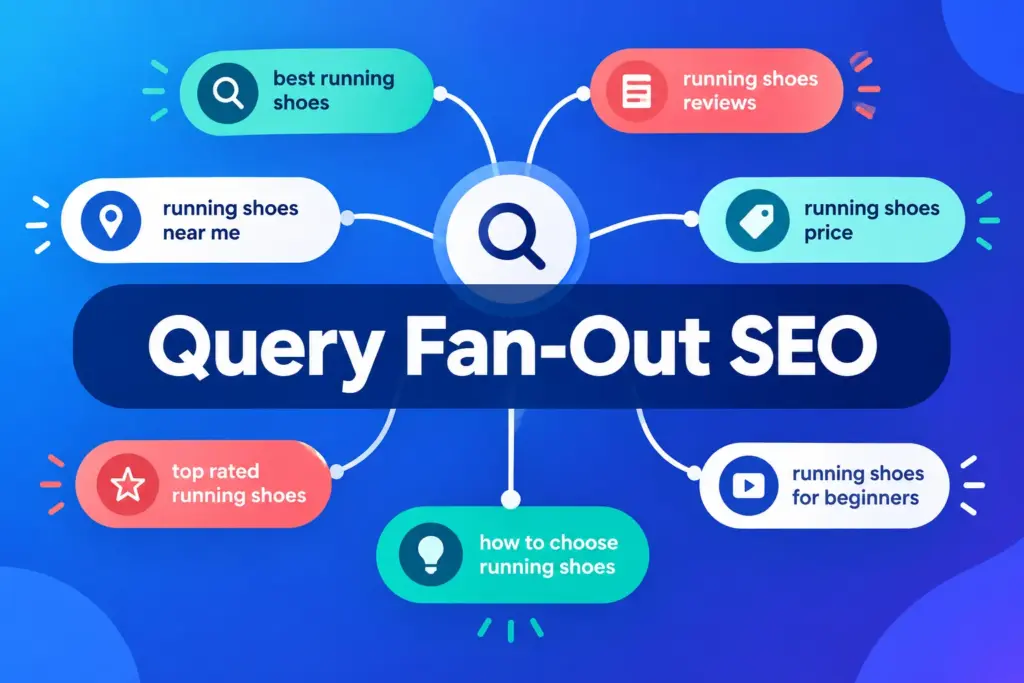
Query fan-out is the mechanism by which Google AI Mode takes a single user query and automatically expands it into multiple related sub-queries before generating a response. Query fan-out SEO is the content strategy built around this behavior, structuring pages so they answer the full set of sub-queries, not just the surface-level question.
Here is what happens technically: when someone types a question into Google AI Mode, the system does not just match keywords. It decomposes the query into several parallel sub-queries, runs them simultaneously against its index, retrieves relevant passages from multiple sources, and synthesizes a single answer [1][2]. Google has confirmed this mechanism publicly, and early observations suggest AI Mode can generate anywhere from five to dozens of sub-queries from a single search [9].
For SEO, this changes the game entirely. A page that only answers the literal question someone typed may get cited once, or not at all. A page that answers the question plus the natural follow-ups AI systems generate gets cited far more often across a wider range of searches.
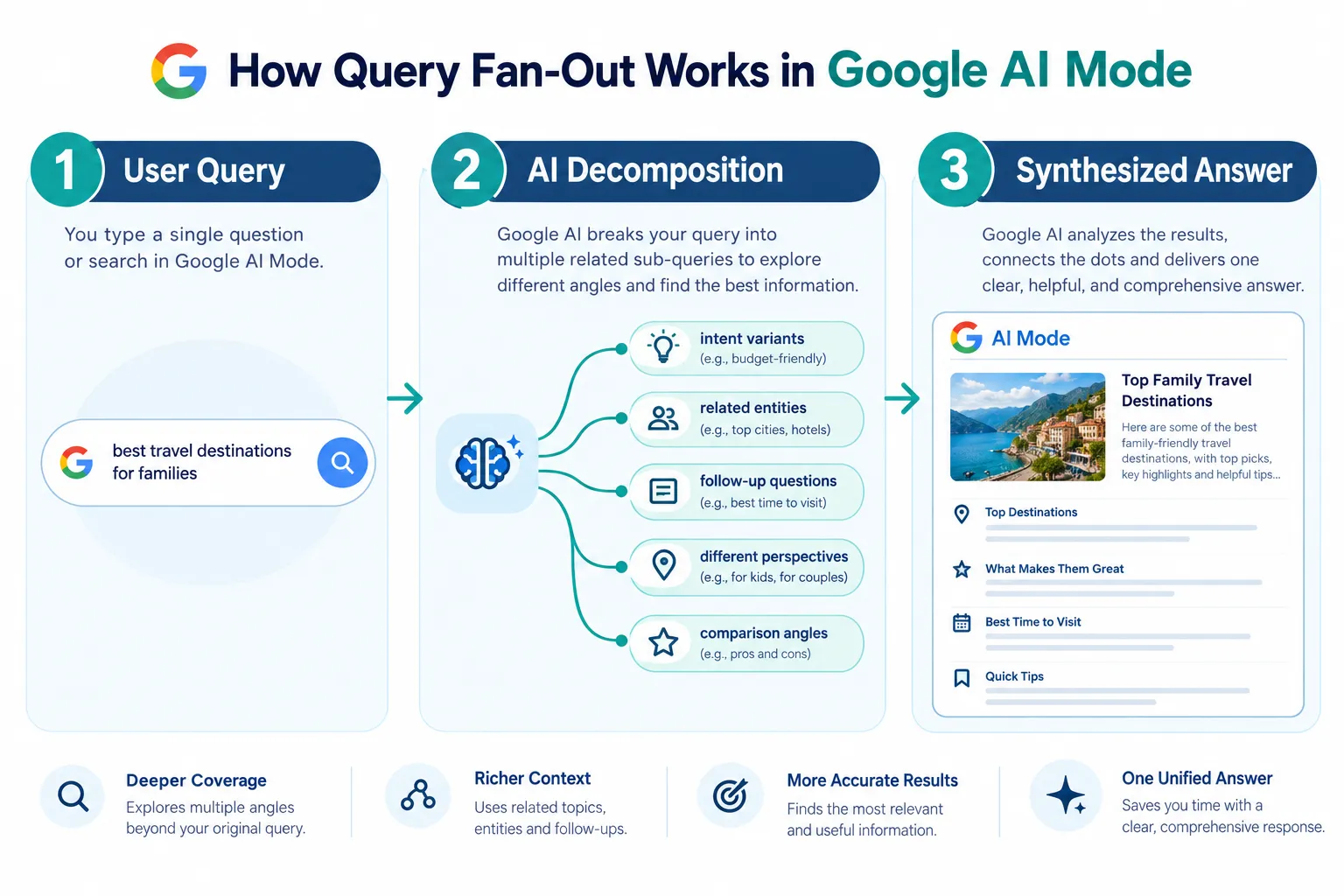
Think of it this way. Someone searches “best CRM for small business.” AI Mode might fan out into sub-queries like: what features matter in a small business CRM, how much does a CRM cost for small teams, what is the difference between HubSpot and Zoho, how long does CRM implementation take, and what mistakes do small businesses make when choosing a CRM. A page that covers all of those angles in one well-structured piece is a much stronger candidate for citation than a page that only lists CRM names.
Why Query Fan-Out Matters for Google AI Mode Results
Query fan-out is important for Google AI Mode because it fundamentally changes how content gets surfaced. AI Mode does not rank pages the way the traditional blue-link results do, it retrieves and synthesizes passages. If your content does not contain the specific passages that answer each sub-query, you will not appear in the synthesized response, regardless of your domain authority [3][6].
Google has been clear that there are no special AI SEO hacks. The fundamentals, quality content, E-E-A-T, topical authority, still drive results [8]. But fan-out amplifies those fundamentals. A site with deep topical coverage gets cited across more sub-queries. A site with thin, single-keyword pages gets bypassed.
The practical implication: zero-click search is accelerating. AI Mode gives users complete answers without requiring a click. Your goal shifts from “rank #1 and get the click” to “be the source AI cites across multiple sub-queries.” Citation share becomes the new organic traffic metric.
Query Fan-Out vs Traditional Keyword Research: Key Differences
Traditional keyword research identifies the single best keyword for a page and optimizes around that term. Query fan-out strategy maps the entire cluster of sub-queries AI systems are likely to generate, and builds content architecture to answer all of them.
Here is a direct comparison:
| Dimension | Traditional Keyword SEO | Query Fan-Out SEO |
|---|---|---|
| Target | One primary keyword per page | A cluster of related sub-queries |
| Content structure | Keyword-optimized paragraphs | Self-contained, question-based sections |
| Success metric | Page ranking and CTR | AI citation share and topic presence |
| Research method | Search volume and competition | Sub-query simulation and topic mapping |
| Authority signal | Backlinks to the page | Topical breadth across the domain |
The shift is from “what keyword should this page rank for” to “what full set of questions should this page answer so AI systems can extract relevant passages from it.” [4][7]
This does not mean traditional keyword research is obsolete. Search volume data still tells you what topics matter to your audience. But it is now the starting point, not the full strategy.
How to Optimize Your Content for Query Fan-Out
Optimizing for query fan-out means restructuring how you plan, write, and organize content so AI systems can extract precise answers from your pages.
Step 1: Map the sub-query cluster before you write. Take your target topic and generate the full set of questions someone might ask before, during, and after their primary search. Use Google’s “People Also Ask” boxes, autocomplete, and tools like Ahrefs or Semrush to find these. You can also prompt ChatGPT or Gemini directly: “What sub-questions would someone researching [topic] want answered?” [5][6]
Step 2: Write in self-contained sections. Each H2 or H3 section should open with a direct 2-3 sentence answer that stands alone. If that passage were lifted out of context and placed in an AI response, would it still make sense? If not, rewrite it until it does [3][8].
Step 3: Use question-based headings. Headings that mirror natural search phrasing are more likely to match the sub-queries AI Mode generates. “How long does query fan-out SEO take to show results” is more citation-ready than “Timeline.”
Step 4: Cover the full topic arc. Include definitions, comparisons, step-by-step processes, common mistakes, cost or timeframe estimates, and edge cases. The more sub-queries your single page covers, the more opportunities AI has to cite you [4][9].
Step 5: Maintain E-E-A-T signals. First-person experience, original data, named experts, and verifiable claims all increase the likelihood that AI systems treat your content as a credible source [6][8].
What Are the Best Tools for Query Fan-Out SEO
No single tool was built specifically for query fan-out SEO, but several existing tools can be combined to simulate the process effectively.
- Ahrefs Site Explorer and Keywords Explorer: Use the “Questions” filter to find question-based keyword variations around your topic. These often mirror the sub-queries AI systems generate [4].
- Semrush Keyword Magic Tool: The question and related keyword filters help map the full sub-query landscape around any seed term.
- Google Search Console: After publishing, check which queries your page is appearing for. A wide spread of related queries suggests your content is being picked up across a fan-out cluster [7].
- ChatGPT / Gemini prompting: Manually prompt AI tools with “what sub-questions would Google AI Mode generate for [query]” to simulate fan-out before you write.
- AlsoAsked and AnswerThePublic: Both tools visualize question clusters around a topic, which maps closely to how AI systems decompose queries [5].
- Surfer SEO: Its content editor surfaces semantically related terms and questions that align with how AI systems interpret topical coverage [5].
The most effective approach combines search volume data from Ahrefs or Semrush with manual AI prompting to stress-test your content plan against likely sub-queries.
Is Query Fan-Out SEO Right for My Website
Query fan-out SEO is relevant for almost any website that depends on organic search traffic. It is especially high-impact for content-heavy sites, SaaS companies, agencies, e-commerce stores with informational content, and local businesses that want to appear in AI-generated local results.
Choose this strategy if:
- Your audience uses Google to research before buying or deciding.
- You are already investing in content marketing and want better AI visibility.
- You are seeing traffic decline from AI Overviews taking over the top of search results.
- You want to build topical authority in a competitive niche.
It may be less urgent if:
- Your business relies entirely on branded searches where users already know your name.
- You are in a highly regulated industry where AI Mode is less active (though this is shrinking).
- Your site is purely transactional with no informational content.
For most businesses, the question is not whether to adopt query fan-out SEO, but how quickly to restructure existing content to match this new reality.
Common Mistakes People Make With Query Fan-Out Strategy
The biggest mistake is treating query fan-out as a new keyword stuffing technique, cramming more questions into a page without actually answering them well. AI systems are good at detecting thin content, and a page full of H2 headings with shallow answers will not get cited [3][8].
Other common mistakes:
- Ignoring the opening answer. Every section needs a direct answer in the first 2-3 sentences. Many writers bury the answer after three paragraphs of context. AI systems extract passages, and a buried answer is a missed citation.
- Writing for one keyword, not a topic. If your content plan still starts with “I want to rank for [keyword]” rather than “I want to own this topic,” you are optimizing for a system that is being replaced.
- Neglecting internal linking. A single page cannot cover every sub-query for a broad topic. A well-linked cluster of pages, a pillar page plus supporting content, gives AI systems more material to draw from across your domain [6][7].
- Skipping the basics. Fast load times, clean HTML structure, and mobile-friendliness still matter. AI systems retrieve content from pages that are technically accessible [9].
- Measuring only rankings. If you track success only through position 1-10 rankings, you will miss the AI citation share that is increasingly driving awareness and traffic.
How Long Does It Take to See Results From Query Fan-Out SEO
Realistically, expect 3-6 months to see meaningful changes in AI citation share after restructuring content for query fan-out. This is similar to the timeline for traditional SEO content updates, with some nuance.
Pages that are already indexed and have some authority tend to see faster movement, sometimes within 4-8 weeks of a significant content update, because Google already trusts the domain. New pages on newer domains take longer, typically 4-6 months before they appear consistently in AI-generated responses [7][8].
The most important variable is content quality. A well-structured, comprehensive page that genuinely answers a full sub-query cluster can get cited in AI Mode faster than a technically optimized but thin page. There is no shortcut here, the content has to be genuinely useful.
Can Query Fan-Out Work for Local SEO and E-Commerce
Yes, query fan-out applies directly to both local SEO and e-commerce, though the execution differs.
For local SEO, AI Mode increasingly generates location-specific answers that pull from business listings, review content, and local landing pages. A local business that structures its service pages to answer the full cluster of local questions, pricing ranges, service process, what to expect, comparisons to alternatives, and FAQs, is far more likely to be cited in AI-generated local results [2][6].
For e-commerce, the fan-out opportunity is primarily in informational and comparison content that supports the buying journey. Product pages alone rarely get cited in AI Mode. But a buying guide, comparison article, or “how to choose” page that answers the sub-queries around a product category can drive significant AI-assisted discovery. Pair that with strong product schema and review content, and you have a solid e-commerce fan-out strategy.
What Is the Difference Between Query Fan-Out and Semantic SEO
Query fan-out and semantic SEO are related but not the same thing. Semantic SEO is the practice of building topical depth and using related terms so search engines understand the full meaning and context of your content. Query fan-out is a specific mechanism in AI search systems that describes how a single query gets decomposed into multiple sub-queries before retrieval [4][5].
Semantic SEO is the foundation. Query fan-out is what happens when AI systems process searches, and why semantic SEO now matters more than it ever did in traditional search.
If you have been doing semantic SEO well, building topic clusters, covering subjects comprehensively, using natural language, you are already partially prepared for a fan-out world. The additional step is structuring your content so individual passages can be extracted and cited independently, not just so the page ranks well as a whole.
How to Measure Query Fan-Out SEO Success
Success metrics for query fan-out SEO are shifting away from page-level rankings toward topic-level visibility and AI citation share.
Metrics to track:
- Query spread in Google Search Console: Check how many distinct queries a single page appears for. A wider spread suggests the page is being matched across a sub-query cluster.
- AI citation monitoring: Tools like Semrush’s AI Toolkit, BrightEdge, and emerging AI visibility platforms are beginning to track how often your domain appears in AI Overviews and AI Mode responses [7][9].
- Organic impressions vs. clicks: As AI Mode grows, impressions may stay high while clicks decline. Track both, and watch for impression growth as a sign of AI visibility even when CTR drops.
- Topic share of voice: How often does your brand appear when someone searches for topics in your niche? This is increasingly the right question to ask.
- Branded search lift: When AI Mode cites your content consistently, branded search volume often increases as users look you up after seeing your name in an AI response.
Traditional rank tracking is still useful for monitoring competitive position, but it should not be your primary measure of success in an AI-first search environment.
What Happens If You Ignore Query Fan-Out in Your SEO Strategy
Ignoring query fan-out does not immediately destroy your rankings. But over time, it creates a growing gap between where you appear in traditional search and where you appear, or don’t appear, in AI-generated responses [10].
The risk is structural. As more users interact with Google AI Mode instead of scrolling through blue links, traffic increasingly flows to sources that AI systems cite. A site optimized only for traditional keyword rankings may maintain its position in the 10 blue links while losing the AI-generated answer at the top of the page, which is where most user attention now goes.
The businesses most at risk are those in competitive informational niches: finance, health, SaaS, marketing, legal, and e-commerce research content. These are the categories where AI Mode is most active and where query fan-out coverage creates the biggest competitive gap [3][6].
The straightforward path forward is to audit your highest-traffic content, identify which pages answer only a single keyword intent, and restructure them to cover the full sub-query cluster. Start with your top 10-20 pages by impressions. That is where the leverage is.
FAQ
What is query fan-out in simple terms? Query fan-out is when Google AI Mode takes your one search query and automatically breaks it into several related sub-questions before generating an answer. It pulls information from multiple sources to cover all those sub-questions at once.
Does query fan-out affect traditional Google search results? Query fan-out is primarily a feature of Google AI Mode, not the traditional 10 blue links. However, the content strategies that work for fan-out, comprehensive topic coverage, self-contained passages, strong E-E-A-T, also improve performance in traditional search.
How many sub-queries does Google AI Mode generate from one search? Google has not published a fixed number, and it likely varies by query complexity. Observations from SEO researchers suggest AI Mode can generate anywhere from a handful to dozens of sub-queries for a single search [9].
Is query fan-out SEO different from writing long-form content? Yes. Long-form content is about length. Query fan-out SEO is about structure, specifically, organizing content into self-contained, question-based sections that can each be extracted and cited independently. A 3,000-word article with poor structure is less citation-ready than a 1,500-word article with clear, direct section answers.
Can small websites compete with query fan-out SEO? Yes, especially in niche topics. AI systems prioritize the most relevant and credible passage for each sub-query, not just the most authoritative domain overall. A small site with genuinely comprehensive, well-structured content on a specific topic can outperform a large site with thin coverage of that same topic.
Do I need to rewrite all my existing content for query fan-out? No. Start with your highest-traffic pages and the content closest to purchase or conversion decisions. Add direct answer openings to each section, fill in missing sub-query coverage, and improve internal linking between related pages. A targeted update is more efficient than a full rewrite.
Does query fan-out SEO work for non-English content? The mechanism applies to any language Google AI Mode supports. The strategy, mapping sub-queries, writing self-contained sections, building topical authority, is language-agnostic. Multilingual sites should apply fan-out thinking to each language version independently, since sub-query patterns can differ significantly across languages and regions.
Conclusion
Query fan-out SEO is not a trend to watch, it is the operational reality of how Google AI Mode retrieves and synthesizes content right now. The shift from single-keyword optimization to sub-query cluster coverage is the most significant change in content strategy since the move to mobile-first indexing.
The businesses that adapt fastest will not be the ones with the biggest budgets. They will be the ones that restructure their content to answer the full arc of questions their audience has, clearly, directly, and in a format AI systems can extract and cite.
Your action plan:
- Pick your top 10 pages by organic impressions in Google Search Console.
- For each page, use Ahrefs, Semrush, or AI prompting to map the full sub-query cluster around the topic.
- Restructure each page so every H2 section opens with a direct 2-3 sentence answer.
- Fill in any sub-queries the page currently misses.
- Set up AI citation monitoring through Google Search Console impression data and any available AI visibility tools.
- Repeat for your next tier of content, working outward from highest-traffic pages.
The fundamentals of good SEO, quality, authority, relevance, have not changed. What has changed is the level of structural precision needed to turn those fundamentals into AI citations and organic visibility.
References
[1] Wtf Is Query Fan Out In Googles Ai Mode – https://digiday.com/media/wtf-is-query-fan-out-in-googles-ai-mode/ [2] What Is Query Fan Out In Ai Search – https://www.searchinfluence.com/blog/what-is-query-fan-out-in-ai-search/ [3] Ai Mode Query Fan Out – https://www.mariehaynes.com/ai-mode-query-fan-out/ [4] Query Fan Out – https://ahrefs.com/blog/query-fan-out/ [5] Query Fan Out – https://surferseo.com/blog/query-fan-out/ [6] Google Query Fan Out – https://www.aleydasolis.com/en/ai-search/google-query-fan-out/ [7] Query Fan Out – https://foundationinc.co/lab/query-fan-out [8] Query Fan Out – https://www.conductor.com/academy/query-fan-out/ [9] searchenginejournal – https://www.searchenginejournal.com/query-fan-out-technique-in-ai-mode-new-details-from-google/552532/ [10] Query Fan Out – https://www.finseo.ai/blog/query-fan-out