
Last updated: October 20, 2026
Most marketing teams still chase form fills and call it growth. That habit is exactly why demand generation marketing exists as a separate discipline, it measures success by pipeline and revenue, not by how many people typed their email into a popup.
Quick Answer
Demand generation marketing is a system of connected campaigns designed to build market awareness of a problem, create buyer trust, and convert that trust into sales-ready pipeline. Unlike lead generation, which counts form fills and MQLs, demand generation is judged by pipeline created, win rate, and sales cycle length. It works across reach, capture, and nurture stages, and it’s the dominant B2B marketing model going into 2026.
Key Takeaways
- Demand generation marketing focuses on pipeline, revenue, and sales cycle length, not just MQL counts or form submissions.
- The modern framework runs in three stages: Reach, Capture, and Bridge, each with its own KPIs.
- Lead generation and demand generation overlap but measure success differently; lead gen tracks volume, demand gen tracks revenue outcomes.[1]
- Email open rates (20-25%), MQL-to-SQL conversion (13-27%), and cost per lead ($75-$200) are current B2B benchmarks worth tracking.[1][2]
- Video, blog content, and webinars are rated the most effective demand-gen formats right now.[3][4]
- 72% of companies in a 2025 benchmark survey reported revenue growth of up to 25% tied to marketing-sourced leads.[4]
- AI tools now support content scaling, lead scoring, and campaign optimization across most demand-gen workflows.[3][5][6]
- Small businesses can run demand generation at a smaller scale using content, email, and community channels without big ad budgets.
What is the difference between demand generation and lead generation
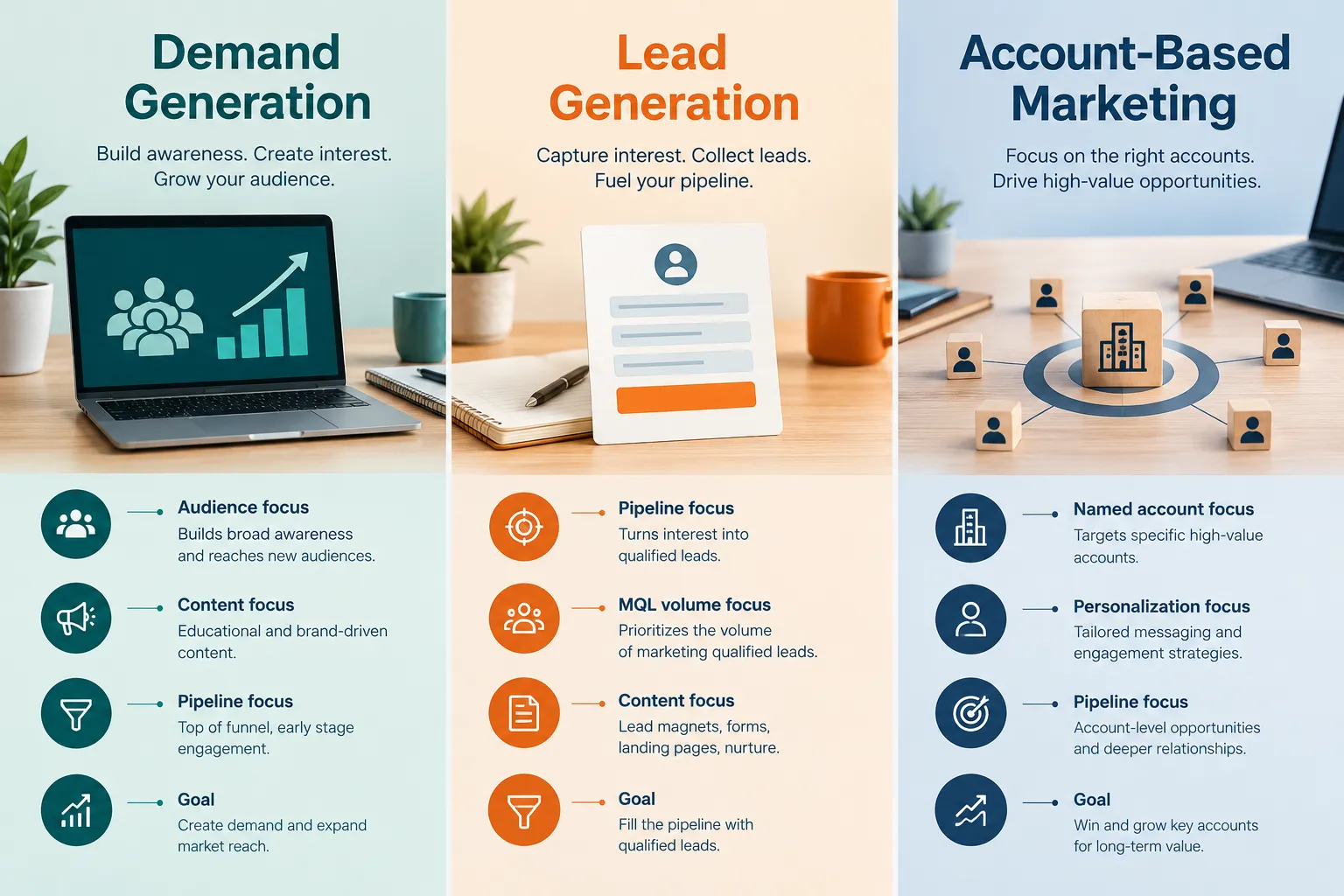
Demand generation builds market belief and converts interest into revenue-ready pipeline; lead generation collects contact details and counts them as MQLs. The two work together, but they answer different questions.
Lead generation asks: how many people filled out a form? Demand generation asks: how many of those people turned into real sales opportunities?
A simple way to separate them:
| Factor | Lead Generation | Demand Generation |
|---|---|---|
| Primary metric | MQLs, cost per lead, form fills | Pipeline created, win rate, sales cycle length |
| Time horizon | Short-term, campaign level | Long-term, market level |
| Content style | Gated whitepapers, landing pages | Educational video, webinars, original research |
| Sales handoff | Based on lead score | Based on buying intent signals |
Current benchmark data backs this split clearly, lead gen is still tracked through MQL volume and form conversions, while demand gen success is reported through pipeline and revenue contribution.[1]
Common mistake: Treating every MQL as sales-ready just because it hit a lead score threshold. A high lead score doesn’t mean the account has budget, timing, or authority to buy.
Demand generation vs inbound marketing which should I use
Use inbound marketing if your main goal is organic traffic and SEO-driven discovery; use demand generation if you need a coordinated system across paid, organic, email, and events that is tied directly to pipeline.
Inbound marketing is really one channel strategy inside a broader demand generation program. It relies heavily on search and content to pull buyers in organically.
Demand generation sits one level above that. It coordinates:
- Organic content and SEO (inbound’s core strength)
- Paid search and social
- Email nurture sequences
- Events and webinars
- Account-based advertising
Decision rule: choose inbound-only if you’re an early-stage blog or small site building authority slowly. Choose full demand generation once you have a sales team that needs predictable pipeline, not just traffic.
For teams starting with content as the main lever, our guide on generating leads with the right content strategy is a useful starting point before scaling into multi-channel demand generation.
How do I build a demand generation strategy from scratch
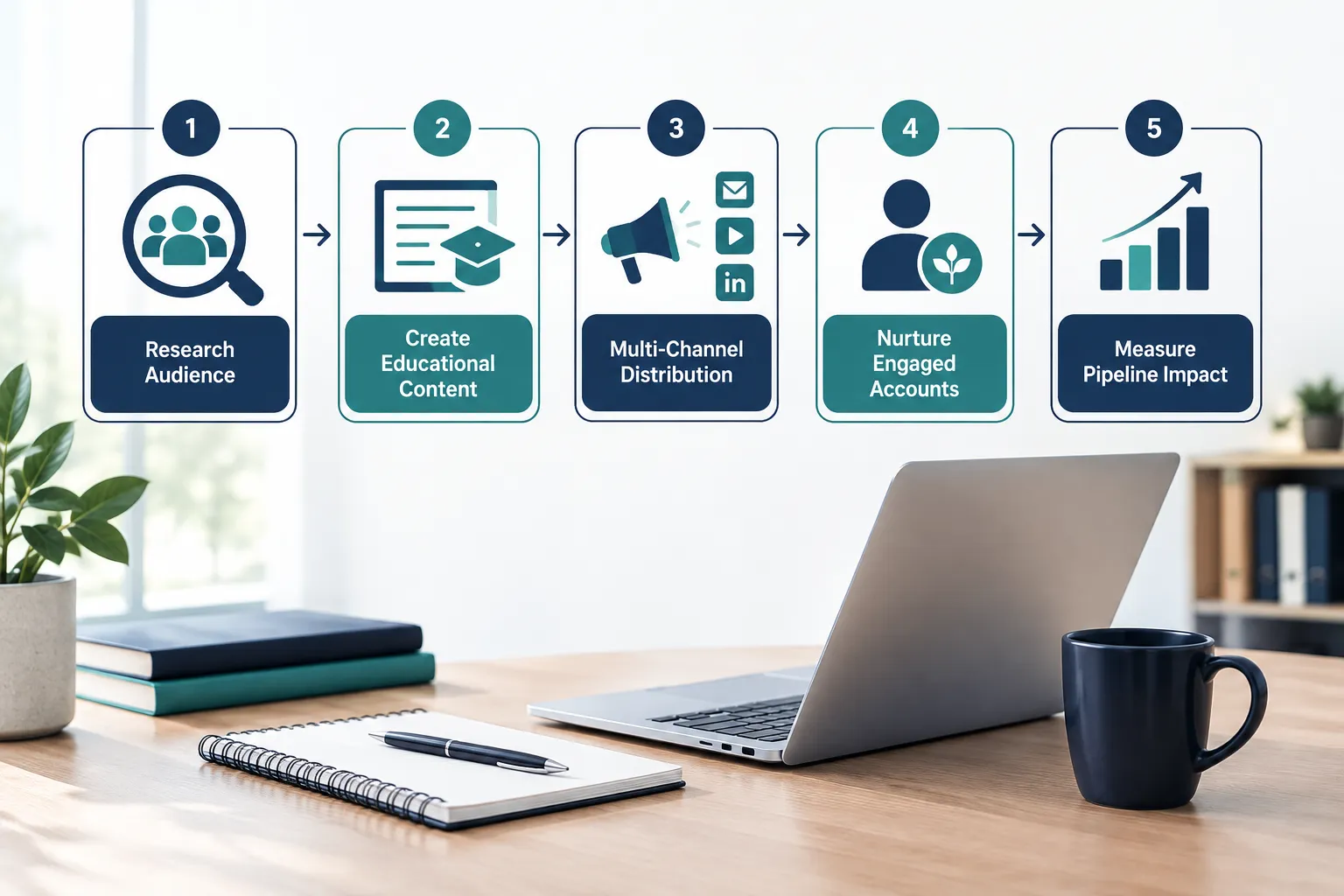
Start by mapping your buyer’s problem awareness, then build content and campaigns around the three stages: Reach, Capture, and Bridge. Each stage needs its own content type, channel mix, and KPI set.
Here’s a practical build sequence:
- Define the problem your market doesn’t fully understand yet. This becomes your Reach messaging.
- Pick 2-3 channels where your buyers actually spend time, website, email, events, paid social.
- Create Reach content: original research, founder commentary, short-form video explaining the problem.
- Build Capture assets: landing pages, demo requests, comparison guides that convert interest into pipeline.
- Set up Bridge nurture: email sequences and retargeting that keep engaged accounts warm until they’re sales-ready.
- Align sales and marketing on what counts as pipeline, not just MQLs.
A multi-channel approach works better than relying on one channel. Our breakdown on multi-channel marketing without overspending covers how to allocate budget sensibly across these stages.
Edge case: If you’re a solo founder or very small team, skip the Bridge stage complexity and run a simple email nurture instead of a full marketing automation platform.
What are the best demand generation KPIs to track
The best KPIs track pipeline, not just activity: sourced pipeline, influenced pipeline, pipeline velocity, win rate, and sales cycle length. Volume metrics like MQLs still matter but should be secondary.
A 2025 benchmark survey found the most-tracked metrics among demand gen teams were:
- Opportunities generated (52%)
- MQLs/SALs (47%)
- Pipeline influenced (43%)
- Revenue generated (43%)
- Total leads/inquiries (41%)[4]
Stage-specific KPIs from the Reach-Capture-Bridge framework:
| Stage | KPIs |
|---|---|
| Reach | Share of voice, branded search volume, brand recall |
| Capture | Pipeline sourced, cost per lead, conversion rate |
| Bridge | Engaged accounts, return visits, nurture velocity |
Current B2B benchmarks worth using as a baseline: email open rates 20-25%, MQL-to-SQL conversion 13-27%, cost per lead $75-$200, landing page conversion 2-5%, and marketing-influenced pipeline share around 40-60%.[1][2]
Choose pipeline-based KPIs if your sales cycle is longer than 30 days. Choose simpler lead-volume KPIs if you’re running short, transactional sales cycles.
Demand generation examples from B2B companies
B2B demand generation usually combines original research, webinars, and account-based advertising rather than relying on gated whitepapers alone. Video and blog content now rank as the most effective formats.[3][4]
Typical example patterns seen across B2B programs:
- A company publishes original research data, then builds a webinar and a series of blog posts around the findings, driving both SEO traffic and sales conversations.
- Account-based advertising targets a named list of 200-500 accounts with LinkedIn ads tied to a specific pain point, feeding directly into sales outreach.
- Case studies and customer testimonials get repurposed into short video clips for paid social, since case studies rank close behind video and webinars in effectiveness.[3][4]
Practitioners report prioritizing lead nurturing campaigns (47%), video (45%), account-based advertising (40%), and webinars (38%) as top investment areas, while company websites (64%), events (59%), email (59%), and multichannel nurturing (59%) remain the top-performing channels overall.[3][4]
Demand generation tools and software options
The right tools depend on your stage of growth: marketing automation platforms for mid-size and enterprise teams, simpler email tools for small businesses, and AI-assisted content and scoring tools layered on top of either.
A practical tool stack by business size:
- Small business / solo marketer: Email marketing platform, basic CRM, website analytics
- Growing team: Marketing automation platform, ABM advertising tool, webinar software
- AI layer (any size): Content generation assistants, predictive lead scoring, campaign optimization tools
AI is now built into most of these workflows, teams use it for scaling content creation, predictive lead scoring, and campaign optimization, with AI moving from pilot projects to full production in many demand gen teams.[3][5][6]
For email specifically, a solid foundation matters more than the platform you pick. See our guide on building a solid email marketing foundation before adding automation on top.
Common mistake: Buying an expensive automation platform before you have enough content or email list volume to justify it. Start simple, scale the tool stack as volume grows.
Why aren’t my demand generation campaigns working
Campaigns usually underperform because teams measure the wrong things, run single-channel efforts, or stop nurturing leads too early. Fixing attribution and channel mix solves most of these problems.
Check these five areas first:
- Wrong KPIs: If you’re only tracking form fills, you can’t see pipeline problems until it’s too late.
- Single-channel dependency: Running only paid ads without organic content or email nurture limits reach.
- No sales-marketing alignment: If sales doesn’t agree on what counts as a qualified opportunity, campaigns look like they’re failing when they’re actually working.
- Weak content formats: Gated PDFs convert worse than video, webinars, and original research right now.[3][4]
- No nurture after initial contact: Most buyers don’t convert on first touch; Bridge-stage nurturing closes that gap.
Quick example: A SaaS company running only Google Ads with no email nurture will see decent click volume but poor pipeline conversion, because interested visitors leave without ever entering a nurture sequence.
Demand generation for SaaS businesses
SaaS demand generation works best when it combines product-led content (comparison guides, demo videos) with account-based advertising aimed at specific buyer titles inside target accounts.
SaaS buyers research extensively before talking to sales, so content needs to answer comparison and pricing-fit questions early. Effective SaaS demand gen programs typically include:
- Comparison and alternative pages targeting competitor searches
- Interactive product demos or short walkthrough videos
- Free trial or freemium funnels tied to nurture emails
- ABM advertising aimed at decision-makers at target accounts
Decision rule: If your SaaS product has a short sales cycle (self-serve, under $100/month), lean heavily on product-led growth and email nurture. If it’s enterprise SaaS with a long sales cycle, invest more in ABM and sales-aligned content.
How long does it take to see results from demand generation
Most B2B demand generation programs take three to six months to show measurable pipeline impact, and longer sales cycles push that timeline further. Reach-stage activities like brand awareness often take longer to show up in direct conversion numbers.
Rough timeline expectations:
- Month 1-2: Content and channel setup, early Reach-stage activity
- Month 3-4: First measurable Capture-stage conversions, early pipeline
- Month 5-6+: Bridge-stage nurture starts converting engaged accounts into closed deals
A 2025 benchmark survey found 72% of companies saw up to a 25% year-over-year revenue increase attributed to marketing-sourced leads, which reflects results compounding over a full year rather than a single quarter.[4]
Common mistake: Judging a demand generation program as a failure after 60 days. Reach and Bridge stages take longer to mature than a single sprint.
Common mistakes people make with demand generation
The biggest mistake is optimizing for MQL volume instead of pipeline quality. A 2026 trend shift shows teams deliberately trading raw lead volume for fewer, sales-ready opportunities.[5][6]
Other recurring mistakes:
- Gating too much content, which reduces Reach-stage visibility and SEO value
- Ignoring Bridge-stage nurture and letting engaged leads go cold
- Not aligning sales and marketing on pipeline definitions
- Measuring clicks and impressions instead of sourced revenue, deal velocity, and conversion rates[5][6]
- Running campaigns in isolation instead of connecting website content, outsourced SEO marketing efforts, and paid channels together
What channels work best for demand generation
Company websites, email, and events consistently rank as top-performing demand generation channels, followed closely by multichannel nurturing and account-based advertising.[3][4]
Top-performing channels based on current practitioner reporting:[3][4]
- Company website (64%)
- In-person events and trade shows (59%)
- Email (59%)
- Multichannel nurturing (59%)
- Account-based marketing (48%)
- Marketing automation (48%)
For businesses in markets where messaging apps drive conversation, WhatsApp marketing can act as an effective Bridge-stage nurture channel alongside email, especially for small businesses reaching local or regional buyers.
Choose events and in-person channels if your buyers are enterprise-level and relationship-driven. Choose email and website-led nurture if your buyers research independently before any sales contact.
Demand generation vs account-based marketing
Account-based marketing is a focused subset of demand generation aimed at a specific list of named accounts, while demand generation runs broader campaigns across the whole addressable market.
| Factor | Demand Generation | Account-Based Marketing |
|---|---|---|
| Target | Broad market segment | Named list of target accounts |
| Content | General educational content | Personalized, account-specific messaging |
| Best for | Mid-market, wide TAM | Enterprise, high-value accounts |
Decision rule: Use ABM if your ideal customers are a small, well-defined list of large accounts. Use broad demand generation if your addressable market is large and no single account drives outsized revenue.
Is demand generation right for small businesses
Yes, small businesses can run demand generation at a smaller scale by focusing on content, email, and community-based channels instead of expensive ABM advertising or large event budgets.
A lean small-business demand gen approach looks like:
- Publish helpful blog content answering real buyer questions (see our content marketing hack for a practical starting approach)
- Build an email list and nurture it consistently
- Use free or low-cost channels like WhatsApp Business for local engagement, with pricing details covered in our WhatsApp Business pricing guide
- Track pipeline from day one, even if it’s a simple spreadsheet instead of a CRM
Who this isn’t for: Businesses with very short sales cycles and low average order value (like a single-product e-commerce store) usually get better ROI from direct performance marketing than a full demand generation program.
Frequently Asked Questions
Is demand generation the same as content marketing? No. Content marketing is one tool inside demand generation. Demand generation also includes paid channels, events, email nurture, and ABM.
What’s a good starting budget for demand generation? There’s no fixed number, it depends on sales cycle length and average deal size. Start with whatever budget covers consistent content production and one paid channel test.
Do I need a CRM to run demand generation? Not immediately, but you need some way to track pipeline, even a simple spreadsheet, before scaling into automation tools.
How is demand generation different from growth marketing? Growth marketing often focuses on product-led experimentation and rapid testing. Demand generation focuses more on building market trust and pipeline over a longer cycle.
Can one person run a demand generation program? Yes, at small scale. Focus on one or two channels and track pipeline manually before adding complexity.
What’s the biggest KPI mistake teams make? Treating MQL volume as the main success metric instead of tracking pipeline, win rate, and sales cycle length.
Does demand generation work for B2C businesses? It can, though it’s more commonly applied in B2B. B2C versions tend to compress the Reach and Capture stages since buying decisions happen faster.
Conclusion
Demand generation marketing isn’t a rebrand of lead generation, it’s a different measurement philosophy built around pipeline and revenue rather than form fills. Start small: pick one problem your market misunderstands, build Reach content around it, set up a simple Capture mechanism, and don’t skip the Bridge-stage nurture. Track pipeline from day one, even with basic tools. Once that foundation works, layer in ABM, paid channels, and AI-assisted scoring as your team and budget grow.
References
- B2B Marketing Benchmarks 2025 2026. thestarrconspiracy.com.
- What Is B2B Marketing Benchmarks Definition Examples and Best Practices. sona.com.
- The Keys to Building High Performing Demand Generation Teams in the Age of AI. demandgenreport.com.
- Dgr Dg337 Surv Benchmarksurvey June 2025. static.sharedirecttech.com.
- 53760 2. demandgenreport.com.
- Take the 2026 Demand Gen Benchmark Survey Today. demandgenreport.com.
demand generation marketing, lead generation vs demand generation, B2B marketing strategy, demand gen KPIs, account-based marketing, marketing pipeline metrics, SaaS marketing strategy, content marketing strategy, multi-channel marketing, digital marketing for beginners, marketing automation tools, revenue marketing