
Last updated: September 14, 2026
Quick Answer: SEO, GEO (generative engine optimization), and AEO (answer engine optimization) are not competing strategies, they build on each other. In 2026, SEO remains the foundation. GEO and AEO are extensions that help your content get cited in AI-generated answers. Most businesses need all three, but the right emphasis depends on your audience, content type, and where your customers are actually searching.
Key Takeaways
- SEO is still the base. Without strong technical SEO, quality content, and authority signals, GEO and AEO won’t work well.
- GEO focuses on getting your content cited inside AI-generated responses from tools like Google AI Overviews, ChatGPT, Perplexity, and Gemini.
- AEO focuses on winning featured snippets, direct answer boxes, and voice search results, essentially optimizing to be the answer.
- AI search now accounts for a significant and growing share of how people find information, making GEO and AEO increasingly important alongside traditional SEO [3].
- The core tactics overlap heavily: clear structure, authoritative content, schema markup, and credible sources help all three.
- KPIs are shifting, clicks are no longer the only metric that matters. AI citations and zero-click visibility are now real business signals [8].
- Small businesses should prioritize local SEO and AEO first, then layer in GEO as their content library grows.
- The fastest way to start: audit your existing content for direct-answer gaps, add structured data, and improve content clarity.
What Is the Difference Between SEO, GEO, and AEO?
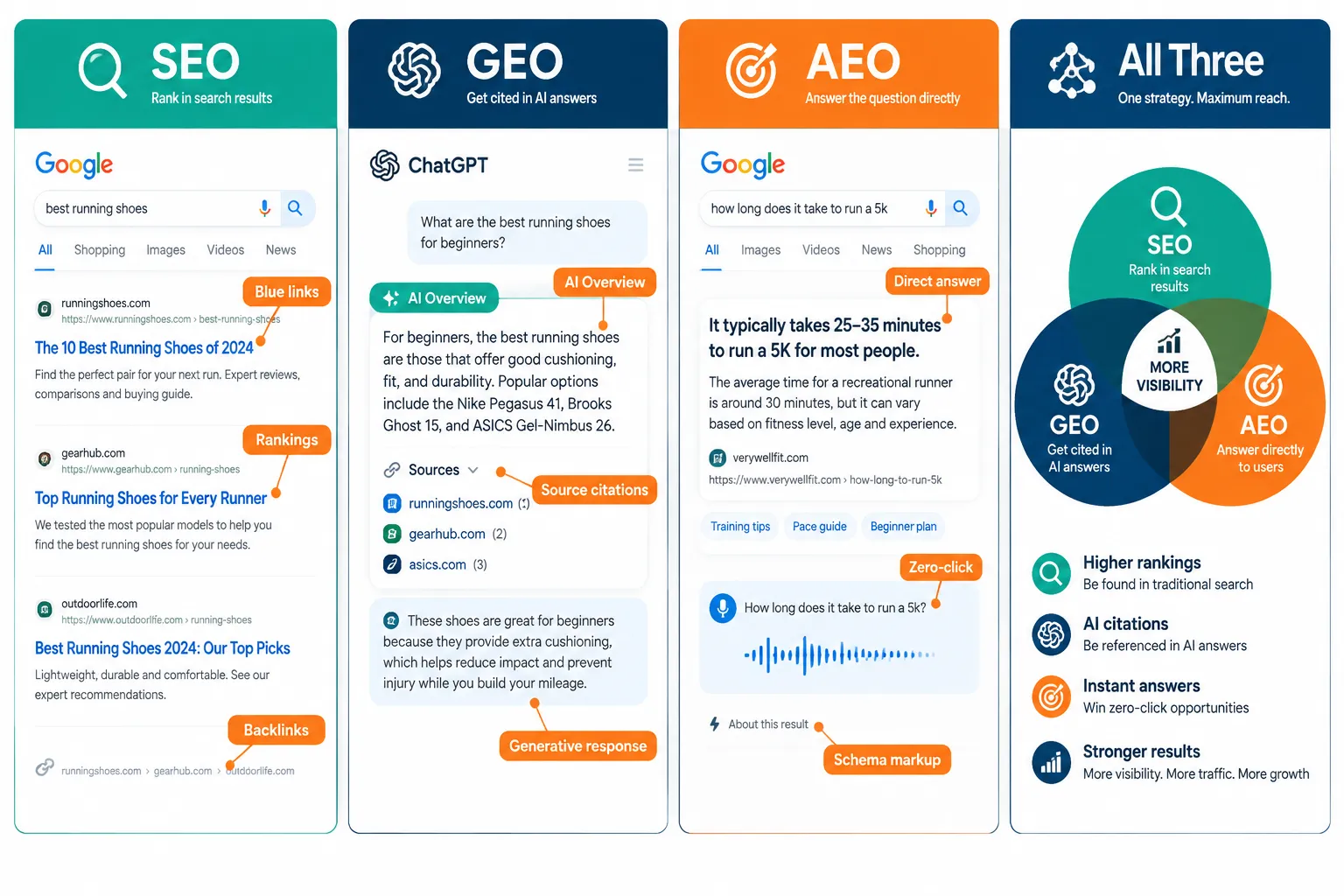
SEO (search engine optimization) is the practice of improving your website so it ranks higher in traditional search engine results pages. GEO, generative engine optimization, is about making your content visible inside AI-generated responses. AEO, answer engine optimization, is about structuring content so it gets selected as the direct answer to a specific question.
Think of it this way:
- SEO gets you ranked on Google’s blue-link results.
- AEO gets you into the featured snippet or voice search answer.
- GEO gets your content cited when ChatGPT, Perplexity, Google AI Mode, or Gemini generates a response.
They’re not three separate channels. They’re three layers of the same content strategy [1]. The underlying requirements, expertise, clear writing, structured data, credible sourcing, are nearly identical. What changes is the output format you’re optimizing for.
How Does Answer Engine Optimization Work Compared to Traditional SEO?
AEO and traditional SEO share the same foundation, but AEO specifically targets the “answer layer” of search, featured snippets, People Also Ask boxes, voice results, and AI Overviews. Where SEO asks “how do I rank for this keyword?”, AEO asks “how do I become the answer to this question?”
The key differences in practice:
| Factor | Traditional SEO | Answer Engine Optimization |
|---|---|---|
| Target output | Ranked page listing | Direct answer box / snippet |
| Content format | Long-form, keyword-rich | Concise, question-answer structure |
| Schema markup | Helpful | Near-essential |
| Success metric | Rankings + clicks | Snippet wins + AI citations |
| Query type | Broad + navigational | Conversational + question-based |
AEO content is typically structured around specific questions with a direct, concise answer in the first 40-60 words, followed by supporting detail [5]. This mirrors how AI systems extract and present information. If your content buries the answer three paragraphs in, it’s unlikely to be selected, by a featured snippet algorithm or an AI model.
What Is Generative Engine Optimization and Why Does It Matter?
Generative engine optimization (GEO) is the practice of structuring, writing, and positioning content so that AI systems, Google AI Overviews, ChatGPT, Perplexity, Gemini, and others, cite your content when generating answers. It matters because AI search is no longer a niche behavior; it’s becoming a primary way people get information [3].
Google’s own guidance confirms that the same principles driving traditional search success, helpful content, E-E-A-T signals, clear structure, also drive visibility in AI-generated results [7]. But GEO adds a few specific requirements:
- Citability: Your content needs to be specific, verifiable, and self-contained enough to be quoted.
- Entity clarity: AI models need to clearly understand who you are, what you cover, and why you’re authoritative.
- Technical accessibility: AI crawlers need clean, static HTML. JavaScript-heavy pages that block crawlers hurt GEO performance [2].
- Source authority: Being cited by other credible sources increases the likelihood that AI models will cite you [4].
Research published in 2025 found that content with clear citations, statistics, and authoritative sourcing was significantly more likely to appear in AI-generated responses than content without those signals [10].
Do I Still Need SEO If I’m Doing AEO in 2026?
Yes, and this is one of the most common misconceptions I see. AEO and GEO do not replace SEO. They depend on it.
If your technical SEO is broken, slow page speed, poor crawlability, thin content, weak domain authority, no amount of schema markup or question-answer formatting will get you into AI Overviews or featured snippets. Google’s AI systems pull from the same index as traditional search [7]. A page that can’t rank can’t get cited.
The right mental model: SEO is the infrastructure. AEO and GEO are the applications running on top of it. You need the infrastructure working before the applications can perform.
That said, the emphasis shifts. In 2026, pure keyword-volume chasing matters less than it did in 2020. Topical authority, content structure, and answer clarity now drive results across all three disciplines [8].
Which Is Better for Small Business: SEO or AEO?
For most small businesses, local SEO combined with AEO gives the best return. Pure GEO is harder to execute without a significant content library and domain authority.
Choose based on your situation:
- Local service business (plumber, dentist, restaurant): Prioritize local SEO (Google Business Profile, local citations, reviews) + AEO for FAQ-style content on your site.
- E-commerce small business: Focus on product SEO, structured data (product schema), and AEO for category-level questions.
- B2B or SaaS startup: Build topical authority through content SEO, then layer AEO and GEO as your content scales.
- Content-heavy brand or media site: GEO becomes a serious priority, your content volume and authority make AI citation realistic.
The honest answer is that small businesses with limited resources should not split focus across all three equally. Start with what drives direct revenue (local SEO, conversion-focused content), then expand [6].
Can You Do SEO and AEO at the Same Time?
Absolutely, and in most cases, you should. The tactics overlap enough that optimizing for one improves the other.
Tactics that serve both SEO and AEO simultaneously:
- Write content that answers a specific question in the first paragraph.
- Use FAQ schema and HowTo schema where relevant.
- Structure pages with clear H2/H3 headings that mirror real search queries.
- Keep answers concise (40-60 words) before expanding into detail.
- Build internal links between related topics to signal topical depth.
- Earn backlinks from credible industry sources to boost authority signals.
The only real tension is between long-form SEO content (which tends to rank for broad terms) and the concise, direct format AEO requires. The solution is to do both in the same piece: lead with a direct answer, then provide the depth that earns rankings and links [4].
How Do I Optimize for AI Search Engines Like Perplexity and ChatGPT?
AI search optimization for tools like Perplexity, ChatGPT Search, and Google AI Mode follows a consistent set of principles: be authoritative, be specific, be structured, and be crawlable.
Practical steps for AI search optimization:
- Get indexed and crawlable. Ensure your pages are accessible to AI crawlers. Check your robots.txt and avoid blocking key content behind JavaScript rendering [2].
- Write self-contained passages. Each section should make sense on its own, without requiring context from the rest of the page. AI models often lift individual paragraphs.
- Use real data and cite sources. Specific statistics with named sources are far more likely to be cited than vague claims [10].
- Build topical authority. Cover a subject thoroughly across multiple pages. AI models favor sources that demonstrate deep expertise on a topic [1].
- Get cited elsewhere. Being referenced by other credible websites increases the probability that AI systems treat you as an authoritative source [4].
- Use structured data. Schema markup helps AI systems understand your content’s context, type, and relevance [5].
One thing I’ve noticed: Perplexity in particular tends to cite sources that have clear, specific answers with supporting evidence. Fluffy, generic content rarely makes it into AI-generated responses regardless of how well it ranks traditionally.
What Are Common Mistakes People Make With AEO?
The biggest AEO mistake is treating it as a formatting exercise rather than a content quality problem. Adding FAQ schema to weak, vague content doesn’t work. The answer has to actually be good.
Other common mistakes:
- Burying the answer. If your direct answer isn’t in the first 50 words of a section, most AI systems and featured snippet algorithms won’t find it.
- Being too vague. “It depends” is not an answer. Give a specific answer first, then explain the conditions.
- Ignoring technical SEO. Broken crawlability, slow load times, and poor mobile experience undermine AEO regardless of content quality.
- Over-optimizing for one query. AEO works best when content covers a topic thoroughly, not when it’s laser-focused on a single phrase.
- Skipping schema. FAQ, HowTo, and Article schema are straightforward to implement and meaningfully improve selection rates for featured snippets and AI answers [5].
- Not updating content. AI systems favor fresh, accurate information. Outdated statistics or stale advice reduce citation likelihood over time [3].
Will AEO Replace Traditional SEO Completely?
No, and this question comes up constantly. AEO and GEO expand where your content can appear; they don’t eliminate the need for traditional search rankings.
Here’s why: even as AI Overviews and AI Mode grow, a significant portion of searches still result in clicks to websites [9]. Users researching purchases, comparing options, reading in-depth guides, or looking for local businesses still visit pages. Zero-click searches are rising, but they’re concentrated in informational and simple factual queries, not in commercial or transactional ones where businesses actually make money.
The realistic picture for 2026: traditional SEO drives traffic and revenue for commercial queries. AEO and GEO drive brand visibility, authority signals, and top-of-funnel awareness for informational queries. Both matter. Neither is dead.
How Do I Know If My Content Ranks in AI Search Results?
Tracking AI citations is harder than tracking traditional rankings, but it’s getting more measurable.
Current methods:
- Google Search Console: Monitor AI Overview appearances through the “Search type” filter, Google has been expanding this reporting [7].
- Manual spot-checks: Search your target questions in Google AI Mode, Perplexity, and ChatGPT Search. See if your domain appears as a cited source.
- Third-party tools: Platforms like Otterly.ai track AI search visibility and citation frequency across major AI search engines [3].
- Brand mention monitoring: Tools like Ahrefs, Semrush, or dedicated AI visibility tools can flag when your domain is referenced in AI-generated content.
The KPI shift is real: clicks alone no longer tell the full story. If your brand is being cited in AI answers, you’re building authority and awareness even when users don’t click through. Track both [8].
What’s the Fastest Way to Get Started With Answer Engine Optimization?
The fastest path to AEO results is auditing your existing content for direct-answer gaps and fixing them, no new content required.
A practical 5-step starting point:
- Identify your top 10-15 informational pages in Google Search Console by impressions.
- Check if each page answers its primary question in the first paragraph. If not, rewrite the opening.
- Add FAQ sections to service and product pages with 4-6 real questions your customers ask.
- Implement FAQ schema on those pages using Google’s structured data guidelines.
- Run a crawl check (Screaming Frog or similar) to confirm your key pages are indexable and load cleanly.
This process typically takes 2-4 weeks for a site with 20-50 pages. Results in featured snippets can appear within weeks of implementation. AI citation results take longer, typically 2-4 months, as AI systems need time to re-index and re-evaluate your content.
Conclusion
The SEO vs GEO vs AEO debate is largely a framing problem. These aren’t competing strategies, they’re sequential layers of the same goal: getting your content in front of the right people, wherever they’re searching.
In 2026, the practical priority order for most businesses is: fix your SEO foundation first, then optimize for direct answers (AEO), then build the topical authority and content depth that earns AI citations (GEO). Skipping the foundation doesn’t work.
Your action plan:
- Audit your top pages for crawlability and content quality.
- Rewrite key pages to lead with direct answers.
- Add FAQ and structured data to high-traffic informational pages.
- Start tracking AI search visibility alongside traditional rankings.
- Build content depth on your core topics, not just individual pages.
The businesses that will win in AI search are the same ones that win in traditional search: those with genuine expertise, clear communication, and content people actually find useful. The tactics evolve. That principle doesn’t.
FAQ
Q: Is GEO the same as AEO? No. GEO (generative engine optimization) focuses on getting cited in AI-generated responses from tools like ChatGPT, Perplexity, and Google AI Overviews. AEO (answer engine optimization) focuses on winning featured snippets, direct answer boxes, and voice search results. They overlap significantly but have different primary targets.
Q: Does schema markup actually help with AI search? Yes. Structured data helps AI systems understand the type, context, and relevance of your content. FAQ schema, Article schema, and HowTo schema are particularly useful for both AEO and GEO.
Q: How long does it take to see results from AEO? Featured snippet wins can appear within a few weeks of implementing direct-answer formatting and FAQ schema. AI citation results typically take 2-4 months, as AI systems need time to re-evaluate your content’s authority.
Q: Do I need a large website to benefit from GEO? Not necessarily, but topical depth helps. A site with 10 high-quality, authoritative pages on a specific topic can outperform a large site with shallow content in AI citations.
Q: Which AI search engines should I prioritize? Google AI Overviews and Google AI Mode should be the primary focus for most businesses, given Google’s market share. Perplexity is worth targeting for research-oriented audiences. ChatGPT Search is growing and worth monitoring, particularly for B2B and tech audiences.
Q: Is voice search the same as AEO? Voice search is one output channel for AEO. Optimizing for direct answers, conversational queries, and featured snippets improves voice search performance, but AEO covers a broader set of answer formats including AI Overviews and People Also Ask boxes.
Q: What’s the biggest ranking signal difference between SEO and GEO? Traditional SEO heavily weights backlinks and on-page keyword signals. GEO weights content specificity, citability, entity clarity, and whether other credible sources reference your content, essentially, whether AI models have reason to trust you as an authoritative source.
References
[1] Generative Engine Optimization GEO Guide 2025 – https://www.tryprofound.com/articles/generative-engine-optimization-geo-guide-2025
[2] Generative Engine Optimization GEO In 2025: The Complete Playbook To Win AI Overviews, ChatGPT, Copilot, Perplexity – https://seotuners.com/blog/seo/generative-engine-optimization-geo-in-2025-the-complete-playbook-to-win-ai-overviews-chatgpt-copilot-perplexity/
[3] AI Search Study 2025 – https://otterly.ai/blog/ai-search-study-2025/
[4] SEO and SEM: Actionable Strategies for Generative AI Search in 2025 – https://tech.bertelsmann.com/en/blog/articles/seo-and-sem-actionable-strategies-for-generative-ai-search-in-2025
[5] AEO Trends – https://owdt.com/insight/aeo-trends/
[6] AI SEO 2025: Tricks & Treats – https://www.level.agency/perspectives/ai-seo-2025-tricks-treats/
[7] Succeeding in AI Search – https://developers.google.com/search/blog/2025/05/succeeding-in-ai-search
[8] AI Search SEO Strategy Guide 2025 – https://www.brainlabsdigital.com/ai-search-seo-strategy-guide-2025/
[9] Search in 2025: The Rise of AI, User Generated Content and Future of SEO – https://www.progress.com/blogs/search-in-2025-the-rise-of-ai–user-generated-content-and-future-of-seo
[10] arxiv research on AI search citation patterns – https://arxiv.org/abs/2509.08919