

Last updated: October 26, 2026
Quick Answer
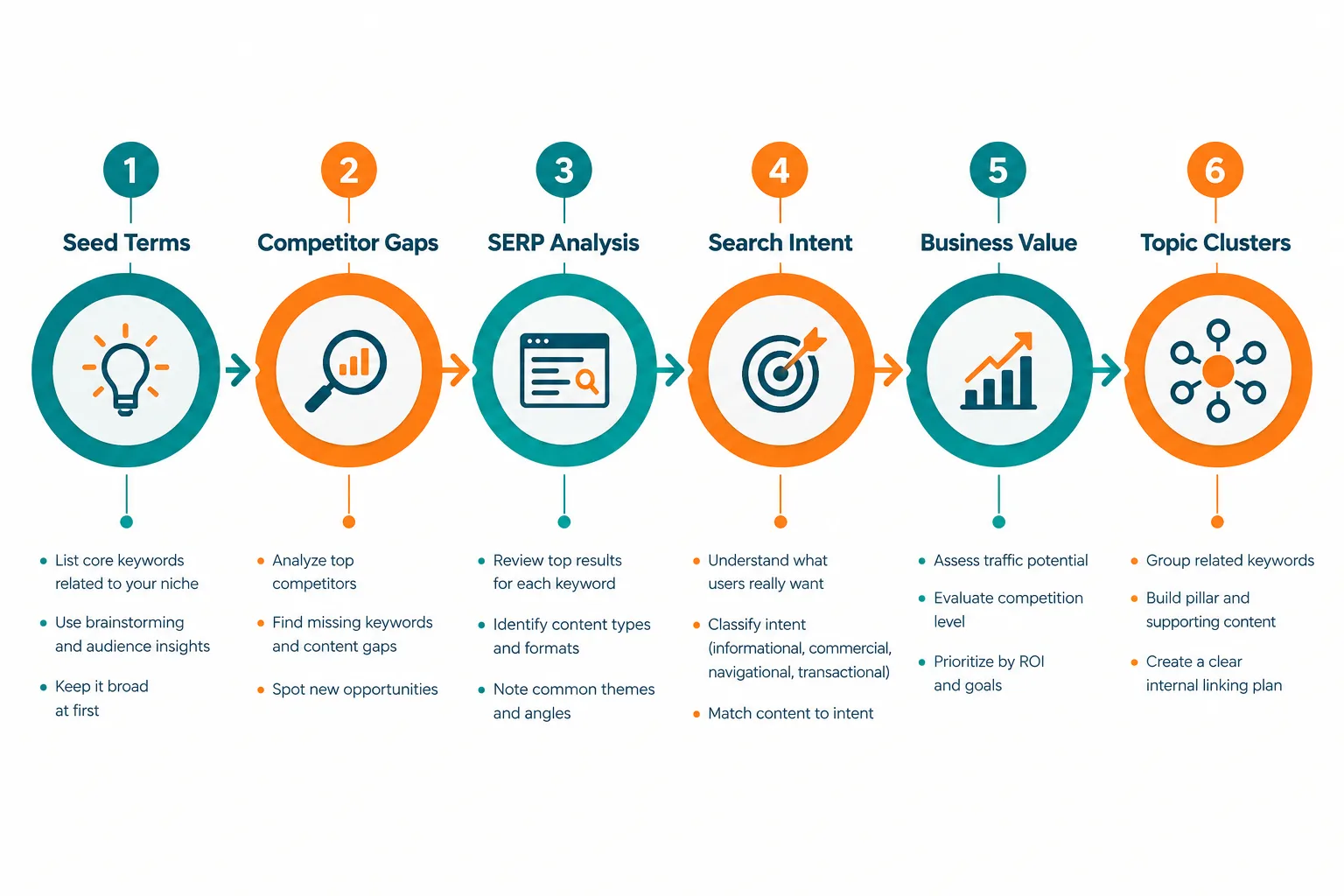
Keyword research for SEO is the process of finding what people type into search engines, understanding why they search that way, and matching those queries to content that satisfies business goals and search intent. A complete process combines seed terms, competitor gap analysis, SERP review, intent mapping, and topic clustering instead of chasing search volume alone [1][2]. Done right, it tells you not just what to write, but what gaps your competitors have left open.
Key Takeaways
- High-intent keyword research prioritizes business value and conversion potential over raw search volume [2].
- Topic clusters and entities now matter more than isolated single keywords for ranking and AI visibility.
- Content gap analysis compares your site against competitors to spot missing topics, formats, and intent coverage [3][4].
- Free tools like Google Search Console, Google Trends, and autocomplete can replace paid tools for small sites [1].
- Semrush, Ahrefs, and Ubersuggest differ mainly in data depth, pricing, and clustering features, not core functionality.
- Common mistakes include ignoring intent, chasing volume, and never updating old research.
- Keyword research is not a one-time project; revisit it every 3 to 6 months or after major algorithm and SERP changes [5].
- Local SEO keyword research needs geo-modifiers and map-pack intent; national SEO needs broader topical coverage.
What Is High-Intent Keyword Research and Why Does It Matter
High-intent keyword research means finding search terms that show a reader is close to taking action, learning seriously, or ready to buy, not just browsing. It matters because it connects your content directly to business outcomes instead of vanity traffic.
A keyword with 50 searches a month but strong buying intent can outperform one with 5,000 searches and no commercial value. For example, “best CRM for small business pricing” shows far more intent than “what is a CRM.” Salesforce’s guidance on keyword research stresses matching content to the stage of the buyer’s journey rather than just volume [6].
Choose high-intent keywords if you run a business site or sell services. Choose broader informational keywords if you’re building topical authority or audience trust first. Most sites need a mix of both, organized around the 4 essential parts of effective online content strategy.
How to Find Content Gaps in Your Niche
Content gap analysis means comparing your published content against competitors and search results to find topics, questions, or formats you haven’t covered yet. You find these gaps by cross-referencing competitor rankings, SERP features, and your own content list.

Here’s a practical gap-finding checklist:
- Pull the top 5 ranking pages for your core topics.
- List every subtopic, heading, and question they cover.
- Mark which ones your site is missing.
- Check the “People Also Ask” and related search boxes for unanswered questions.
- Group gaps by intent, not just by topic name.
Content gaps fall into recognizable types: missing subtopics, missing formats (like comparison tables or calculators), missing depth, and missing freshness [5]. A searchatlas analysis of gap methods notes that technical and competitor-driven comparison is now standard practice, not optional [3].
Edge case: if your competitors are large brands with domain authority you can’t match soon, target the gaps they’ve left in long-tail, specific questions instead of head terms.
Best Free Keyword Research Tools for SEO
You can run a full keyword research process without paying for tools, using Google Search Console, Google Trends, autocomplete, and “People Also Ask” boxes. These free sources show real query data straight from Google.
- Google Search Console: shows queries your site already ranks for, including impressions you’re missing clicks on.
- Google Trends: shows seasonality and rising interest for a topic.
- Google Autocomplete and related searches: reveal natural phrasing people actually use.
- AnswerThePublic-style question maps: surface question-based long-tail keywords.
Mangools notes that combining free data sources with manual SERP review can match paid tool insights for smaller sites with limited budgets [1]. Choose free tools if you’re a student, freelancer, or small business owner just starting out. Choose paid tools once you’re managing multiple sites or need bulk competitor data.
How to Identify What Keywords Your Competitors Are Ranking For
You find competitor keywords by running their domain through a keyword gap or site-explorer tool, which lists every query they rank for along with position and estimated traffic. This reverse-engineering step is often the fastest way to build a content list.
Steps to follow:
- Enter a competitor’s domain into a keyword gap tool.
- Filter by keywords they rank for that you don’t.
- Sort by estimated traffic or difficulty.
- Check search intent for each keyword before adding it to your list.
- Note which pages on their site target each keyword.
Common mistake: copying competitor keywords without checking if your business actually serves that intent. If a competitor ranks for a service you don’t offer, skip it. Neil Patel’s keyword research guidance stresses that competitor data should feed into your own content plan, not replace independent judgment [7].
Keyword Research for Beginners Step by Step
Beginners should start with a short seed list, expand it using free tools, check search intent, and then group related terms into topic clusters before writing anything. This keeps the process from becoming overwhelming.
A simple beginner workflow:
- Write 10 to 15 seed topics related to your niche.
- Expand each seed using autocomplete, Trends, and “People Also Ask.”
- Label each keyword by intent: informational, navigational, commercial, or transactional.
- Group similar keywords into clusters around one main topic.
- Pick one cluster to start, write a comprehensive page, then build supporting articles around it.
This approach reflects a broader shift toward topical clusters and entities over isolated keyword targeting, a method SEO.com also recommends for durable rankings [8]. If you’re new to content planning overall, pair this with a content marketing hack for faster execution.
How to Tell If a Keyword Is Worth Targeting
A keyword is worth targeting when it has clear search intent matching your content, a difficulty level realistic for your site’s authority, and business value tied to traffic or conversions. Volume alone is not enough.
Use this scoring approach:
| Factor | What to check | Decision rule |
|---|---|---|
| Search intent | Does the SERP match your content type? | Skip if intent mismatch |
| Difficulty | Can your domain realistically rank top 10? | Target easier terms first if new site |
| Business value | Does ranking help leads or sales? | Prioritize commercial terms for revenue sites |
| Volume | Is there enough demand to justify effort? | Low volume okay if intent is strong |
Semrush’s keyword research guidance echoes this shift toward prioritizing business value over raw volume alone [2]. Edge case: branded or hyper-local keywords often look “low volume” in tools but convert extremely well, so don’t dismiss them automatically.
Semrush vs Ahrefs vs Ubersuggest for Keyword Research
Semrush, Ahrefs, and Ubersuggest all offer keyword volume, difficulty scores, and competitor data, but they differ in database size, clustering features, and pricing tiers. Semrush and Ahrefs generally offer deeper competitor and backlink data, while Ubersuggest is positioned as a lighter, budget-friendly entry point.
- Choose Semrush if you need strong content gap tools and marketing-wide features beyond SEO.
- Choose Ahrefs if backlink and SERP-position tracking is your main priority.
- Choose Ubersuggest if you’re a freelancer or small business just starting with keyword tracking.
The tool landscape heading into late 2026 increasingly treats clustering, competitor analysis, and question-based keyword discovery as must-have features rather than extras [9]. Pick based on budget and how often you need bulk competitor exports, not brand reputation alone.
Common Keyword Research Mistakes That Hurt SEO
The most damaging mistakes are chasing high-volume keywords with no business fit, ignoring search intent, and never revisiting old keyword lists as the SERP changes. These mistakes waste writing effort on content that never converts or ranks.
Other frequent errors:
- Targeting one keyword per page instead of clustering related terms.
- Skipping SERP analysis before writing, missing format expectations like lists or videos.
- Overlooking question-based and “jobs to be done” queries that AI search surfaces more often now.
- Treating keyword research as a one-time task instead of an ongoing loop.
If you’re also optimizing for image-heavy content, remember supporting basics like alt text that helps people and search engines still matter for discoverability.
How to Do Keyword Research for a Niche Market
Niche keyword research works the same core process but needs deeper manual review because tools often underreport volume for small, specific markets. You rely more on community language, forums, and direct competitor review than on tool-generated numbers.
Practical approach for niche markets:
- Read forums, Reddit threads, and niche Facebook groups for real phrasing.
- Check competitor blogs even if tools show “zero volume” for their keywords.
- Prioritize specificity over search volume; niche buyers use precise language.
- Build clusters around pain points unique to the niche, not generic industry terms.
Example: a niche skincare brand targeting “fragrance-free moisturizer for rosacea” will find real buyers even if the tool shows low monthly searches.
Is Keyword Research Still Important in 2026
Yes, keyword research is still essential in 2026, but the focus has moved from single keywords toward topical clusters, entities, and the questions people ask AI-powered search tools. The mechanics changed; the goal of matching content to real demand has not.
AI Overviews and generative search results now pull from pages that cover a topic comprehensively with clear structure, which makes keyword research feed directly into content architecture. For structured tracking of how your content performs in these new surfaces, review Google Search Console’s AI performance report alongside traditional keyword data. For a broader comparison of these newer optimization approaches, see GEO vs AI search optimization vs AEO.
How Often Should You Redo Your Keyword Research
Redo keyword research every 3 to 6 months for active content sites, and immediately after any major Google algorithm update or noticeable traffic shift. Treat it as a recurring loop, not a one-time project.
Decision rule: if your niche moves fast (tech, finance, marketing), check monthly trend data even between full research cycles. If your niche is stable (local services, evergreen topics), a quarterly review is usually enough.
Keyword Research for Local SEO vs National SEO
Local SEO keyword research centers on geo-modifiers, map-pack intent, and “near me” style queries, while national SEO keyword research focuses on broader topical authority and competing against bigger domains. The tools and process overlap, but the keyword shape differs.
- Local example: “plumber in Pune for leak repair”
- National example: “how to fix a leaking pipe yourself”
Local businesses should also pair keyword work with Google Business Profile optimization for AI search since map-pack visibility depends on more than keywords alone.
How Long Does It Actually Take to Do Keyword Research
A focused keyword research session for one content cluster typically takes 2 to 4 hours using free or paid tools, while a full-site keyword audit for a new project can take several days spread across competitor analysis, clustering, and gap review. Timeframes depend heavily on niche size and tool access.
Beginners doing manual research with free tools should expect more time, closer to a full day per cluster, since there’s no automated clustering to speed things up.
Can You Do Effective Keyword Research Without Paid Tools
Yes, you can do effective keyword research without paid tools by combining Google Search Console, Trends, autocomplete, and manual SERP review, though it takes more manual effort and time than using an all-in-one paid platform. This approach works well for students, freelancers, and small business owners on tight budgets.
The tradeoff: free methods give you real query data but lack bulk competitor exports and automated clustering, so you’ll spend more time organizing data by hand.
FAQ
What is the difference between keyword research and content gap analysis? Keyword research finds search terms and their intent; content gap analysis compares your existing content against competitors to find missing topics and formats [3].
Do I need paid tools to start keyword research? No. Free tools like Google Search Console and Trends can get you started, though paid tools save time on bulk competitor data.
How many keywords should one article target? One primary keyword plus related terms within the same topic cluster, not multiple unrelated keywords.
What counts as a high-intent keyword? Keywords showing buying readiness, comparison behavior, or specific problem-solving language, like “best” or “pricing” or “how to fix.”
Should small businesses focus on local or national keywords first? Local keywords first, since they face less competition and convert faster for service-area businesses.
How do I know if a content gap is worth filling? Check if the gap matches a search intent your site can realistically satisfy and if competitors are already ranking well for it.
Is keyword difficulty score always accurate? No, difficulty scores are estimates based on backlink and ranking patterns, not guarantees. Use them as a guide, not a rule.
Can AI search tools replace traditional keyword research? Not entirely. AI search surfaces still rely on topical coverage and entity relationships, which keyword research helps map out.
Conclusion
Keyword research for SEO works best as a repeatable loop: start with seed terms, find competitor gaps, study the SERP, map search intent, weigh business value, then organize everything into topic clusters. Skip any one step and you end up with content that ranks for the wrong reasons or doesn’t rank at all.
Start small. Pick one niche topic, run it through this process this week, and publish one cluster page with two or three supporting articles. Then revisit the data in three months and adjust based on what actually drove traffic and leads. That’s how you build a content strategy that keeps improving instead of guessing.
References
- Keyword Research. mangools.com.
- Keyword Research. semrush.com.
- Content Gap Analysis. searchatlas.com.
- Content Gap Analysis. shopify.com.
- Types of SEO Gaps. seobotai.com.
- How to Do Keyword Research. salesforce.com.
- Keyword Research. neilpatel.com.
- Keyword Research. seo.com.
- Top SEO Keyword Research Tools for 2026. rankfender.com.