

Last updated: October 26, 2026
Quick Answer
Building topical authority for AI search means organizing content around one core subject so deeply and clearly that AI systems like ChatGPT, Perplexity, and Google AI Overviews repeatedly choose your pages as the source. The framework that works best in 2026 combines a pillar page, 8-12 connected cluster articles, firsthand proof, consistent author entities, and regular content refreshes rather than just publishing more pages.
Key Takeaways
- Topical authority is about depth and structure, not page count. Quality clusters with strong internal links beat scattered blog posts.
- AI engines pick sources based on topical fit and entity coherence, not domain size alone.[1]
- A pillar page plus 8-12 cluster pages is the proven structure cited across 2026 industry research.[2][3]
- 96% of Google AI Overview citations come from sources with strong E-E-A-T signals, so credibility filters out weak sites before relevance even matters.[4]
- Only 38% of AI Overview citations come from top-10 organic rankings, so ranking well in Google does not guarantee AI citation.[4]
- Clustered sites see 23% more organic visibility, 40% more traffic, and 3.2x more AI citations than sites with standalone posts.[5]
- Small, focused sites can out-cite large domains if their entity coherence and cluster depth are strong.
- Refreshing and re-linking existing cluster content matters as much as publishing new pages.
What Is Topical Authority and How Does It Help With AI Search Rankings
Topical authority is the degree to which search engines and AI answer engines treat your site as a trustworthy, comprehensive source on one specific subject. It helps AI search because systems like ChatGPT and Perplexity pull answers from domains their retrieval systems already recognize as authoritative on that topic.[1]
This matters because AI search doesn’t reward single viral articles the way classic SEO sometimes did. It rewards consistency. A site that writes one great post about “email marketing for small business” won’t get cited nearly as often as a site with a full cluster covering email list building, automation tools, deliverability, and compliance, all interlinked.
There’s also a related but different idea worth knowing: topical ownership. Topical authority describes how well you cover a subject. Topical ownership describes whether AI tools consistently pick you as the go-to source for that subject.[6] As of mid-2026, only about 15.2% of categories had a clear topic owner, while 53.7% were still open fields with multiple contenders.[7] That’s good news if you’re starting now, since there’s real room to win.
Decision rule: if your niche still has no dominant cited source when you check AI Overviews and Perplexity, treat it as an open field and move fast to build a cluster before a competitor claims it.
How Do Content Clusters Work for Building Expertise and Earning Backlinks
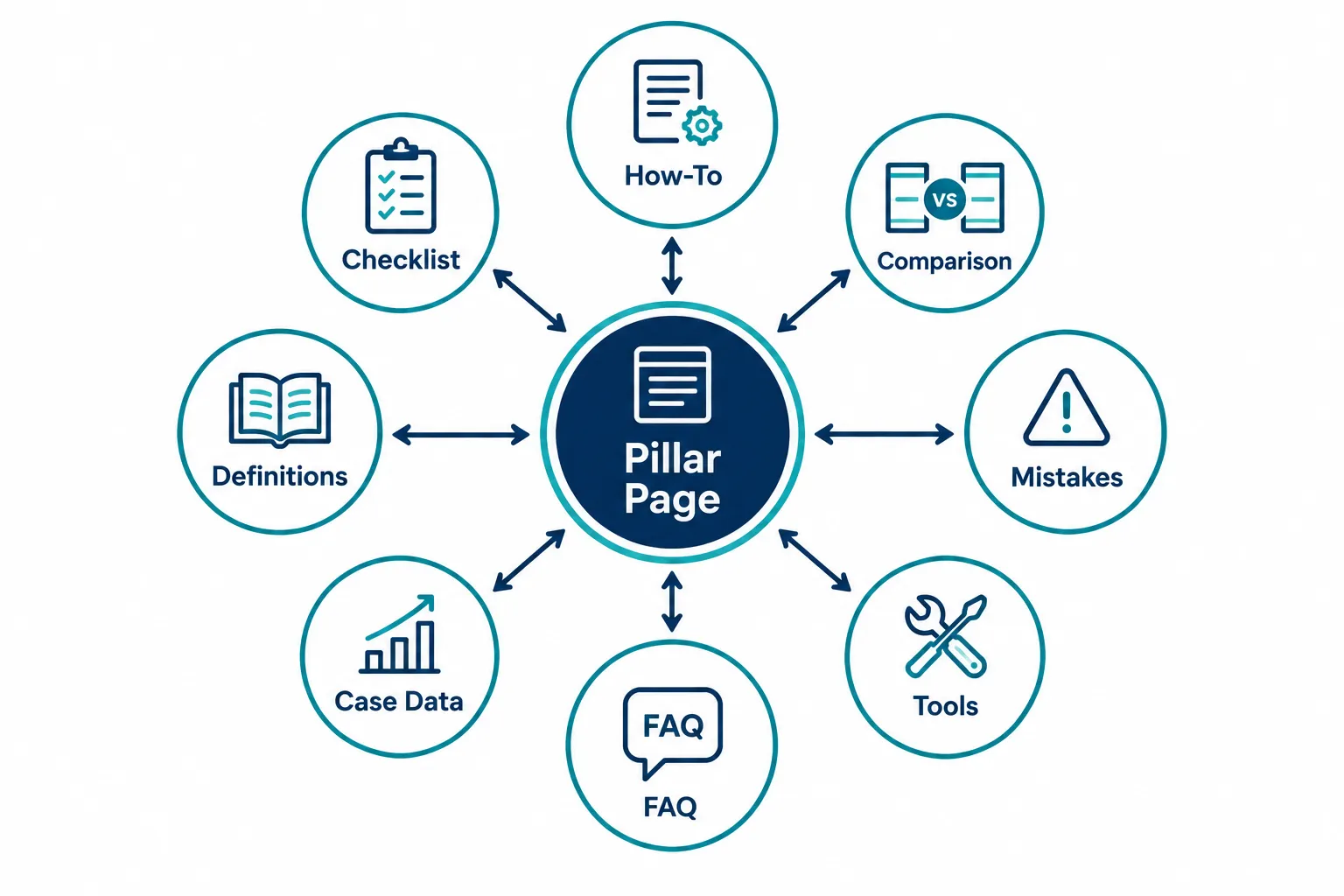
Content clusters work by grouping one pillar page with several supporting articles that each cover a specific angle of the same topic, all linked back to the pillar and to each other. This structure concentrates internal link equity, signals depth to search engines, and gives other sites more reasons to link to you because each page answers a narrow, useful question.
A typical cluster includes:
- One pillar page covering the broad topic (2,000-3,000 words works well, per HubSpot’s pillar-page research cited in recent 2026 guides).[3]
- 8-12 spoke pages, each handling informational, transactional, comparison, or question-based intent.[2][5]
- Bidirectional links between every spoke and the pillar.
- At least one page with firsthand proof: original examples, screenshots, or data you can stand behind.
AI citation experiments found that topical relevance and a page’s position inside the content network (its internal links and hub location) had the biggest effect on which URL got cited first, more than overall domain size.[8]
Common mistake: writing spoke articles that barely link back to the pillar or to each other. Isolated spokes lose most of their citation value even if the writing is good.
Difference Between Topical Authority and Traditional Keyword Optimization
Traditional keyword optimization targets individual search phrases one page at a time. Topical authority targets an entire subject area using interconnected pages, entities, and proof, which is what AI systems actually evaluate.
| Traditional keyword SEO | Topical authority for AI search |
|---|---|
| One keyword, one page | One entity, many connected pages |
| Success measured by rank position | Success measured by citation frequency across AI tools |
| Backlinks are the main authority signal | Entity density, author consistency, and cross-domain mentions matter alongside links[1] |
| Content can stand alone | Content must connect through internal links to earn full value[8] |
| Volume helps rankings | Depth and structure matter more than volume[4] |
If you only optimize for keywords, you might still rank in Google’s top 10 and never get cited in an AI Overview, since only 38% of those citations come from top-10 rankings anyway.[4]
How Long Does It Take to Build Topical Authority From Scratch
Building topical authority from scratch typically takes three to six months of consistent publishing and linking before you see early AI citation signals, and six to twelve months for a mature cluster to show stable citation share. There’s no official verified timeline from Google or AI vendors, so treat this as a working estimate based on how clusters are structured and refreshed.
Factors that speed it up:
- Picking a narrower topic instead of a broad one (a specialized niche cluster builds authority faster than a generic one).
- Publishing cluster pages close together in time rather than spreading them over a year.
- Adding original proof early (data, screenshots, named case examples) instead of adding it later.
- Refreshing older pages instead of only adding new ones, since studies show once a brand earns a strong mention share in AI answers, it tends to keep it.[7]
Edge case: if you’re entering a category where a competitor already owns the topic (per the “topical ownership” data above), expect a longer timeline and plan to out-cover them on underserved subtopics first.
Best Tools for Mapping and Organizing a Content Cluster Strategy
The best tools for mapping clusters are a mix of keyword research tools, visual mapping tools, and your own CMS’s internal linking reports; no single tool replaces manual topic mapping.
Practical options:
- Spreadsheet or Notion board to list the pillar topic, every subtopic, search intent, and linked URLs.
- Keyword clustering tools (many SEO platforms offer this) to group related queries automatically.
- Google Search Console to check which queries are already surfacing impressions for your existing pages, including the Google Search Console’s AI Performance report for tracking AI-driven visibility.
- A simple diagram tool (Miro, Whimsical, or even hand-drawn) for visualizing hub-and-spoke relationships before you write anything.
For a deeper look at structuring the plan before writing, our guide on the 4 essential parts of effective online content strategy walks through the planning stage in more detail.
Why Am I Not Getting Citations Even With a Strong Content Cluster
You might not be getting citations because AI engines filter heavily on E-E-A-T signals before relevance, and weak author credentials or thin proof can disqualify a page entirely. Remember: 96% of AI Overview citations come from sources with strong E-E-A-T.[4]
Common reasons clusters fail to earn citations:
- No named, consistent author entity across pages (anonymous “admin” bylines hurt trust signals).
- Missing firsthand evidence like original examples, data, or screenshots.
- Weak internal linking, so pages read as isolated rather than part of a network.
- Outdated content that hasn’t been refreshed, even if the cluster structure is sound.
- No structured markup helping AI systems understand entity relationships on the page.[4]
Quick example: a site with ten well-written articles but zero internal links between them will likely underperform a site with six tightly interlinked articles under one named author.
Hub and Spoke Model vs Content Cluster Framework: Which Is Better
The hub and spoke model and the content cluster framework are essentially the same structure described two ways, so there’s no real competition between them; both rely on a central pillar page connected to supporting pages.
Where people get confused is scale and intent coverage:
- Hub and spoke often emphasizes the technical linking structure (one hub, many spokes pointing back).
- Content cluster framework emphasizes the planning process (mapping intents, entities, and questions before building the hub).
In practice, use both ideas together: plan your cluster like a framework (map entities and questions first), then build it like hub and spoke (strict internal linking back to the pillar). Pillar pages with at least five interconnected spokes appeared in 86% of observed AI citation events in one 2026 data study, so the linking density matters more than which label you use.
How Many Pillar Pages and Cluster Articles Do I Need for Topical Authority
Most sites need one pillar page per core subject, supported by 8-12 cluster articles covering that subject’s informational, transactional, comparison, and question-based angles. That’s the structure consistently referenced across 2026 industry guides.[2][5]
A practical breakdown for one cluster:
- One pillar page (2,000-3,000 words, broad overview).
- Two to three “how-to” cluster pages.
- One to two comparison or “vs” pages.
- One “common mistakes” page.
- One tools or resources page.
- One FAQ-style page answering narrow questions.
- One case data or proof page with original examples.
If your site covers multiple subjects, build separate clusters for each one rather than mixing them into a single oversized pillar. For practical lead-generation structuring, see 4 steps to generate leads with the right content strategy.
Can Small Businesses Build Topical Authority or Is It Only for Big Sites
Small businesses can absolutely build topical authority, and in some cases they have an advantage because AI engines favor topical fit and entity coherence over overall domain size. A small, specialized site with a tight cluster can out-cite a large generic site that spreads thin across many unrelated subjects.
Small-business case studies in 2026 data showed clustered sites gaining 23% more organic visibility and 3.2x more AI citations compared to sites relying on standalone posts.[5]
Decision rule: choose a narrow local or niche topic (for example, “HVAC maintenance for coastal homes” instead of “home improvement”) if you’re a small site, since narrow clusters are easier to cover completely and faster to build authority around.
If local visibility matters to your business, pair your cluster with a strong Google Business Profile optimization guide for AI search setup, since local and topical signals often reinforce each other.
What Are the Most Common Mistakes People Make Building Topical Authority
The most common mistake is confusing content volume with topical authority, publishing dozens of loosely related posts instead of a tightly connected cluster around one entity. Authority is earned across the cluster, not from any single page’s word count.[2]
Other frequent mistakes:
- Skipping internal links between cluster pages (treating each post as standalone).
- Using inconsistent or anonymous author bylines, which weakens trust signals.[4]
- Never refreshing older cluster pages after publishing.
- Ignoring structured data and entity markup that help AI systems parse relationships.[4]
- Chasing keywords instead of mapping the full set of audience questions on a topic.
Does Topical Authority Strategy Work for Ecommerce or Just Blogs
Topical authority works for ecommerce just as well as it does for blogs, though the cluster content types shift toward product comparisons, buying guides, and use-case pages instead of purely educational posts.
For an ecommerce cluster, a pillar page might cover “best running shoes for flat feet,” with spokes covering specific brand comparisons, sizing guides, care instructions, and return policy FAQs, all linking back to category and product pages. The same rules apply: consistent author or reviewer bylines, original testing notes where possible, and strong internal linking between guide content and product pages.
How to Know If Your Topical Authority Efforts Are Actually Working
You’ll know your topical authority efforts are working when you see your domain cited repeatedly across multiple AI tools for your target topic, not just ranking well in traditional search. Standard Google Search Console data doesn’t expose AI citation counts directly, so manual tracking is necessary.[4]
Practical ways to check:
- Run your target queries manually in ChatGPT, Perplexity, and Google AI Overviews, and log whether your domain appears.
- Track the “mention-citation gap”: how often your brand is mentioned in AI answers versus how often it’s actually linked as a source.[4]
- Watch for repeat appearances over several weeks rather than judging from one check.
- Use a formula-based view if you want something more analytical: Topic Authority = (Content Depth x Coverage Breadth x Internal Connection Strength) / Topic Competition, a working model some 2026 cluster strategists use to score cluster strength.
What Alternatives Exist to Content Clusters for AI Search Optimization
A few alternatives exist, though none fully replace a well-built cluster for earning consistent AI citations. These include single comprehensive “skyscraper” pages, digital PR for cross-domain mentions, and structured data-only approaches.
- Skyscraper pages: one very long, exhaustive page covering a topic alone. Works for narrow topics but struggles to cover question variety as well as a cluster.
- Digital PR and cross-domain mentions: getting cited by credible external sites, videos, and communities builds entity coherence even outside your own cluster.[4]
- Structured entity markup alone: helps AI parse relationships but doesn’t substitute for actual content depth.[4]
- E3 cluster mapping: a topic-mapping approach built around core entities and experiences rather than keywords, useful as a planning method before building the actual cluster.[9]
Most practitioners combine these with a cluster rather than using them as a true replacement. For related repurposing tactics that stretch cluster content further, see our AI content repurposing workflow guide.
Which Industries Benefit Most From a Content Cluster Approach
Industries with complex, research-heavy buying decisions benefit the most from content clusters, including healthcare, legal, finance, B2B software, and home services, since these topics generate many genuine follow-up questions AI systems need answered.
Industries that benefit strongly:
- Healthcare and legal services, where E-E-A-T signals and author credentials carry extra weight.
- SaaS and B2B tools, where comparison and “how it works” content is in constant demand.
- Home services and local businesses, where location-specific spokes pair well with a service pillar.
- Education and career guidance, where step-by-step and FAQ content formats fit naturally.
Industries with simpler, low-research purchases (impulse retail, for example) still benefit, but the citation upside is smaller since fewer people ask AI tools detailed questions before buying.
Quick Cluster-Building Checklist
- Pick one core entity or topic, not a broad category.
- Map every realistic follow-up question your audience would ask.
- Build one pillar page (2,000-3,000 words).
- Build 8-12 spoke pages covering how-to, comparison, mistakes, tools, and FAQ angles.
- Link every spoke back to the pillar and to related spokes.
- Use a consistent, named author across the cluster.
- Add at least one page with original proof or data.
- Add structured entity markup where relevant.
- Check AI tools manually every few weeks to track citation appearances.
- Refresh older pages every few months instead of only adding new ones.
FAQ
What is topical authority in simple terms? Topical authority is when search engines and AI tools trust your site as a complete, credible source on one subject, based on how deeply and consistently you cover it.
Do I need a pillar page for every topic I write about? Yes, if you want to build real authority. Standalone posts without a connecting pillar rarely earn repeat AI citations.
How many cluster articles are enough to start? Start with the pillar plus 4-5 spokes, then expand toward 8-12 as research and data in 2026 guides recommend.[2][5]
Can AI citations happen without ranking on page one of Google? Yes. Only about 38% of AI Overview citations come from top-10 organic rankings, so citation and ranking are separate outcomes.[4]
Does refreshing old content really help topical authority? Yes. Refreshing signals ongoing expertise and keeps internal links accurate, which supports the entity coherence AI systems look for.
Is topical authority only about written content? No. Cross-domain mentions, videos, and community discussions also build entity coherence outside your own site.[4]
Can a brand new website build topical authority quickly? It’s possible in open topic fields with no clear owner yet, but expect three to six months minimum for early signals to appear.
Conclusion
Building Topical Authority for AI Search: A Content Cluster Framework That Earns Citations comes down to structure, proof, and consistency, not publishing speed. Pick one core entity, map the real questions people ask about it, build a pillar page with 8-12 tightly linked spokes, add original evidence, keep author bylines consistent, and refresh the cluster instead of abandoning it after launch.
Start small: choose one topic you already know well, draft the question map, and build just the pillar plus five spokes this month. Check your citation appearances across ChatGPT, Perplexity, and Google AI Overviews after a few weeks, then expand the cluster based on what’s missing. For more on structuring content that supports this kind of growth, explore the 4 essential parts of effective online content strategy, part one and our breakdown of GEO vs AI search optimization vs AEO to round out your approach.
References
- Topical Authority 2026 Content Silos That Rank and Get Cited by AI. nicodigital.com.
- Content Clusters. authoritystack.ai.
- Topical Authority Content Clusters. brambla.co.uk.
- What Is Topical Authority for AI Search a 2026 Guide. meev.ai.
- How to Write SEO Content with AI for Small Business. aidev.com.
- Why Topical Authority Isnt Enough for AI Search 474250. searchengineland.com.
- Topical Authority AI Search 482875. searchengineland.com.
- Why Topical Authority Is Essential for AI Search Success. practicebuilders.com.
- Topical Authority Pillar Cluster Framework. metaflow.life.