
Last updated: October 28, 2026
Quick Answer
To get cited in AI search answers, your LinkedIn profile needs clear, keyword-aligned entities in the headline and About section, quantified proof of experience, consistent topic focus across posts and articles, and full public visibility. AI answer engines pull from profiles that read like evidence, not marketing copy. Completeness, relevance, and activity are the three signals that matter most [1].
Key Takeaways
- Getting cited means an AI tool like ChatGPT, Gemini, or Perplexity quotes or links your profile as a source in its answer, not just that you rank in LinkedIn search.
- AI systems weigh relevance, completeness, and activity when deciding which profiles to surface [1][2].
- A Premium subscription is not required to get cited; visibility settings and content quality matter more.
- Headlines carry more weight for AI summarization than long About paragraphs because they are scanned first.
- Posting consistency matters less than topic consistency; AI favors profiles that repeat the same themes over time.
- Private profiles cannot be cited because AI crawlers and search tools need public, indexable content.
- Recommendations and endorsements add trust signals but rarely get quoted directly in AI answers.
- LinkedIn Articles and Featured content act as a “source shelf” AI tools can pull quotable lines from.
What Does It Mean to Be Cited in an AI Search Answer
Being cited means an AI answer engine, such as Google AI Overviews, ChatGPT Search, or Perplexity, references your LinkedIn profile or post as a source when answering a user’s question. This is different from simply appearing in LinkedIn’s internal search results.
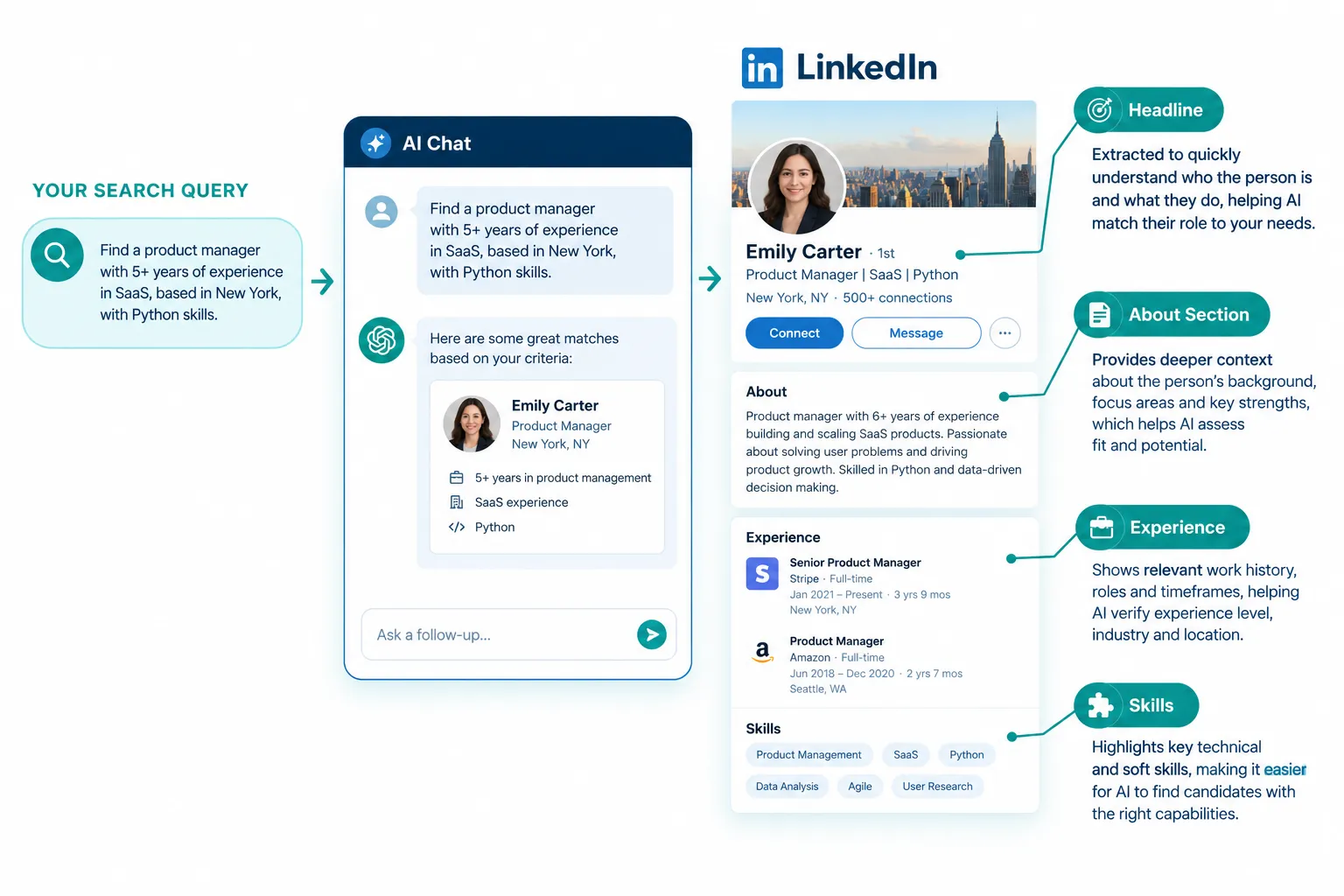
A citation can look like a direct link under an AI-generated answer, a quoted line attributed to your name, or a summarized fact pulled from your Experience section. AI tools treat LinkedIn profiles as structured, semi-trusted data: a mix of a resume, a publication record, and a professional bio. According to AI Syndicate’s research on LinkedIn and AI answers, profiles that read like evidence (specific roles, named outcomes, dated activity) get pulled into answers far more often than vague self-descriptions [3].
Example: if someone asks an AI tool “who are SEO consultants in Mumbai with agency experience,” a profile listing a specific agency name, years, and a quantified result is more likely to surface than one that just says “SEO expert.”
How Do AI Search Engines Decide Which LinkedIn Profiles to Cite
AI search engines favor profiles that combine topical relevance, completeness, and recent activity. These three factors form LinkedIn’s own ranking logic, and AI tools that scrape or index LinkedIn data tend to follow a similar pattern [1][2].
Here’s what each factor actually means in practice:
| Ranking Factor | What It Means | How to Improve It |
|---|---|---|
| Relevance | Keywords match the query intent | Align headline, About, and Skills with terms your audience searches |
| Completeness | Profile has no empty or thin sections | Fill Experience, Education, Licenses, Featured, and Skills fully |
| Activity | Recent posts, articles, or comments | Publish on a consistent topic, not just a consistent schedule |
A profile with a strong headline but an empty Experience section rarely gets cited, because AI models can’t verify the claim with supporting detail. Completeness acts like a trust filter before relevance even gets evaluated.
Do You Need a Premium LinkedIn Profile to Get Cited in AI Answers
No, a free LinkedIn account can get cited in AI search answers. Premium subscriptions unlock analytics and InMail credits, but they don’t change whether AI crawlers can read or quote your public content [2].
What actually affects citation eligibility:
- Public profile visibility (free, under Settings)
- Indexable content such as Articles and posts
- Complete sections that give AI something specific to quote
Premium is worth considering for job seekers who want InMail access or deeper analytics, but it has no direct link to AI citation frequency. Skip it if your only goal is AI visibility; spend that budget on writing better Experience bullets instead.
Why Isn’t My LinkedIn Profile Showing Up in AI Search Results
Your profile likely isn’t showing up because it’s set to private, lacks specific keywords, or has thin, generic content that gives AI nothing concrete to cite. This is the most common and most fixable problem [4][5].
Common reasons profiles stay invisible to AI tools:
- Profile visibility restricted to “LinkedIn members only” instead of public
- Headline says something vague like “Passionate Professional” with no role or industry term
- About section written in first-person storytelling with no named skills, tools, or results
- No Featured section, articles, or publications to act as supporting evidence
- Account inactive for months, so AI systems treat it as stale data
Decision rule: if your profile hasn’t published anything in 90+ days and has fewer than three Featured items, treat AI visibility as broken until you fix both.
What LinkedIn Keywords and Skills Help With AI Visibility
Keywords that match how recruiters and AI systems phrase queries help the most, not generic buzzwords like “hardworking” or “team player.” Align your Headline, About, Experience, and Skills sections with actual job titles, tools, and outcomes your audience searches for [1][6].
Practical approach:
- List 5-8 terms your ideal reader or recruiter would type into a search bar (for example, “technical SEO consultant,” “Google Ads specialist,” “React developer”).
- Place the strongest 2-3 terms in your headline.
- Repeat the full set naturally across About, Experience bullets, and the Skills section.
- Avoid stuffing; one unnatural repetition is more damaging than one missing keyword.
This mirrors the same logic used in traditional keyword research for AI search: intent-matching beats keyword density every time.
How Often Should You Post on LinkedIn to Get Cited by AI
There’s no fixed posting frequency that guarantees AI citation, but profiles that publish on a consistent topic at least two to four times a month tend to build enough content depth to get noticed [7]. Consistency of theme matters more than daily posting.
A practical cadence that works for most professionals:
- One LinkedIn Article or long-form post per month on a core topic
- Two to three shorter posts per month reinforcing the same themes
- Comments on relevant industry posts to show ongoing activity
Common mistake: posting daily about unrelated topics (motivation quotes one day, industry news the next) confuses both human readers and AI systems trying to detect your topical authority.
Can You Get Cited in AI Search Answers With a Private LinkedIn Profile
No. A private LinkedIn profile cannot be cited in AI search answers because AI tools and search crawlers need public, indexable pages to reference [3][4].
To fix this:
- Go to Settings and Privacy, then Visibility.
- Set “Edit your public profile” to visible for everyone.
- Confirm individual sections (Experience, Education, Skills) are also toggled public.
- Check that your profile appears when searched in an incognito browser window.
This is the single most overlooked step. Many professionals optimize their headline and About beautifully, then wonder why nothing shows up in AI answers, simply because the profile was never public to begin with.
What’s the Difference Between LinkedIn SEO and AI Search Citations
LinkedIn SEO focuses on ranking inside LinkedIn’s own search bar, while AI search citation focuses on being quoted or linked by external AI tools answering a user’s question outside LinkedIn entirely. They overlap but aren’t the same goal [2][8].
| Aspect | LinkedIn SEO | AI Search Citation |
|---|---|---|
| Goal | Rank in LinkedIn’s internal search | Get quoted/linked in AI-generated answers |
| Primary signals | Keywords, connections, activity | Public content, specific claims, topical depth |
| Where it shows | LinkedIn search results page | ChatGPT, Gemini, Perplexity, Google AI Overviews |
| Optimization focus | Recruiter search terms | Quotable, fact-based statements |
If your only goal is recruiters finding you on LinkedIn, focus on LinkedIn SEO. If you want AI tools citing you across the open web, you need both: good internal SEO and externally quotable, publicly visible content. This distinction is similar to the GEO vs AI search optimization vs AEO comparison used for websites.
Does Your LinkedIn Headline Matter More Than Your Summary for AI
Yes, the headline generally matters more for AI visibility because AI summarization tools scan headlines first as a compressed signal of who you are and what you do [5]. The About section adds depth, but the headline sets the frame.
What a strong headline includes:
- A specific role or title (not a vague label)
- One or two keywords matching search intent
- A result or specialty if space allows
Example structure: “SEO Consultant | Technical SEO & AI Search Visibility | Helped Websites Improve Organic Traffic”
The About section should then expand on the headline with specific proof: named tools, measurable outcomes, and topic focus. Write the opening line of your About section as a standalone, quotable statement, since that’s often the first line AI tools extract.
How Long Does It Take Before Your Profile Appears in AI Search Answers
There’s no fixed timeline, but profiles with complete sections, public visibility, and consistent topical content typically start appearing in AI-referenced results within a few weeks to a few months after optimization, depending on how actively AI tools index LinkedIn and related web mentions [3][4].
Factors that speed this up:
- Public profile from day one (no delay from privacy settings)
- Existing Featured articles or publications that are already indexed
- Consistent activity rather than a one-time profile edit
Factors that slow it down:
- Infrequent posting after the initial optimization
- No external mentions or backlinks reinforcing your name and expertise
- A profile that was recently made public after years of being private
What Are Common Mistakes That Prevent LinkedIn Profiles From Being Cited
The most common mistake is writing a profile that sounds impressive but contains no verifiable specifics, which gives AI nothing concrete to quote [9][10]. Vague language is the biggest blocker.
Other frequent mistakes:
- Treating the About section as a personal story instead of a skills-and-results summary
- Leaving Skills, Licenses, or Featured sections empty
- Using the same generic headline as hundreds of other professionals in the same field
- Posting inconsistently or abandoning the profile after initial setup
- Ignoring recommendations entirely, which removes a layer of third-party validation
Edge case: career changers sometimes keep an outdated headline from a previous role. AI tools will cite the old job title, not the new direction, until the headline is updated.
Are Certain Industries or Job Titles More Likely to Get Cited by AI
Yes, professionals in fields with clear, searchable expertise, such as technology, marketing, finance, law, and healthcare, tend to get cited more often because their skills map cleanly to common AI queries [6][8]. Roles with vague titles or highly internal functions get cited less.
Why this happens:
- AI queries about “best SEO consultant” or “top React developer” map directly to specific job titles
- Internal-facing roles (like “Operations Coordinator” at a company with no public content) rarely match external search intent
- Consultants, freelancers, and thought leaders who publish Articles get cited more than employees who never post publicly
Choose this focus if: your job title already matches a common search phrase. If it doesn’t, consider adding a clarifying phrase in your headline, like “Operations Manager | Supply Chain & Logistics Process Improvement.”
How Does Having Recommendations and Endorsements Affect AI Citations
Recommendations and endorsements strengthen trust signals but are rarely quoted word-for-word in AI answers; they work more as supporting context than as citation material [10]. AI tools weigh them as a credibility layer, not primary content.
Practical use:
- Request recommendations from people who can mention a specific project or result, not just “great to work with”
- Treat endorsements as a completeness signal (profiles with zero endorsed skills look unfinished)
- Don’t over-invest time chasing endorsements if your About section and Experience bullets are still thin
Is Optimizing for AI Citations Worth It Compared to LinkedIn Ads
For most professionals and small business owners, optimizing a LinkedIn profile for AI citations is more cost-effective long-term than running LinkedIn Ads, because profile optimization has no ongoing media cost and builds compounding visibility [2][3]. Ads deliver faster but temporary reach.
| Approach | Cost | Timeframe | Longevity |
|---|---|---|---|
| Profile optimization for AI citations | Free (time investment) | Weeks to months | Long-term, compounding |
| LinkedIn Ads | Ongoing ad spend | Immediate | Stops when budget stops |
Choose profile optimization if you want sustainable visibility and have time to publish consistently. Choose ads if you need immediate leads for a specific campaign and already have a complete, public profile as the landing destination.
This approach pairs well with broader strategies covered in how to get your website cited in Google AI Overviews, ChatGPT, and Gemini and how to optimize content for Google AI Overviews, since the underlying principle, writing specific, quotable, evidence-backed content, applies across platforms.
Quick Checklist for LinkedIn AI Citation Readiness
- Profile set to fully public, including individual sections
- Headline includes a specific role and 2-3 target keywords
- About section opens with a quotable, specific sentence
- Experience bullets follow Context-Action-Result with numbers where possible
- Featured section includes at least 2-3 articles or publications
- Skills section filled and endorsed
- Posting cadence of 2-4 pieces per month on a consistent topic
- Recommendations requested from people who can cite specific results
FAQ
What does it mean when LinkedIn says a profile is “cited” by AI? It means an AI tool referenced or linked that specific profile, post, or article as a source while answering a user’s question, rather than generating a generic response.
Do I need to post every day to get cited by AI? No. Consistency of topic matters more than frequency. Two to four focused posts a month beats daily unrelated content.
Can a student or fresh graduate get cited in AI search answers? Yes, if the profile clearly states skills, projects, and a specific career direction, even without years of professional experience.
Does changing my headline immediately improve AI visibility? Not instantly, but it’s the fastest change you can make, since AI tools often scan headlines first when summarizing who you are.
Should I use LinkedIn Articles instead of short posts? Articles generally give AI tools more quotable, structured content than short posts, making them a stronger “source shelf” for citations [3].
Is a verified LinkedIn badge required for AI citation? No, verification adds a trust signal but isn’t required. Public visibility and complete content matter more.
Do recommendations get quoted directly by AI tools? Rarely. They add credibility but AI answers typically pull from Experience, About, and published content, not third-party recommendations.
How is LinkedIn AI citation different from showing up in Google search? LinkedIn AI citation involves AI tools like ChatGPT or Gemini referencing your profile in a generated answer, while Google search ranking is about appearing in traditional search result listings.
Conclusion
Getting cited in AI search answers isn’t about gaming an algorithm. It’s about making your LinkedIn profile specific, public, and genuinely useful as a source of real information. Start with the basics: make your profile public, rewrite your headline with real keywords, and fill every section instead of leaving gaps.
Then build evidence over time. Publish one solid Article a month, write Experience bullets with actual numbers, and request recommendations that mention specific results instead of generic praise. This is a slower process than running ads, but it compounds, and unlike paid visibility, it keeps working long after you stop actively promoting it.
If you’re also working on getting your website cited in AI answers, the same logic applies. Check out related guidance on keyword research and Google AI Overviews link visibility in 2026 to apply the same principles across your entire online presence, not just LinkedIn.
References
- Linkedin Profile SEO Checklist 2026 Basir Jaffery Ridkf. linkedin.com.
- Optimize Linkedin AI. valueyournetwork.com.
- Linkedin and AI Answers. aisyndicate.com.
- Linkedin AI Visibility. rafalszymanski.pl.
- Linkedin Profile Optimization 2026. simplify.jobs.
- Linkedin AI Search Can Your Profile Match Recruiter Intent Turner Wdcwe. linkedin.com.
- Vengreso Linkedin Personalbranding Careergrowth Activity 7500975131251355648 Dftg. linkedin.com.
- How Get Cited AI Search Engines Linkedin Oded Tsamir Tol2f. linkedin.com.
- Linkedin Profile Optimization. gradguide.nl.
- Linkedin Profile Optimization Executives. media-all.in.