

Last updated: October 20, 2026
Quick Answer
Local SEO for home builders means optimizing your Google Business Profile, website, reviews, and citations so you show up in the Map Pack when buyers search “home builders near me” or “new homes in [city].” Most builders can see real movement in 60 to 90 days by fixing GBP categories, running a steady review campaign, and publishing city-specific landing pages. It takes consistent weekly work, not a one-time setup.
Key Takeaways
- The Map Pack is the three-listing box with a map that appears above organic results for local searches, and it captures most of the clicks for builder queries [1][2].
- Google ranks Map Pack listings on relevance, distance, and prominence, with reviews carrying the heaviest weight among prominence signals [3][4].
- Set your Google Business Profile’s primary category to “Home Builder” or “Custom Home Builder,” never a generic “Construction Company” or “Real Estate Agency” [5][6].
- Builders with multiple active communities should create a separate, verified GBP for each sales office location, not one profile stretched across counties [5].
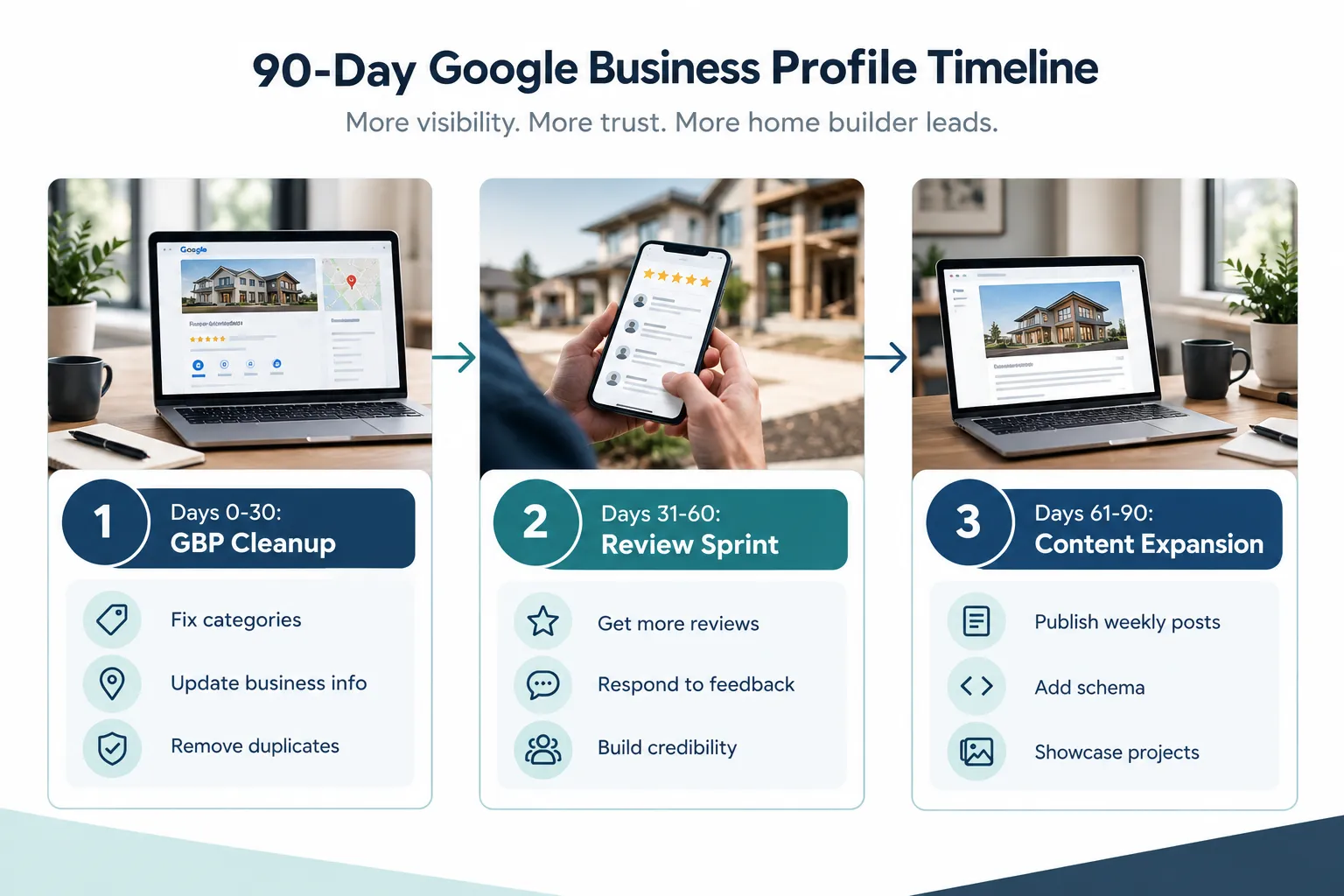
- A realistic 90-day plan: Days 0-30 for GBP and citation cleanup, Days 31-60 for review generation and city pages, Days 61-90 for content expansion and schema [1][2][5][7].
- You generally need a real physical address (a sales office or model home counts) to maintain a verified Maps listing, a PO box or virtual office usually won’t work [1][5].
- Reviews, and how often you get them, often matter more than backlinks for ranking movement in competitive builder markets [3].
- Local SEO and paid search work best together: local SEO builds lasting visibility, while ads fill gaps while your profile and reviews mature [2][7].
What Is the Google Map Pack and Why Does It Matter for Home Builders
The Google Map Pack is the box of three local business listings with a map that appears near the top of search results for queries with local intent. For home builders, it matters because buyers searching “home builders near me” or “new homes in [city]” see this box before anything else, and it drives most of the calls and model-home visit requests [1][2].
Roughly 46% of all Google searches carry local intent, and builder searches are almost always local by nature, nobody searches for a home builder outside their target city [2]. If your business isn’t in that three-pack, you’re relying entirely on paid ads or word of mouth to get discovered. This is exactly why Local SEO for Home Builders: Win the Map Pack in 90 Days has become one of the highest-ROI projects a builder can run this year.
A buyer typically moves from a broad search (“new homes”) to a specific one (“home builder in Round Rock”). The Map Pack shows up right at that narrowing stage, when intent is highest and the buyer is close to picking up the phone [2].
How Do I Get My Home Building Business in the Google Map Pack
You get into the Map Pack by claiming and fully optimizing your Google Business Profile, then building enough relevance, distance match, and prominence signals to outrank competitors for your target queries [1][4].
Google’s local algorithm weighs three things:
- Relevance, does your profile and website clearly say you build homes in this city or county?
- Distance, how close is your registered address to the searcher (or the searched location)?
- Prominence, how well-known and trusted is your business online, based on reviews, links, citations, and engagement [4].
A 2026 breakdown of local ranking signals estimates reviews account for roughly 20% of ranking weight, on-page signals about 15%, behavioral signals (calls, direction requests) around 9%, and links about 8% [3]. That tells you exactly where to spend your first month of effort: reviews and on-page relevance, not just backlinks.
Decision rule: if your GBP is unclaimed or still using a generic category like “General Contractor,” start there before touching anything else on your website.
How Long Does It Actually Take to Rank in Local Search Results
Most home builders with a clean GBP, consistent reviews, and basic city-page optimization start seeing Map Pack movement within 60 to 90 days, though competitive metro markets can take longer [1][5].
Timeframes depend on:
- Market competition, a builder in a small county competes with far fewer profiles than one in a major metro.
- Starting point, an unclaimed or miscategorized profile needs cleanup time before anything else works.
- Review velocity, builders who systematically ask every closed buyer for a review move faster than those who ask occasionally.
A common mistake is expecting overnight results after one GBP edit. Local ranking is cumulative, Google needs repeated, consistent signals (new reviews, new posts, consistent NAP) before it trusts a profile enough to rank it higher [3].
What Are the Best Local SEO Strategies Specifically for Builders
The best local SEO strategies for home builders combine a fully optimized Google Business Profile, community-level listings, city-specific landing pages, and a steady review pipeline tied to closings [2][5][7].
Here’s what actually moves the needle, ranked by typical impact:
| Strategy | What it does | Effort level |
|---|---|---|
| GBP category and field cleanup | Fixes relevance signal immediately | Low, one-time |
| Weekly GBP posts | Signals activity and freshness | Low, ongoing |
| Review generation after closing | Builds strongest prominence signal | Medium, ongoing |
| City/community landing pages | Ties website to specific service areas | Medium, one-time per market |
| Citation cleanup (top 50 directories) | Fixes NAP consistency across the web | Medium, one-time |
| Schema markup (LocalBusiness) | Helps Google confirm location data | Low, one-time |
Builders operating across several counties should treat each community almost like a separate small business for SEO purposes, with its own profile, photos, and local content [5]. For a wider view of how search behavior is shifting with AI-driven results, our guide on Google AI Mode SEO is worth a read alongside this.
How Do I Optimize My Google Business Profile for Construction and Real Estate
Optimizing a GBP for a home builder means setting the right category, writing a complete keyword-rich description, uploading real project photos, and keeping hours and service areas accurate [5][6].
Specific steps:
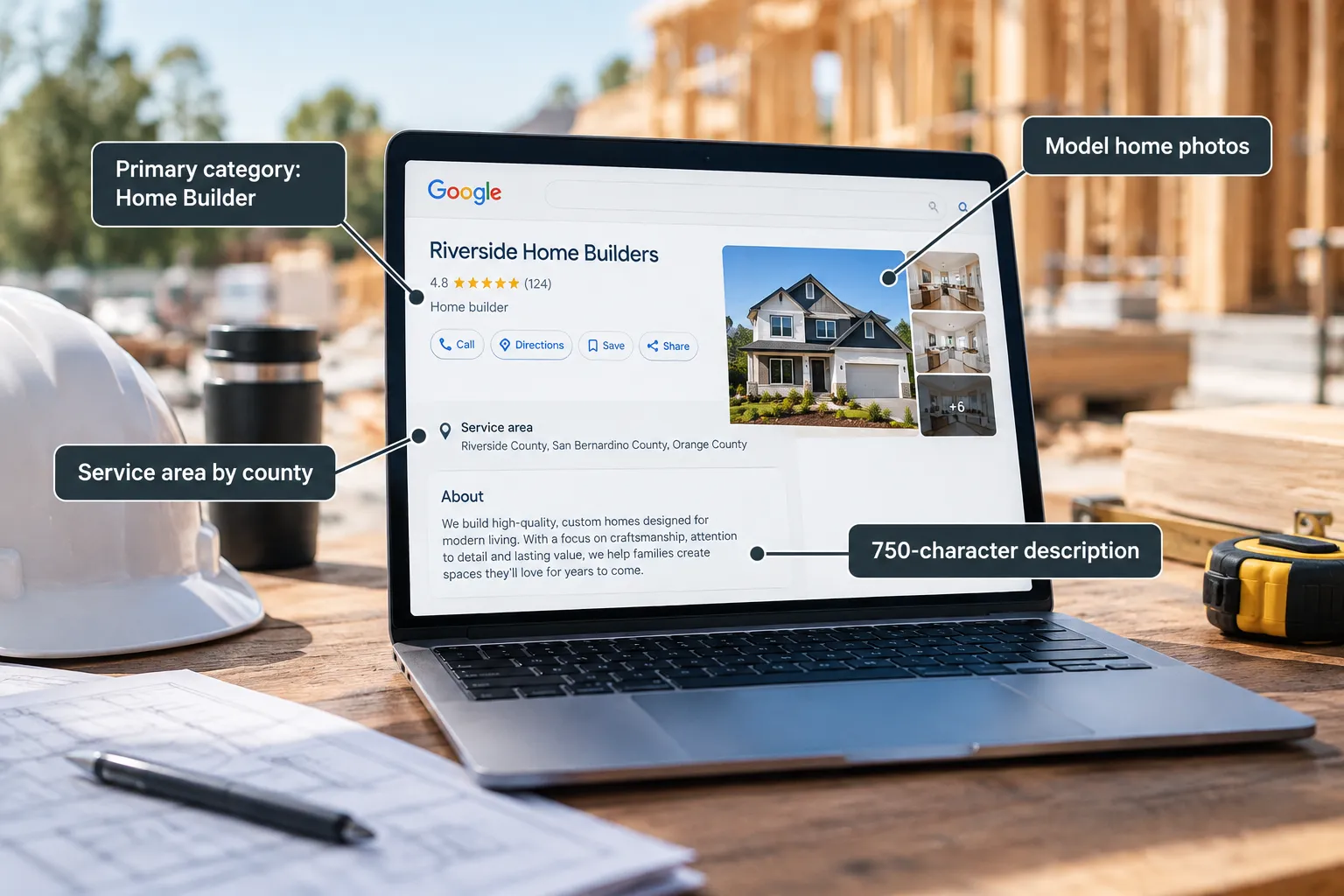
- Primary category: “Home Builder” or “Custom Home Builder”, not “Real Estate Agency” or plain “Construction Company” [5][6].
- Secondary categories: add “Real Estate Developer,” “Construction Company,” and “Model Home” where applicable [6].
- Description: write around 750 characters naturally including your main markets and keywords, avoiding stuffing.
- Photos: upload 20 or more high-quality images of communities, model homes, exteriors, and interiors, this signals a genuine, active presence [5][8].
- Service area: define it by county, not a vague mile radius, so Google understands exactly where you build [5][6].
- Hours: list model-home visiting hours separately from office hours to avoid confusing buyers [5][6][8].
- Q&A section: pre-answer common buyer questions like build timelines, price ranges, and build-on-your-lot options [5][6][8].
Our full walkthrough on the Google Business Profile Optimization Guide for AI Search 2027 goes deeper into field-by-field setup if you want the complete checklist.
What Keywords Should Home Builders Target for Local SEO
Home builders should target city-plus-service combinations like “custom home builder in [city],” “new homes in [county],” and “build on your lot [city],” rather than broad national terms [4][9].
Practical keyword groups to build pages around:
- City/community + “home builder” (e.g., “home builder in Pflugerville”)
- County + “new homes” (e.g., “new homes Williamson County”)
- Service-specific terms: “build on your lot,” “semi-custom homes,” “energy-efficient new construction”
- Long-tail buyer-intent phrases: “home builder near me with model homes open now”
Include these naturally in title tags, H1s, meta descriptions, and image alt text on each location page, without repeating the exact phrase unnaturally across the page [4][9]. If you’re unsure how keyword structure affects crawling and ranking more broadly, our piece on common SEO mistakes to stop making covers related pitfalls worth checking.
Do I Need a Physical Office Location to Rank in Google Maps as a Builder
Yes, you generally need a real, staffed physical address, a sales office, model home, or administrative office, to maintain a verified Google Business Profile for Maps [1][5].
A PO box, virtual office, or an address you don’t actually staff usually gets flagged or suspended during Google’s verification process. If you build in multiple communities, each community with its own sales office can qualify for its own verified listing, provided the location is real and has set hours [5].
Edge case: if you’re a new builder without a permanent office yet, use your model home address once it’s staffed, and hold off on claiming a GBP until you have a legitimate, visitable location, a suspended profile is harder to recover than a delayed launch.
How Much Does Local SEO Cost for Home Builders
Local SEO costs for home builders vary widely depending on whether you do it in-house or hire help, but a realistic range for professional management runs from a few hundred to a few thousand dollars per month, depending on market size and number of communities [5][7].
Cost drivers include:
- Number of active communities (each may need its own GBP and landing page)
- Market competitiveness (metro areas cost more to rank in than smaller counties)
- Whether you need ongoing content creation, review campaign management, and citation audits
- Whether schema and technical SEO work is included
Honest take: builders with a single community and a small budget can do a meaningful version of this themselves using a checklist and consistent weekly effort. Builders with multiple active communities across counties usually benefit from hiring help because the citation and review workload multiplies fast.
Can I Rank in the Map Pack if I Build Homes in Multiple Cities or Counties
Yes, but each active community generally needs its own verified GBP tied to a real sales office address, plus a matching city or community landing page on your website [5].
Trying to rank one single GBP for an entire multi-county operation rarely works well, because Google ties relevance to the registered address and nearby service area. Instead:
- Create a separate GBP for each community with its own sales office.
- Build a dedicated landing page per city/community with local content, NAP data, and an embedded Google Map.
- Add LocalBusiness and address schema to each page to confirm geographic relevance to Google [1].
- Post weekly updates on each community’s GBP about events, inventory, and open-house hours [5].
What Common Local SEO Mistakes Do Home Builders Make
The most common mistake is choosing the wrong GBP category or running one GBP across multiple cities instead of separate community profiles [5][6].
Other frequent mistakes:
- Leaving service area set to a generic radius instead of defining it by county
- Ignoring citation consistency across real-estate directories like Zillow, Realtor.com, and NewHomeSource, these sometimes outrank the Map Pack itself for competitive queries
- Not responding to reviews, positive or negative
- Treating GBP as a one-time setup instead of a weekly posting habit
- Using the same generic homepage content for every city instead of unique, localized landing pages [1]
If you’re also managing content output across multiple channels, our guide on AI content repurposing to avoid AI slop is useful for keeping local pages fresh without burning out your team.
How Do I Get More Google Reviews and Ratings for My Construction Company
You get more reviews by asking systematically after every closing and model-home visit, making it easy with a direct link, and responding to every review you receive [3][5][8].
A simple system that works:
- Send a review request text or email within 48 hours of closing.
- Ask buyers to mention their city, community name, and home type in the review (this reinforces local relevance signals) [3].
- Respond to every review, positive or negative, within a few days.
- Track review velocity monthly, a steady trickle beats a one-time push followed by silence.
Common mistake: asking for reviews only at closing and forgetting model-home visitors, real estate agent partners, and subcontractors who had a good experience working with you.
Is Local SEO Better Than Google Ads for Generating Builder Leads
Local SEO and Google Ads solve different problems, local SEO builds durable, no-cost-per-click visibility over time, while ads deliver immediate traffic while your profile and reviews are still maturing [2][7].
Neither fully replaces the other. A practical approach:
- Run Google Ads for immediate lead flow in your first 90 days while local SEO signals build up.
- Shift budget gradually toward organic/local as your Map Pack position stabilizes.
- Keep ads running for high-competition keywords where Map Pack ranking is slow to move.
Choose local SEO first if you have 90+ days before your next sales deadline. Choose ads first if you need leads this month and your GBP is brand new.
Can New Home Builders With No Reviews Compete in Local Search Rankings
Yes, but it takes longer and requires leaning harder on GBP completeness, citation accuracy, and early review requests rather than relying on prominence alone [3][4].
New builders without a review history should:
- Fully complete every GBP field (hours, categories, description, photos) since this signal is immediately available, unlike reviews
- Get listed accurately on top real-estate directories (Zillow, Realtor.com, NewHomeSource, BDX) right away
- Start requesting reviews from the very first closing, don’t wait to “build up” a customer base first
- Use schema markup and localized content to strengthen relevance signals while prominence catches up
Edge case: a brand-new builder with zero reviews but a perfectly optimized GBP can sometimes outrank an established competitor with a sloppy, outdated profile, relevance and on-page signals still matter even before reviews accumulate [3][4].
Do I Need a Website to Appear in the Google Map Pack
Technically no, a bare GBP can appear in the Map Pack, but practically yes, a website with city-specific landing pages, schema markup, and localized content significantly strengthens relevance and prominence signals, and it’s where buyers go after the map click [1].
Without a website:
- You lose the ability to add structured data (LocalBusiness schema) that helps Google confirm your service areas
- You can’t build dedicated pages per community, which hurts multi-city rankings
- You miss the conversion step, Map Pack clicks often lead to a website visit before a phone call
A simple, well-structured site with embedded maps and local content per market is one of the most reliable ways to support long-term Map Pack visibility [1].
A Practical 90-Day Checklist
- Days 0-30: Fix GBP category, complete every field, audit top 50 citations, confirm NAP consistency.
- Days 31-60: Launch review request system, start weekly GBP posts, publish core city/community landing pages.
- Days 61-90: Expand localized content, add or refine schema markup, review GBP Insights and call data, adjust based on what’s working.
Frequently Asked Questions
What is the fastest way to appear in the Map Pack as a home builder? Claim and fully complete your Google Business Profile with the correct “Home Builder” category, then start requesting reviews from every closed buyer immediately [3][5].
Does a builder need separate websites for each community? No, separate landing pages on one website usually work fine, as long as each page has unique local content, NAP data, and schema markup [1].
How many reviews does a builder need to rank well? There’s no fixed number, steady, ongoing review velocity matters more than hitting a specific count [3].
Can I use my home address as my GBP location? Only if it’s a legitimate, staffed location you can verify; builders typically use a sales office or model home instead [1][5].
Will Google Ads help while I wait for local SEO to work? Yes, running ads alongside local SEO work is a common and practical way to maintain lead flow during the first 90 days [2][7].
Do AI Overviews replace the traditional Map Pack? Not entirely, AI-generated modules like “Top-Rated” providers are appearing alongside the classic Map Pack on some queries, but both still depend heavily on reviews and GBP completeness [10].
How often should I post on Google Business Profile? Weekly posts mentioning your city, services, and current inventory or events are recommended for maintaining activity signals [9].
Conclusion
Winning the Map Pack as a home builder isn’t about one clever trick, it’s about stacking small, consistent fixes: the right GBP category, complete profile fields, steady reviews, and city-specific content that actually matches what buyers search for. Builders who treat this as a 90-day sprint with weekly check-ins tend to see real movement, while those who set it up once and walk away usually stall.
Start this week with a GBP audit: check your category, fill every blank field, and send your next closed buyer a review request. For a deeper look at how AI-driven search is reshaping local visibility beyond the Map Pack, read our guide on SEO vs GEO vs AEO in 2026, and if you want help structuring your citation cleanup, our resource on outsourcing your SEO marketing is a practical next read.
References
- What Is the Google Map Pack. rallio.com.
- Home Builder Marketing Trends 2026. foxxr.com.
- Win the Map Pack. deangarland.com.
- Local SEO in 2026 How to Rank in Google Maps and the Local Pack. mettevo.com.
- Home Builder SEO. chatterbuzzmedia.com.
- SEO for Builders. aiclicks.io.
- Home Builder Marketing Guide. digitalthirdcoast.com.
- SEO for Homebuilders. riffanalytics.ai.
- Google Maps SEO. thestacc.com.
- Maps Pack How to Get Found Local SEO. searchinfluence.com.