

Last updated: October 20, 2026
Most B2B marketing teams spend their first 30 days picking channels. That is the wrong starting point, and it is the main reason pipeline numbers look weak by day 90. A working B2B demand generation strategy: a 90-day plan to build pipeline, starts with fixing data and defining the ideal customer, then launches a small number of channels, and only scales what produces actual sales opportunities, not just form fills [1].
I have watched marketing teams in India and globally burn entire quarters chasing lead volume while sales kept asking “where’s the pipeline?” The gap usually comes from skipping the boring groundwork, clean data, shared definitions, and tracking that actually works.
Quick Answer
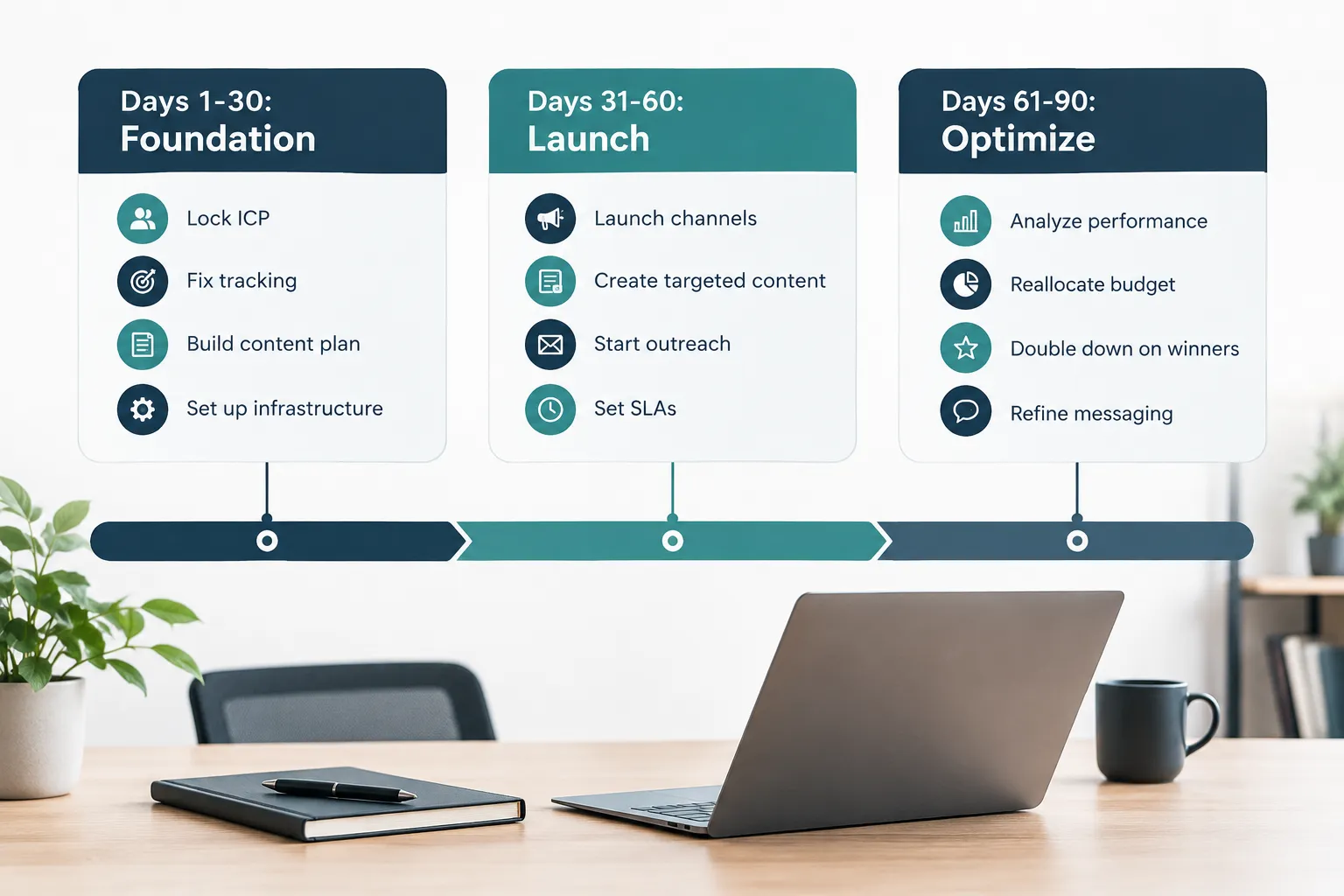
A B2B demand generation strategy built around a 90-day plan has three phases: Days 1-30 (lock your ideal customer profile, fix tracking, align sales and marketing on definitions), Days 31-60 (launch 2-3 channels with clear SLAs), and Days 61-90 (shift 20-30% of budget toward channels generating real pipeline, not just leads) [2][3]. Done correctly, you should see early pipeline signals by week 8-10, with meaningful qualified opportunities by day 90.
Key Takeaways
- Demand generation and lead generation are related but different: demand gen builds awareness and trust before capture even starts [4]
- Days 1-30 should focus entirely on data hygiene, ICP definition, and tracking infrastructure, not channel launches [2]
- Set sales-marketing SLAs early; without shared definitions of a qualified lead, pipeline numbers will always be disputed [3]
- Measure cost-per-SQO (sales qualified opportunity) and pipeline-per-dollar instead of cost-per-lead alone [5]
- Small budget teams should pick one creation channel and one capture channel rather than spreading thin [6][7]
- A realistic 90-day target is early-stage pipeline, not closed revenue, B2B sales cycles are longer than 90 days
- Reallocate budget toward what’s converting by day 60-70, not day 90, so you have runway to course-correct
What Is B2B Demand Generation and How Does It Work
B2B demand generation is the set of marketing activities that create awareness, build trust, and generate interest in your product before someone ever fills out a form. It works by combining content, communities, and targeted outreach to make your target accounts aware they have a problem you solve, then capturing that interest through intent signals [4][5].
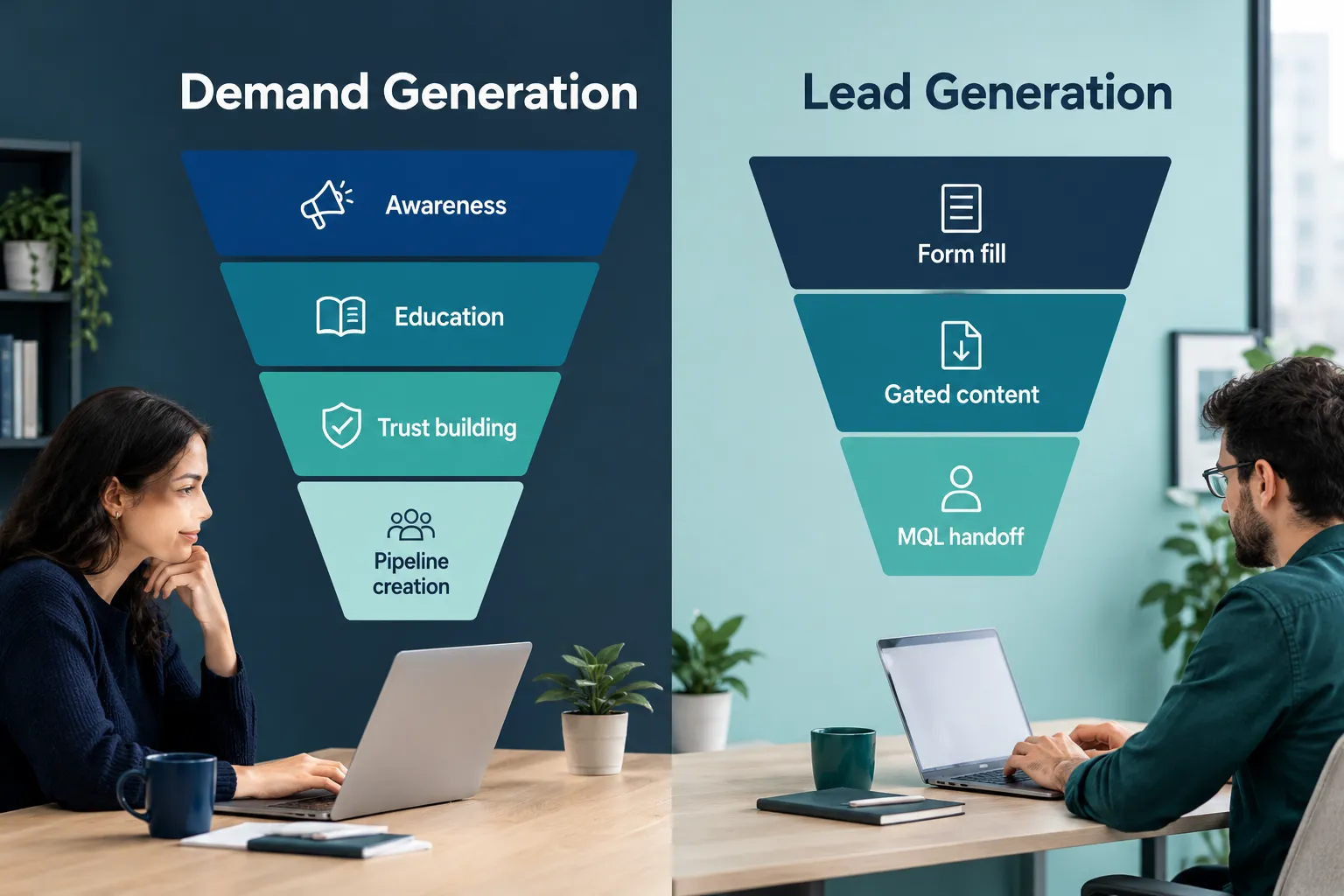
Unlike traditional lead generation, demand generation treats “demand creation” and “demand capture” as two separate motions that work together:
- Demand creation: educational content, podcasts, LinkedIn thought leadership, webinars, activities that build trust before any ask
- Demand capture: search ads, retargeting, intent-based outbound, activities that catch people already looking for a solution
- Demand interception: catching buying signals on third-party platforms, review sites, and communities where your buyers research [5]
A quick example: a SaaS company publishing weekly LinkedIn posts about a specific workflow problem is doing demand creation. The same company running Google Ads on “best [category] software” is doing demand capture. Both need to run together for a 90-day plan to work.
Demand Generation vs Lead Generation: What’s the Difference
Lead generation is about collecting contact information through gated content and forms. Demand generation is about building enough trust and awareness that leads convert faster once captured [4][8].
| Aspect | Lead Generation | Demand Generation |
|---|---|---|
| Primary goal | Collect contact details | Build awareness and trust |
| Content approach | Gated (forms required) | Mostly ungated, educational |
| Timeline to impact | Faster, shorter cycle | Slower, compounds over time |
| Success metric | Number of leads | Pipeline value, SQOs |
| Sales readiness | Often cold or unqualified | Warmer, pre-educated buyers |
Decision rule: Choose lead gen tactics if you need quick volume for an event or short campaign. Choose demand gen as your foundation if you’re building a sustainable B2B pipeline over quarters, not weeks.
Days 1-30: Building the Foundation of Your 90-Day Plan
The first 30 days of a B2B demand generation strategy should focus on fixing what’s broken before spending more money on new channels. Skipping this step is the single most common reason 90-day plans fail to produce pipeline [2][3].
Concrete actions for weeks 1-4:
- Lock your ICP (ideal customer profile), define firmographics, pain points, and buying triggers with input from sales, not marketing alone
- Audit your tracking stack, confirm UTM parameters, CRM-to-marketing automation sync, and attribution are actually working
- Set sales-marketing SLAs, agree on what counts as an MQL, SQL, and SQO before launching anything new
- Clean your database, remove duplicate records, dead contacts, and bad email addresses
- Map your current content, identify gaps for middle and bottom-of-funnel stages
If your CRM and marketing automation platform aren’t talking to each other correctly, everything you build in days 31-90 will report inaccurate numbers. This is why I always tell teams: spend money on data plumbing before you spend money on ads. For a deeper look at building the content layer underneath this foundation, see our guide on effective online content strategy.
Days 31-60: Launching Channels With Discipline
Days 31-60 of the 90-day plan should launch two to three channels maximum, each with a clear owner and measurable SLA, rather than testing everything at once [2]. Spreading budget across five or six channels in month two almost always produces weak signal in all of them.
A realistic month-two channel mix for most B2B companies looks like this:
- One organic/content channel, SEO-driven blog content or LinkedIn thought leadership
- One paid capture channel, search ads or retargeting aimed at bottom-funnel intent
- One outbound motion, targeted outreach to accounts showing intent signals
Common mistake: launching paid social for broad awareness in month two before your website and content can actually convert that traffic. Fix conversion paths first, then scale traffic.
If you’re running email as part of this mix, make sure your email marketing foundation is solid before layering in automation sequences. And if paid and organic are running together, review our thoughts on multi-channel marketing to avoid overspending across too many fronts.
Days 61-90: Optimizing and Reallocating Budget
The final 30 days should shift 20-30% of your budget away from underperforming channels and into whatever is already producing pipeline, not just leads [2]. This is where most teams get nervous because it means admitting a channel didn’t work, but holding onto a weak channel out of sunk-cost thinking wastes the whole quarter.
Steps for days 61-90:
- Pull cost-per-SQO by channel, not just cost-per-lead
- Kill or pause anything that’s produced leads but zero sales conversations
- Double down on the channel with the best pipeline-per-dollar ratio
- Brief sales on which accounts showed the strongest intent signals
- Document what worked so month four isn’t starting from scratch
Edge case: if nothing has produced pipeline by day 70, don’t wait until day 90 to react. Pull the plug on the weakest channel at day 70 and redirect that budget immediately, you’ll lose less time than waiting for a “fair” 90-day test.
How Much Does a Demand Generation Strategy Cost
Costs vary widely depending on team size, tools, and paid media spend, and there’s no single verified industry-wide number that applies to every B2B company [9][10]. What matters more than a fixed budget figure is allocation: most of the first 30 days’ cost should go toward data and tooling fixes, not paid ads.
Rough cost categories to plan for:
- Marketing automation and CRM tooling (often existing cost, but may need upgrades for intent data)
- Content production (writers, designers, video)
- Paid media budget for search and retargeting
- Outbound tools for intent-based prospecting
- Analytics and attribution software
Choose a leaner version if: you’re a startup or small team, focus budget on one creation channel and one capture channel rather than a full-stack demand gen build [6][7].
Best Demand Generation Tools for B2B
The right toolset depends on company size and sales motion, but most B2B demand gen stacks need four core categories: CRM, marketing automation, intent/visitor identification, and analytics [5]. No single tool does everything well, so expect to combine two or three.
Core categories and what they solve:
- CRM, tracks accounts and deal stages (HubSpot, Salesforce)
- Marketing automation, manages email sequences and lead scoring
- Intent data / visitor ID, identifies anonymous website visitors and buying signals
- Analytics and attribution, connects marketing activity to closed pipeline
Common mistake: buying an intent data tool before fixing CRM hygiene. Intent signals are useless if they’re routed into a messy database nobody checks.
How Long Does It Take to See Results From Demand Generation
Early pipeline signals typically show up around week 8 to week 10 of a well-run 90-day plan, with meaningful qualified opportunities visible by day 90, but closed revenue usually takes longer because B2B sales cycles often run 60-180 days beyond pipeline creation [2][3]. Anyone promising closed deals within 90 days for a typical mid-market B2B sale is probably overselling results.
Realistic expectation: treat day 90 as a pipeline-building milestone, not a revenue milestone. If your sales cycle averages 120 days, your 90-day demand gen plan is setting up quarter two or three revenue, not quarter one.
Why Isn’t My Demand Generation Working
Demand generation usually underperforms because of broken attribution, misaligned sales-marketing definitions, or launching too many channels without enough budget behind each one [2][3]. Before blaming the channel, check whether the problem is actually measurement.
Quick diagnostic checklist:
- Is your CRM correctly attributing pipeline back to the original touchpoint?
- Does sales agree with marketing on what counts as a qualified lead?
- Are you spreading a small budget across too many channels?
- Is your website converting the traffic you’re already sending it?
- Are SLAs between sales and marketing actually being followed, not just written down?
Common Demand Generation Mistakes to Avoid
The most common mistake is launching channels before fixing tracking and ICP definition, which makes every later metric unreliable [2]. A close second is measuring success by lead volume instead of pipeline value.
Other frequent mistakes:
- Gating too much content, which blocks the trust-building that demand gen depends on
- No shared SLA between sales and marketing, causing disputes over “what counts” as qualified
- Scaling a channel before confirming it actually produces sales conversations
- Ignoring intent data from existing website visitors who never filled out a form
- Treating 90 days as a revenue deadline instead of a pipeline-building window
Demand Generation for Startups With Small Budgets
Startups with limited budgets should pick exactly one demand creation channel and one demand capture channel rather than attempting a full multi-channel build [6][7]. Trying to run five channels on a small budget usually means none of them get enough spend to produce a clean signal.
A lean startup 90-day setup often looks like:
- Creation channel: founder-led LinkedIn content or a focused blog on one core problem
- Capture channel: targeted search ads on high-intent bottom-funnel keywords
- Outbound: manual, highly targeted outreach to a short list of ideal accounts
Decision rule: choose organic content as your primary channel if you don’t have paid budget; choose paid search as primary if you have budget but no content engine yet.
How to Measure Demand Generation ROI
Demand generation ROI should be measured using cost-per-SQO and pipeline-per-dollar spent, not cost-per-lead, because lead volume alone doesn’t reflect sales readiness [5]. Teams that only track leads often see “great” numbers that never translate into revenue.
Practical ROI measurement steps:
- Tag every channel with consistent UTM parameters
- Connect marketing automation to CRM so pipeline stages are visible by source
- Calculate cost-per-SQO per channel monthly
- Track pipeline-per-dollar, not just total pipeline value
- Review win rates by source to see which channels bring higher-quality opportunities
Can You Do Demand Generation Without a Sales Team
Yes, demand generation can run without a dedicated sales team, but someone still needs to own the handoff from marketing-qualified interest to an actual sales conversation, even if that person wears multiple hats [4]. Solo founders and small teams often do this themselves in the early stages.
Who this fits: early-stage startups, solo consultants, and small agencies where the founder or a single growth person handles both marketing and sales conversations.
Who this doesn’t fit: larger B2B companies with complex, multi-stakeholder sales cycles, those genuinely need a dedicated sales function to convert demand into closed revenue.
Demand Generation for B2B SaaS Companies
B2B SaaS companies typically need one strong content creation channel, one capture channel for bottom-funnel intent, and outbound targeting accounts already showing product-fit signals [6][7]. SaaS buying cycles tend to be research-heavy, so educational content plays a bigger role than in other B2B segments.
SaaS-specific priorities for the 90-day plan:
- Product-led content showing real use cases, not just feature lists
- Free trial or demo capture paths optimized for self-serve buyers
- Outbound sequences targeting accounts that match your highest-LTV customer profile
- Customer success stories used as demand creation content, not just sales collateral
What’s a Realistic Pipeline Target After 90 Days
A realistic 90-day target is early-stage, sales-accepted pipeline, not closed revenue, and the exact number depends heavily on average deal size, sales cycle length, and existing brand awareness [3]. There is no single universal benchmark that applies across all B2B companies, so avoid treating generic numbers from other industries as your target.
What to measure instead of a fixed number:
- Number of sales-accepted opportunities created in months 2 and 3
- Pipeline value attributable to new 90-day-plan activities
- Conversion rate from MQL to SQL to SQO across your new channels
Demand Generation Alternatives if It’s Not Working
If demand generation isn’t producing pipeline after a genuine 90-day effort, the most common alternatives are account-based marketing (ABM) for a tighter target list, or a heavier outbound sales motion that doesn’t rely on inbound content at all [8][9]. Neither alternative replaces demand gen entirely, they usually work best layered on top of it.
- Choose ABM if: your total addressable market is small and high-value, so you’d rather go deep on fewer accounts
- Choose outbound-heavy if: your sales cycle depends more on relationship-building than self-serve research
- Choose a hybrid if: you have budget for both, most mature B2B companies end up running ABM and broader demand gen together
Best Channels for B2B Demand Generation in 2026
The strongest B2B demand generation channels in 2026 remain organic content (SEO and LinkedIn), paid search for bottom-funnel intent, and targeted outbound to accounts showing buying signals, with AI-driven intent data increasingly filling the gap between anonymous traffic and sales-ready leads [5]. Channel performance still depends heavily on your specific audience and sales cycle, so test before committing large budget.
For teams building their content engine as a creation channel, our piece on generating leads with the right content strategy walks through the practical steps. If you’re also thinking about how AI search is changing discovery, it’s worth reading about Generative Engine Optimization since buyers increasingly research through AI tools before ever visiting your site.
FAQ
What is the difference between demand generation and demand capture? Demand generation builds awareness and trust before a buyer is actively searching; demand capture catches buyers who are already looking for a solution, often through search ads or retargeting [5].
Do I need a big budget to start demand generation? No. Startups can run an effective 90-day plan with one creation channel and one capture channel, focusing budget tightly rather than spreading across many channels [6][7].
How do I know if my demand generation plan is failing? Check attribution accuracy and sales-marketing SLA alignment first, most “failures” are actually measurement or definition problems, not channel problems [2][3].
Can content marketing alone drive B2B demand generation? Content is usually the creation engine, but it needs a capture mechanism (forms, chat, intent tools) paired with it to convert interest into pipeline [4].
What should I measure instead of lead volume? Track cost-per-SQO and pipeline-per-dollar by channel instead of raw lead counts, since lead volume doesn’t reflect sales readiness [5].
Is 90 days enough to see closed revenue? Usually not for typical B2B sales cycles. Ninety days is realistic for building qualified pipeline; closed revenue often follows months later depending on your sales cycle length.
What’s the biggest mistake companies make in month one? Launching new channels before fixing data tracking and sales-marketing alignment, which makes every later metric unreliable [2].
Conclusion
A working B2B demand generation strategy: a 90-day plan to build pipeline isn’t about picking the trendiest channel, it’s about sequencing the work correctly. Fix your data and definitions first, launch a disciplined set of channels second, then reallocate budget toward what’s actually producing pipeline third.
If you’re starting from scratch, begin with the audit in days 1-30 before touching any new ad spend. For a broader look at how demand generation fits into customer acquisition overall, check our guide on using demand marketing as a customer acquisition strategy. And if you want help thinking through the technical tracking setup that makes this whole plan measurable, our about page has more on how we approach practical, step-by-step digital marketing guidance.
References
- B 2 B Demand Generation. grouglobal.com.
- B2B Demand Generation Plan. thesmarketers.com.
- How to Build a B2B Demand Gen Strategy for Pipeline. heysid.com.
- Demand Generation. monday.com.
- Demand Generation. konabayev.com.
- B2B SaaS Demand Generation. tomba.io.
- Scalable Demand Generation B2B SaaS. saashero.net.
- B2B Demand Generation. sendspark.com.
- B2B Demand Generation Strategy. sproutworth.com.
- Demand Generation Best Practices. prospeo.io.