
Last updated: October 28, 2026
Quick Answer
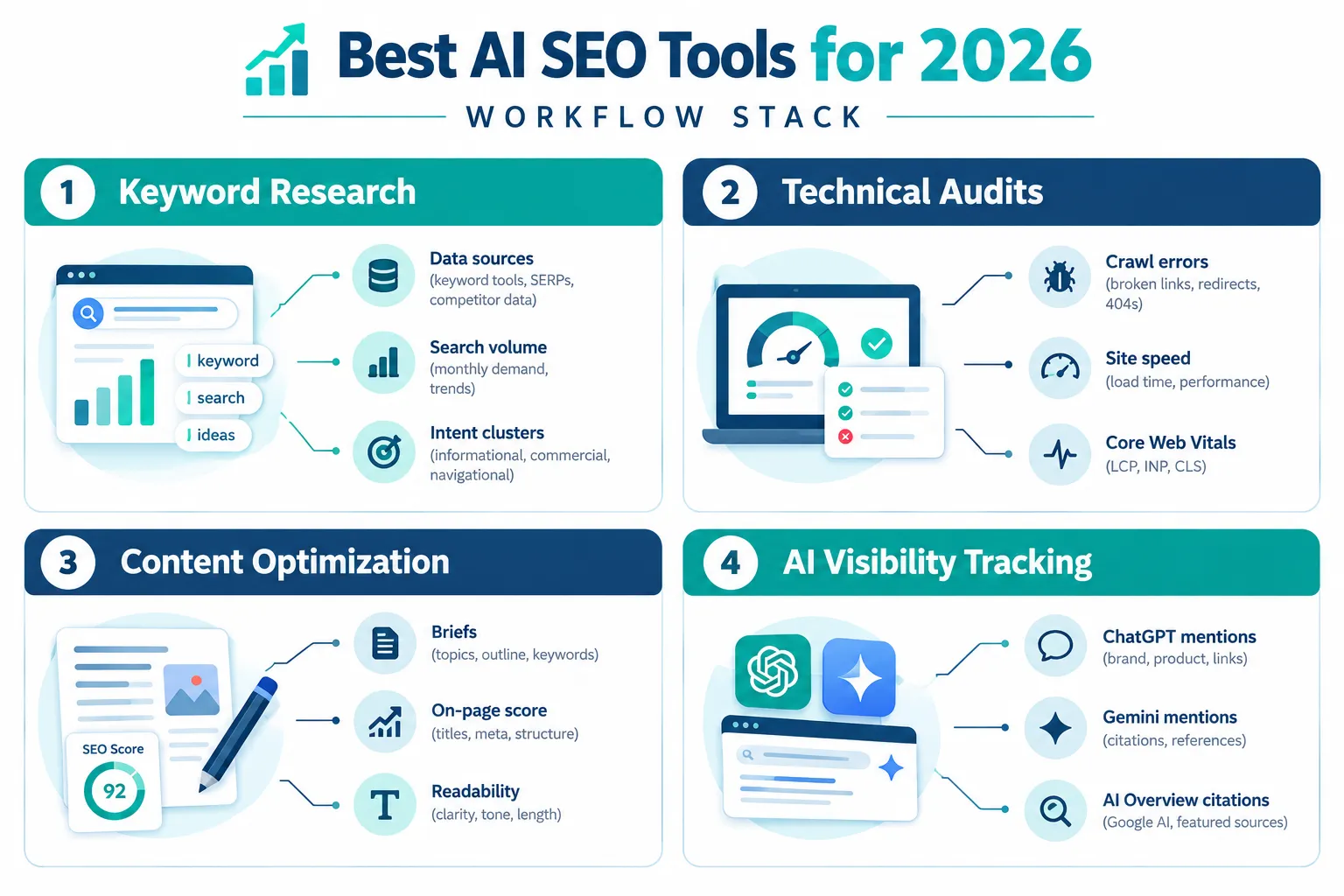
The best AI SEO tools for 2026 are not single apps but a three-layer stack: a data suite (Semrush, Ahrefs, or SE Ranking) for keyword research and technical audits, a content optimizer (Surfer, Frase, or Clearscope) for on-page grading, and a dedicated AI visibility tracker (Surfer’s AI Tracker, Trackings.ai, or LLMrefs) to see where your brand shows up in ChatGPT, Gemini, and AI Overviews. No single tool replaces human judgment, but this combination covers most real SEO work in 2026.
Key Takeaways
- A proper AI SEO stack in 2026 has three layers: data suite, content optimizer, AI visibility tracker.[1]
- Surfer, Frase, and Clearscope lead content optimization; pricing ranges roughly $39 to $129 per month.[1][2]
- Semrush, Ahrefs, and SE Ranking now bundle AI visibility modules tracking 4 to 6 AI engines.[2][3]
- Free tools like Google Search Console still matter for first-party AI performance data.[4]
- No AI tool, however good, should replace a final human review before publishing.
- Small businesses can run a lean stack for under a hundred dollars a month; agencies need the full suite.
- Keyword research is shifting toward unified visibility scores that blend Google and AI search signals.[5]
- Technical audits in 2026 increasingly combine crawl data with AI-generated on-page grading.[6][7]
What Is AI Visibility and Why Should You Care About It for SEO
AI visibility means how often, and in what context, your brand or content appears inside AI-generated answers on platforms like ChatGPT, Gemini, Perplexity, and Google’s AI Overviews. It matters because a growing share of searches now resolve inside an AI answer box instead of a traditional ten-blue-links page.
Industry commentary through October 2026 suggests AI visibility will become a core KPI alongside organic traffic and rankings, with major suites racing to expand how many AI engines they monitor.[2][3][8] If you want to understand the mechanics of showing up in these answers, our guide on Google AI Overviews link visibility breaks down the practical side.
Choose to track AI visibility if your audience researches products or services through conversational AI tools, not just Google search. If your traffic is still 90 percent classic organic search, it still matters, but it’s a secondary metric for now.
How Much Do AI SEO Tools Cost Compared to Regular SEO Software
AI SEO tools generally cost between $39 and $329 per month depending on how much AI visibility tracking and content automation you need, which is comparable to or slightly higher than traditional SEO software because of the added AI monitoring layer.
Here’s a rough breakdown based on October 2026 pricing data:
| Tool category | Example tools | Approximate monthly range |
|---|---|---|
| Content optimization | Frase, Surfer, Clearscope | $39 to $129 |
| All-in-one suites | Semrush, Ahrefs, SE Ranking | $60 to $328 |
| Technical audit crawlers | Screaming Frog, Semrush | Free tier to $279/year license |
| AI visibility add-ons | SE Ranking AI add-on, Ahrefs with AI | $89 to $328 |
Exact pricing changes often, so treat these as directional and verify current rates before buying.[1][2][6]
Which AI SEO Tool Is Best for Keyword Research Specifically
Surfer and Rankability stand out for keyword research in 2026, with Surfer offering strong all-round keyword and content workflows from around $49 a month, and Rankability offering a unified visibility score across Google and AI search starting near $97 a month.[2][5]
Other strong options:
- NeuralText, good for topic clustering and semantic keyword grouping.[9]
- Keywordly, useful for intent-based discovery using conversational, community-driven queries.[9]
- Semrush and Ahrefs, best when you also need competitive and backlink data tied to the same keyword list.
Choose Rankability if you specifically want one score that blends traditional, local, AI, and video visibility. Choose Surfer if you want keyword research connected directly to content briefs. For a deeper walkthrough of adapting keyword research for AI search behavior, see our keyword research for AI search guide and our broader keyword research fundamentals resource.
What’s the Difference Between AI SEO Tools and Traditional SEO Tools
Traditional SEO tools mainly collect and display data, rankings, backlinks, crawl errors, while AI SEO tools additionally interpret that data, generate recommendations, and in some cases track your presence inside AI-generated answers, not just search engine result pages.[3][8]
Traditional tools answer “where do I rank.” AI SEO tools try to answer “where do I rank, what should I fix, and does an AI chatbot mention me.” The newer category also includes autonomous agents like Ryze AI or RankTack, which research, draft, and publish content with minimal human input.[10]
Can You Use Free AI SEO Tools or Do You Need to Pay
Yes, you can run a basic AI SEO workflow using free tools, but you’ll hit limits on depth and AI visibility tracking that usually require a paid upgrade.
Free or low-cost starting points:
- Google Search Console, free, first-party data including the AI performance report.
- Screaming Frog (free tier), crawls up to 500 URLs.
- Semrush, free tier covers around 100 pages for basic audits.[4][6][7]
For actual AI engine mention tracking (ChatGPT, Gemini, Perplexity), free tools are limited, and most reliable trackers like Trackings.ai, LLMrefs, or Peec AI require a paid plan. Our piece on tracking AI visibility covers more free-vs-paid options in detail.
How Do You Actually Use AI SEO Tools for Audits Step by Step
A practical AI-assisted audit follows six repeatable steps: crawl the site, flag technical errors, run an AI content grader, check backlinks, check AI engine mentions, then prioritize fixes by impact.
- Crawl the site with Screaming Frog or Semrush’s Site Audit to find broken links, duplicate titles, and indexing issues.[6][7]
- Review Core Web Vitals using Lighthouse data inside the same dashboard.
- Run an AI content grader like Clearscope or Surfer on your top pages to compare against ranking competitors.[1]
- Check backlink health in Ahrefs or Semrush, flagging toxic or lost links; our guide to top backlink monitoring tools has more detail.
- Check AI engine visibility with SE Ranking’s AI Tracker or Otterly.ai.
- Rank fixes by business impact, not just by tool score, a low-traffic page with a broken schema tag is lower priority than a top-converting page losing AI Overview citations.
Common mistake: running the audit once and never repeating it. SEO data and AI answer patterns shift monthly, so quarterly re-audits are the minimum.
Are AI SEO Tools Good for Small Businesses or Just Enterprises
AI SEO tools work for both, but small businesses should pick one lean stack instead of buying every tool, while enterprises typically need multi-seat suites with broader AI engine coverage.
A small business or solo blogger can realistically run:
- Google Search Console (free)
- Frase or Surfer for content (around $39 to $49/month)
- One AI visibility tracker on a basic plan
Enterprises or agencies managing dozens of client sites usually need Semrush’s or Ahrefs’ full suite plus an AI visibility add-on, since those plans scale across multiple users and domains.[3]
Edge case: a local business with no national competition may not need AI visibility tracking at all yet, since local AI answer coverage is still uneven.
What Are the Most Common Mistakes People Make With AI SEO Tools
The biggest mistake is publishing AI-generated content or AI audit recommendations without human review, which leads to factual errors, generic phrasing, and sometimes duplicate content across competitors using the same tool.
Other frequent mistakes:
- Trusting an AI content score as the only ranking factor, ignoring actual search intent.
- Buying an expensive all-in-one suite before testing a cheaper tool for your actual workflow.
- Ignoring Google Search Console data while obsessing over third-party dashboards.
- Not re-checking AI visibility trackers regularly, since AI engines change their answer sources often.
Decision rule: if a tool’s output needs more editing time than writing from scratch would take, it’s the wrong tool for that task.
Can AI Replace a Human SEO Audit Completely
No, AI cannot fully replace a human SEO audit. AI tools are excellent at finding patterns in large datasets, broken links, duplicate tags, content gaps, but they miss business context, brand voice, legal considerations, and nuanced search intent that a trained SEO professional catches.
Flowninja’s 2026 analysis makes a similar point, noting that no single tool covers all of technical SEO, user experience, and AI-answer monitoring together, which is exactly why human oversight stays necessary.[4] Use AI tools to do the first 80 percent of pattern detection, then have a person make the final prioritization and strategy call.
What AI SEO Tools Integrate With My Marketing Stack
Most modern AI SEO platforms integrate with Google Search Console, Google Analytics, WordPress, and common CMS platforms, plus some connect to outreach tools like Pitchbox and internal linking tools like Link Whisper.
Practical integration examples:
- Semrush and Ahrefs both pull Google Search Console data directly into dashboards.
- Surfer and Frase offer WordPress plugins for inserting content recommendations directly into drafts.
- Search Atlas focuses on automating and deploying technical or on-page fixes directly to your site.
Check the Google Search Console AI performance report for a close look at how first-party AI click data now shows up inside Google’s own reporting.
How Accurate Are AI SEO Audit Reports Really
AI SEO audit reports are generally accurate for structural and technical issues (broken links, missing meta tags, slow load times) but less reliable for subjective judgments like content quality or search intent matching, where human review still catches errors AI misses.
Crawl-based data (from Screaming Frog or Semrush’s Site Audit) tends to be highly accurate since it’s based on direct site scanning.[6][7] AI content scores and AI visibility percentages are closer to informed estimates, since they depend on sampling AI engine responses that change frequently. Treat those numbers as directional trends, not exact measurements.
Do You Need Technical Skills to Use AI SEO Tools
No, most modern AI SEO tools are built for non-technical marketers, with dashboards, plain-language recommendations, and one-click fixes, though understanding basic SEO concepts like crawlability and schema markup helps you use the recommendations correctly.
If you’re new to SEO, start with a simplified explanation of core concepts before jumping into tool dashboards. Our breakdown of SEO vs GEO vs AEO in 2026 is a good primer for understanding why these tools now track AI answer engines alongside traditional search.
What’s the Best Workflow for Combining AI Tools With Manual SEO Work
The best workflow uses AI tools for data collection and first drafts, then relies on a human for strategy, final editing, and quality control before publishing anything.
Recommended 2026 workflow checklist- Use a data suite (Semrush, Ahrefs, or SE Ranking) for keyword research and audits
- Use a content optimizer (Surfer, Frase, Clearscope) for briefs and on-page scoring
- Add an AI visibility tracker (Trackings.ai, LLMrefs, Peec AI) for AI engine mentions
- Have a human editor review every piece before publishing
- Re-audit quarterly and re-check AI visibility monthly
This matches the cross-source workflow pattern seen across Albato, Frase, Fast.io, and MediPlus’s 2026 comparisons.[1]
Which AI SEO Tool Has the Most Accurate Keyword Research Data
Ahrefs and Semrush are generally considered to have the most extensive and accurate keyword databases because of the scale of their crawled backlink and search data, while Rankability differentiates itself by blending that data with AI and local visibility scoring.[2][5]
If pure data volume and historical accuracy matter most, Ahrefs or Semrush win. If you want one unified score across Google and AI search channels, Rankability’s SPI approach is more useful even if the raw keyword database is smaller.
For readers exploring how AI search changes keyword strategy more broadly, our GEO vs AI search optimization vs AEO explainer is worth a read alongside this guide, and the ChatGPT Search vs Google Search strategy guide covers how keyword intent shifts across platforms.
FAQ
What is the single best AI SEO tool for 2026? There isn’t one single best tool. Surfer is the strongest all-round pick for combined keyword research and content optimization, while Semrush or Ahrefs suit teams needing deeper audit and backlink data.[1][2]
Do AI SEO tools guarantee higher rankings? No tool guarantees rankings. They improve efficiency and surface data patterns, but actual ranking improvement depends on content quality, site authority, and execution.
Is Surfer or Frase better for solo bloggers? Frase is generally recommended for solo writers due to its lower cost and simpler workflow, around $49 a month.[2]
How many AI engines do top trackers monitor? Leading trackers monitor between 4 and 6 AI engines as of October 2026, including ChatGPT, Gemini, Perplexity, and Google’s AI Mode.[2][8]
Can I skip traditional SEO tools and only use AI visibility trackers? No. AI visibility trackers measure presence in AI answers but don’t replace technical audits, keyword research, or backlink analysis needed for overall search performance.
Are free versions of these tools enough for a small blog? Free tiers of Screaming Frog, Google Search Console, and Semrush’s limited audit cover basic needs, but serious growth usually requires at least one paid content or tracking tool.[4][6]
Conclusion
Picking the best AI SEO tools for 2026 comes down to matching tools to repeatable tasks: one platform for data and audits, one for content optimization, and one for AI visibility tracking, with a human reviewing every output before it goes live. Start small if budget is tight, Google Search Console plus one paid content optimizer covers most beginner and small business needs. Scale up to a full suite like Semrush or Ahrefs once you’re managing multiple sites or clients. Whatever stack you pick, re-check your AI visibility numbers monthly, since AI engines change their answer sources often, and treat every AI-generated recommendation as a draft that needs a second human look before it ships.
References
- Best AI SEO Tools. albato.com.
- Best AI for SEO. theairankings.com.
- 10 AI SEO Tools in 2026 Grouped by What They Replace. varsity.co.uk.
- Best Site Audit Tools. flowninja.com.
- Best SEO Keyword Research Tools. rankability.com.
- SEO Audit Tools. semrush.com.
- Best SEO Audit Tools. zapier.com.
- Best SEO Tools. zapier.com.
- AI. seo.com.
- Best AI SEO Tool. straight.com.