

Last updated: October 24, 2026
Quick Answer
ChatGPT Search vs Google Search: A Practical Strategy to Earn Visibility in Both comes down to one habit: write content that answers a real question clearly, structure it so machines and humans can both read it, and make sure your site is technically open to crawlers from both OpenAI and Google. You don’t need two separate content plans. You need one strong content plan built around clarity, citations, and crawlability, then tuned slightly for each platform’s quirks.
Key Takeaways
- ChatGPT Search is now a free, sign-in-optional product used by millions, not a hidden chatbot feature [1][2].
- Google still dominates total search volume, but ChatGPT Search is a real competitive threat worth preparing for [3][4].
- Both platforms reward clear, well-structured, question-answering content, but they differ in how they choose and cite sources.
- Google gives you measurable AI visibility data through Search Console’s generative reporting; ChatGPT Search currently does not [5].
- You can rank in ChatGPT Search without ranking high in Google, because citation selection isn’t identical to classic rankings.
- Technical crawlability (robots.txt, server response, structured content) is a non-negotiable prerequisite for both.
- The biggest mistake marketers make is treating AI search optimization as a separate project instead of an extension of solid SEO.
What Is ChatGPT Search and How Does It Actually Work
ChatGPT Search is OpenAI’s built-in web search feature inside ChatGPT that fetches live information from the internet and blends it into a conversational answer with inline citations [1]. It launched in late 2024 and expanded to free, logged-out users by late 2024 into 2025, which massively widened its reach [2][6].
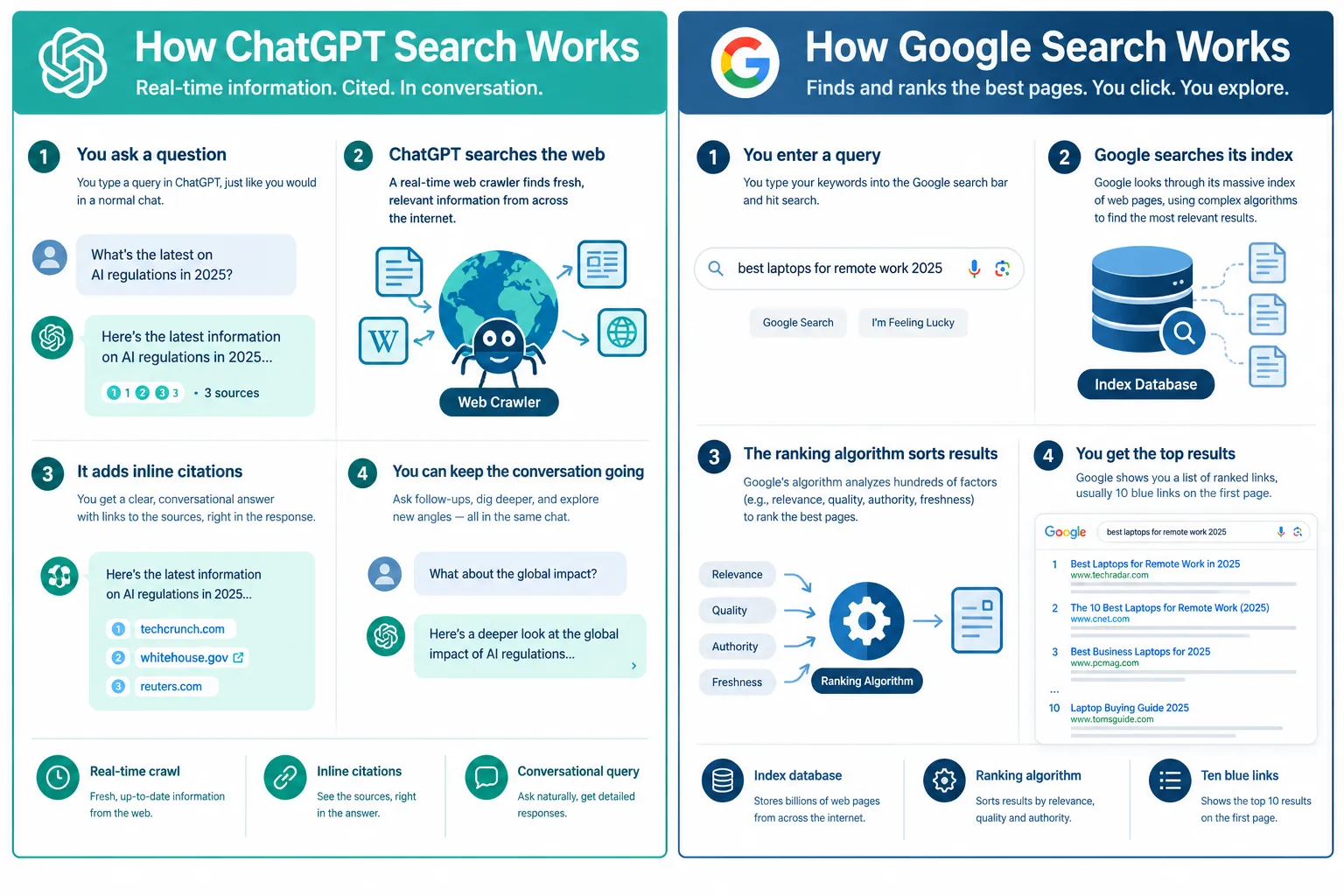
Here’s what happens behind the scenes when someone asks ChatGPT a question that needs fresh information:
- ChatGPT recognizes the query needs current or factual data rather than general knowledge.
- It runs a web search, similar in spirit to a search engine crawl, and pulls candidate pages.
- It selects a handful of sources it judges accessible, relevant, and trustworthy.
- It generates a conversational answer and attaches clickable citations to those sources.
This process depends heavily on your page being crawlable and clearly written. If a bot can’t read your page, it can’t be selected, no matter how good the content is [1][7].
How Does ChatGPT Search Differ From Google Search
Google Search ranks and displays many results in a list; ChatGPT Search picks a small set of sources and writes a synthesized answer with citations. That’s the core functional difference, and it changes how you should write.
| Factor | Google Search | ChatGPT Search |
|---|---|---|
| Output format | List of ranked links, AI Overviews on top of some queries | Conversational answer with inline citations |
| Number of sources shown | Many (10+ organic results) | Few (typically 3-8 cited sources) |
| Discovery method | Index-based crawling, PageRank-style signals | Real-time web search plus model judgment |
| Measurement tools | Search Console AI Overviews/AI Mode reporting [5] | No official analytics yet |
| Query style | Keywords and phrases | Full conversational questions |
| Login required | No | No, since access expanded to logged-out users [2] |
Decision rule: if your audience asks long, specific questions (“what’s the best way to…”), optimize phrasing for ChatGPT Search too. If your audience types short keyword queries, Google’s classic ranking factors still matter most.
Why Should I Optimize for ChatGPT Search if I Already Rank in Google
You should optimize for ChatGPT Search because it’s pulling in a growing share of question-based queries, and relying on one discovery channel is risky for your online presence. Industry coverage already frames ChatGPT Search as a genuine competitor to Google, not a novelty [3].
Think about it from a traffic diversification angle:
- Google algorithm updates can swing your rankings overnight; a second discovery channel cushions that risk.
- Many users now ask ChatGPT instead of typing a Google query, especially for research-heavy or comparison questions.
- Being cited in ChatGPT Search builds brand recall even without a click, which matters for grow your online presence goals long term.
If you already rank well in Google, you have a head start: much of what makes you citable in ChatGPT Search (clear structure, authoritative answers, up-to-date facts) overlaps with classic SEO made simple principles.
What Content Strategy Works Best for Both ChatGPT Search and Google Search
The strategy that works for both is answer-first writing: open every page and every section with a direct answer, then support it with detail, examples, and data. This single habit satisfies Google’s generative AI content guidance and ChatGPT’s citation model at the same time [5].
Practical steps to build this strategy:
- Pick one clear question per page or section heading.
- Answer it in the first one to three sentences, in plain language.
- Add supporting detail: steps, examples, numbers, comparisons.
- Use descriptive subheadings that match how people actually phrase questions.
- Keep paragraphs short enough that each one could stand alone as a quote.
- Update facts and dates regularly, since both systems favor fresh, accurate information.
This approach lines up closely with what we cover in the 4 essential parts of effective online content strategy, and it’s worth revisiting if your current content leans on fluffy introductions instead of direct answers.
How Do I Get My Website Indexed in ChatGPT Search
You get indexed by making sure your site is technically crawlable, publicly accessible, and not blocked by robots.txt rules that exclude OpenAI’s crawler. There’s no manual submission form like Google Search Console; visibility depends on being discoverable and citable [1][7].
Checklist for crawlability:
- Confirm your robots.txt doesn’t block OpenAI’s search crawler.
- Make sure pages load without heavy JavaScript rendering barriers.
- Use clean HTML structure with real headings, not image-based text.
- Add structured data (schema markup) where relevant, since it helps machines parse your content correctly.
- Keep server response times fast and avoid frequent downtime.
A common mistake here is assuming that ranking in Google automatically means a crawler can read your page the same way. Pages with heavy client-side rendering sometimes rank in Google (which can render JavaScript) but still get skipped by other crawlers with stricter limits.
Is ChatGPT Search Free or Do I Need a Paid Subscription
ChatGPT Search is free to use, including for people who aren’t logged in, following OpenAI’s expansion of access in late 2024 [2][6]. You don’t need a ChatGPT Plus subscription just to use search features, though paid tiers may offer extra usage limits or model access depending on current OpenAI policy.
For marketers and business owners, this matters because:
- Your potential customers don’t need to pay anything to discover you through ChatGPT Search.
- There’s no gated paywall limiting who sees AI-generated answers citing your content.
- That free, broad reach is exactly why ignoring this channel is a missed opportunity for your online presence.
Which Search Engine Drives More Traffic Right Now, ChatGPT or Google
Google still drives far more total search traffic worldwide than ChatGPT Search, but ChatGPT Search’s audience grew quickly after removing the login requirement [2][3]. Google remains the default habit for most people, while ChatGPT Search is still earning trust as a daily tool.
What this means practically:
- Don’t abandon classic SEO; Google traffic still pays the bills for most websites.
- Treat ChatGPT Search visibility as an additive channel, not a replacement.
- Track both where possible, since the mix will keep shifting as adoption grows.
For a deeper look at how Google itself is changing with generative features, see our breakdown of Google AI Mode vs AI Overviews.
What Are the Biggest Mistakes People Make Optimizing for ChatGPT Search
The biggest mistake is treating ChatGPT Search optimization as a separate, exotic discipline instead of an extension of good content and technical SEO. Another common error is chasing keyword density instead of writing genuinely useful, well-organized answers.
Other mistakes worth avoiding:
- Blocking crawlers accidentally through outdated robots.txt rules.
- Publishing thin content with no real supporting detail or examples.
- Ignoring freshness: stale pages with outdated facts get skipped for citation.
- Forgetting measurement entirely because ChatGPT Search lacks native analytics, instead of using indirect tracking methods.
- Overloading pages with vague pronouns (“this,” “it”) instead of clear, self-contained sentences that a model can safely quote.
If you want a structured way to think about where AI optimization overlaps with traditional and answer-based SEO, read our comparison of GEO vs AI search optimization vs AEO.
Can You Rank in ChatGPT Search Without Ranking in Google
Yes, it’s possible to be cited in ChatGPT Search without ranking on page one of Google, because ChatGPT’s source selection isn’t a direct mirror of Google’s ranking algorithm. ChatGPT Search weighs accessibility, clarity, and relevance to the specific question asked, which can favor a well-structured page over a page that merely has stronger backlink authority [1].
Example scenario: a small business blog post with a precise, well-organized answer to a niche question might get cited by ChatGPT even while sitting on page two of Google, simply because it’s the clearest crawlable match for that exact question.
That said, don’t treat this as a shortcut around SEO fundamentals. Strong technical SEO and authority signals still help in both environments; they just aren’t applied identically.
Who Actually Uses ChatGPT Search vs Google Search
Google Search is used by nearly everyone with internet access for everyday lookups, navigation, shopping, and local search; ChatGPT Search is used more by people seeking explanations, comparisons, and research-style answers in one place. Understanding this split helps you decide where to invest content effort.
- Students and researchers often prefer ChatGPT Search for summarized explanations.
- Shoppers comparing products may start in Google for listings, then ask ChatGPT for a quick comparison summary.
- Local searches (store hours, directions, nearby services) still lean heavily on Google and Google Business Profile data; see our Google Business Profile optimization guide for AI search if local visibility matters to you.
- Professionals doing quick research during work often use ChatGPT Search for speed.
How Long Does It Take to Get Visibility in ChatGPT Search
There’s no fixed timeline, but expect visibility to build gradually as your content becomes more crawlable, clearer, and more frequently matched to real questions, similar to how organic SEO visibility compounds over weeks and months. OpenAI continues refining search quality through ongoing release updates, which can shift which sources get cited over time [1].
Practical expectations:
- Technical fixes (removing crawler blocks) can take effect within days once crawled again.
- Content restructuring toward answer-first writing may take a few weeks to show citation patterns.
- Building topical authority across multiple well-structured pages takes months, just like traditional SEO made simple principles teach.
What SEO Tactics Work for ChatGPT Search But Not Google
Tactics that lean harder toward ChatGPT Search include writing in full conversational question form and front-loading definitive answers, since the model is matching intent to a direct response rather than ranking ten competing pages. Google still rewards these habits too, but it also tolerates more keyword-style phrasing that ChatGPT Search doesn’t need as much.
- Writing in natural question-and-answer pairs works especially well for ChatGPT Search citation selection.
- Avoiding vague referential language (“it,” “this”) matters more for ChatGPT Search because the model may quote a passage out of its original page context.
- Classic tactics like backlink building and domain authority still matter more heavily for Google rankings than for ChatGPT’s source selection.
Does My Existing Content Automatically Appear in ChatGPT Search Results
No, existing content doesn’t automatically appear; it only gets considered if it’s crawlable, relevant to the question asked, and clear enough to be cited confidently. Older blog posts with thin structure or blocked crawling rules are often invisible to ChatGPT Search even if they rank fine in Google.
Audit your existing content with these questions:
- Is the page blocked in robots.txt for any AI-related crawler?
- Does the page answer a specific question directly near the top?
- Is the information still accurate and dated appropriately?
- Does the page use real heading tags instead of styled text?
What Should I Change About My Website for ChatGPT Search Visibility
Start by auditing crawlability, then restructure your top content around direct answers, and finally track performance indirectly since native ChatGPT analytics don’t exist yet. Google, by contrast, now gives you a dedicated AI Performance report inside Search Console to measure AI Overviews and AI Mode impressions [5].
Action list:
- Check robots.txt and server logs for crawler access issues.
- Rewrite introductions to lead with the direct answer.
- Add schema markup for FAQs, articles, and products where relevant.
- Improve image accessibility; our guide on alt text helping people and search engines explains why this also supports AI parsing.
- Monitor Google’s generative visibility using our walkthrough of Google Search Console’s AI Performance report.
- For ChatGPT Search, track indirectly through referral traffic patterns and brand mention monitoring, as detailed in how to track AI visibility.
FAQ
Is ChatGPT Search replacing Google Search? Not currently. Google still handles far more search volume, but ChatGPT Search is a growing, serious alternative worth preparing content for [3].
Do I need separate content for ChatGPT Search and Google? No. One well-structured, answer-first content strategy serves both, with small technical and phrasing adjustments for each.
Can small businesses realistically get cited in ChatGPT Search? Yes, especially for niche, specific questions where a clear, crawlable page can beat larger competitors with weaker structure.
Does backlink building still matter for AI search visibility? Yes for Google rankings, and indirectly for ChatGPT Search since authority and clarity often correlate, though ChatGPT’s selection isn’t a direct backlink-based ranking system.
How do I know if ChatGPT Search is sending me traffic? Check referral traffic sources in your analytics platform and look for direct mentions or link clicks originating from ChatGPT domains, since there’s no native first-party reporting yet.
Should I update old blog posts for AI search visibility? Yes. Refreshing facts, adding direct answers near the top, and fixing structure on existing posts is often faster than creating new content from scratch.
What technical SEO basics matter most for ChatGPT Search? Crawlability through robots.txt, clean HTML structure, fast load times, and avoiding heavy JavaScript rendering barriers matter most.
Does AI Mode in Google compete with ChatGPT Search? Yes, Google’s AI Mode and AI Overviews serve a similar conversational answer function within Google’s own ecosystem; read our comparison of Google AI Mode SEO for more detail.
Conclusion
The practical path forward isn’t choosing between ChatGPT Search and Google Search; it’s building one strong, answer-first content foundation that naturally works for both. Fix the technical basics first, since a crawler that can’t read your page won’t cite it, no matter how good the writing is. Then rewrite your key pages to answer real questions directly, add supporting detail with examples and steps, and keep facts current.
Measure what you can in Google through Search Console’s generative reporting, and track ChatGPT Search indirectly through referral data and brand mentions until better analytics arrive. This isn’t a one-time project. It’s a habit you build into your regular content and SEO workflow, which is exactly how you make smarter marketing decisions and protect your visibility as search keeps splitting across multiple platforms.
References
- Introducing Chatgpt Search. openai.com.
- Openai Launches Chatgpt Search Competing with Google and Perplexity. cnbc.com.
- Chatgpt Search Launch. 9to5google.com.
- Updates. developers.google.com.
- Web Multimodal in Sc. developers.google.com.
- Openai Brings Its AI Powered Web Search Tool to More Chatgpt Users. techcrunch.com.
- Articles. help.openai.com.