

Last updated: October 28, 2026
Quick Answer
There’s no single winner in the Google Ads vs Microsoft Ads debate. Google Ads usually wins on raw lead volume and local-intent searches, while Microsoft Ads often wins on cost-per-click and lead quality for B2B companies, thanks to LinkedIn profile targeting and a less competitive auction. The right pick depends on your audience, budget, and whether you’re chasing a local plumber’s next job or a SaaS demo booking from a procurement manager.
Key Takeaways
- Google Ads has far bigger reach across search, Display, and YouTube, making it the default for local businesses needing volume.
- Microsoft Ads typically offers lower CPCs and solid B2B targeting through LinkedIn company and job-function data.
- Local Services Ads are moving into Performance Max with pay-per-lead goals starting August 1, 2026, changing how local businesses buy leads on Google [1][2].
- Microsoft Advertising rolled out optimization experiments and deeper automation in September 2026 to protect lead quality while cutting manual work [3][4][5].
- A new HubSpot integration with Microsoft Advertising, live by late September 2026, gives B2B marketers pipeline-level visibility that Google still requires manual CRM setup to match [3][6].
- Running both platforms together is common and often the smartest move, not an either/or decision.
- Microsoft Ads needs a realistic budget and patience; it rarely performs well with tiny test budgets or copy-pasted Google campaigns.
What’s the Actual Difference Between Google Ads and Microsoft Ads
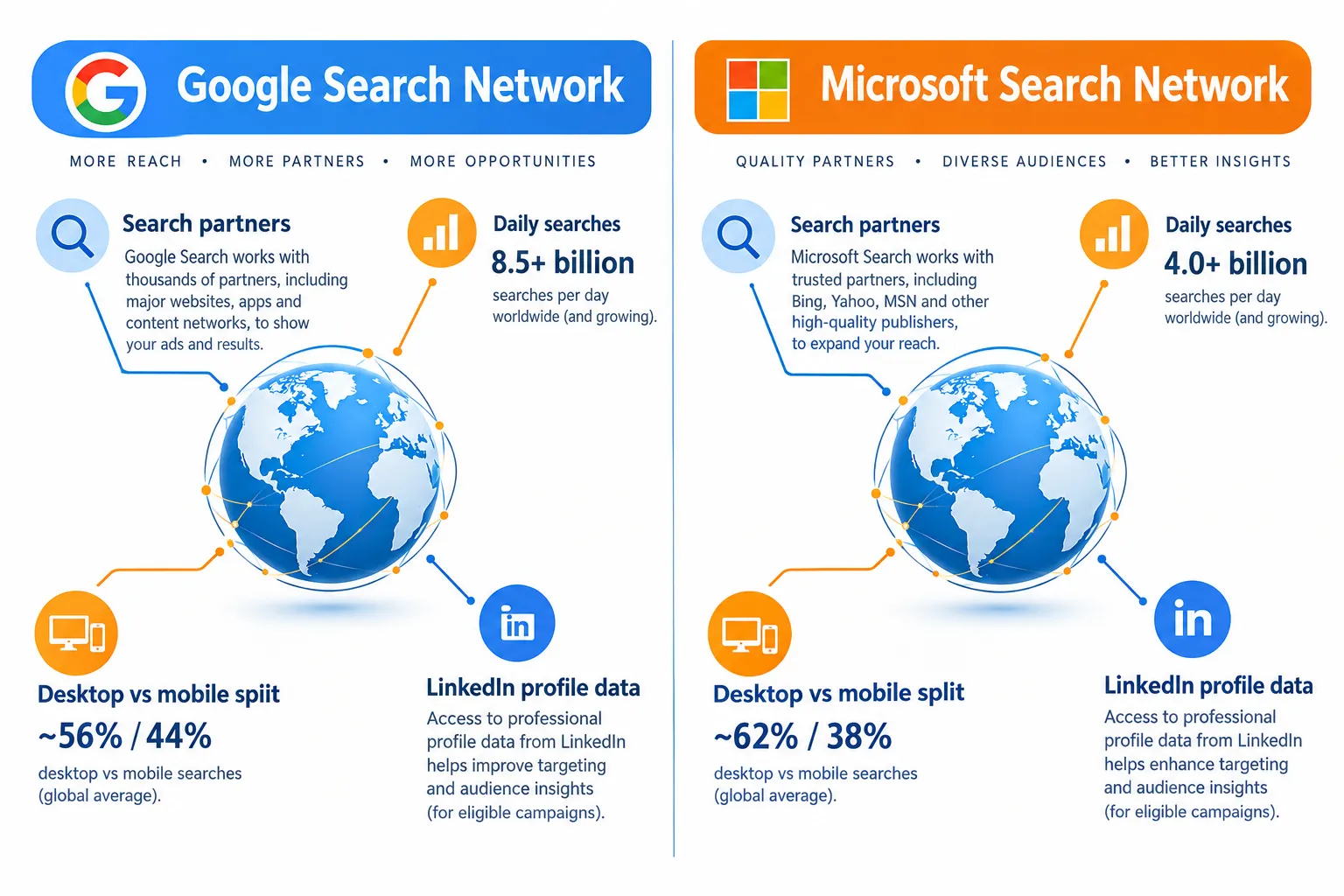
Google Ads runs on Google Search, YouTube, Display, and Gmail, reaching a massive global audience across mobile and desktop. Microsoft Ads runs on Bing, Yahoo, AOL, and partner networks like DuckDuckGo, with a desktop-heavy, slightly older, higher-income user base.
The practical difference shows up in three places:
- Audience behavior: Bing users skew toward desktop and work-related searches, which often means better conditions for B2B research and purchase decisions.
- Auction competition: Fewer advertisers bid on Microsoft Ads, so costs per click tend to run lower for comparable keywords.
- Targeting tools: Microsoft Ads offers LinkedIn profile targeting (job function, company, industry) baked directly into campaign setup, something Google Ads doesn’t offer natively.
If your buyers work in offices on company laptops during business hours, Microsoft Ads deserves a serious look alongside Google.
Which Platform Gives Better ROI for B2B Lead Generation
Microsoft Ads often delivers better ROI for B2B lead generation because of lower CPCs combined with LinkedIn-powered targeting, but Google Ads usually delivers more total leads because of its larger search volume. ROI depends more on your targeting setup than the platform name on the invoice.
Microsoft Advertising expanded its LinkedIn-based targeting boost for B2B advertisers in September and October 2026, letting advertisers layer company lists directly onto Search campaigns [3][7]. That update matters for B2B marketers who want to reach specific accounts rather than broad job titles. Pair that with the HubSpot integration for pipeline-level lead quality tracking, live by late September 2026, and B2B teams finally get a clearer line from click to closed deal without stitching together spreadsheets [3][6].
Choose Microsoft Ads for B2B if: your ideal customer works a desktop job, you have a defined target account list, and you want cheaper clicks while testing message-market fit.
Choose Google Ads for B2B if: you need volume fast, your buyers search heavily on mobile, or you’re running YouTube and Display alongside Search.
For a deeper look at turning ad clicks into actual pipeline rather than vanity leads, see this guide on B2B marketing leads versus pipeline.
Is Microsoft Ads Cheaper Than Google Ads
Yes, Microsoft Ads is generally cheaper per click than Google Ads because fewer advertisers compete for the same keywords. That said, “cheaper” doesn’t always mean better value if the traffic quality doesn’t match your product.
A consistent pattern across performance marketing circles: Google wins on scale, Microsoft wins on cheaper B2B clicks. That’s a fair summary, but it comes with a catch. Lower CPCs only help if the resulting leads convert. Some industries see Bing traffic convert just as well as Google at half the cost. Others see thinner volume that never adds up to a meaningful pipeline.
Common mistake: Assuming lower CPC automatically means lower cost-per-lead. Always track cost-per-qualified-lead, not just cost-per-click, before declaring a winner.
How Big Is Microsoft Ads’ Audience Compared to Google
Microsoft Ads reaches a noticeably smaller audience than Google Ads worldwide, but the gap narrows in certain markets and demographics, especially desktop users in the US, UK, and other English-speaking B2B-heavy regions. Google dominates mobile search and global reach by a wide margin.
For local businesses chasing broad visibility, Google’s scale is hard to ignore. For B2B advertisers targeting a narrower professional audience, the smaller Microsoft pool can still contain exactly the right people, just with less noise and less competition bidding against you.
Why Should a Local Business Use Microsoft Ads Over Google
A local business should consider Microsoft Ads when its target customers are working professionals searching from desktop devices during business hours, and when Google competition has driven CPCs too high to stay profitable. For most local service categories, though, Google Ads remains the stronger default because of mobile search volume and Local Services Ads.
Google’s Local Services Ads program is shifting into Performance Max campaigns with pay-per-lead goals starting August 1, 2026 [1][2]. That migration changes bidding mechanics for local businesses that rely on Google’s pay-per-lead model, and some advertisers have reported confusion during the transition [1]. If you’ve been burned by that shift or found Google CPCs unsustainable in a crowded category like insurance or legal services, running a parallel Microsoft Ads campaign can diversify risk and pick up cheaper desktop-based leads.
For local businesses specifically, pairing paid ads with a strong Google Business Profile optimization strategy almost always outperforms paid ads alone.
Do Microsoft Ads Work for Local Service Businesses Like Plumbers
Microsoft Ads can work for local service businesses, but results vary a lot by trade and location because Bing’s local search volume is much smaller than Google’s. Plumbers, electricians, and similar trades usually see better volume on Google due to mobile “near me” search behavior, but a well-targeted Microsoft campaign can still generate a steady trickle of cheaper leads worth testing with a modest budget.
Edge case: In smaller towns with less search competition on Bing, a local trade business sometimes finds Microsoft Ads surprisingly cost-effective simply because almost nobody else is bidding there.
Decision rule: Run Microsoft Ads for local services if your Google cost-per-lead has become unprofitable, or if you want a low-risk secondary channel using the same keyword list you already built for Google.
What’s Harder to Learn, Google Ads or Microsoft Ads
Google Ads has a steeper initial learning curve because of its sheer number of campaign types, bidding strategies, and automation layers. Microsoft Ads is generally easier to pick up, especially since it shares a similar interface structure and even allows direct import of Google campaigns.
That said, Microsoft Advertising has been adding its own automation complexity through optimization experiments launched in September 2026, designed to let advertisers test bidding and targeting changes systematically rather than guessing [4][5]. Beginners should still start with Google Ads to learn core PPC concepts like Quality Score, keyword match types, and conversion tracking, since most educational resources and official certifications focus there. Once comfortable, importing that knowledge into Microsoft Ads takes a fraction of the time.
If you’re starting from zero on paid ads, it helps to first build a foundation in digital marketing for beginners before tackling multi-platform PPC.
Can You Run Both Google and Microsoft Ads at the Same Time
Yes, running Google Ads and Microsoft Ads simultaneously is not only possible, it’s the recommended approach for most mid-size and larger advertisers. The two platforms rarely cannibalize each other’s traffic since their audiences and search behaviors differ.
Practical setup checklist:
- Start with your best-performing Google Ads campaign structure as a template.
- Import it directly into Microsoft Ads using the built-in import tool.
- Adjust bids downward to reflect lower average CPCs on Microsoft.
- Add LinkedIn profile targeting layers if you’re running B2B campaigns.
- Set up separate conversion tracking so you can compare cost-per-lead side by side.
- Review performance weekly for the first month, since Microsoft’s algorithm needs time to learn.
Budget allocation example: A B2B SaaS company with a combined paid search budget might put 70% into Google Ads for volume and 30% into Microsoft Ads for cheaper, higher-intent LinkedIn-targeted leads, then shift the split based on actual cost-per-qualified-lead after 60 days.
Why Aren’t My Microsoft Ads Getting Leads
Microsoft Ads campaigns usually underperform because of insufficient budget, copy-pasted Google settings that don’t fit Bing’s smaller auction, or missing conversion tracking that hides real performance. Low search volume on certain keywords can also starve a campaign before it has a chance to learn.
Checklist to diagnose the problem:
- Confirm conversion tracking is actually firing (a shockingly common gap).
- Check if your daily budget is too small for Microsoft’s algorithm to exit the learning phase.
- Review search terms for irrelevant matches pulled in from broad match.
- Verify your landing page loads properly on desktop, since that’s where most Bing traffic lands.
- Make sure bids aren’t set so low that your ads simply aren’t showing.
Common Mistakes People Make When Switching from Google to Microsoft Ads
The biggest mistake is treating Microsoft Ads as a clone of Google Ads and expecting identical performance overnight. Microsoft’s audience, auction dynamics, and even ad approval timelines differ enough that a direct copy-paste strategy usually underperforms.
Other frequent mistakes:
- Setting budgets too low to let automated bidding, which Microsoft has pushed harder since October 2026, actually learn [3][8].
- Ignoring LinkedIn targeting options that make Microsoft genuinely different for B2B.
- Expecting Bing-level mobile traffic to match Google’s mobile dominance.
- Skipping the optimization experiments feature that became generally available in September 2026, which helps test changes without risking the whole account [4][5].
Does Microsoft Ads Actually Work or Is Google Ads Better
Both platforms work, but “better” depends entirely on your goal. Google Ads wins for volume, mobile reach, and local intent; Microsoft Ads wins for cost efficiency and desktop-based B2B targeting. There’s still no definitive cross-platform benchmark proving one platform universally beats the other, so judging performance requires testing with your own data rather than trusting generic claims.
What Size Budget Do You Need for Microsoft Ads to Work
Microsoft Ads generally needs a monthly budget large enough to collect at least 15 to 30 conversions within 30 to 45 days for automated bidding to optimize properly. Below that threshold, campaigns often stay stuck in a data-starved learning phase.
Exact figures vary by industry and keyword cost, so treat this as a rough benchmark rather than a guarantee. A B2B company targeting niche job titles may need a smaller budget because competition is thinner, while a local business in a competitive category may need a larger one just to generate enough click volume to learn from.
Are There Cheaper Alternatives to Google Ads and Microsoft Ads
Yes, alternatives exist depending on your goals: organic SEO, Google Business Profile optimization for local visibility, LinkedIn organic posting for B2B, and content marketing all reduce dependence on paid clicks over time. These channels take longer to show results but carry no ongoing cost-per-click.
For businesses wanting to cut paid ad dependency, building visibility through content strategy focused on lead generation and showing up in AI Overviews and AI-generated search answers are becoming real traffic sources alongside traditional PPC.
Which Platform Is Better for B2B SaaS Companies
For B2B SaaS companies, Microsoft Ads often delivers stronger lead quality thanks to LinkedIn profile targeting and a desktop-heavy audience, while Google Ads still delivers higher total lead volume and broader top-of-funnel reach. Most SaaS marketing teams get the best results running both, with clearer attribution now easier thanks to the HubSpot-Microsoft Advertising integration for pipeline-level tracking [3][6].
Quick example: A SaaS company selling to HR managers might run broad Search and YouTube campaigns on Google to build awareness, then run a tightly targeted LinkedIn-company-list campaign on Microsoft Ads to capture decision-makers at a lower cost per click.
Comparison Table: Google Ads vs Microsoft Ads at a Glance
| Factor | Google Ads | Microsoft Ads |
|---|---|---|
| Audience size | Much larger, mobile-heavy | Smaller, desktop-heavy |
| Average CPC | Typically higher | Typically lower |
| B2B targeting | Limited native options | LinkedIn profile targeting built-in |
| Local leads | Strong via Local Services Ads/Performance Max | Weaker local volume |
| Setup effort | Steeper learning curve | Easier, importable from Google |
| Pipeline tracking | Requires manual CRM setup | Native HubSpot integration (2026) |
FAQ
Is Microsoft Ads worth it in 2026? Yes for many B2B and desktop-focused businesses, especially after the September 2026 optimization experiments and LinkedIn targeting updates made lead quality easier to manage [3][4].
Do I need separate landing pages for Google and Microsoft Ads? Not necessarily, but separate conversion tracking is essential to compare performance accurately between the two platforms.
Can small businesses afford both platforms? Yes, many small businesses start with a modest Microsoft Ads test budget alongside their existing Google Ads spend to see if cheaper clicks translate into real leads.
Does Microsoft Ads support Performance Max-style automated campaigns? Microsoft Ads has been pushing automated bidding features through 2026, though its automation suite differs structurally from Google’s Performance Max [8].
What changed with Google Local Services Ads in 2026? Google began migrating Local Services Ads into Performance Max campaigns with pay-per-lead goals starting August 1, 2026, altering how local businesses bid for leads [1][2].
Should B2B companies prioritize LinkedIn targeting on Microsoft Ads? Yes, if targeting specific job functions or companies matters to your sales process, since this targeting isn’t natively available on Google Ads.
How long before Microsoft Ads results stabilize? Most campaigns need 30 to 45 days of consistent spend before bidding algorithms have enough data to optimize reliably.
Conclusion
Neither platform deserves blind loyalty. Google Ads earns its place through scale, mobile reach, and local intent capture, while Microsoft Ads earns its place through cheaper clicks and genuinely useful B2B targeting that Google simply doesn’t offer natively. The smartest move for most B2B and local businesses is testing both with proper conversion tracking, then letting actual cost-per-qualified-lead data decide the budget split rather than assumptions.
Start small: import your best Google campaign into Microsoft Ads, set realistic budgets, track leads through to pipeline, and review after 45 days. That one step alone will teach you more about smarter marketing decisions than any blog post, including this one.
References
- Local Services Ads Are Transitioning to Performance Max Campaigns with Pay Per Lead Goals. support.google.com.
- Local Service Campaigns. developers.google.com.
- Less Busywork More Growth What New in Microsoft Advertising This September. about.ads.microsoft.com.
- Microsoft Advertising Optimization Experiments September 2026. relevantaudience.com.
- Microsoft Advertising Optimization Experiments Now Available. ppcnewsfeed.com.
- Microsoft Advertising September Partner Pulse. about.ads.microsoft.com.
- Blog. about.ads.microsoft.com.
- Release Notes. learn.microsoft.com.