

Last updated: October 20, 2026
AI Overviews now answer a huge share of Google searches without the reader ever clicking a blue link. If your website is not the source behind that answer, you are invisible to a growing slice of your audience, even if you still rank on page one.
Quick Answer
To get cited in Google AI Overviews, ChatGPT and Gemini, your site needs three things working together: it must be crawlable and indexable, it must already rank or be snippet-eligible for the topic, and the content must be written in a clear, answer-first format that AI systems can lift cleanly. There is no special schema or “AI-only” markup that guarantees a citation. This is still SEO, just with sharper standards for clarity and trust.
Key Takeaways
- AI Overviews and AI Mode use Google’s regular Search index, not a separate ranking system, so normal SEO fundamentals still apply.[1]
- Small websites and niche blogs do get cited, especially for specific, well-answered questions big brands ignore.
- ChatGPT leans heavily toward large, established domains like Wikipedia, major news outlets, and well-known commerce sites.[2]
- You cannot pay Google, OpenAI, or Gemini to get cited in AI answers. There is no ad product for this.
- Google now lets you opt out of being used to ground AI Overviews through Search Console controls introduced in June 2026.[3]
- Answer-first writing, fact density, and clean structure matter more than any technical trick like llms.txt.[1]
- Crawl access for AI bots (including OAI-Searchbot) is the first requirement for ChatGPT citations.[4]
What Is a Google AI Overview Citation and How Does It Work
A Google AI Overview citation happens when the AI-generated summary at the top of a search result page links directly to your page as a source for part of its answer. It works by pulling from pages that are already indexed and ranking well in Google’s regular Search system.[1]
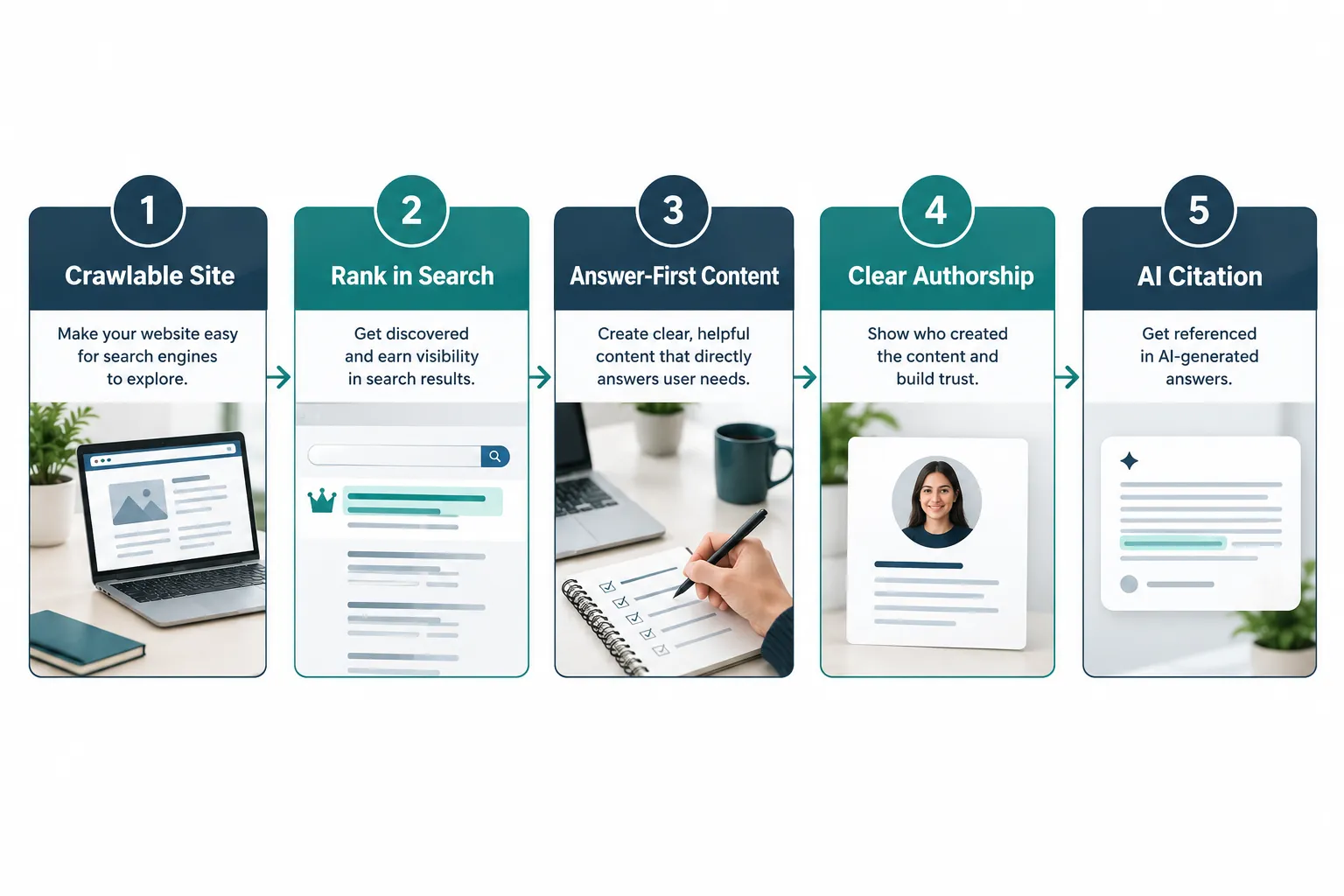
Google has confirmed publicly that AI Overviews and AI Mode run on the same Search index and ranking infrastructure as classic search results.[1] There is no separate “AI index” you submit to. A few practical implications:
- If a page cannot be indexed normally, it cannot be cited in an AI Overview.
- The AI system selects passages, not whole pages, so clear, isolated chunks of information get pulled more easily.
- Citations rotate based on query phrasing, so the same page might get cited for one version of a question and skipped for a slightly different one.
This connects directly to how Google AI Mode SEO works for ranking and citations, where the underlying mechanics are explained in more depth.
Do Small Websites Get Cited in AI Overviews or Mainly Big Brands
Small websites do get cited, particularly when they answer a narrow question with more clarity and specificity than a large publisher bothers to write. Big brands dominate broad, commercial queries, but specific, local, or technical questions often favor smaller, focused sites.
Think about it this way: a national news site will rarely write a detailed, 800-word answer to “how to register a sole proprietorship in Maharashtra.” A niche legal or business blog will. That specificity is exactly what AI summarizers look for.
Choose to compete here if:
- You can write with more detail and precision than the big players on a specific sub-topic.
- Your page already ranks on page one or two for related long-tail queries.
- You have genuine first-hand knowledge or data, not rehashed content.
How Long Before Your Website Shows Up in AI Summaries
There is no fixed timeline, but most sites see AI citations only after the underlying page is already ranking well in regular search, which itself can take weeks to months depending on competition and domain authority. Freshly published pages with little ranking history rarely appear in AI Overviews right away.
A reasonable expectation: if a page is brand new, give it at least 4 to 12 weeks to get indexed and start ranking before judging AI citation performance. If the page already ranks in the top 10 for its target query and still never appears in AI Overviews, the problem is usually format, not time.
You can track this signal directly using Google’s AI reporting tools. See our breakdown of Google Search Console’s AI Performance report to check whether your pages are already being surfaced in AI features.
Difference Between Google AI Overview Citations and Regular Search Rankings
A regular search ranking is a position on the results page based on relevance and authority signals. An AI Overview citation is a selection decision, where the AI picks specific passages from already-ranking pages to build a generated answer, regardless of exact position.
| Factor | Regular Ranking | AI Overview Citation |
|---|---|---|
| Basis | Position 1 to 10+ on SERP | Passage-level extraction from top-ranking content |
| Visibility | Fixed blue link and snippet | May appear even from position 5-8 if passage is clear |
| Control | Standard SEO (keywords, backlinks, UX) | Same SEO plus answer-first clarity and fact density |
| Guarantee | None | None, can change between identical queries |
Ranking well is the entry ticket. Citation is the selection that happens after that ticket gets you in the door.
Can You Pay to Get Cited in ChatGPT and Gemini
No. There is currently no paid advertising product from Google, OpenAI, or Gemini that buys you a citation inside an AI-generated answer. Anyone offering a “guaranteed AI citation” package is selling a myth.
What you can legitimately pay for:
- SEO and content work that improves your chance of ranking (which is a prerequisite).
- PR and digital coverage that builds brand mentions across authoritative sites, which seems correlated with ChatGPT citation frequency.[2]
- Technical fixes that remove crawl barriers for AI bots.
Be skeptical of any agency or tool claiming direct “pay-to-cite” access. If it sounds like buying ad placement inside an AI answer box, it does not exist as of this guide’s writing.
Why Isn’t My Website Being Cited in AI Overviews
The most common reason is that the page does not clearly and directly answer the question within the first few sentences, forcing the AI to skip it in favor of a competitor with a tighter answer. Other frequent causes include weak topical authority, blocked crawlers, or thin content padded with fluff.
Quick diagnostic checklist:
- Does the page answer the core question in the first 1-3 sentences? If not, rewrite the opening.
- Is the page actually ranking in the top 10-15 for the target query? If not, this is a ranking problem, not a citation problem.
- Check robots.txt and server logs for blocked AI crawlers.
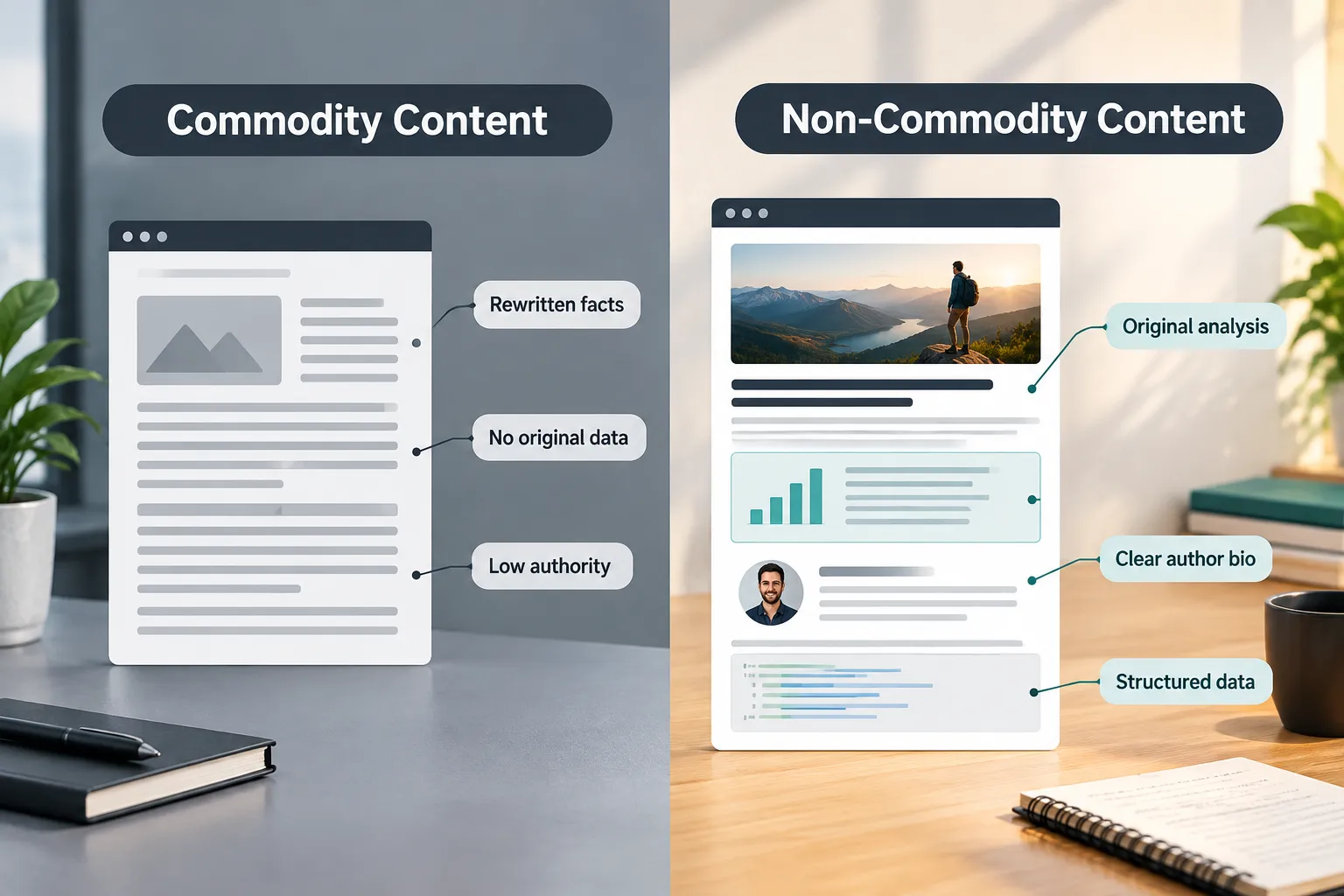
- Is the content commodity-level, meaning it says the same thing as 20 other pages? Google’s updated AI guide specifically flags non-commodity content as a requirement.[1][5]
- Is authorship and organizational trust visible (author bio, about page, contact info)?
What Content Format Works Best for AI Overview Citations
The format that works best is answer-first writing: a direct, self-contained answer in the opening sentences of a section, followed by supporting detail, examples, and structure like bullets or short tables. AI systems favor content that can be lifted as a stand-alone passage without needing outside context.
Practical structure rules:
- Lead every H2 with a 2-3 sentence direct answer.
- Use specific nouns instead of vague pronouns (“this feature” instead of “this”).
- Break steps into numbered lists when explaining a process.
- Use short tables for comparisons instead of long paragraphs.
- Avoid burying the useful fact in the fourth paragraph.
This is essentially the same discipline behind good featured snippet writing, extended further. For a deeper framework on this approach, see our Generative Engine Optimization guide.
Does E-E-A-T Still Matter for Getting Picked Up by AI Summaries
Yes, E-E-A-T (Experience, Expertise, Authoritativeness, Trustworthiness) still matters, and Google’s own AI optimization guidance explicitly ties brand authority and reputation to AI visibility.[1][6] AI systems appear to favor sources that already carry reputation signals across the web, not just on-page keywords.
Practical signals that help:
- Visible author bios with real credentials or experience.
- A clear “About” page and contact information.
- Mentions of your brand or author across other credible sites (digital PR).
- Original data, analysis, or opinion rather than rewritten summaries of other articles.
Writing honest, people-first content was always good SEO advice. It is now also the baseline for AI citation eligibility.
Should I Rewrite Content Specifically for AI or Use Existing Pages
In most cases, update your existing high-performing pages rather than creating separate “AI-only” versions. Google has directly debunked the idea that you need special AI-targeted formats like llms.txt files or artificial content chunking to appear in AI Overviews.[1]
Choose to rewrite an existing page if:
- It already ranks reasonably well but buries the answer deep in the text.
- It is outdated, thin, or repeats information available elsewhere without adding anything new.
Choose to create a new page if:
- No existing page covers the specific question at all.
- The topic deserves its own dedicated, detailed treatment separate from a broader page.
Do not create duplicate “AI versions” of the same page. That confuses both users and crawlers and can hurt your website’s indexing instead of helping it.
Which Websites Get Cited Most in Google AI Overviews
Analysis of citation patterns shows established, high-authority domains across news, reference, commerce, and technology sectors dominate AI Overview and ChatGPT citations, though topic-specific niche sites still break through for narrow queries.[2][7][8] Wikipedia, major publishers, and large product/review sites consistently appear across many query types.
What this means practically:
- If you are a small business or blog, compete on specificity, not breadth.
- Local businesses should focus on location-specific, highly practical queries where national brands have no detailed answer.
- Build topical depth around a cluster of related questions rather than one broad page.
What Happens if a Competitor’s Content Gets Cited Instead of Mine
If a competitor’s page gets cited, it usually means their content answers the exact query phrasing more directly, ranks slightly better, or carries stronger trust signals on that specific topic. This is not permanent and often shifts as both pages get updated or as the query phrasing changes.
Steps to respond:
- Compare the competitor’s cited passage directly against your equivalent section. What is clearer or more specific in theirs?
- Check whether your page actually ranks near theirs. If you are ranking significantly lower, fix ranking first.
- Add original data, examples, or detail your competitor’s page lacks.
- Improve your opening sentences so the direct answer appears immediately.
Can I Opt Out of Being Included in AI Overview Citations
Yes. Google introduced Search Console controls in June 2026 that let site owners opt out of being used to ground AI Overviews, AI Mode, and AI Overviews in Discover, separate from opting out of regular search indexing.[3] This gives publishers more granular control than before.
Who should consider opting out:
- Publishers worried about AI summaries reducing click-through traffic on high-value content.
- Sites with licensing concerns about how their content gets reused in generated answers.
Who should NOT opt out:
- Businesses and bloggers trying to build visibility and brand awareness through AI search, since opting out removes the citation opportunity entirely.
Common SEO Mistakes That Hurt Your Chances of AI Overview Citations
The most damaging mistakes are blocking AI crawlers in robots.txt, writing commodity content that says nothing new, and burying the direct answer under long introductions. Fixing these three issues solves the majority of citation problems.
Other frequent mistakes:
- Treating llms.txt or special “AI schema” as a magic fix (Google says neither is required).[1]
- Ignoring slow-loading WordPress pages, which hurt crawl efficiency and user experience alike.
- Publishing content with no clear author or organizational trust signal.
- Keyword-stuffing instead of answering the actual question a real person types.
- Forgetting to maintain consistent blogging that builds topical authority over time.
For businesses managing this without in-house staff, it is worth reviewing how to outsource SEO marketing to an agency that understands AI search, not just traditional ranking.
Do AI Tools Like Claude and Perplexity Have Different Citation Requirements Than Google and Gemini
Yes, somewhat. While the shared foundation (crawlability, authority, clear answers) applies across all AI systems, each platform has its own crawler, its own citation behavior, and its own bias toward certain domain types. OpenAI, for instance, explicitly requires allowing OAI-Searchbot crawl access as a baseline requirement for ChatGPT Search citations.[4]
Key differences to know:
- ChatGPT and Perplexity tend to cite large, established domains more heavily than Google AI Overviews do.[2][8]
- Gemini operates inside Google’s own index and ranking system, so it follows the same fundamentals as AI Overviews.[1]
- Claude and Perplexity both rely on live web retrieval, meaning current crawl access and technical accessibility matter just as much as content quality.
Practically, this means checking your robots.txt file for each major AI bot (Googlebot, OAI-Searchbot, and others) rather than assuming one blanket setting covers everything.
FAQ
Is there a special schema markup required for AI Overview citations? No. Google has stated clearly that no special “AI schema” is required to appear in AI Overviews or AI Mode.[1]
Does llms.txt actually help get my site cited? Google has directly debunked llms.txt as a requirement or meaningful ranking factor for AI citations.[1]
Can I block ChatGPT but still appear in Google AI Overviews? Yes, crawler permissions are platform-specific. Blocking OAI-Searchbot affects ChatGPT citations but has no direct effect on Google’s systems.[4]
Do AI Overviews reduce website traffic? Many publishers report reduced click-through on queries fully answered by AI Overviews, which is part of why Google added opt-out controls in 2026.[3]
Is GEO a completely different skill from SEO? No. Google explicitly frames GEO and AEO as “still SEO,” just with sharper emphasis on clarity, trust, and non-commodity content.[6]
Will AI Overviews change again in 2027? Expect continued expansion of publisher controls and a stronger bias toward expert, brand-backed content, but the core fundamentals of crawlability and clear answers should stay stable.
Should local businesses care about AI citations? Yes, especially those optimizing a Google Business Profile for AI search visibility, since local queries increasingly trigger AI-generated summaries too.
Conclusion
Getting cited in Google AI Overviews, ChatGPT and Gemini comes down to fundamentals most SEO professionals already know, applied with more discipline: be crawlable, rank well, answer clearly, and build real authority instead of recycled content. None of this requires exotic technical tricks or special AI schema.
Start with one practical step this week: pick your best-performing page, rewrite its opening paragraph into a tight, 2-3 sentence direct answer, and check your robots.txt file to confirm you are not accidentally blocking AI crawlers. Small, specific fixes like these move the needle faster than chasing rumors about secret AI optimization hacks.
References
- AI Features. developers.google.com.
- Most Cited Domains in Chatgpt. ahrefs.com.
- New Controls Website Owners. google.
- 9237897 Chatgpt Search Publisher and Website FAQ. help.openai.com.
- Google AI Search Guidelines. wordstream.com.
- Googles New AI Search Guide Calls Aeo and Geo Still SEO. searchenginejournal.com.
- AI Platform Citation Source Index 2026. everything-pr.com.
- Top Sources Chatgpt Citations Jun 2026. indexly.ai.