

Last updated: October 24, 2026
Quick Answer
Google AI Overviews and AI Mode Preferred Sources reward publishers who combine topical depth, clear structure, and reader trust, not just keyword rankings. To build search visibility in 2026, you need your site verified in Search Console’s AI features report, content that answers questions directly, and enough reader loyalty that people actively choose your site as a Preferred Source. Publishers who treat this as a brand-building exercise, not a technical hack, are the ones showing up consistently in AI Overviews and AI Mode.
Key Takeaways
- Preferred Sources is a real Google feature that lets users pick sites they want to see more often, which can earn a “preferred” badge in AI Mode and AI Overviews [1].
- A new embeddable button, launched August 2026, lets readers add your site as a Preferred Source without leaving your page.
- AI Overviews and AI Mode share a large overlap in trusted domains, so general SEO authority still matters a lot [2].
- Branded searches are a huge trigger for AI Overviews, appearing on over 80% of tracked branded queries by late September 2026 in some datasets [3].
- Only about 7.1% of clicks on AI Overview pages come from links inside the AI answer itself, so traditional listings still carry most of the traffic.
- AI Mode on Chrome now opens pages side by side with the AI panel, rewarding pages rich enough to support follow-up questions [4][5].
- Structured, well-organized content with schema and clear authorship is what AI Mode tends to summarize and cite [6].
- Small publishers can still compete if they own a narrow topic with real depth and original reporting.
What exactly are Google AI Overviews and how do they work
Google AI Overviews are short, AI-generated summaries that appear at the top of search results, pulling information from multiple web pages and linking back to them [7][8]. They are designed to give a quick answer so users don’t have to click through several pages immediately.
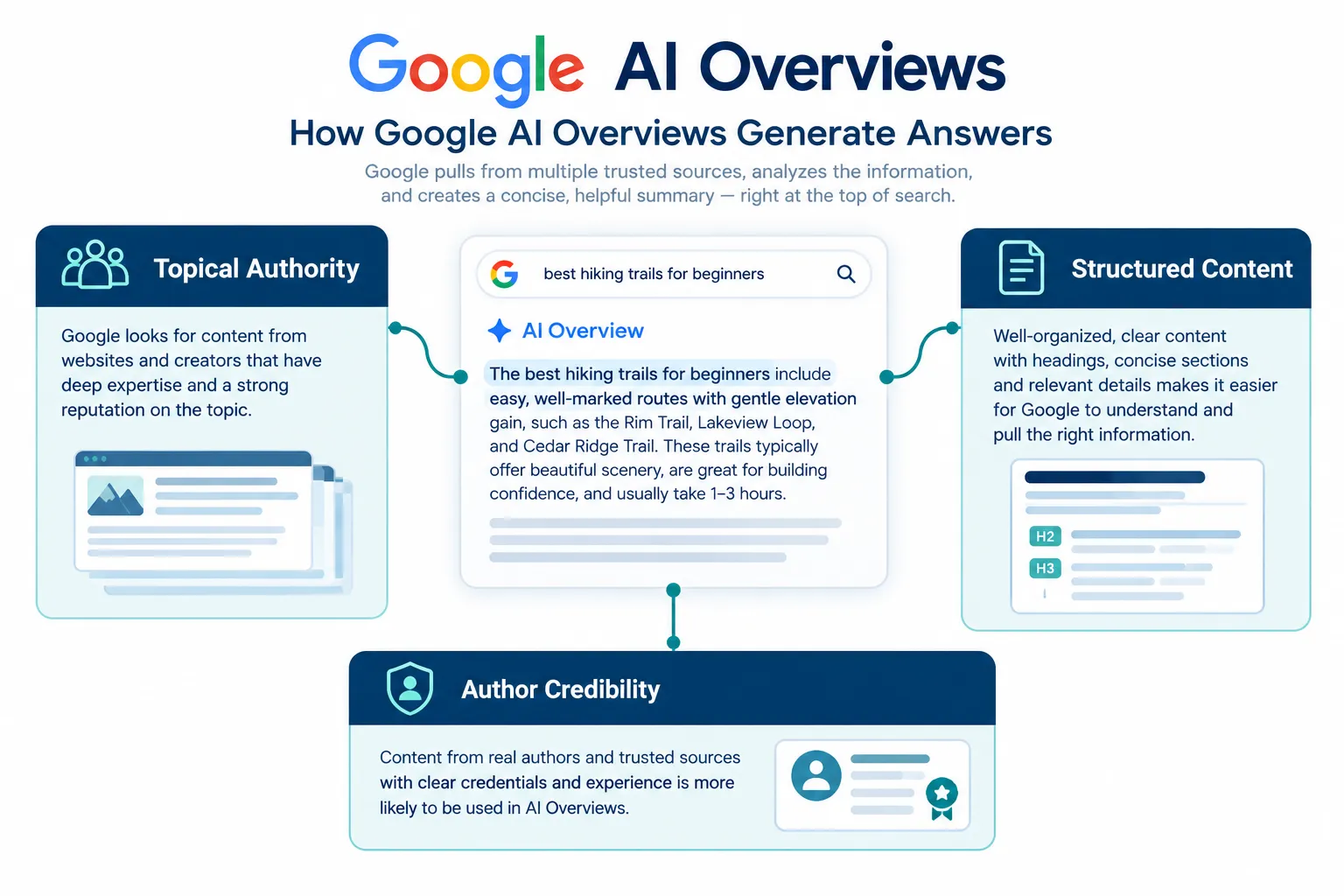
Google builds these summaries using its generative models combined with its usual search ranking systems. It does not create answers from nothing. It still depends on indexed, crawlable web content. That means basic SEO fundamentals, like fast-loading pages and clean site structure, still decide whether your content can even be considered.
Decision rule: if your page already ranks on page one for a query, it has a reasonable chance of being pulled into an AI Overview for that same query. If you’re not ranking organically, an AI Overview citation is very unlikely.
How is AI Mode different from regular Google search results
AI Mode is a deeper, chat-style search experience, while AI Overviews are quick snapshots sitting above standard results. Google describes AI Mode as Gemini-powered and conversational, supporting text, images, files, video, and even Chrome tabs as inputs [6][7][8].
Where AI Overviews give you a paragraph and move on, AI Mode breaks a complex question into subtopics, runs several searches in parallel, and stitches the findings into one longer answer with links for verification [6]. Users can also move from a basic AI Overview straight into AI Mode for follow-up questions, all inside one connected search flow [7][8].
In April 2026, Google added a feature on Chrome desktop where clicking a link inside AI Mode opens that page side by side with the AI panel [4][5]. This makes AI Mode more useful for comparison shopping, research, and detailed questions, and it rewards publishers whose pages have enough depth to answer a follow-up without the reader leaving.
)
Which publishers are getting traffic from Google AI Overviews
Publishers with strong topical authority, clear branding, and content that matches common question phrasing are the ones showing up most often in AI Overviews. Data reported by Semrush shows AI Overviews appearing heavily on branded searches, which naturally favors publishers people already search for by name [3].
DemandSphere data cited by Semrush found AI Overviews appearing on 26.12% of tracked branded queries in early September 2026, climbing to over 90% at one point later that month, and settling around 82% by month’s end [3]. A separate Ahrefs study on US desktop results saw similar growth, from 65.1% in August to nearly 83% by late September [3]. This pattern tells you something practical: if people already search your brand name, you have a better shot at AI Overview visibility than a brand nobody has heard of.
What content does Google AI Mode actually use for overviews
Google AI Mode draws from indexed, crawlable web pages that answer the query directly and that fit within its broader search ranking and generative AI features systems. It favors content that is well-structured, uses clear headings, and is easy to parse into a summary [6].
Practically, this means:
- Pages with direct answers near the top of the content
- Clear H2/H3 structure that mirrors how people actually ask questions
- Schema markup that helps machines understand entities and relationships
- Original reporting or data that isn’t just a rewrite of someone else’s article
Common mistake: publishers write long articles that bury the answer three paragraphs deep. AI systems tend to favor content that states the point early, then explains. If you’re reorganizing old content for this, check our Google AI Mode SEO guide for a structured approach.
How do I get my website into Google AI Overviews
You get into AI Overviews mainly by ranking well organically, writing clear and direct answers, and making sure your technical SEO is solid enough for Google to crawl and understand your content. There’s no separate submission process specifically for AI Overviews.
Steps that genuinely help:
- Confirm your site is verified in Search Console and check the AI features report for visibility data.
- Write content that answers the core question in the first two or three sentences of each section.
- Add schema markup (Article, FAQ, HowTo where relevant).
- Build topical depth across related subtopics instead of one thin page.
- Keep publishing consistently so Google sees ongoing activity and freshness.
You can monitor your progress using the AI Performance report inside Search Console, which shows impressions and clicks tied to AI-driven search features.
Do I need to change my SEO strategy for AI Mode
Yes, but the change is more about depth and structure than starting over. Traditional ranking signals like backlinks, page speed, and relevance still matter, but AI Mode also rewards content built to survive follow-up questions [6].
Practical adjustments:
- Write comprehensive guides instead of thin posts targeting one keyword.
- Anticipate follow-up questions and answer them in the same piece.
- Use comparison tables and lists where they genuinely help explain something.
- Keep author bios and credentials visible, since credibility signals matter for how Google judges trustworthiness.
If you’re unsure where AEO and GEO fit next to classic SEO, our comparison on SEO vs GEO vs AEO in 2026 breaks down the differences in plain language.
Why isn’t my site showing up in AI overviews
Your site may not be showing in AI Overviews because it isn’t ranking well organically, your content doesn’t directly answer the query, or your technical SEO has gaps that block crawling and indexing. AI Overviews pull from existing search rankings, so weak organic visibility usually means weak AI visibility too.
Check these common blockers:
- Pages missing clear, direct answers near the top
- No structured data or inconsistent schema
- Thin content that doesn’t cover the topic fully
- Slow page speed or poor mobile experience
- Images without descriptive alt text, which hurts how machines understand page context (see our alt text guide for fixes)
Edge case: sometimes a page ranks fine but still gets skipped because a competitor’s content format (like a table or numbered list) is easier for the AI system to summarize. Reformatting your answer can sometimes fix this without changing the core content.
What are Preferred Sources in Google AI Mode
Preferred Sources are sites that users explicitly choose to see more often in their search results, and Google can highlight these with a “preferred” badge inside AI Mode and AI Overviews [1]. This is a direct audience-loyalty signal layered on top of normal ranking.
To be eligible, Google’s documentation states publishers must have their site included in “Search generative AI features” within Search Console, and only domain-level or subdomain-level properties can be added to the source-preferences tool [1]. In August 2026, Google rolled out an interactive Preferred Sources button that publishers can embed directly on pages, letting readers add the site as a preferred source without leaving the article. This button sends users straight back to your page after they click it, strengthening the chance of appearing in Top Stories and getting that preferred-source label [9].
Once a site earns Preferred Source status, it can apply globally across languages and locales where AI Overviews and AI Mode are live, which matters for publishers with international audiences [1].
)
Can small publishers compete with big sites in AI Overviews
Yes, small publishers can compete if they own a narrow topic deeply instead of trying to cover everything broadly. AI systems value clear expertise signals more than sheer site size.
A small blog focused tightly on, say, personal finance for freelancers in India has a real shot at AI Overview citations for freelancer-specific tax questions, even against a massive finance publisher, because the big site likely treats that topic as one article among thousands. Decision rule: choose depth over breadth if your resources are limited. One excellent, frequently updated resource beats ten shallow posts.
Does appearing in AI Overviews actually drive traffic
Appearing in AI Overviews helps brand visibility, but it does not guarantee strong click-through traffic, since most clicks still happen through standard listings rather than the AI summary itself. A randomized experiment reported by LovedBy.ai found only about 7.1% of clicks on AI Overview pages came from links inside the generated answer.
This means AI Overviews work best as an additional discovery layer, not your main traffic source. Publishers should still invest in ranking well in traditional blue links, news modules, and other standard result types, because that’s where most engagement happens even on pages that also show an AI Overview.
What content strategy works best for AI Mode visibility
The strongest AI Mode strategy combines original reporting, clear structure, author credibility, and consistent publishing, all centered on a defined topic area. This is the combination that supports both ranking and Preferred Source eligibility.
Practical checklist:
- Publish original data, surveys, or analysis instead of only summarizing others
- Use descriptive headings that match how people phrase questions
- Keep author bylines with real credentials and experience visible on every page
- Publish on a consistent schedule so Google sees ongoing topical commitment
- Track your AI-driven visibility over time using tools like our guide on tracking AI visibility
Mini example: a local business review site that publishes one well-researched comparison guide per week, with clear author credentials and embedded data tables, is far more likely to earn repeat Preferred Source selections than a site publishing ten thin, unsigned posts in the same week.
Are there niches where AI Overviews don’t show
Yes, some query types show AI Overviews far less often, particularly highly sensitive topics (medical emergencies, legal disputes, certain financial advice) where Google applies extra caution, and very localized or transactional searches that favor map packs or shopping results instead. Branded queries, by contrast, show AI Overviews extremely often, in some datasets over 80% of the time by late September 2026 [3].
If your niche sits in a cautious category, don’t panic if you see less AI Overview presence. Focus energy on ranking well in traditional results and local search instead, since that’s where your audience is likely clicking anyway.
What common mistakes do publishers make with AI Mode optimization
The most common mistake is treating AI Mode optimization as a separate technical trick instead of strengthening overall content quality and site trust. Publishers often chase schema markup tweaks while ignoring thin content, weak authorship signals, or inconsistent publishing.
Other frequent mistakes:
- Writing content that answers a keyword but not the actual reader question
- Ignoring Search Console’s AI performance data entirely
- Skipping author bios, which weakens credibility signals
- Expecting instant results instead of building topical authority over months
- Forgetting that local business visibility also matters; check our Google Business Profile optimization guide if your business depends on local AI search results
Is traditional SEO still worth it if AI Overviews keep growing
Yes, traditional SEO is still essential because AI Overviews and AI Mode both depend on the same underlying ranking systems, crawlability, and indexing that classic SEO has always required. Research tracking domain overlap found AI Mode and AI Overviews share at least 363 of the top 500 domains tracked, showing Google trusts largely the same sites across both experiences [2].
In other words, you can’t skip fundamentals and expect AI visibility instead. Good technical SEO, strong backlinks, and clear content structure remain the foundation. AI Overviews and Preferred Sources sit on top of that foundation, not in place of it.
Comparison: AI Overviews vs AI Mode vs Preferred Sources
| Feature | AI Overviews | AI Mode | Preferred Sources |
|---|---|---|---|
| Format | Short summary above results | Conversational, multi-step | Badge inside AI Mode/Overviews |
| Depends on | Organic ranking, crawlability | Deep structured content | Reader clicks on embeddable button |
| Best for | Quick branded/factual queries | Complex, comparison queries | Loyal, returning audiences |
| Publisher action | Improve SEO basics, clarity | Build comprehensive guides | Add the Preferred Sources button |
FAQ
What is the difference between Google AI Overviews and AI Mode? AI Overviews are short summaries shown above regular search results, while AI Mode is a full conversational search experience that supports follow-up questions and multimodal input [7][8].
How do I check if my site appears in AI Overviews? Use the AI features report inside Google Search Console to see impressions and clicks tied to AI-driven search surfaces.
What is a Preferred Source badge? It’s a label Google shows when a site has been chosen by enough users as one they want to see more often, appearing inside AI Mode and AI Overviews [1].
Can I add a Preferred Sources button to my website? Yes, Google announced an embeddable button in August 2026 that lets readers mark your site as preferred without leaving the page.
Does ranking high organically guarantee an AI Overview citation? No, but it significantly increases your chances, since AI Overviews draw from existing organic rankings.
Do AI Overviews reduce website traffic? They can reduce some click-through on affected queries, but data shows most clicks on AI Overview pages still come from traditional listings, not the AI summary itself.
Should small blogs bother optimizing for AI Mode? Yes, especially if they own a narrow, well-defined topic with real depth and consistent publishing.
Is schema markup required for AI Overviews? It’s not strictly required, but it helps Google understand page content faster, which supports both AI Overviews and AI Mode visibility [6].
Conclusion
Google AI Overviews and AI Mode Preferred Sources are reshaping how publishers earn search visibility in 2026, but the core work hasn’t changed as much as it seems. You still need strong SEO fundamentals, genuine topical depth, and content people actually trust. What’s new is the direct audience-loyalty layer: Preferred Sources rewards sites that readers actively choose, not just sites that rank well.
If you’re starting today, audit your Search Console AI performance data, tighten your content structure around direct answers, add the Preferred Sources button where it fits, and commit to covering your chosen topic area with real depth instead of scattered posts. Review our Google AI Mode vs AI Overviews breakdown next if you want a clearer side-by-side understanding before you rebuild your content plan.
References
- Preferred Sources. developers.google.com.
- Google AI Overviews. paralax.ai.
- AI Overviews Appearing for Major Brands. semrush.com.
- AI Mode Chrome. google.
- Google Now Lets You Explore the Web Side by Side with AI Mode. techcrunch.com.
- Google AI Mode. zapier.com.
- Search Io 2026. google.
- Google Io 2026 All Our Announcements. google.
- Google Gives Publishers New Tool Combat AI Search 4254786. thedailystar.net.
digital marketing, SEO made simple, Google AI Overviews, AI Mode, Preferred Sources, generative engine optimization, AEO, search visibility, content strategy, technical SEO, publisher growth, AI search optimization