

Last updated: November 4, 2026
Quick Answer
CRO for AI-generated traffic means rebuilding landing pages, trust signals and funnels around visitors who arrive from AI chat tools and AI search answers with more background knowledge but less predictable intent. These visitors often skip the top of your funnel entirely, so pages need instant context recaps, visible proof, and flexible qualification paths instead of generic hero sections built for first-time searchers.
Key Takeaways
- AI-referred visitors arrive pre-informed by a chatbot summary, so landing pages need a quick recap, not a fresh pitch from zero.
- Intent-shifting visitors can move from “just researching” to “ready to buy” within one session, so funnels need branching paths, not a single linear form.
- Trust signals like verified reviews, security badges and clear author credentials matter more for AI traffic because the visitor didn’t choose you through ranking position [1].
- Chatbot-style conversion funnels on landing pages are showing measurable lift when paired with A/B testing [2][3].
- Bounce rates from AI referral traffic tend to run higher than standard organic search, mostly because of mismatched context [4].
- You don’t always need a separate landing page for AI traffic, but you do need separate messaging blocks that can be tested independently.
- Standard conversion rate benchmarks for chatbot-assisted funnels vary widely by industry, so treat any single number as a rough reference point, not a target [5][6].
What Is AI-Generated Traffic and How Does It Differ From Organic Search Traffic
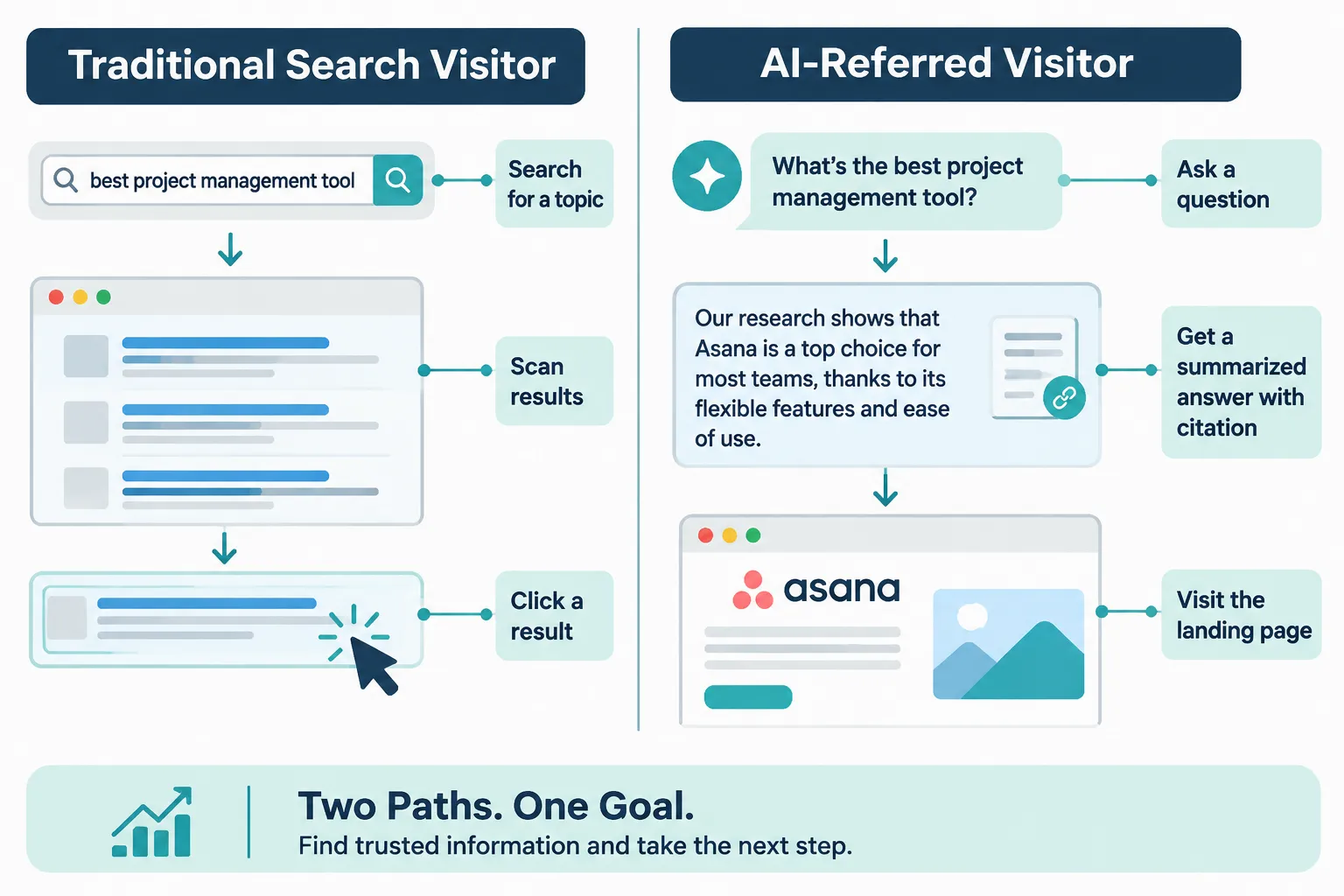
AI-generated traffic is visitor flow that originates from AI chat tools, AI Overviews, or AI Mode answers rather than a traditional blue-link search result. The visitor has already read a summarized answer before clicking, so they arrive with partial knowledge instead of a blank question.
Organic search traffic usually starts with a query and a list of options. AI-generated traffic starts with an answer the visitor has already partly accepted. That changes what a landing page needs to do:
- Organic visitor: needs explanation, comparison, and orientation.
- AI-referred visitor: needs confirmation, proof, and a reason to act now.
This shift is part of a larger move where AI search and LLM surfaces are changing where and how visitors arrive on a website, which is why CRO teams are starting to track AI referral traffic as its own segment inside analytics, similar to how marketers already track AI visibility across search engines.
Why Do Visitors From AI Tools Have Different Buying Intent Than Regular Visitors
Visitors from AI tools often arrive with a researched opinion already formed, which makes their buying intent sharper on some points and vaguer on others. They might know exactly what feature they want but have no idea what your brand actually does.
A chatbot usually answers a narrow question (“best CRM for a 5-person team”) and the visitor clicks through on one recommendation among several mentioned. That means:
- The visitor compared you against competitors before landing, often without visiting your site.
- The visitor expects the page to match what the chatbot said, word for word almost.
- If the chatbot got a detail wrong or outdated, the visitor arrives confused rather than convinced.
Decision rule: if your product changes frequently (pricing, features, policies), add a short “last verified” note near key claims so AI-referred visitors don’t bounce over a mismatch.
What Trust Signals Actually Work for Converting AI-Generated Traffic
Trust signals that work best for AI traffic are the ones that replace the “ranking position trust” the visitor skipped by not browsing search results. Visible, specific proof beats vague brand statements.
Signals that perform well:
- Real customer reviews with dates and specific outcomes, not generic star counts.
- Security and compliance badges placed near forms, not buried in the footer.
- Author or expert credentials next to advice-driven content.
- Clear refund, guarantee, or cancellation terms stated plainly, not hidden in a policy link.
- Media mentions or third-party citations, since AI tools often cite third parties themselves.
Common mistake: stacking five trust badges in a row at the top of the page. It looks cluttered and AI-referred visitors scan fast; pick two or three that answer their specific doubt.
How to Structure Landing Pages Specifically for AI Traffic Visitors
Landing pages for AI traffic should open with a direct answer recap, followed by proof, then one clear action, not a broad brand story. The visitor already knows roughly what you offer, so the page’s job is to confirm and convert.
A working structure looks like this:
- Headline that mirrors the likely AI answer, confirm what they expect to find.
- Context recap block, two or three lines restating the core value, in case the chatbot summary was partial.
- Proof section, reviews, numbers, or case detail placed high, not after a long scroll.
- Single primary action, one form or one button, not three competing CTAs.
- Secondary path for undecided visitors, a comparison link or FAQ accordion for people who aren’t ready yet.
This mirrors advice already covered in generative engine optimization strategies, where content built for AI citation also tends to convert better post-click because it’s structured around direct answers.
Why Do AI Traffic Funnels Have Higher Bounce Rates and How to Fix It
AI traffic funnels often show higher bounce rates because the landing page doesn’t match the context the visitor already has in their head. Fixing this means closing the gap between what the chatbot told them and what the page shows.
Common causes of the mismatch:
- Pricing or feature details on the page don’t match what the AI tool summarized.
- The page assumes the visitor is brand new and repeats basic explanations they already know.
- Load speed is slow on mobile, where a large share of AI-referred clicks happen [4].
Fixes that actually move the number:
- Keep a changelog of claims that AI tools commonly cite, and update the page the same week pricing or features change.
- Trim the above-the-fold content to the recap and proof, skip the long intro.
- Run mobile speed checks monthly, since mobile-first CRO patterns for AI search audiences depend heavily on load time and thumb-friendly layout [4].
What Are Intent-Shifting Visitors and When Do They Change Their Mind
Intent-shifting visitors are people whose goal changes mid-session, starting as a casual researcher and becoming a buyer, or the reverse, within the same visit. This happens more with AI-referred traffic because the chatbot interaction already nudged them partway through a decision before they even landed.
They typically shift at these moments:
- After reading one strong proof point (a review, a number, a guarantee).
- After realizing the price is different from what they expected.
- After a chatbot widget on your own site answers a follow-up question they still had.
Quick example: a visitor lands on a pricing page expecting to “just look,” reads a specific review mentioning a result close to their own situation, and converts within two minutes. The proof point, not the headline, caused the shift.
Common Mistakes People Make When Optimizing for AI Traffic Conversion
The biggest mistake is treating AI-referred visitors exactly like regular search visitors and reusing the same top-of-funnel page without adjustment. Several smaller mistakes compound this:
- Ignoring referral source segmentation in analytics, so AI traffic behavior stays invisible.
- Overloading the page with long-form explanation the visitor doesn’t need anymore.
- Skipping conversational elements like chat widgets, even though AI-influenced visitors respond well to them [7][8].
- Testing landing page changes only on aggregate traffic instead of isolating the AI-referred segment.
How Much Should You Spend on CRO Testing for AI-Generated Traffic
There’s no fixed industry figure here, and any specific dollar number would be a guess rather than a verified benchmark. A more useful approach is to size the testing budget against the traffic volume and value of the segment.
Practical sizing approach:
- If AI-referred traffic is under 5% of total sessions, start with low-cost tests: headline wording, proof placement, one CTA variant.
- If it’s a growing share (track this monthly via Search Console’s AI performance reporting), justify a dedicated landing page variant and a small chatbot pilot.
- Treat chatbot funnel testing as its own line item since A/B testing for conversational experiences uses different tools and metrics than standard page testing [2].
Decision rule: fund a dedicated AI-traffic test only once you can reliably segment that traffic in analytics. Spending on tests you can’t measure separately wastes the budget.
Can You Use the Same Landing Pages for AI Traffic and Regular Traffic or Do You Need Different Versions
You can usually reuse the same page shell, but you need different content blocks that can be swapped based on referral source. Full duplicate pages are rarely necessary unless the two audiences want fundamentally different proof.
Comparison guide:
| Factor | Shared page with dynamic blocks | Fully separate page |
|---|---|---|
| Setup effort | Lower, one template | Higher, two templates to maintain |
| Message accuracy | Good, if blocks are well targeted | Best, since everything is written for one audience |
| Maintenance | Easier long-term | More pages to update when pricing changes |
| Best for | Most small and mid-size sites | High-volume AI referral segments with distinct needs |
Choose shared blocks if your AI traffic volume is moderate and your core offer doesn’t change by audience. Choose a separate page if AI referral traffic is a large, stable share of conversions and the messaging genuinely needs to differ.
Which Trust Signals Have the Biggest Impact on AI Traffic Conversions
Specific, verifiable proof tends to outperform general brand trust markers for AI-referred visitors, because this audience already skipped the step of comparing brands through search rankings.
Ranked by typical impact, based on general CRO patterns:
- Detailed customer outcomes (specific numbers, specific use case).
- Security or data-handling badges near any form.
- Clear policy terms stated in plain language.
- Author or company credentials tied to the specific claim being made.
- Third-party media mentions, since these echo how AI tools build their own citations.
How to Build a Funnel That Handles Multiple Intent Changes From One Visitor
A funnel built for intent-shifting visitors needs branching paths rather than one straight line from landing page to checkout. Each branch should match a different confidence level.
A workable setup:
- Entry page with the recap and proof, as described earlier.
- Light qualification step, a short question or chatbot prompt, not a long form.
- Branch A (ready now): direct path to checkout or booking.
- Branch B (comparing): a detailed comparison page or FAQ accordion.
- Branch C (just researching): a low-commitment offer like a guide download or email capture.
Chatbot-driven funnels with persistent context across these branches, meaning the bot remembers earlier answers instead of restarting, show better conversion outcomes, along with calibrated human handoff when a question goes beyond the bot’s script [7][8].
Is It Worth Optimizing for AI Traffic or Should I Focus on Other Channels
It’s worth optimizing for AI traffic if that segment already shows measurable volume in analytics, but it shouldn’t replace investment in other channels that still drive the bulk of conversions for most sites today.
Decision framework:
- Optimize for AI traffic first if: it’s a growing share of referrals and your product/content is already being cited in AI answers.
- Keep focus on other channels if: AI referral volume is still under 2-3% of sessions, or your main growth lever is still paid search, SEO, or demand generation.
This isn’t an either-or choice long-term. SEO and CRO are converging around visibility in AI answers and the trust funnel that follows the click, so teams already doing technical SEO well are in a better position to adapt landing pages for this traffic without starting from scratch.
What’s the Average Conversion Rate You Should Expect From AI-Generated Traffic
There isn’t one reliable universal benchmark for AI-referred traffic conversion rates yet, since reporting methods and definitions of “AI traffic” still vary across tools and platforms [5][6]. Treat any number you see quoted as an estimate specific to that source’s dataset, not a general standard.
What’s safer to track instead:
- Compare AI-referred conversion rate against your own organic search conversion rate, month over month.
- Track chatbot-assisted conversions separately, since these often convert differently than static landing pages [3][9].
- Watch trend direction rather than chasing a fixed percentage target.
How Often Should You Test and Update Landing Pages for AI Traffic Performance
Landing pages built for AI-generated traffic need more frequent review than standard pages because AI tools update their answers and summaries on their own schedule, not yours. A monthly check is a reasonable baseline for most sites.
Recommended cadence:
- Monthly: review AI referral conversion trends and bounce rate changes.
- Quarterly: refresh proof elements (reviews, numbers, badges) and recheck pricing accuracy.
- Immediately after any pricing or feature change: update the recap block so it matches what AI tools might be citing.
This pairs well with ongoing checks through Google Search Console for indexing and traffic diagnostics, since a page that stops ranking or gets re-crawled slowly can also stop appearing correctly in AI summaries.
FAQ
Is AI-generated traffic the same as referral traffic from ChatGPT or Gemini? Mostly yes. AI-generated traffic usually means clicks coming from AI chat tools, AI Overviews, or AI Mode answers, tracked separately from standard organic or paid referral traffic.
Do I need a chatbot on my landing page to convert AI traffic well? Not always, but chatbot-assisted funnels do show conversion gains in several studies when paired with testing and clear handoff rules [2][3][8]. Start with a simple widget before building anything complex.
Why does my AI-referred traffic bounce faster than my search traffic? Usually because the page content doesn’t match what the AI tool told the visitor beforehand. Fixing the recap block and keeping claims current is the first step.
Should pricing pages look different for AI-referred visitors? Keep the numbers identical everywhere, but you can add a short recap line confirming what was likely summarized elsewhere, since mismatched expectations drive bounces.
Can small businesses realistically test for this traffic segment? Yes, once the segment is visible in analytics. Start with simple headline and proof-placement tests before investing in a dedicated page or chatbot flow.
How do I even track AI-generated traffic separately? Use referral source segmentation in your analytics tool, cross-checked against AI performance reporting in Search Console, and tag any chatbot-assisted conversions separately.
Conclusion
AI-referred visitors aren’t a smaller version of your regular traffic. They arrive with partial context, compare you before they land, and can change their mind mid-session faster than most funnels expect. Getting CRO for AI-generated traffic right means confirming what the visitor already believes, placing specific proof early, and giving them more than one path depending on how ready they actually are.
Start small: segment this traffic in analytics this month, fix the recap block on your top landing page, and run one trust-signal test before building anything bigger. That’s a realistic first step toward turning this traffic into a channel you actually understand, not just a line item in your reports.
References
- Chatbots as a Growth Channel for SEO Conversions. authoritysolutions.com.
- Chatbot Ab Testing Optimization. conferbot.com.
- Chatbot Lead Generation 3x Conversion. conferbot.com.
- Mobile Cro for AI Search and Mobile First Audiences. moburst.com.
- Chatbot Conversion Rate. supplo.io.
- Chatbot Conversion Rate. chatbotscape.com.
- Chatbot Marketing Strategy 2026. robylon.ai.
- Chatbot Conversion Rate Optimization. vocui.com.
- Chatbot Analytics. conferbot.com.
CRO for AI-generated traffic, AI search traffic, landing page optimization, trust signals, conversion funnels, intent-shifting visitors, chatbot conversion, AI referral traffic, GEO, AEO, A/B testing, conversion rate optimization