
Last updated: October 28, 2026
Quick Answer
Google AI Search in 2026 rewards brands that have verifiable authority and a well-organized library of content, creative and first-party data over brands that simply bid on keywords or chase rankings. AI Overviews now pull answers from sources it trusts, and Google Ads increasingly pulls creative directly from your asset library to build ads inside AI answers. If your brand lacks structured content and assets, you lose visibility on both the organic and paid side, no matter how much you spend.
Key Takeaways
- AI Overviews reached roughly 1.5 billion monthly users and appear on about 13% of US queries, making AI summaries a mainstream part of search behavior.
- Organic click-through rates drop sharply when AI Overviews appear, but brands cited inside the Overview actually see CTR gains on both organic and paid clicks.
- Pages outside the traditional top 10 can still get cited in AI Overviews if they show strong expertise, weakening the old “rank #1 to win” model.
- Google’s own guidance tells site owners to focus on helpful, clear, user-first content rather than keyword tricks.
- Google Ads is placing ads directly inside AI Overviews, which makes your Google Ads asset library a direct input into paid AI visibility.
- Asset Studio uses AI to improve Ad Strength and placement eligibility, tying creative quality to how often your ads actually show up.
- Small businesses can compete by building topical depth and a tidy asset library instead of trying to outspend larger brands.
- Paid search has stayed relatively stable so far, but agencies are already restructuring campaigns around connected content and creative assets rather than isolated keyword bids.
What is brand authority in Google AI search
Brand authority in Google AI search means Google AI Search systems treat your brand as a reliable, well-established source worth quoting or recommending. It is built from consistent expertise signals across your website, reviews, mentions and structured data, not from a single ranking position.
Google’s AI Search guidance explicitly tells publishers to focus on helpfulness and clarity instead of over-optimizing for keywords or backlinks. That is a meaningful shift from classic SEO, where backlink count and exact-match keywords often decided who ranked. Authority now comes from a mix of:
- Content that directly answers real questions, including likely follow-up questions
- Consistent entity signals (your business name, categories, and facts matching across the web)
- Genuine expertise demonstrated through depth, not just volume
- Trust markers like reviews, citations from other reputable sites, and clear authorship
Decision rule: if your content answers a question in one clear paragraph that could stand alone as a quote, you are building the kind of authority AI Overviews look for. If your content buries the answer under five paragraphs of fluff, it won’t get cited even if it ranks well.
How does Google AI search use asset libraries
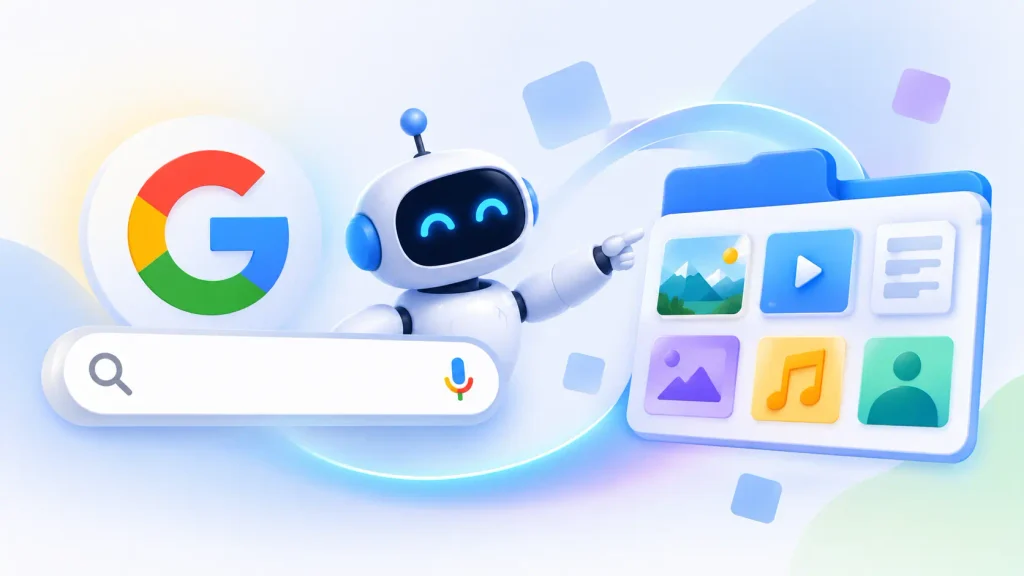
Google AI search uses asset libraries, especially inside Google Ads, as the direct source of creative material that gets pulled into AI-generated answers and ad placements. The asset library is an account-level storage system holding images, videos, logos, headlines and descriptions that can be reused across campaigns and formats.
When Google rolled out Ads in AI Overviews, it described the goal as moving users “from discovery to decision faster” by weaving ad creative straight into AI responses. That means your logo, product shots and messaging stored in the asset library are no longer background material for display ads. They are now candidate inputs for AI-native ad placements.
Google’s Asset Studio adds another layer: it uses AI to generate new creative based on Google’s best practices, specifically to raise your Ad Strength score and widen the range of placements your ads qualify for.[6] A thin, outdated asset library limits what Asset Studio and the AI systems can work with, which directly caps your paid reach.
Related reading: for a broader look at how AI Overviews treat links and citations, see our guide on Google AI Overviews link visibility in 2026.
Why does brand authority matter more in 2026 search
Brand authority matters more in 2026 because Google AI Search Overviews have become the default answer layer for a large share of queries, and Google’s AI increasingly decides which brand gets quoted rather than which page ranks highest. This shift rewards consistent expertise over keyword manipulation.
BrightEdge data reported by Search Engine Land found that after Google’s March 2025 core update, overlap between pages cited in AI Overviews and pages ranking in the top 10 organic results actually dropped from 16% to 15%. In plain terms: ranking #3 no longer guarantees you get cited, and ranking #14 doesn’t disqualify you either. What matters more is whether your content demonstrates clear expertise on the specific question being asked.
The Digital Marketing Institute’s October 2025 analysis reached a similar conclusion, noting that backlinks and keyword optimization “no longer guarantee visibility” inside AI-generated summaries. Expert commentary from SEO strategist Mufaddal Sadriwala in a 2025 Majestic interview takes a more optimistic view, estimating that only 5-10% of queries face significant impact, and arguing that authority-rich, question-answering content helps brands get treated as trusted contributors inside Overviews.
Common mistake: assuming your existing top-10 rankings guarantee Google AI Search Overview citations. They don’t. You need standalone, clearly answered content, not just high rank.
What’s the difference between organic and paid visibility in AI search
Organic visibility in Google AI Search means your content gets cited or summarized for free inside an Google AI Search Overview answer. Paid visibility means your ad, powered by your asset library, appears directly within or alongside that AI answer. Both now depend heavily on brand authority and asset quality, not just bids or backlinks.
| Factor | Organic AI visibility | Paid AI visibility |
|---|---|---|
| Main driver | Content clarity, expertise, citation-worthy structure | Asset Strength, creative quality, relevance |
| Cost model | No direct cost, but requires content investment | Pay-per-click or impression, within Ads in AI Overviews |
| Control | Limited; Google decides citation inclusion | More direct control via asset library and bidding |
| CTR behavior | Often drops overall, but rises sharply if cited | Rose from about 7.89% to 11% when brand appeared in Overview |
| Key lever | Clear, self-contained answers | Organized asset library plus Asset Studio optimization[6] |
Seer Interactic’s February 2025 data showed exactly this split: overall organic CTR for Google AI Search Overview queries fell from 1.41% to 0.64% year-over-year, but when a brand’s content was actually included in the Overview, organic CTR rose to 1.02% and paid CTR rose to 11%. That halo effect is the clearest evidence that organic and paid visibility are no longer separate games in AI search.
How do I build brand authority for Google AI search
You build brand authority for Google AI search by publishing content that answers real questions clearly, keeping facts about your business consistent everywhere online, and earning genuine mentions from other trusted sites. This is a step-by-step process, not a one-time fix.
- Audit your top queries and check whether your current pages answer them in a short, quotable paragraph near the top.
- Fix entity consistency, make sure your business name, address, categories and descriptions match across your website, Google Business Profile, and directories.
- Add structured data (schema markup) so Google’s AI systems can parse your content’s facts without guessing.
- Earn third-party mentions through guest contributions, interviews, or being referenced by industry sites, this reinforces that others vouch for your expertise.
- Keep content updated, stale pages lose trust signals faster in AI search than they did in classic organic ranking.
For practical ways to track whether this work is paying off, see our resource on how to track AI visibility and Google Search Console’s AI performance report.
Example: a regional accounting firm that consistently answers “how much does a CPA cost in [city]” with a clear, direct paragraph, backed by matching NAP details on its Google Business Profile, is far more likely to get cited than a firm with scattered, inconsistent listings.
What counts as an asset library for Google search
An asset library, in the Google Ads sense, is the centralized storage of every creative element your ads can use: logos, product images, videos, headlines, descriptions and sitelinks, all reusable across campaigns and formats. In a broader content sense, your asset library also includes your blog posts, FAQs, case studies and structured data that AI systems can draw from.
Google’s mobile app extends asset library management to on-the-go editing, reinforcing that this is meant to be a living, constantly updated repository rather than a static folder. For Performance Max and Ads in AI Overviews, the assets stored here directly determine what Google’s systems can assemble into an ad.
Decision rule: if you only have three product photos and one generic headline, choose to expand your library first before increasing ad spend. More budget cannot fix a thin asset pool.
Can small businesses compete with brand authority in AI search
Yes, small businesses can compete with brand authority in Google AI Search by focusing on narrow topical expertise and consistent local signals instead of trying to out-publish large competitors. AI systems reward clear, specific answers more than sheer content volume.
A local plumber who writes one genuinely clear, well-structured page on “why is my water heater making noise” has a real shot at citation, especially combined with a complete Google Business Profile and consistent reviews. Large brands often spread themselves thin across broad topics, which can leave gaps that focused local businesses fill well.
Edge case: if your niche is extremely competitive nationally (like general insurance advice), expect larger brands to dominate citations. Narrow your angle to a specific local market or sub-topic where you can realistically build deeper authority.
What happens if my brand doesn’t have a strong asset library
Without a strong asset library, your brand loses eligibility for higher-impact ad placements, including Ads inGoogle AI Search Overviews, and your Ad Strength scores suffer, which limits reach even if your bids are competitive.[4][6] On the organic side, thin content assets mean AI Overviews have nothing substantial to cite, so you get skipped in favor of brands with clearer, more complete answers.
This is compounding. Publishers who lost visibility show how severe the drop can be: MailOnline’s click-through rate fell more than 56% after AI Overviews launched, and related reporting found CTR drops of up to 89% for some publishers between June and July 2025. The New York Times saw search-driven traffic share fall from about 44% to 35.5% of total traffic between 2022 and mid-2025, according to Similarweb and Wall Street Journal data cited by The Verge. These are large publishers with real authority, the drop for a brand with no asset library and weak content depth is likely to be more severe, not less.
Common mistake: treating this as purely an SEO problem. It’s also a creative operations problem. If your Google Ads asset library hasn’t been refreshed in a year, you are already behind on the paid side too.
How do I create assets for Google AI search visibility
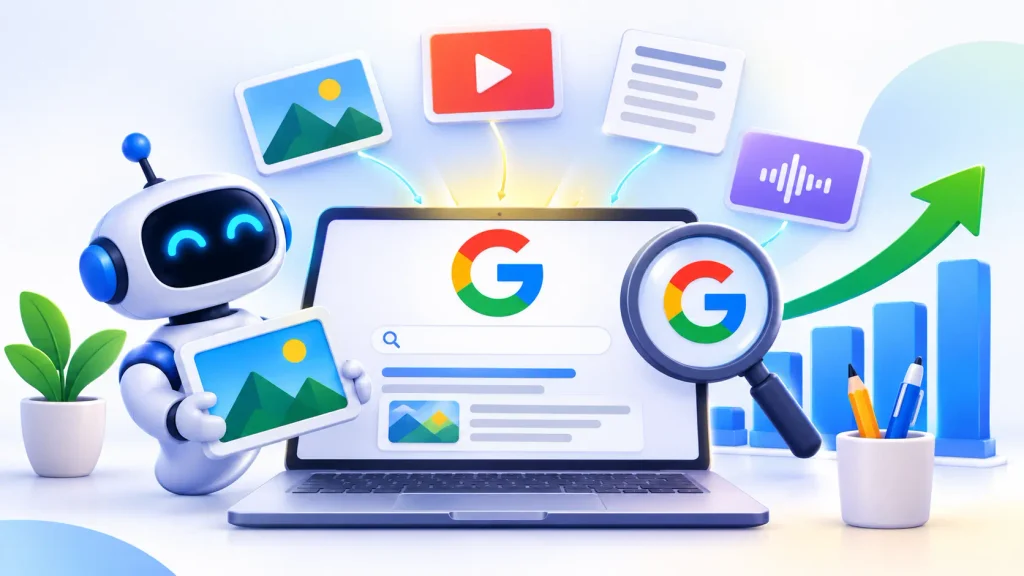
You create assets for Google AI search visibility by building a structured content library (clear Q&A pages, FAQs, how-to guides) alongside a well-organized Google Ads asset library (fresh images, videos, logos and copy variations). Both need regular updates, not a one-time setup.
Checklist for building usable assets:
- Write pages that open with a direct answer in the first 1-3 sentences
- Add FAQ sections that mirror real search phrasing
- Use alt text that helps people and search engines understand your images
- Upload multiple image sizes, aspect ratios and video lengths to your Ads asset library
- Run Asset Studio periodically to refresh creative and improve Ad Strength
- Keep logos and brand colors consistent across every asset format
For deeper tactical guidance on phrasing and structure, check our keyword research for AI search guide and our piece on optimizing content for Google AI Overviews.
Will traditional SEO still work in 2026 with Google AI
Traditional SEO still works in 2026, but it works differently. Technical SEO, site speed, crawlability and structured data remain necessary, but they are no longer sufficient on their own to earn AI Overview citations.
Google’s May 2025 guidance stressed helpfulness and clarity over keyword density or backlink volume as the deciding factor for AI Search performance. That doesn’t mean SEO fundamentals are dead. It means the bar moved from “can you rank” to “can you be clearly quoted.” For a full comparison of how these approaches differ, read our breakdown of SEO vs GEO vs AEO in 2026 and GEO vs AI search optimization vs AEO.
Choose traditional SEO alone if: you’re targeting queries with little AI Overview presence (often very niche or transactional queries). Choose SEO plus GEO/AEO practices if: your target queries already trigger AI Overviews, which is increasingly common across informational searches.
What are common mistakes brands make with AI search optimization
The most common mistake is treating AI search optimization as a copy of old SEO tactics, focusing on keyword stuffing and backlink chasing instead of clear, citation-worthy answers and a well-maintained asset library.
Other frequent mistakes:
- Ignoring the Google Ads asset library entirely, assuming it’s just for display ad basics
- Publishing long, meandering introductions instead of answering the question immediately
- Letting business information go inconsistent across directories and profiles
- Assuming paid search is “safe” from AI disruption when agencies are already restructuring around connected assets[7]
- Failing to update old content, which erodes trust signals over time
Quick example: a brand with 40 blog posts but zero FAQ schema and a messy, outdated Ads asset library is far less likely to show up in AI Overviews or Ads in AI Overviews than a brand with 15 focused, well-structured posts and a current asset library.
Do local businesses need brand authority for Google AI search
Yes, local businesses need brand authority for Google AI search because local queries increasingly trigger AI-generated answers that pull from the most consistent, trustworthy local sources, not just the nearest business.
A complete, well-reviewed Google Business Profile, consistent NAP (name, address, phone) data, and locally-specific content all contribute to local brand authority. Local businesses that skip this and rely only on proximity risk losing visibility to competitors with stronger digital footprints, even if they’re farther away.
How does my brand get verified in Google AI search 2026
Google does not offer a single formal “verification” badge for Google AI Search in 2026. Instead, your brand earns trust gradually in Google AI Search through consistent entity signals, structured data, genuine third-party mentions and a track record of accurate, helpful content.
Think of Google AI Search visibility as reputation accumulation rather than a one-time checklist. The closest things to “verification” steps for Google AI Search are: claiming and completing your Google Business Profile, using schema markup correctly, maintaining an active and consistent presence across trusted directories, and building genuine citations from other reputable sites in your industry.
Is brand authority different from domain authority for AI search results
Yes, brand authority is different from domain authority in Google AI Search. Domain authority is a third-party metric (not from Google) that estimates link strength, while brand authority in Google AI Search reflects how much Google’s AI systems trust your brand’s facts, consistency and expertise across the entire web, not just backlinks pointing at your domain.
A site can have decent domain authority from years of backlinks but still get skipped by Google AI Search if its content doesn’t directly and clearly answer questions. Conversely, a newer site with strong entity consistency and sharply answered content can out-perform an older domain with scattered, vague information in Google AI Search results.
e FAQ question and schema answer too, for example “Is brand authority the same as domain authority in Google AI Search?”
Conclusion
Google AI Search in 2026 has moved the goalposts. Isolated keyword bids and backlink counts used to be enough to win visibility. Now, brand authority and a well-organized asset library decide whether you get cited in an Google AI Search Overview or placed inside an AI-powered ad experience.
The practical next step is simple: audit your content for clear, quotable answers, tidy up your Google Ads asset library, and make sure your brand facts are consistent everywhere Google looks. Start with your highest-traffic pages, add FAQ sections that mirror real questions, and refresh your asset library inside Google Ads this month rather than waiting for the next algorithm update. For a deeper walkthrough on controlling how your site appears in these systems, see our guide on Google AI search website controls and our overview of Google AI Mode SEO. Brands that treat content, creative and data as one connected system, instead of separate line items, will be the ones AI search chooses to show.
References
- Google News May 2025. seopress.org.
- Semrush AI Overviews Study. semrush.com.
- Google AI Overview Organic Ranking Overlap Drop Core Update 454264. searchengineland.com.
- 2025 Google Ads Recap. business.google.com.
- Answer. support.google.com.
- Answer. support.google.com.
- After a Year of Googles AI Overviews Marketers Consider Tweaking Their Paid Search Strategies. digiday.com.
- Answer. support.google.com.
- Answer. support.google.com.
- Google AI Search Online Publishing. theverge.com.
Frequently Asked Questions
Quick answers about brand authority, asset libraries and visibility in Google AI Search.
What is the main idea behind this article?
Google AI Search in 2026 rewards brands with verifiable authority and a well-organized library of content, creative and first-party data. Brands that only bid on keywords or chase rankings lose ground on both the organic and paid side.
Does ranking in the top 10 guarantee I will be cited in an AI Overview?
No. Overlap between pages cited in AI Overviews and top 10 organic results was reported at around 15% after Google’s March 2025 core update. A page outside the top 10 can still be cited if it shows clear expertise and answers the question directly.
Why does being cited in an AI Overview matter for paid results too?
Seer Interactive data showed that overall organic CTR on AI Overview queries fell from 1.41% to 0.64%. When a brand was included in the Overview, organic CTR rose to 1.02% and paid CTR reached about 11%. Organic and paid visibility now influence each other.
What is a Google Ads asset library?
It is account-level storage for the creative elements your ads can use: logos, images, videos, headlines, descriptions and sitelinks. These can be reused across campaigns and formats, including Performance Max and Ads in AI Overviews.
What does Asset Studio do?
Asset Studio uses AI to generate new creative based on Google’s best practices. Its aim is to improve your Ad Strength and widen the placements your ads qualify for. A thin or outdated asset library gives it less to work with.
What should I do first if my asset library is weak?
Expand and refresh the library before raising ad spend. More budget cannot fix a thin asset pool. Upload multiple image sizes, aspect ratios and video lengths, keep logos and brand colors consistent, and run Asset Studio periodically.
How should I structure content so AI systems can quote it?
- Open each page with a direct answer in the first 1–3 sentences.
- Make that answer a self-contained paragraph that could stand alone as a quote.
- Add FAQ sections that mirror real search phrasing.
- Add schema markup so facts can be parsed without guessing.
- Update older pages regularly so trust signals do not fade.
Why do consistent business details matter?
Your business name, address, phone number, categories and descriptions should match across your website, Google Business Profile and directories. Consistent entity signals help Google’s systems treat your brand as a reliable source.
Can a small or local business compete with larger brands?
Yes. Small businesses can build narrow topical depth, keep local signals consistent and maintain a tidy asset library instead of trying to outspend larger brands. If your niche is dominated nationally, narrow your angle to a specific local market or sub-topic.
Is there an official way to get my brand “verified” for Google AI search?
No. Google does not offer a single verification badge for AI search in 2026. Trust builds over time through a complete Google Business Profile, correct schema markup, consistent directory presence and genuine third-party mentions.
Is brand authority the same as domain authority?
No. Domain authority is a third-party metric that estimates link strength. Brand authority in AI search reflects how much Google’s systems trust your facts, consistency and expertise across the whole web, not only the links pointing to your domain.
Does traditional SEO still matter?
Yes, but it is no longer enough on its own. Technical SEO, site speed, crawlability and structured data remain necessary. The bar has moved from “can you rank” to “can you be clearly quoted.” If your target queries already trigger AI Overviews, combine SEO with GEO/AEO practices.
What are the most common mistakes brands make?
- Treating AI search like old SEO, with keyword stuffing and backlink chasing.
- Ignoring the Google Ads asset library.
- Writing long introductions instead of answering immediately.
- Letting business information become inconsistent across profiles.
- Assuming paid search is safe from AI disruption.
- Never updating old content.